Supply Chain Visibility Software Market Size, Growth Trends 2035
Supply Chain Visibility Software Market Size & Share 2026 - 2035
Market Size by Component, by Deployment Mode, by Enterprise Size, by Application, by End Use, Growth Forecast.
Report ID: GMI10277
Published Date: December 2025
Report Format: PDF
Download Free PDF
- Summary
- Table of Contents
Supply Chain Visibility Software Market Size
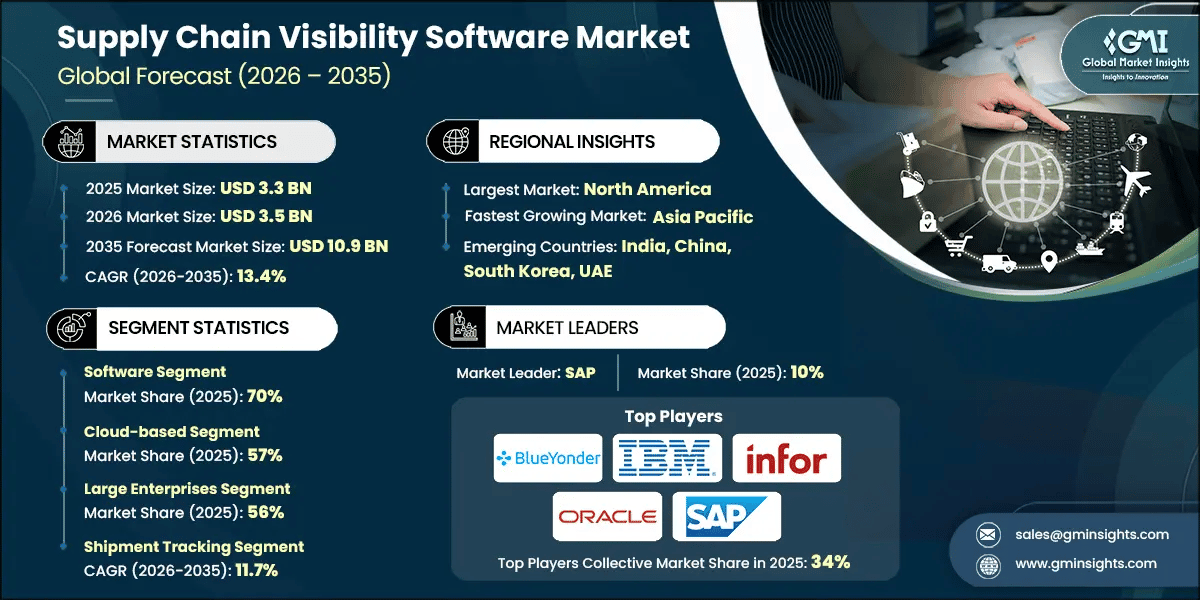
The global supply chain visibility software market size was estimated at USD 3.3 billion in 2025. The market is expected to grow from USD 3.5 billion in 2026 to USD 10.9 billion in 2034, at a CAGR of 13.4%, according to latest report published by Global Market Insights Inc.
Supply Chain Visibility Software Market Key Takeaways
Market Size & Growth
- 2025 Market Size: USD 3.3 Billion
- 2026 Market Size: USD 3.5 Billion
- 2035 Forecast Market Size: USD 10.9 Billion
- CAGR (2026–2035): 13.4%
Regional Dominance
- Largest Market: North America
- Fastest Growing Region: Asia Pacific
Key Market Drivers
- Digital transformation of supply chains.
- Rise of e-commerce and complex global trade.
- Need for risk management and supply-chain resilience.
- Regulatory, compliance, sustainability, and traceability requirements.
- Industry expansion and growth of key sectors.
Challenges
- High implementation and integration costs.
- Data security and privacy concerns.
Opportunity
- Expansion in emerging markets.
- Integration with IoT and AI technologies.
- Cloud-based and SaaS solutions.
- Focus on sustainability and traceability.
Key Players
- Market Leader: SAP led with over 10% market share in 2025.
- Leading Players: Top 5 players in this market include Blue Yonder, IBM, Infor, Oracle, SAP SE , which collectively held a market share of 34% in 2025.
Get Market Insights & Growth Opportunities
__ Download Free PDF
Digital transformation is driving the adoption of supply chain visibility software as companies shift from manual tracking to cloud-native platforms. Disruptions like COVID-19, geopolitical tensions, and climate events have accelerated this transition, exposing weaknesses in traditional supply chains.
Artificial intelligence, machine learning, and IoT sensors are transforming supply chain visibility into predictive intelligence. AI platforms enable demand forecasting, anomaly detection, and route optimization, while IoT sensors provide real-time data on critical conditions. Blockchain and edge computing further enhances traceability and compliance.
Organizations are increasingly adopting supply chain visibility and traceability solutions, driven by stricter regulatory requirements. Key regulations fueling this trend include the EU's corporate sustainability due diligence directive (CSDDD), the FDA's food safety modernization act section 204 (FSMA 204), the EU's deforestation regulation (EUDR), and the Uyghur forced labor prevention act (UFLPA).
Expanding regulatory mandates in areas like food safety, deforestation, and corporate due diligence are driving demand for visibility solutions. The EU Deforestation Regulation enforces penalties of up to 4% of annual EU turnover for non-compliance, pushing organizations to adopt event-based tracking and integrate carbon accounting with supplier data collection.
In 2024, North America dominated the supply chain visibility software market, driven by the US's adoption of advanced digital tools for real-time shipment tracking, strong logistics infrastructure, and a thriving e-commerce sector.
The Asia-Pacific region, led by China, India, Japan, and Southeast Asia, is experiencing rapid growth. China focuses on tech-driven supply chains, India leverages visibility tools for its logistics and e-commerce boom, while Japan and Southeast Asia aim to enhance efficiency and resilience.
Share
To get key market trends
__ Download Free PDF
Supply Chain Visibility Software Market Trends
Supply chain visibility has advanced from reactive tracking to predictive intelligence and autonomous decision-making. Modern platforms use AI and analytics to anticipate disruptions, recommend actions, and execute responses automatically.
AI adoption is transforming supply chains, with 59% of leaders using AI and 98% finding it effective. AI platforms analyze data like weather, geopolitical events, and social media to predict ETAs, detect anomalies, and identify risks across supplier networks.
Regulatory mandates are accelerating multi-tier visibility adoption. The EU's Corporate Sustainability Due Diligence Directive and the Uyghur Forced Labor Prevention Act require companies to ensure compliance with human rights, environmental standards, and provenance tracking across value chains.
Technology enablers like supplier network mapping platforms, blockchain-based provenance tracking, and collaborative data-sharing networks drive multi-tier visibility. For example, Infor Nexus connects over 94,000 organizations, enabling ecosystem-wide transparency across suppliers, manufacturers, brokers, 3PLs, and banks.
The adoption of IoT sensors, edge computing, and digital twin technologies provide real-time visibility into supply chain operations. These devices monitor critical conditions like location, temperature, and humidity, ensuring effective management of perishable goods and sensitive products.
Edge computing minimizes latency and bandwidth issues by processing data near its source, enabling real-time decisions. It is crucial for autonomous vehicles, warehouse robotics, and time-sensitive transportation tasks.
Digital twins, virtual replicas of physical supply chain assets and processes, enable scenario simulation, what-if analysis, and optimization. Organizations use them to model factory performance, test network configurations, and prepare for disruptions.
Blockchain and distributed ledger technologies are being adopted for applications requiring immutable records, multi-party trust, and provenance verification. Blockchain ensures a tamper-proof audit trail, enabling product authentication and custody tracking without central authority.
Supply Chain Visibility Software Market Analysis
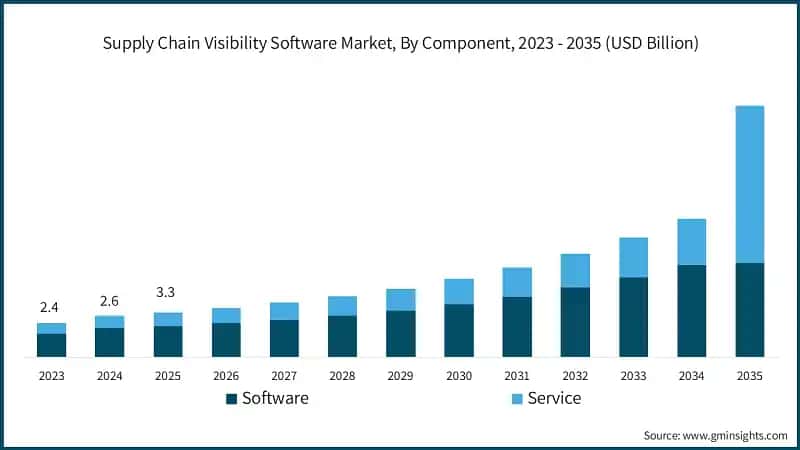
Based on component, the supply chain visibility software market is segmented into software and services. The software segment dominates the market with 70% share in 2025, and the segment is expected to grow at a CAGR of 12.8% from 2026 to 2035.
-
Software components, including visibility platforms, control tower applications, and analytics dashboards, play a crucial role in capturing, processing, and presenting supply chain data.
-
Cloud-native software architectures are driving growth, with SaaS models enabling faster deployments, reduced costs, and continuous updates. Key vendors like SAP, Oracle, and Infor offer integrated solutions for visibility, planning, and execution.
-
The services segment is growing at a faster rate with a CAGR of 14.5% from 2026 to 2035, due to the complexity of visibility implementations and the need for specialized expertise.
-
Professional services including consulting, system integration, data migration, and change management are critical for successful deployments, particularly for large enterprises with complex, heterogeneous IT landscapes.
-
A 2025 PwC survey reveals that 47% of organizations face integration complexity, while 44% struggle with data quality, driving demand for solutions to unify systems and improve governance.
-
Organizations are increasingly turning to support and maintenance services to optimize their visibility investments, ensuring user training and adaptability to changing business needs.
-
Mid-market organizations are adopting managed services models, where vendors or third parties manage visibility platforms due to a lack of in-house supply chain technology expertise.
Learn more about the key segments shaping this market
__ Download Free PDF
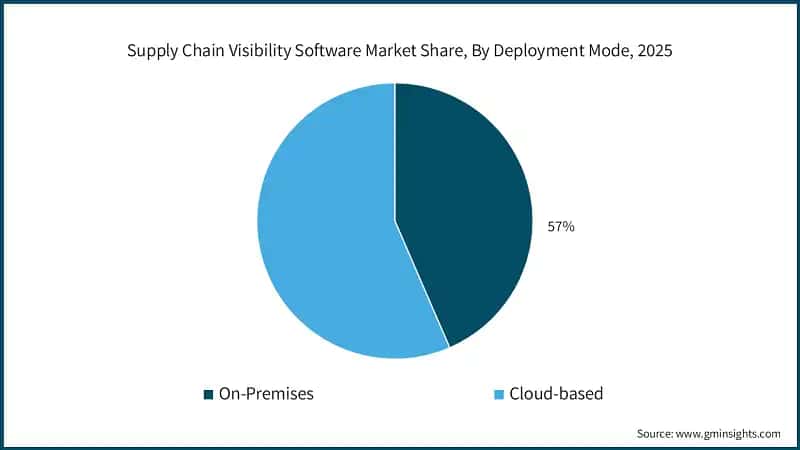
Based on deployment mode, the supply chain visibility software market is segmented into on-premised and cloud-based. The cloud-based segment dominated the market, accounting for around 57% share in 2025 and is expected to grow at a CAGR of 14.1% from 2026 to 2035.
-
The growth of the segment can be attributed to its scalability, accessibility, and cost-effectiveness. These solutions allow businesses to access real-time data from anywhere, facilitating better decision-making and collaboration across the supply chain.
-
Organizations benefit from cloud deployment through reduced initial capital outlay, quicker realization of value, automatic software updates, scalable resources, and a lighter IT operational load.
-
Moreover, a significant trend is the integration of cloud platforms with advanced analytics and IoT devices, providing comprehensive visibility and control over supply chain operations.
-
The cloud model also supports rapid implementation and easy scalability, making it an attractive option for both SMEs and large enterprises.
-
Organizations can implement cloud-based visibility solutions in a matter of weeks or months, a significant reduction from the typical 6–12-month timeline for on-premises setups.
-
Hyperscaler partnerships drive the cloud segment by offering global infrastructure, regional data residency, and AI/ML services. Examples include Manhattan Associates on Google Cloud Marketplace, SAP's collaborations with AWS and Microsoft Azure, and Oracle's Fusion SCM platform.
-
On-premises deployment remains relevant for organizations with strict data sovereignty needs, limited internet connectivity, or significant on-premises infrastructure investments.
-
Industries like defense, government, and financial services still use on-premises deployments due to security and regulatory needs but are gradually adopting hybrid architectures combining core systems with cloud-based analytics and collaboration layers.
-
Organizations are adopting diverse deployment models, with core systems on-premises or private clouds and public clouds used for collaboration, analytics, and partner integration.
Based on enterprise size, the supply chain visibility software market is segmented into large enterprises and SMEs. The large enterprises segment dominated the market, accounting for around 56% share in 2025 and is expected to grow at a CAGR of 12.6% from 2026 to 2035.
-
Large enterprises, with revenues exceeding USD 10 billion, leverage complex global supply chains, substantial IT budgets, and advanced technologies to manage extensive supplier networks, SKUs, and trading partners across multiple countries.
-
Large enterprises are also more likely to adopt emerging technologies including AI, IoT, blockchain, and digital twins.
-
Large enterprises have the resources to pilot new technologies, the scale to justify investments, and the technical sophistication to integrate advanced capabilities into existing systems.
-
Cloud-based SaaS models are driving SME growth by offering enterprise-grade visibility technology through subscription pricing, pre-built integrations, and vendor-managed infrastructure, eliminating high upfront costs.
-
The shift from capital expenditure to operational expenditure aligns with SME financial models and enables incremental adoption that scales with business growth.
-
SME adoption is further supported by industry-specific solutions and vertical SaaS platforms that provide pre-configured workflows, best practices, and domain expertise.
Based on application, the supply chain visibility software market is segmented into order management, asset tracking, inventory management, shipment tracking, supply chain planning and others. The shipment tracking segment is projected to dominate the market and is expected to grow at a CAGR of 11.7% from 2026 to 2035.
-
Shipment tracking, the largest application segment, provides real-time location, status, and estimated time of arrival for in-transit shipments across all transportation modes.
-
Shipment visibility ensures accurate delivery commitments, proactive delay communication, and efficient warehouse planning for inbound receipts and dock scheduling.
-
Asset tracking's high growth rate with a CAGR of 15.9% from 2026 to 2035, reflects the proliferation of IoT sensors, RFID tags, and GPS devices that enable real-time location and condition monitoring.
-
Asset tracking is critical for managing returnable transport items (containers, pallets, racks), high-value equipment, and temperature-sensitive shipments.
-
The automotive industry uses RFID and BLE sensors to track returnable containers and reduce packaging costs. Healthcare and pharmaceutical sectors rely on asset tracking to ensure temperature-sensitive products maintain required conditions during transport and storage.
-
Order management visibility helps organizations track orders from placement to fulfillment, ensuring accurate delivery dates and proactive exception handling.
-
The rise of e-commerce, driven by over 90% of consumers expecting 2–3-day delivery, is fueling demand for order-level visibility to streamline fulfillment, carriers, and delivery options.
-
Real-time inventory visibility helps organizations optimize inventory turnover, prevent stockouts, and minimize excess stock across warehouses, distribution centers, and retail locations.
-
Supply chain planning applications integrate visibility data with demand forecasting, supply planning, and sales and operations planning (S&OP) processes.
-
Real-time visibility into demand signals, inventory positions, and supply constraints enables more accurate forecasts and responsive plans. AI-driven planning platforms use visibility data to detect anomalies, identify trends, and recommend plan adjustments.
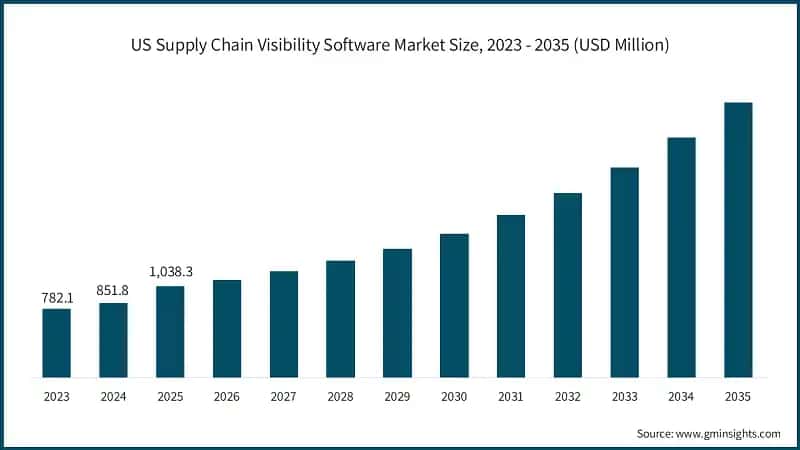
The US supply chain visibility software market is expected to experience significant and promising growth from 2026 to 2035.
-
The US dominates the Supply Chain Visibility Software Market, driven by e-commerce growth, complex supply chains, and innovations from key players like Oracle and IBM.
-
US shippers, carriers, and 3PLs are adopting visibility platforms to enhance supply chain transparency and operational efficiency. AI-driven analytics and predictive insights are key enablers of this shift.
-
Regulatory mandates like the FDA food safety modernization act section 204 and the Uyghur forced labor prevention act are accelerating traceability and compliance reporting in supply chains.
-
The US ecosystem, driven by AI, IoT, cloud computing, and real-time data integration, enhances visibility software by improving forecasting and enabling rapid disruption responses.
-
Logistics operators and enterprises are adopting visibility solutions to meet the rising demand for omnichannel fulfillment, last-mile tracking, and resilient supply chains.
North America dominated the supply chain visibility software market with a market share of 39% in 2025.
-
North America dominates the supply chain visibility software market, driven by key players like Oracle, IBM, and Blue Yonder, alongside advanced digital infrastructure and early technology adoption.
-
In Q1 2024, U.S. online sales reached USD 289.2 billion, driving demand for last-mile visibility and omnichannel fulfillment. Canada supports the market with increased adoption of advanced visibility platforms to enhance cross-border logistics and supply chain resilience.
-
Canada’s adoption reflects cross?border trade integration and cold?chain priorities in food and life sciences, where item?level visibility reduces spoilage and accelerates recalls.
-
Regulations like the FDA food safety modernization act section 204 and the Uyghur forced labor prevention act are driving companies to enhance traceability and compliance across supply chains.
-
Over half of North American organizations are prepared for supply chain disruptions, unlike the lower readiness in Asia-Pacific. Investments in AI, cloud, and IoT tools improve efficiency and risk management.
-
North America is set to maintain its dominance due to its strong regulatory framework, large market size, and advancements in AI, predictive analytics, and real-time supply chain monitoring.
China is fastest growing country in Asia Pacific supply chain visibility software market growing with a CAGR of 13.8% from 2026 to 2035.
-
China dominates the Asia-Pacific market, driven by manufacturing growth, digitalization initiatives, and increasing e-commerce requiring better supply chain visibility.
-
Strong government support, a large domestic market, and investments in AI, IoT, and cloud infrastructure drive the rapid adoption of visibility platforms in manufacturing, logistics, and retail.
-
In 2024, leading Chinese manufacturers and logistics providers adopted AI-powered visibility platforms with IoT sensors, improving inventory tracking and operational efficiency.
-
China is advancing its supply chain with smart warehouses, digital twins, and predictive analytics to enhance efficiency and reduce disruptions in domestic and international trade.
-
Chinese firms are improving supply chain operations with cloud visibility, AI forecasting, and automation, while prioritizing sustainability and compliance for greater efficiency.
Asia Pacific region dominated the supply chain visibility software market, which is anticipated to grow at a CAGR of 15.7% during the analysis timeframe.
-
In 2024, the Asia-Pacific region became the fastest-growing market for Supply Chain Visibility Software, driven by industrialization, digital transformation, and rising e-commerce in key countries.
-
China drives regional growth as a global manufacturing hub, investing in digital supply chains and adopting AI- and IoT-enabled platforms. Companies like SAP China, Oracle, and Blue Yonder are expanding solutions across key manufacturing hubs and ports.
-
India is rapidly adopting visibility software to drive digital transformation in logistics, improve last-mile tracking, and enhance supply chain resilience.
-
Japan and Southeast Asia are leveraging advanced visibility solutions to enhance cross-border trade and supply chain efficiency, driven by government digitalization initiatives.
-
The Asia-Pacific region is projected to capture a significant share of global market value by 2035, driven by investments in visibility technologies, e-commerce growth, and rising middle-class consumption.
Germany dominates the Europe supply chain visibility software market, showcasing strong growth potential, with a CAGR of 11.1% from 2026 to 2035.
-
Germany's leading firms, including SAP, Blue Yonder, IBM, and Continental, are collaborating with manufacturers, retailers, and 3PLs to deploy advanced supply chain visibility platforms, improving transparency, efficiency, and risk management.
-
Regulatory frameworks like the Corporate sustainability due diligence directive and the EU digital product passport drive the adoption of real-time visibility tools, ensuring compliance with environmental, human rights, and traceability standards.
-
German companies are utilizing AI, IoT, and cloud platforms to deliver predictive insights, automate exception management, and monitor cross-border logistics.
-
For instance, in 2024, SAP and Blue Yonder partnered with German manufacturers and logistics firms to implement AI-powered visibility systems, showcasing Germany's leadership in digital supply chain technologies.
Europe supply chain visibility software market accounted for USD 900 million in 2025 and is anticipated to show growth of 12.8% CAGR over the forecast period.
-
Europe's stricter regulations on data protection, privacy, and traceability limit its market share compared to North America and Asia-Pacific.
-
Germany leads Europe’s market with advanced manufacturing, digital adoption, and platform deployments by SAP, Oracle, and Blue Yonder, while the UK, France, and the Nordics significantly support regional growth.
-
Stringent European regulations, such as the Corporate sustainability due diligence directive and the EU Digital Product Passport, are driving the adoption of visibility platforms by mandating traceability, compliance monitoring, and digital product lifecycle recording.
-
In Europe, businesses leverage visibility software to navigate stringent EU regulations, such as REACH, GDPR, and environmental reporting mandates, underscoring the continent's commitment to sustainability, regulatory compliance, and supply chain traceability.
-
Over two-thirds of European organizations are channeling investments into bolstering supply chain visibility and security, focusing on transparency, risk management, and operational efficiency.
-
OEMs, logistics firms, and retailers are driving supply chain digitization using predictive analytics, AI, and IoT to enhance efficiency and inventory management.
Brazil leads the Latin American supply chain visibility software market, exhibiting remarkable growth of 13.9% during the forecast period of 2026 to 2035.
-
Brazil's supply chain visibility software market is steadily growing, driven by increasing demand for digital logistics solutions and real-time shipment tracking, along with the modernization of distribution networks.
-
Government initiatives, including digital trade facilitation and e-invoicing mandates, are driving the adoption of visibility platforms by companies.
-
Brazilian manufacturers, logistics providers, and technology integrators are adopting AI and IoT solutions from global software leaders like Oracle, SAP, and Blue Yonder to address domestic supply chain needs and regulations.
-
Fleet operators and logistics companies in Brazil are leveraging cloud-based platforms, predictive analytics, and real-time monitoring to enhance supply chain reliability and efficiency.
Saudi Arabia to experience substantial growth in the Middle East and Africa supply chain visibility software market in 2025.
-
Saudi Arabia, propelled by the National Industrial Development and Logistics Program (NIDLP) and the digitalization objectives of Vision 2030, is swiftly enhancing its supply chain visibility ecosystem.
-
Across manufacturing, retail, and logistics sectors, visibility platforms are gaining traction, thanks to government investments in smart logistics hubs, IoT networks, and cloud infrastructure.
-
Saudi organizations leverage IoT sensors, AI analytics, and cloud platforms to enhance supply chain management, facilitating smooth monitoring, exception handling, and better decision-making in intricate domestic and regional networks.
-
Saudi Arabia is positioning itself as the frontrunner in the Middle East's market, bolstered by robust digital infrastructure, regulatory backing, and strategic moves to modernize its logistics and trade operations.
Supply Chain Visibility Software Market Share
The top 7 companies in the supply chain visibility software industry are SAP, Oracle, IBM, Blue Yonder, Descartes Systems, Infor, and Manhattan Associates contributed around 36% of the market in 2025.
-
SAP leads the market with its robust supply chain management suite, integrating AI-driven IBP into demand and supply planning with S&OP capabilities. The introduction of Joule AI agents enhances efficiency through autonomous production planning and supplier onboarding.
-
Oracle strengthens its position with the Oracle Fusion Cloud SCM suite, offering real-time tracking, predictive ETAs, and seamless integration with Oracle ERP for unified data and cross-functional insights.
-
Blue Yonder's 2024 acquisition of One Network Enterprises strengthened its multi-tier collaboration and network visibility, enhancing planner efficiency, reducing inventory write-offs, and lowering expediting costs.
-
IBM leverages the Sterling Supply Chain Visibility platform for enhanced order-to-cash and procure-to-pay processes, integrating B2B messaging and EDI. Its blockchain-enabled IBM Food Trust ensures traceability, while AI-driven insights optimize operations in regulated sectors like food and pharma.
-
Infor's Nexus platform connects over 94,000 organizations globally, offering predictive ETAs, proactive alerts, control tower capabilities, and integration with TMS, procure-to-pay, and supply chain finance. Industry-specific workflows enhance efficiency and compliance in sectors like automotive, aerospace, and fashion.
-
Manhattan Associates' cloud-native Manhattan Active platform integrates planning, warehouse management, transportation, and omnichannel order management, offering real-time visibility and AI-driven forecasting for retailers and logistics providers.
-
Descartes Systems specializes in transportation visibility and global logistics connectivity. Its MacroPoint platform ensures real-time freight visibility, while its Global Logistics Network enhances B2B collaboration and international trade through customs compliance and cross-border logistics.
Supply Chain Visibility Software Market Companies
Major players operating in the supply chain visibility software industry are:
- Blue Yonder
- Descartes Systems
- FourKites
- IBM
- Infor
- Kinaxis
- Manhattan Associates
- Oracle
- Project44
-
SAP
-
SAP, Oracle, and IBM dominate the market with advanced supply chain visibility platforms. SAP SE integrates IBP, Logistics Management, and Business Network for AI-driven insights and predictive planning. Oracle Fusion Cloud SCM offers real-time tracking and cross-functional analytics, while IBM Sterling focuses on blockchain traceability and secure collaboration for regulated industries.
-
Blue Yonder enhances operations with predictive alerts, inventory optimization, and planning efficiency through its Supply Chain Command Center. Infor Nexus connects global organizations, offering control towers, predictive ETAs, and AI-driven supply chain tools.
-
Manhattan Associates' Manhattan Active integrates warehouse, transportation, planning, and omnichannel order management with AI forecasting. Kinaxis rapid response focuses on real-time scenario planning, demand-supply alignment, and supply chain resilience using advanced analytics.
-
Project44, FourKites, and Descartes Systems Group specialize in real-time logistics visibility. Project44 and FourKites focus on multimodal freight tracking and predictive ETAs, while Descartes MacroPoint integrates TMS and customs compliance for seamless supply chain operations.
Supply Chain Visibility Software Market Report Attributes
Key Takeaway| Details
Market Size & Growth Base Year| 2025 Market Size in 2025| USD 3.3 Billion Market Size in 2026| USD 3.5 Billion Forecast Period 2026 - 2035 CAGR | 13.4% Market Size in 2035| USD 10.9 Billion Key Market Trends Drivers| Impact Digital transformation of supply chains| Companies are adopting visibility software to modernize operations and improve real-time decision-making. Rise of e-commerce and complex global trade| Growing shipment volumes and cross-border trade increase the need for end-to-end shipment tracking. Need for risk management and supply-chain resilience| Businesses use visibility tools to detect disruptions early and maintain continuity during uncertainties. Regulatory, compliance, sustainability, and traceability requirements| Visibility platforms help companies meet reporting rules, ensure transparency, and track carbon footprints. Industry expansion and growth of key sectors| Expanding retail, manufacturing, and logistics sectors are driving increased adoption of visibility systems for supply chain management. Pitfalls & Challenges | Impact High implementation and integration costs| High deployment and integration costs hinder visibility platform adoption by small and mid-sized businesses. Data security and privacy concerns| Concerns over data breaches and shipment sensitivity demand strict security measures. Opportunities: | Impact Expansion in emerging markets| Growing digital adoption in developing regions creates strong demand for modern visibility platforms. Integration with IoT and AI technologies| IoT sensors and AI analytics enhance real-time tracking, predictive insights, and end-to-end operational intelligence. Cloud-based and SaaS solutions| Scalable and cost-effective SaaS platforms accelerate adoption across businesses of all sizes. Focus on sustainability and traceability| Increasing need for carbon tracking and product traceability boosts demand for advanced visibility tools. Market Leaders (2025) Market Leaders|
- SAP
10% Market Share
Top Players|
- Blue Yonder
- IBM
- Infor
- Oracle
- SAP SE
Collective market share in 2025 is 34%
Competitive Edge|
- SAP provides integrated supply chain visibility through its SAP supply chain control tower, delivering real-time insights and seamless integration with enterprise systems.
- Oracle enhances logistics transparency with real-time tracking and predictive analytics through its Oracle Transportation Management and Oracle SCM Cloud platforms.
- IBM harnesses AI, blockchain, and cloud technologies to enhance visibility, monitor risks, and ensure traceability in intricate global supply chains.
- Blue Yonder leverages machine learning to optimize forecasting, inventory management, and decision-making in supply chains.
- Infor enhances supply chain connectivity through its Infor Nexus platform, offering multimodal tracking and automated exception management.
Regional Insights Largest Market| North America Fastest growing market| Asia Pacific Emerging countries| India, China, South Korea, UAE Future outlook|
- The market for supply chain visibility software is anticipated to grow quickly as more businesses use digital solutions for end-to-end supply chain management and real-time tracking.
- Supply chains are becoming more intelligent, predictive, and robust because to developments in AI, IoT, and cloud technology.
- Strong cooperation between shippers, carriers, and tech companies is revolutionizing international logistics by improving supply chain agility, efficiency, and transparency.
What are the growth opportunities in this market?
__ Download Free PDF
Supply Chain Visibility Software Industry News
-
In October 2025, SAP introduced Joule AI agents for supply chain management, including tools for automating production orders, analyzing change requests, and managing supplier onboarding, aimed at reducing errors and accelerating processes.
-
In October 2025, Impilo partnered with Current Health to enhance the speed, visibility, and reliability of medical supply deliveries, supporting advanced therapies like cell and gene treatments, CAR-T, and bispecific immunotherapies.
-
In May 2025, Manhattan Associates launched all Manhattan Active solutions on Google Cloud Marketplace, enhancing its partnership with Google Cloud. This allows customers to streamline procurement and leverage Google Cloud AI for better insights and automation.
-
In April 2024, Blue Yonder acquired One Network Enterprises, a provider of digital supply chain network technology. The acquisition brought One Network’s digital supply chain network platform alongside its supply chain tools to provide customers real-time visibility across the supply chain for upstream raw material suppliers to OEM customers and carriers.
-
In February 2024, Oracle launched new supply chain and logistics capabilities to enhance global efficiency, visibility, and execution, with availability in regions like Indonesia and Asia Pacific.
The supply chain visibility software market research report includes in-depth coverage of the industry with estimates & forecasts in terms of revenue (USD Mn) from 2022 to 2035, for the following segments: Click here to Buy Section of this Report
Market, By Component
- Software
- Services
- Consulting
- Implementation
- Support & maintenance
Market, By Deployment Mode
- On-premises
- Cloud-based
Market, By Enterprise Size
- Large enterprises
- SME
Market, By Application
- Order management
- Asset tracking
- Inventory management
- Shipment tracking
- Supply chain planning
- Others
Market, By End Use
- Retail and consumer goods
- Healthcare and pharmaceuticals
- Manufacturing
- Transportation and logistics
- Automotive
- Aerospace and defense
- Food and beverages
- Others
The above information is provided for the following regions and countries:
- North America
- US
- Canada
- Europe
- Germany
- UK
- France
- Italy
- Spain
- Russia
- Nordics
- Portugal
- Croatia
- Asia Pacific
- China
- India
- Japan
- Australia
- South Korea
- Singapore
- Thailand
- Indonesia
- Vietnam
- Latin America
- Brazil
- Mexico
- Argentina
- MEA
- South Africa
- Saudi Arabia
- UAE
- Turkey
Authors: Preeti Wadhwani, Satyam Jaiswal
Research methodology, data sources & validation process
This report draws on a structured research process built around direct industry conversations, proprietary modelling, and rigorous cross-validation and not just desk research.
Our 6-step research process
-
1. Research design & analyst oversight
At GMI, our research methodology is built on a foundation of human expertise, rigorous validation, and complete transparency. Every insight, trend analysis, and forecast in our reports is developed by experienced analysts who understand the nuances of your market.
Our approach integrates extensive primary research through direct engagement with industry participants and experts, complemented by comprehensive secondary research from verified global sources. We apply quantified impact analysis to deliver dependable forecasts, while maintaining complete traceability from original data sources to final insights.
-
2. Primary research
Primary research forms the backbone of our methodology, contributing nearly 80% to overall insights. It involves direct engagement with industry participants to ensure accuracy and depth in analysis. Our structured interview program covers regional and global markets, with inputs from C-suite executives, directors, and subject matter experts. These interactions provide strategic, operational, and technical perspectives, enabling well-rounded insights and reliable market forecasts.
-
3. Data mining & market analysis
Data mining is a key part of our research process, contributing nearly 20% to the overall methodology. It involves analysing market structure, identifying industry trends, and assessing macroeconomic factors through revenue share analysis of major players. Relevant data is collected from both paid and unpaid sources to build a reliable database. This information is then integrated to support primary research and market sizing, with validation from key stakeholders such as distributors, manufacturers, and associations.
-
4. Market sizing
Our market sizing is built on a bottom-up approach, starting with company revenue data gathered directly through primary interviews, alongside production volume figures from manufacturers and installation or deployment statistics. These inputs are then pieced together across regional markets to arrive at a global estimate that stays grounded in actual industry activity.
-
5. Forecast model & key assumptions
Every forecast includes explicit documentation of:
-
✓ Key growth drivers and their assumed impact
-
✓ Restraining factors and mitigation scenarios
-
✓ Regulatory assumptions and policy change risk
-
✓ Technology adoption curve parameter
-
✓ Macroeconomic assumptions (GDP growth, inflation, currency)
-
✓ Competitive dynamics and market entry/exit expectations
-
6. Validation & quality assurance
The final stages involve human validation, where domain experts manually review filtered data to identify nuances and contextual errors that automated systems might miss. This expert review adds a critical layer of quality assurance, ensuring data aligns with research objectives and domain-specific standards.
Our triple-layer validation process ensures maximum data reliability:
-
✓ Statistical Validation
-
✓ Expert Validation
-
✓ Market Reality Check
Trust & credibility
10+ Years in Service Consistent delivery since establishment
A+ BBB Accreditation Professional standards & satisfaction
ISO Certified Quality ISO 9001-2015 Certified Company
150+ Research Analysts Across 10+ industry verticals
95% Client Retention 5-year relationship value
Verified data sources
-
Trade publications
Security & defense sector journals and trade press
-
Industry databases
Proprietary and third-party market databases
-
Regulatory filings
Government procurement records and policy documents
-
Academic research
University studies and specialist institution reports
-
Company reports
Annual reports, investor presentations, and filings
-
Expert interviews
C-suite, procurement leads, and technical specialists
-
GMI archive
13,000+ published studies across 30+ industry verticals
-
Trade data
Import/export volumes, HS codes, and customs records
Parameters studied & evaluated
- Macroeconomic factors
- Microeconomic factors
- Technology & innovation
- Regulatory & political environment
- Demographics
- Value chain analysis
- Market dynamics
- Porter's five forces
- PESTLE analysis
- Competitive benchmarking
- Supply-demand gap analysis
- Pricing trends
- SWOT Analysis
- Mergers & Acquisitions Activity
- Investment & Funding Landscape
- Company Profiles
Every data point in this report is validated through primary interviews, true bottom-up modelling, and rigorous cross-checks. Read about our research process →
Frequently Asked Question(FAQ) :
What is the market size of the supply chain visibility software in 2025?
The market size was USD 3.3 billion in 2025, with a CAGR of 13.4% expected through 2034. The shift to cloud-native platforms and the adoption of AI, IoT, and blockchain technologies are driving market growth.
What is the projected value of the supply chain visibility software market by 2034?
The market is poised to reach USD 10.9 billion by 2034, driven by advancements in predictive intelligence, regulatory mandates, and real-time visibility technologies.
What is the expected size of the supply chain visibility software industry in 2026?
The market size is projected to reach USD 3.5 billion in 2026.
How much revenue did the software segment generate in 2025?
The software segment generated approximately 70% of the market revenue in 2025 and is expected to grow at a CAGR of 12.8% from 2026 to 2035.
What was the valuation of the cloud-based deployment segment in 2025?
The cloud-based deployment segment accounted for around 57% of the market share in 2025 and is set to expand at a CAGR of 14.1% through 2035.
What is the growth outlook for the large enterprises segment till 2035?
The large enterprises segment, which held a 56% market share in 2025 is anticipated to showcase around 12.6% CAGR up to 2035.
Which region leads the supply chain visibility software sector?
North America leads the market with a 39% share in 2025, led by advanced digital infrastructure, early technology adoption, and the presence of key players like Oracle, IBM, and Blue Yonder.
What are the upcoming trends in the supply chain visibility software market?
Key trends include AI-driven predictive insights, blockchain-based traceability, IoT-enabled real-time monitoring, edge computing for faster processing, and digital twins for simulation and optimization.
Who are the key players in the supply chain visibility software industry?
Key players include Blue Yonder, Descartes Systems, FourKites, IBM, Infor, Kinaxis, Manhattan Associates, Oracle, Project44, and SAP.
Supply Chain Visibility Software Market Scope
-
Supply Chain Visibility Software Market Size
-
Supply Chain Visibility Software Market Trends
-
Supply Chain Visibility Software Market Analysis
-
Supply Chain Visibility Software Market Share
Related Reports
- Parcel Sorting System Market
- Intelligent Transportation System Market
- FMCG Logistics Market
- Logistics Automation Market
Authors: Preeti Wadhwani, Satyam Jaiswal
Customize this Report Inquiry Before Buying