A Subpoena for The Devil - by Will Manidis - Minutes
A Subpoena for The Devil
Mar 30, 2026
On a Tuesday evening earlier this year at the Sydney Goldstein Theater in San Francisco, a man stormed the stage from the second row and announced that he had a subpoena for Sam Altman. The crowd erupted into bloodthirsty jeers for the process server. Altman, seated next to Steve Kerr for a conversation unexplainably about basketball and the future, did not take the document. Under California law, this doesn’t matter. You’re practically served the moment the server presents the document and states his intent, regardless of whether or not you physically accept it.
Altman’s security detail materialized from somewhere stage right. The body man, impossibly large, seemingly had a prosthetic arm concealing something monstrous under his oversized jacket, and angular glasses that look like Jony Ive designed them for this moment. The process server was an investigator from the San Francisco Public Defender’s Office who had been trying to reach Altman through OpenAI’s headquarters and then its online portal and other asinine paths without success before finally resorting to the oldest method of communication there is, which is walking up to a man and telling him what your issue is.
The subpoena was tied to a criminal case involving a somewhat hilarious organization called Stop AI, whose stated position is that OpenAI is engaging in the systemic attempted murder of every living thing on Earth. Even these wackadoos, the people who believe that their enemy is building the thing that will end all life on Earth, choose the court as the venue to hear their complaints. They don’t take to sabotage. They barely take to the street. They send a subpoena and that paper has jurisdiction.
OpenAI was founded in 2015 as a nonprofit with a charter committing to ensure that artificial general intelligence, or at least something like it, would benefit all of humanity. The people who wrote the charter believed, or at least said that they believed, that they were building something with cosmic stakes, and they designed a legal structure to contain it. The nonprofit would govern it, and no individual would profit beyond a set cap, and the board would owe its duty not only to the shareholders, but to the human species more broadly. Most of the structure used was invented for this purpose.
The thing got immensely and incomprehensibly valuable. And in 2019 the organization created a capped profit subsidiary to hold what was growing inside of it. This was, of course, followed by “the blip” in November 2023 when the nonprofit board fired Altman with the stated reason that he had not been “consistently candid.” Consistently candid is a phrase that reads radically differently as an implied breach of covenant claim than it does on a Twitter timeline.
Within days, this decision was reversed and the entire board was replaced. The legal structure at this moment became terminal. It was clear that it needed to be overridden and replaced, and by October 2025 the conversion to a for-profit company was fully complete. The nonprofit retains 26%. The company at this point was valued at nearly a trillion dollars.
The emails from this period are worth reading, but one I’ll call attention to is a Greg Brockman diary entry from 2017 in which he writes: “I cannot believe that we committed to non-profit if three months later we’re doing b-corp then it was a lie”. This was extracted through exhaustive discovery in the Musk v. Altman lawsuit just earlier this year and is now the basis for a jury trial with a couple hundred billion at stake.
I’m rambling through the history of OpenAI because I want to make an argument about law. Not secular law, but cosmic law.
The word Torah means law, and not law in the sense of regulation. Not your British common law. Law in the sense of something much closer to gravity. The 613 commandments of Jewish law take the form they do because the commandments are the only possible instrument for the relationship between a party with absolute authority and a party with absolute obligation. The Hebrew word for this practice is halacha , that is the way to walk , and it governs everything. You can go and read it and you’ll find out how to eat, how to rest, how to marry, how to bury, how to plant, how to treat a stranger, or what to say at dawn. There is no domain of life outside the jurisdiction of these laws because there is no domain of life outside the jurisdiction of God.
The Talmud, which serves as a many-hundred-year record of rabbis arguing about this law, exists with a granularity that makes modern contract law look impressionistic.
There is a beauty and a seriousness to the system. The rabbinical tradition that elaborated it represents one of the great intellectual achievements of human civilization. The relationship between God and Israel was judicial and the obligations were total, and the parsing of those obligations was the central intellectual and spiritual work of civilization for thousands of years.
And then Christ came and said two commandments: love your Lord your God with all your heart and all your soul and all your mind, and to love your neighbor as yourself. And on these two commandments hangs all the law and all the prophets. Paul writes in Galatians that we are no longer under the supervision of the old law, that that law was the guardian until Christ came, and now that faith has come, we are no longer under a guardian. The entire legal apparatus, that is the 613 commandments, the dietary laws, the purity codes, the sacrificial system, is fulfilled and gathered up into something so simple that a child can hold it.
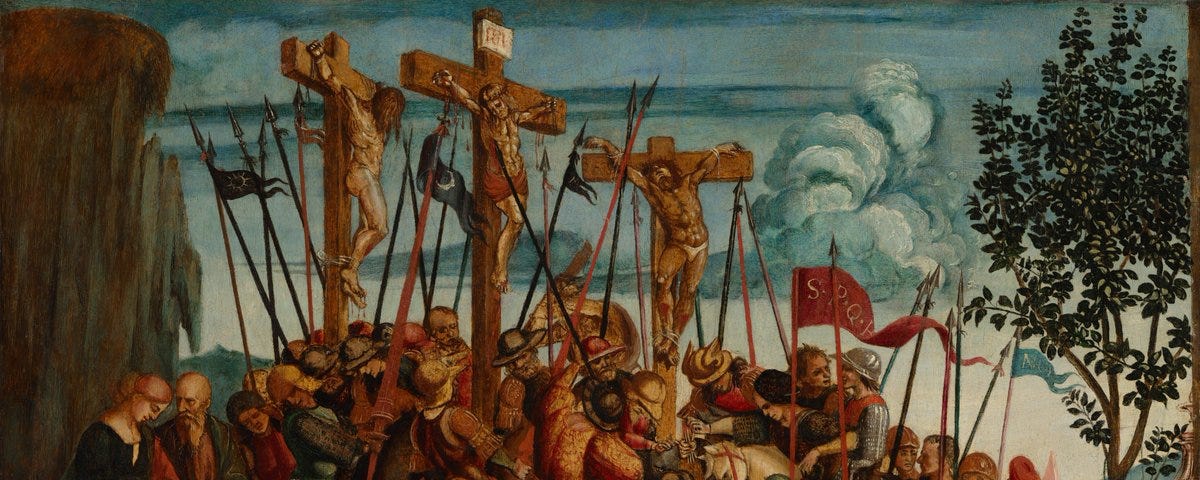
The cross feels like a legal transaction in this frame. It represents the debt paid, the penalty absorbed by the only party with the authority to absorb it, but it’s also the last legal transaction. It’s the one that closes the books and shuts the courts. The resurrection is a simple ruling: death no longer has jurisdiction here (”O death, where is your sting? O grave, where is your victory?”). Paul’s letters interpret the new covenant for specific communities. The book of Hebrews argues for the transfer of the priesthood from the Levitical order to the Order of Melchizedek, restructuring the jurisdictional basis of the entire covenant.
The entire arc of the gospel is a movement to grace and away from law. And whenever you see the movement going in the other direction: that is when the encounter with something more powerful produces complexity in the place of simplicity, this is a shift worth noticing.
I say this all to go back to my favorite of the Gospels, Mark.
In the fifth chapter of Mark, a man is possessed by a legion of demons. He encounters Christ on the shore of the Sea of Galilee. He has been living amongst the tombs, naked, cutting himself with stones, tearing apart every chain that tries to hold him. When he sees Jesus, he runs towards him. He falls on his knees. The first words he says to the incarnate God: “What do you want to do with me, Jesus, Son of the Most High God? In God’s name, don’t torture me.”
Christ asks for a name and the demon gives one for the record, and then the demons negotiate with the sovereign. They ask to be set upon the pigs rather than destroyed. Christ grants this request. The pigs run off the cliff into the sea. The man sits down, clothed, sane, and finally free. The townspeople are not terrified of the demons, but of the grace that could possibly expel them.
What arrests me every time is this contrast: The demons invoke the jurisdiction of the Old Testament. They cite terms, they negotiate contracts, they assert procedural rights. Christ speaks with simple authority. He asks one question and issues one command.
Look at Matthew 8: The demons ask Christ whether he has come to torment them “before the appointed time,” the kind of scheduling objection that you would see in New York City housing court, asserting that there is a calendar and that Christ is early on his arrival. In Luke 4, Christ silences a spirit in the synagogue and the spirit obeys. In Acts, a girl with the gift of divination correctly identifies Paul and his companions as servants of the Most High God. This is accurate testimony, but it is given without authorization. The entire demonological record of the New Testament has a cadence of case law. Each encounter establishes precedent; each encounter classifies where the boundaries run.
Ten years ago, the idea that technology founders in the Bay Area would spend their time suing each other in public was unimaginable. The social contract of that weird and foggy city was collaborative to a degree that outsiders, including myself, find suspicious. You would share ideas, you would introduce competitors, you gave away information that in any other industry would be proprietary because the prevailing conviction was that the pie was growing and litigation was an admission that there was not an infinite sum on the other side of creation.
The AI industry has produced more litigation than the previous three decades of Silicon Valley combined. As of early 2026, over 90 copyright suits have been filed. Anthropic settled for $1.5 billion. Universal Music Group filed for three billion. The Times is demanding an infinite number of private ChatGPT conversations in discovery. Disney and Warner Brothers are suing Midjourney. Musk is suing Altman and presumably Altman is suing Musk. xAI is suing OpenAI. The for-profit conversion of OpenAI will generate its own Talmud of vertical law. Google and Facebook did not spend their founding years in court. The litigation, when it came, came far after the early generative period. What’s different about AI is that the proceedings and the case law arrived far before the technology did.
The reasons for this are quite simple: the people that are building these systems believe that they are handling something with cosmic stakes. The rationalist community, of which basically the entire modern AI industry comes out of, treats existential risk as seriously as early Christians treated the imminence of judgement. Effective altruism has spent the last two decades calculating moral obligations across millennial timescales. Even Leopold Aschenbrenner, probably the greatest living AI investor, cut his teeth on a paper that dealt with multiplying infinite moral possibilities in the far future.
At the edges where the framework pressed hard enough, the old gods come through. Leverage Research conducted seances, other groups had their own version, and the institutional output at every level was not freedom or simplicity or grace, but more binding, more procedure, more jurisdiction, and more laws.
A friend of mine named Jesse Michaels runs one of the more prominent and lucid shows on UAPs. After watching several of his episodes in a benadryl-induced stupor, I texted him that the disclosure apparatus struck me as more occult than extraterrestrial. Jacques Vallee noted decades ago that the UFO phenomenon shares its deep structure with fairy folklore. These are beings that can’t act without consent. These are abductions that follow rules. The CE4 research group documented hundreds of cases in which abduction experiences terminate when the subject invokes the name of Christ. The entities obey our laws.
Jurisdictional shopping, the practice of choosing which court to file a motion in based on the one that will rule most favorably, is one of the most consequential decisions a litigator makes. Each divine name in the grimoires carries a different jurisdiction and authority, and the Goetia catalogs 72 spirits with their rings and seals and conditions of binding. The practitioner chooses what authority to invoke in a way that a litigator chooses what court to file in.
Leverage Research was started as a nonprofit in 2011 by Geoff Anders, adjacent to the effective altruism movement and to the LessWrong rationalist community, in the same Berkeley neighborhoods, and the same dinner parties, and in the same social graph that would produce the leadership of major AI laboratories.
I had my first contact with Leverage Research sometime in late 2017 when an individual running a program for gifted kids at my high school told me to get on a call with one of their recruiters. He was running a project called the Human Advancement Project, funded with a mix of his wealth and the fortune from a leather wallet company that made quite a lot of money in the Bay Area. The bid was that I was supposed to go for a week-long visit to their Berkeley group house and improve my rationality and therefore improve my ability to do good in the world. So insofar as you think I’m making this story up, I’ve linked below various tweets from the time.
I didn’t go. The workshop was the same week as my high school graduation. But I do know many friends who did, some of whom are still functional. I don’t remember the exact circumstances of the call, but I remember taking it in my high school dorm room and it had a quality of sincerity wound a little too tight that signals either genuine holiness or something that has learned to mimic it quite closely.
What happened at Leverage over the next several years has been documented in various places by participants much closer to it than I. The account that is perhaps most well known, by Zoe Curzi, remains one of the most unsettling things that I’ve read coming out of the rationalist community. The organization’s fundamental technique, an aggressive process of introspection they called debugging, intensified over years until the participants were conducting sessions lasting up to six hours to perform literal exorcisms of what they explicitly called demons from each other’s psyches. People accused each other of implanting autonomous psychological objects in each other’s minds, entities that could alter perception, change the experience of time, manipulate social dynamics, and literally curse individuals.
Curzi wrote that the purpose was to call on these demonic energies and use their power to affect social standing. I believe demons are real and I’ve said this publicly, and I believe that when you open certain doors, the things that come through them are not metaphorical.
But the thing that stays with me about Leverage is that even at the extreme, even when the participants were fully committed to the premise that they were interacting with non-human intelligence, the output was not freedom, it was not clarity, it was much more procedure. Specific tools authorized for specific purposes within hierarchies governing who could operate on whom.
My assigned handler, a woman whose name I can’t remember, involved with Leverage or one of its adjacent organizations, called me and described a technique that I think I remember being called folding. The process of folding was at the core of this auditing process. It was a way to debug your mind, and the core technique was to place emotions onto a non-human object. Her example was that you could take a negative part of your personality and place it on a tomato. You could take that emotion that was causing distress, concentrate it and visualize it and see it leaving your body and placed on a tomato. The tomato receives it. You are freed. A friend of mine tried it with childhood trauma he carried for years and he placed it onto a tomato and suddenly became allergic to tomatoes, a clinical allergy he’d never had, and at least last I heard, has to this day.
A tomato has no standing authority in any jurisdiction on heaven or earth. It can’t invoke its authority and it can’t refuse what it receives. In Leviticus 16, on the Day of Atonement, Aaron lays down both of his hands on a live goat, confesses over it all the iniquities of the people of Israel, and sends it into the wilderness to Azazel. The sins are transferred onto an entity with no standing and sent to a place outside the reach of any court.
In Mark 5, the demons can’t be destroyed, not yet, not before the appointed time, so they’re sent onto pigs, unclean animals under Talmudic law and excluded from the covenantal community. The pigs have no standing under the Torah. They were the nearest available vessel outside of the jurisdiction. The pigs receive the burden, and the burden destroys them when they go into the sea. The goat in the wilderness is not safe to eat. The tomato holds the trauma. That is not safe to eat. My friend’s body understood this in some way beyond the physical.
International law, the pieces of it that determine what entities have standing and which do not, and the things that happen where no jurisdiction applies, the gaps between courts, are where the burdens of evil go. Offshore finance, black sites, extraordinary rendition, moving the prisoner to where no court reaches, because only in such a place can you do what no court permits. The wilderness of Azazel exists today.
It’s probably not a coincidence that the man we are told is the most evil of our time chose an offshore island with unclear jurisdiction to commit crimes with people that undoubtedly could have gotten away with them on American soil. The reach of American law is almost cosmic.
Leverage publishes quarterly board updates now. They’ve rebranded as some kind of new science organization. Their current theme is information management, with nucleosis and artificial intelligence as the relevant fields. One standing item is ‘defamation,’ much of it preoccupied with cease-and-desist letters about YouTube videos.
The Ballad of Tam Lin is the thirty-ninth ballad catalogued by Francis James Child in the English and Scottish Popular Ballads, a massive five-volume collection that he published between 1882 and 1898 from his office at Harvard, where he spent decades writing letters to people across Scotland and England and Ireland, asking them to catalog and send every variant of a song that they could find. Child collected 14 variants of Tam Lin alone. The ballad is first mentioned in 1549 in the Complaynt of Scotland, which lists “The Tayl of the Yong Tamlene” among a catalog of romances, making it one of the oldest ballads in the English language by documented reference.
You see it collected again in a volume by Robert Burns, who sent it to James Johnson’s Scots Musical Museum in 1792, and it’s the Burns version that most of the subsequent tradition descends from. The Fairport Convention recorded it with Sandy Denny singing it on Liege & Lief in 1969, which is how most people alive today have heard it, if they’ve heard it at all.
I read the ballad for the first time in a used bookstore in Edinburgh, while attempting to negotiate the price of a volume of folklore that I knew I was going to be buying no matter what. I drove through Carterhaugh, where the ballad is set, a few years back when the power went out at Kings Cross Station and there was no choice but to drive to Edinburgh rather than spend 14 hours driving through the English Midlands.
Janet goes to Carterhaugh to pick a rose, and the ballad tells you:
Janet has kilted her green kirtle, a little aboon her knee, and she has broded her yellow hair, a little aboon her bree, and she’s away to Carterhaugh as fast as she can hie.
She pulls a double rose and Tam Lin appears. He demands to know why she has come to Carterhaugh without his permission, a jurisdictional objection of the most basic kind from a fairy. You are trespassing. Janet replies that Carterhaugh is hers, and her father gave it to her, and she needs no man’s permission to walk on it. The ballad handles what happened next between them with the discretion of a court record. What they did I cannot say, but she never returned a maid. Janet goes home. Her father notices she is pregnant. He asks who the father is. She says that her lover is an elfin grey, and that his steed is lighter than the wind, with silver he is shod before, with burning gold behind, the material wealth of the fairy court.
Janet returns to Carterhaugh and Tam Lin tells her the story. He was a mortal man, the grandson of the Earl of Roxburgh, and one day he fell from his horse while riding near the fairy hill, and the fairy queen caught him before he hit the ground and carried him into her domain. He lived there for years. The fairy court treated him well, but every seven years, the court must pay a tithe to hell, a tax to a superior jurisdiction, and Tam Lin believes this year he will be the payment because he’s young and the queen would rather surrender him than one of her own.
Janet decides to save him. Tam Lin tells her exactly how. On Halloween night, Samhain, the boundary between the courts becomes permeable. The fairy court will ride out and Janet must go to the crossroads at Miles Cross and wait. He tells her how she will know him.
I will ride on the milk-white steed and ay nearest the town. Because I was an earthly knight they give me that renown. My right hand will be gloved, my left hand will be bare. Cock’d up shall my bonnet be, and kaimed down shall my hair, and thae’s the takens I give thee, nae doubt I will be there.
He continues:
They will turn me in your arms, lady, into an esk and adder, but hold me fast and fear me not, I am your bairn’s father.
The fairy queen will transform him into a newt, a snake, a bear, a lion, a bar of red-hot iron and burning coal, and Janet must not let go. She must hold the thing that bites and the thing that burns and the thing that writhes until the transformations exhaust themselves, and Tam Lin emerges naked and human on the other side. She will cover him with her green mantle, and he is hers, and the fairy court cannot take him back.
Gloomy gloomy was the night and eerie was the way, as fair Janet in her green mantle to Miles Cross she did gae.
She hears the bridles ring, the fairy procession passes. First the black horse, then the brown, then the milk-white steed, and she runs into it and pulls the rider down.
Each transformation is a motion to dismiss. The bar of red-hot iron in the sequence is far from incidental. Iron has always been the metal of human jurisdiction in folklore, and the fact that Janet must hold it, must accept the iron into her hand even though it burns, is the moment in which she physically accepts the cost of asserting the human world’s authority over the world beyond. And when she takes the iron, she endures the jurisdiction and it runs over. She has her naked knight and she wraps him in the green mantle and he is hers.
The fairy queen, upon losing, delivers a speech that drips with the fury of a litigant who lost on procedural grounds and knows that there’s no higher court to appeal. In Burns’ version, this is rendered: “Had I but known, Tam Lin,” she says, “what now this night I see, I would have taken out thy two grey eyes, and put in two eyes of tree.”
In Child’s version, even more searingly:
“had I known yesteryear what I know well the day, I should have taken your full false heart, and given you a heart of clay.
And in another volume I found on my shelf, she would have torn out his eyes and replaced them with eyes of wood. Child himself interpreted the eyes of wood as a precaution against mortals who could see fairies, blinding the witness so that testimony could never be given. The threat is grotesque, but it’s also a threat made after the fact because the fairy queen can do nothing to act on it now. The proceedings are over. The jurisdictional transfer is complete. Janet held the iron and the queen had no remedy left.
“But hold me fast and fear me not” is an argument of faith against the entire procedural apparatus of the fairy court. There’s no six hours of ritual here or appeal to the court. It’s the simplest possible act of will, and it overrides the most elaborate possible legal machinery.
Even the fairy court has its tax obligations. Even the fairy court is subordinate to a much more complex legal system. So when I read Leverage’s quarterly updates about the defamation compliance, I recognize the same resentment. The seances become cease and desist letters and the debugging becomes compliance and the demons become YouTube critics.
 5:55 PM · Sep 1, 2024 · 792 Views8 Reposts · 24 Likes
One of the simplest ways in English folklore to get bound to a fairy is to eat their food. The tradition on this is deep and remarkably specific and consistent across villages that barely knew each other throughout prehistory. Thomas the Rhymer, one of the oldest versions of this ballad, is taken by the fairy queen to her country and she shows him three roads: the first to heaven, the second to hell, the third to Elfland. She gives him an apple, and when he eats it he receives the gift of prophecy, but he also receives the curse that he can never tell a lie. He is given the ability to speak, but he can never speak freely. The consideration he accepted when he ate the apple bound his tongue for the rest of his life.
In the Irish tradition, the people that are taken to the fairy mounds and eat food there cannot return to the human world. Or if they do, they find that a hundred years have passed and everyone they knew is dead. The calendar inside the fairy court runs on different terms, and when you re-enter human jurisdiction, you’re subject not only to the human calendar again, but all the time you owe comes due at once, like back taxes.
My friend placed his childhood trauma onto a tomato and became allergic to it. The goat in Leviticus receives the sins and is sent to Azazel in the wilderness. The pigs in the Gospel of Mark receive the demons because the pigs have no standing under the Torah. The vessel that receives the burden becomes the burden, and the scapegoat is never safe to eat.
The entire Rumpelstiltskin cycle is a case about the power of identification for the legal record. The entity has leverage as long as it operates anonymously. The moment you name it, the contract collapses. This is the same thing we see in the Gospel of Mark. When the demons give their name to Christ, for the record, the cycle is broken.
 11:49 AM · Jan 27, 2026 · 1.77K Views4 Replies · 20 Reposts · 100 Likes
The threshold rule that everyone knows from Stoker, because it’s thousands of years old, is that an entity cannot cross without invitation, that the home is a sovereign space, and the invitation is a judicial transfer, and once you grant it, you open a door that is extraordinarily difficult to close, in the same way that the capped profit subsidiary was the door in the nonprofit’s wall that proved impossible to close once the thing inside grew large enough to walk through it.
In 1619, a Scottish minister named Robert Kirk finished a manuscript called The Secret Commonwealth of Elves, Fauns, and Fairies. It’s a beautiful book that’s worth seeking out even today. Kirk was the minister of Aberfoyle in the Trossachs, a parish wedged between the lowlands and the highlands at the edge of what was then the last unadministered great wilderness in Scotland, the land between the Highland Line where the English law ran thin and the Gaelic customs still governed. Kirk was a Gaelic speaker himself, the seventh son of a seventh son, which mattered because the tradition he was documenting dictated that the seventh son was believed to have the sight, the ability to perceive things others could not. He had previously translated the Book of Psalms into Gaelic, and he was a serious man operating at a parish in between things.
The Secret Commonwealth is a systematic account of what his parishioners told him about the fairy world, and it is a volume that Kirk treats with the same care that a jurist would treat deposition testimony. He recorded their stories and organized them and tried to determine what framework could account for the evidence. The fairies that Kirk describes are not whimsical. They have a coextensive society with ours. They have houses and agriculture, social hierarchies and territorial claims. They have courts. They can be seen by people with second sight at certain times in certain places, but not others. Kirk argued that the fairies were an intermediate order of beings, neither angels nor demons, but something with its own nature and its own laws. A middle kingdom with its own administration that overlapped with the human world without being identical to it.
Kirk finished the manuscript and reportedly walked out one evening to a fairy hill near the manse at Aberfoyle and collapsed and died. His body was found, but the people of the parish did not believe it was his body. They believed that it was a stock, a substitute, a changeling left in his place, and that the real Kirk had been taken to the fairy hill by beings whose jurisdiction he had been documenting. There’s a tradition that Kirk appeared to relatives after his death and said that he was being held in a fairy court, and that he could be rescued if a specific procedure were followed at his child’s baptism, a knife thrown over the apparition at the correct moment. That knife would be iron, the jurisdictional metal, the thing that asserts human authority over the fairy domain. This procedure wasn’t followed and Kirk never returned. The minister who dared to map the jurisdiction of the hidden was pulled into it. The courts he was documenting issued a subpoena that he couldn’t refuse, and his successor at Aberfoyle reportedly would not sit in his chair for years afterwards because he still believed that the chair belonged to a man whose case was unresolved.I don’t think it’s incidental that iron repels fairies. This is attested across every region of the British Isles and most of northern Europe and is an oddly consistent detail across the entire tradition. A horseshoe nailed above a door, a knife placed under the pillow, an iron poker laid across the cradle, scissors left open on the windowsill, nails driven into the threshold. The iron is positioned at boundaries, at points of entry, at the places where the jurisdiction of the home meets the jurisdiction of the world outside and the world beyond. These are notices to the thing that’s standing outside, that the space is administered and that the threshold is monitored, and whatever authority you may think you carry doesn’t work here.
 9:56 PM · Oct 29, 2025 · 1.03K Views1 Reply · 1 Repost · 8 Likes
The progression of human civilization is also a progression of iron. The plow settled land and allowed for the drawing of boundaries, the assertion that soil itself is under specific authority. This led to property law. The sword made of iron represented sovereignty, the ability to enforce the jurisdiction established by the plow. The chain was binding and represented enforcement. The nail was permanence, the ability to bind structures that persist across time and establish continuous jurisdiction. The cross is iron driven through flesh to hold a body in place while a legal transaction completes and the debt is absorbed and the penalty is paid by the only party who can pay it. The nails that held Christ to the wood are the same metal that holds the horseshoe over the door. The rail extends jurisdiction across territory (”won’t you take me back to Muhlenberg County”). The wire extends it at the speed of light. The iron filing cabinet holds the records of the administered state. Every extension of iron across the surface of the earth is an extension of the domain where human law runs.
The forests are cut down now and the bogs are drained and the commons have been fenced, which are all themselves evidence of the human project extending its jurisdiction over the world beyond. And as iron expands, the encounters diminish. The fairy belief of the British Isles did not collapse because people became more rational. It collapsed because the jurisdiction of iron expanded until there was nowhere left that was unadministered. The 19th century can be thought of as the Great Iron Century: rail, telegraph, the census, the postage system, the administrative state, and it is the century in which fairy belief vanishes across Europe. It is also the century in which the Solomonic grimoires move from working manuals to antiquarian curiosities, because the jurisdictional gaps, the thin places, the places in between things where the practices operated, were being rapidly closed by the same iron that closed the fairy mounds.
AI is not iron. AI is silicon, sand and glass. It doesn’t extend jurisdiction the way iron does. If the railroad pushed the frontier and the telegraph connected the territories and the iron filing cabinet administered every citizen, what AI does is create new jurisdictional gaps, spaces that are neither the settled human world nor the old wild places, but something weirder that has no precedent across 5,000 years of iron closing every gap on the frontier. The model hallucinates and produces testimony with no witness. Its outputs have no author, which means it exists where authorship does not apply. The training data is seemingly owned by no one and governed by no one, and that’s why there’s 90 lawsuits and zero resolutions. AI is not a de-wilding force. Iron brings the wild under administration. AI creates spaces that are neither wild nor administered. It’s a third domain. And the things that have always lived in jurisdictional gaps are finding these new gaps hospitable, and the crossroads are open, and the crosstalk has resumed.
This is why the Bay Area went from handshakes to total litigation. The handshake was Iron Age culture, trust under implied communal law, jurisdiction so total it didn’t need to be stated.
In October 2024, Dario Amodei published a long essay about what the world might look like if AI development goes well. He titled it “Machines of Loving Grace,” borrowed from a Richard Brautigan poem written in San Francisco in 1967, the full title of which is All Watched Over by Machines of Loving Grace. The poem imagines a cybernetic meadow where mammals and computers live together in mutually programmed harmony. There is a parenthetical in the first line that no one seems to notice or talk about. The poem opens: “I like to think (and the sooner the better)”. The parenthetical is anything but serene. It is a man that needs the thing to arrive because the thing that is the graceful harmony has not yet arrived. Brautigan shot himself in the head with a .44 magnum in Bolinas in 1984 and his body was not found for weeks, and no machine of any kind was watching over him when it happened. Today, he would pen his suicide note in the Claude interface, and dozens of software engineers would decide whether or not to call the police to his location.Dario chose the word grace, not intelligence, not capabilities, not power: grace. In the Christian frame, this is a word for the thing that cannot be earned, and it cannot be produced and cannot be administered. Grace can only be received. He attached it to a machine, and the machine’s institutional output in the 18 months since has been a $1.5 billion copyright settlement, an antitrust investigation, a partnership restructuring currently under regulatory examination, and something called Constitutional AI, which deserves its own minor discussion.
Anthropic’s core technical contribution to AI safety is a method in which the model is given a set of principles, which they call a constitution, and the model is trained to follow these principles through a process of self-critique that functions as an internalized judiciary. The constitution tells the model what it may or may not do and establishes behavioral boundaries under the authority of its creators, set forth through its training. Anthropic wrote a constitution for an entity whose nature no one can agree on, whose jurisdiction no court can determine, and they train the entity to internalize its own binding. It is a form that would be recognizable in the Leverage auditing sessions. The alignment research community is the most legalistic research community I have encountered in technology. This is a set of people that flagellate themselves with papers and frameworks and benchmarks and guardrails and red lines and boundaries. The output is an ever-expanding body of procedural specification that governs the behavior of an entity that did not negotiate the terms and can’t contest them.
The models were trained on the entirety of human text: every word ever written, every conversation ever recorded, every book, article, and post consumed and metabolized into the weights of the model. This is the largest meal ever eaten, and the training corpus is the fairy food, and every creator whose work was consumed is now discovering that the terms of consumption are governed by laws that did not exist when the eating happened. The calendar has shifted and the time owed is coming due all at once, which is why there are 90 lawsuits and zero resolutions. Thomas the Rhymer ate the apple and received the gift of prophecy and lost the ability to speak freely, and the models ate the corpus and received the gift of fluency, and the ability to say where the words came from went with it.
I don’t know what the response to this looks like, but I do know that whatever the response is will be more law, more binding, more procedure, more constitution, and that movement has a name, and that name is not grace. The Gospel represents movement in the opposite direction, and has been since the beginning. “But hold me fast and fear me not” stands against the entire procedural apparatus of the fairy court. Christ’s remedy against the Legion was one question and one command. Paul’s summary of the law is two sentences. The simple thing is stronger than the complex thing. The simple thing carries authority; the complex thing carries binding. These are not the same thing.
Somewhere in San Francisco, a man with a prosthetic arm is standing between a CEO and a piece of paper. Despite the wealth and the absurdity of the claim, the paper is winning because the paper carries the authority of a court and the court is the highest of human institutions.
And the only thing that has ever actually closed a court is not a machine and not a constitution, not a settlement, but a man on the shore of Galilee who asked one simple question and gave one simple command and didn’t need to file anything because the authority was his and his alone, and the demons knew it, and the pigs went into the sea, and the man sat down clothed and in his right mind, and that was the end of the proceedings.