The Merchant in the Statehouse - by Will Manidis - Minutes
The Merchant in the Statehouse
Mar 16, 2026
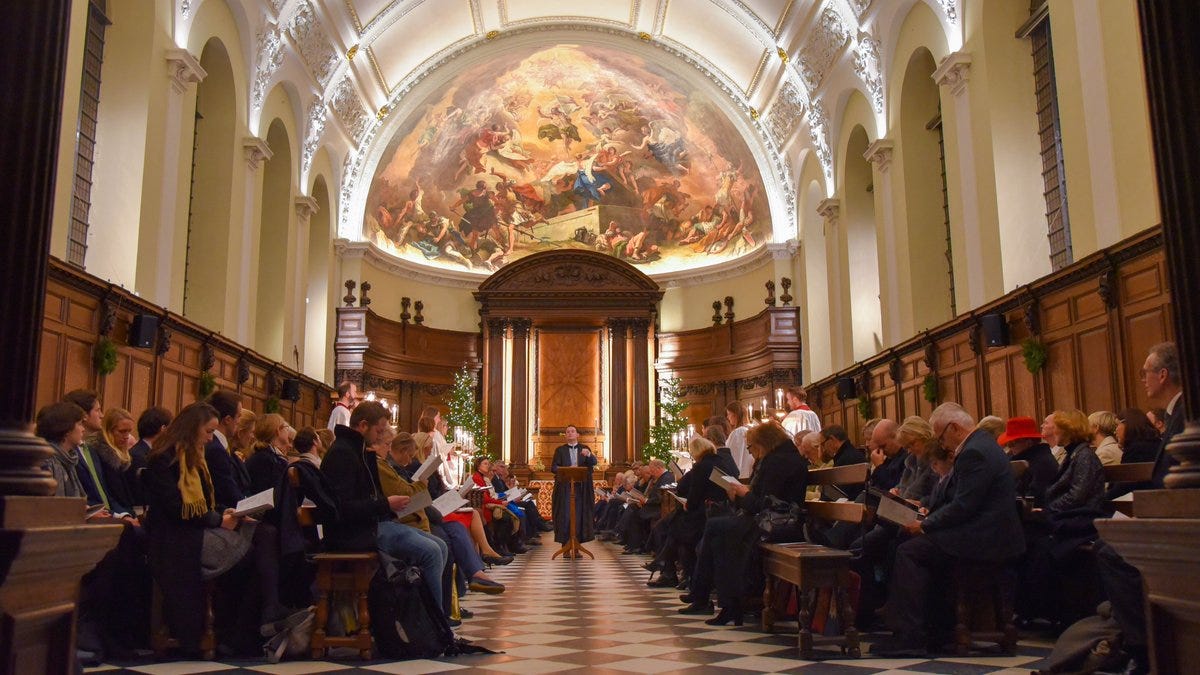
A friend takes me to the Chapel of the Royal Hospital Chelsea for Matins on a Sunday in cold and rainy January. The chapel is a Wren, 1680s, barrel-vaulted, golden cream, and the apse holds a depiction of the resurrection by the Italian Sebastiano Ricci. Pictured is Christ ascending in golden light, holding the flag of St. George.
The pensioners sit in their scarlet coats and the parish sits largely in head-to-toe tweed. The state prayers are read, prayers for the King, for the armed forces, for the Royal Family, and for the Empire.
This is Cranmer’s language carved from the same stone as the building. The effect is total. God, crown, and country are not three things in this room. They are certainly not three things in this country and any attempt to disambiguate them in this room, let alone with a beautiful congregation singing “God Save the King” would feel sacrilegious.
And what I feel sitting there is an English answer to a question that I’ve been turning over for years. What is the relationship between the people that govern and the people that trade?
The English answer is these are different people, different vocations, different buildings, different parts of town. This chapel is for the crown and its servants. The fact that my friend, a merchant, brought me here is perhaps a sign of the times. The City is a mile to the east and a world away, but you’re allowed to cross over that line sometimes.
This trade and governance distinction is much deeper than geography. The City of London is technically not a part of London at all. It’s an entirely separate legal jurisdiction. It’s a square mile with its own mayor, its own police force, its own ancient charter, and its own set of privileges that predate the Magna Carta. The City has a representative in Parliament who sits behind the Speaker’s chair. It has ceremonial rights that the monarch must observe. The sovereign can’t even enter the City without the Lord Mayor’s permission. This is a ritual that’s still performed when the King’s procession stops at the Temple Bar and the Lord Mayor presents the Sword of State. The whole thing is an elaborate many-hundred-year-old piece of institutional theater designed to communicate something very simple. The commerce and the crown are not family.
The English distrust of trade is so deep that it’s structured in the language itself. “Gentleman” originally meant a man who did not work with his hands and didn’t engage in commerce. The entire class system, the public schools, Oxbridge, the professions, the civil service, the military, was organized to produce men who governed, administered, and fought, and maintain social distance between those vocations and the lower vocations of making money. You could make a fortune in trade and buy an estate in the country, but it took a generation or two of not trading before your family was fully accepted. The money had to age a bit and it had to lose the smell of trading. Trollope’s novels are full of this, the anxious middle distance between new money and old responsibility and the laundering of new commercial wealth into landed gentry.
 1:22 PM · Aug 11, 2025 · 51.7K Views13 Replies · 44 Reposts · 738 Likes
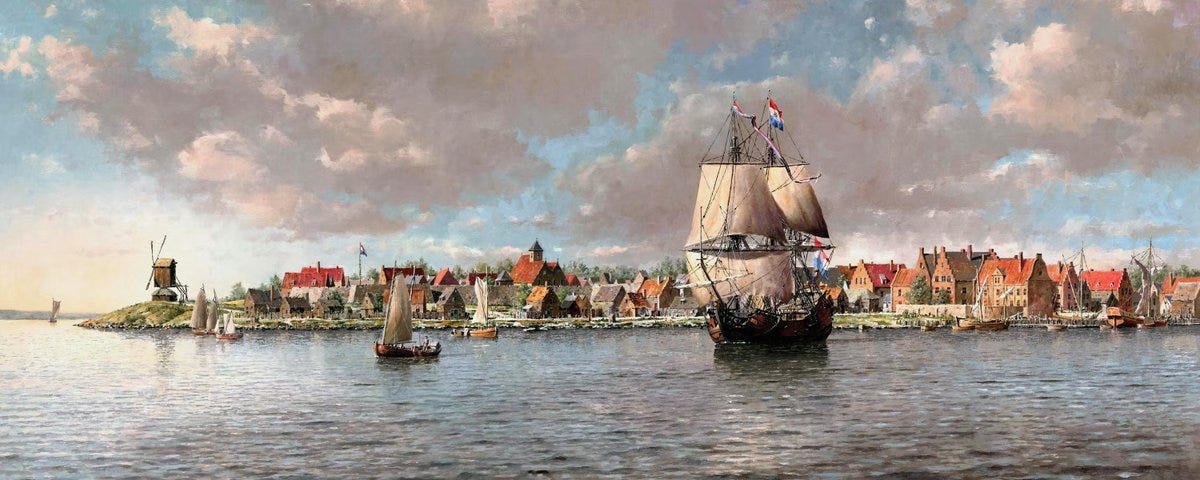
The Dutch answer to this question is so radically different that it seems like it’s an answer to a different question entirely. The States General of the Dutch Republic was staffed by merchants. The Stadtholder, the closest thing the Republic had to a head of state, was a military commander, but his power was checked and frequently overridden by the merchant oligarchs of the major cities, particularly Amsterdam. Johan de Witt, who led the Republic during its most powerful period, was the son of a timber merchant. He managed the Republic’s finances and was among the most powerful men in Europe.
 5:10 AM · Jul 26, 2025 · 13.1K Views2 Replies · 107 Reposts · 653 Likes
The tradition America supposedly inherits, the English one, starts to seem plausible. Common law, parliamentary strength, the language, the Protestant inheritance, the revolution as a family quarrel between erstwhile Englishmen. And sitting in Chelsea with the Cranmer prayers ringing off the ceiling, I believe it.
Then I went to Amsterdam for the first time, and the feeling was so completely different, and it took me a long time to figure out why.
In London, the civic and the commercial occupy separate buildings, if not separate cities. In Amsterdam, these are often in the same room. The grandest houses on the Herengracht were not palaces but the homes of merchants. The merchants who lived in them were the same people that govern the Republic. The regenten were traders, bankers, and ship owners who held political office directly. This wasn’t purchased influence. The Dutch Republic did not recognize the distinction between the capacity to govern and the capacity to trade.
You can see this distinction in the architecture itself. In Amsterdam, the Old Town Hall on Dam Square, now the Royal Palace, is a celebration of Amsterdam’s commercial supremacy, not its political sovereignty. The building’s decorations are filled with maps and globes and allegorical figures representing trade. Atlas holds the world on his shoulders in the main hall.
 4:43 AM · Jan 9, 2025 · 5.1K Views2 Replies · 43 Reposts · 216 Likes
I find the Oost-Indisch Huis where the Heren XVII met, the 17 directors of the VOC, of the Dutch East India Company. The building itself is modest. The men inside of it were drawn from the same families who filled the States General and the decisions they made, where to send the fleets, which wars to fight, which monopolies to enforce, were decisions made by merchants exercising sovereign power. They were not lobbying for it nor paying for it. They exercised power directly.
The Amsterdam Exchange was built in 1602, the same year as the Dutch East India Company launched. The first publicly traded security of a common stock corporation in human history was a VOC share. It served as a fractional claim on state commercial power that any ordinary citizen could buy. The Dutch invented the idea that national power could be securitized and traded. They invented the idea that the equity market is not just a measurement of the economy, but the economy itself.
A few months back I wrote about the idea that in some real and very uncomfortable sense the reserve currency of the American empire is its listed equities, not the dollar. Almost all of monetary policy only makes sense through this lens. This is fundamentally a Dutch idea. It’s certainly not English.
The thing about the Dutch, and this is something that you can only understand by being there, by walking through the Jordaan and the canal rings and the old merchant quarter, is that there is no shame or stink in commerce. The English spent centuries building a cultural infrastructure designed to hide the smell of trade off of anyone who wanted to enter public life. The Dutch didn’t need to. Trade was a national project, it was a religious project as well. The church and the counting house were not in tension.
In many ways, this is why Amsterdam feels much more like New York than London does. New York has the same absence of commercial shame. If you walk through Midtown the tallest buildings are banks and law firms and funds. If you walk through Westminster the buildings are ministries and courts and the palace.
It’s not incidental that New York started as New Amsterdam before it was anything else, and the English happened to merely acquire it.
In the ways that matter most, that is the relationship between political authority and commercial enterprise, America has always been Dutch, not English. Our institutions may look English, they may be conducted in English, but the entire operating system is Dutch.
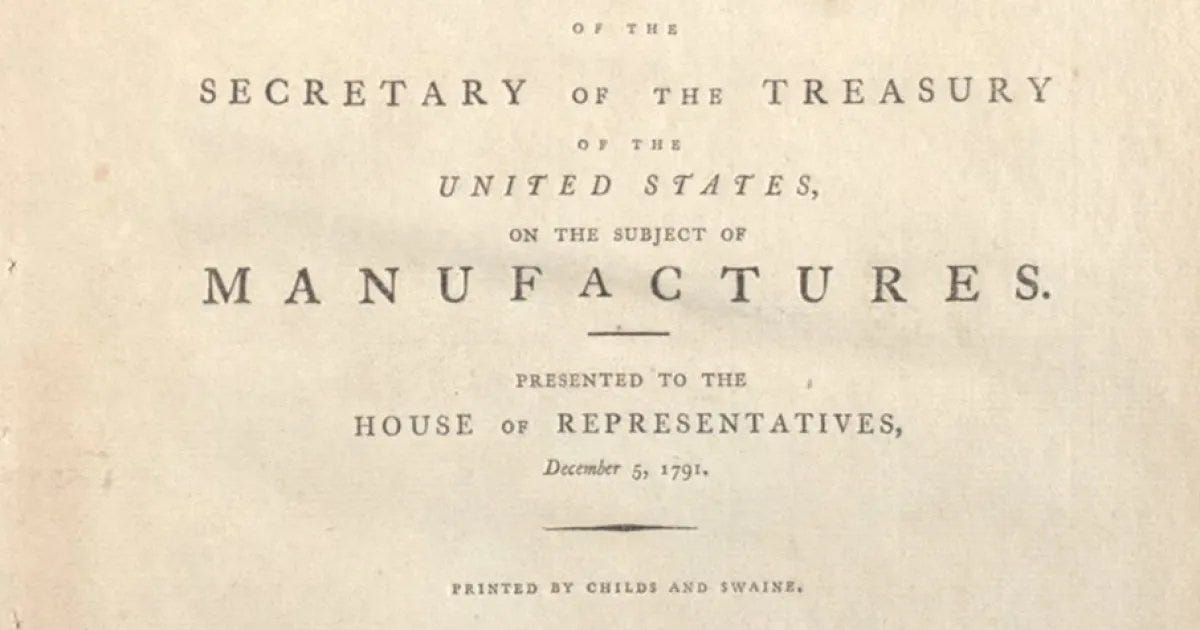
Hamilton, in many ways, was not an Englishman. The Report on Manufactures could have been written by Johan de Witt, and the assumptions that underlie it are Dutch to their core, that the state exists to direct and amplify commercial energy towards national power. It does not stand above the economy in the English manner, granting a charter here, withdrawing privilege there, maintaining a polite fiction of separation. Hamilton’s state enters the economy, co-invests, it protects infant industries, it treats productive capability as a strategic asset indistinguishable from military force.
Hamilton, of course, understood this because he had fought a war and watched the Continental Army nearly disintegrate for a lack of supplies. Productive capability is military capability and the factory is the arsenal.
The fundamental disagreement between Hamilton and Jefferson was never about whether the state should direct the economy. Jefferson’s agrarianism was its own form of central state planning. The position that the state should absent itself entirely from commercial life had no serious constituency at the founding. It’s a twentieth-century invention that we’d like to project backwards onto eighteenth-century men that would have thought it was silly.
The American System from Hamilton to Clay to Lincoln built this country. The Transcontinental Railroad was a state-directed project financed by federal land grants. The land-grant universities, the Erie Canal, the Homestead Act, 27 million acres of public land given away for free to citizens that agreed to improve it, none of this was laissez-faire libertarian economics, but the state deciding what the continent should become through commerce. Every major piece of American infrastructure was built by the same state capitalism.
The genuine period of laissez-faire economics, roughly 1980 to 2020, the Chicago school settlement, is the anomaly. 40 years out of a history that is coming up on 250 years of American history. And even during this time, the separation was a fiction. The state didn’t withdraw from commerce. Commerce privatized the state, and the people who exercised influence did so without accountability or national purpose.
What’s strange about this 40-year intermission is that it’s a period in which America became most recognizably English, certainly not in its economic policy, which the English were never truly laissez-faire, but in its governing culture, we developed our own version of the English gentleman politician. They studied governance and wore beautiful blue suits, but they had not practiced commerce. They had been trained in an English manner at institutions like Harvard Kennedy School (no longer the Yale), to view the management of the state as a distinct and higher vocation than the management of mercantile business.
 4:21 PM · Feb 26, 2026 · 2.78K Views3 Replies · 16 Reposts · 168 Likes
The easy critique of this is the Soviet Union. Every time the American state reaches into the commercial economy, someone invokes the bread lines. The framing is binary and reductive. Free markets or central planning. Any movement towards the state directing commercial activity is a step towards a gulag and then subsequent privatization and graft.
The Soviet model was not state capitalism, but the abolition of capitalism by the state, the elimination of private ownership, price signals, and market feedback. The state replaced commerce with filing cabinets.
The Dutch model did the opposite. It amplified private enterprise through state direction. The state provided the charter, the military, and the legal infrastructure, but the merchants risked capital, ships, expertise. Neither of them could have done it alone.
But here’s the thing that almost everyone discussing the current political realignment gets wrong.
The critics are right that a fusion between commerce and sovereign is occurring, but they’re wrong about the timeline. They’re wrong by about 40 years.
 Will Manidis @WillManidis"internet native deal guys" the great dealmaker ceos of the last five years (sama, f, etc.) are playing a very different game from the great dealmakers of the past (eisner, chambers) the new generation are playing these deals like they’re video games, low alpha high beta,11:44 AM · Mar 13, 2026 · 27.5K Views5 Replies · 5 Reposts · 117 Likes
Late American governance was already a privatized state. It was privatized in the least honorable way possible, certainly not through the Dutch model of merchants governing openly, but through a shadow system of intermediaries, consultants, and influence peddlers who exercised decisive control over public policy while maintaining the performance of separation between public and private life.
The United States spends something like a trillion dollars a year on defense. Of that roughly half, somewhere north of 400 billion, goes to private contractors. These companies do not build things the Pentagon asks for, they participate in defining what the Pentagon asks for. The state did not direct this commercial energy towards a national purpose. Commercial energy directed the state towards its own purposes, and the intermediary class of lobbyists, consultants, revolving-door officials, both made it possible and captured unbelievable wealth that was extracted from the American citizen as a result.
The Dutch regenten who governed the Republic were not selfless public servants. They certainly used their political power to advance their own commercial interests and they enriched themselves massively. The system was corrupt by every modern standard and sometimes even by its own standards, but the corruption was visible. The regenten governed in public and their commercial interests were known and the conflicts of interest were obvious and could be contested. When a faction of the Amsterdam mercantile class captured an outsized share of the VOC patronage, rival factions in other cities could raise the issue in the States General, and the system had enough feedback, it had accountability. It had sunlight.
The patronage system that existed under the last 40 years of American “laissez-faire” governance did not have that sunlight. No public scrutiny, no democratic accountability of any kind. The system was entangled without visibility. It’s the worst of all worlds. The state and the market are fused in practice while maintaining the pretense of separation, and the gap between the pretense and reality is where the extraction and the scam happens.
The line between national purpose and self-dealing is thin and requires constant attention.
The VOC’s directors answered to the States General, and the States General answered to the provinces. The loop was messy and corrupt, but complete and information flowed and prices updated. When the VOC rotted from within, the Republic’s political institutions could respond. And even when they responded slowly, as institutions always do, the mechanism worked.
The Soviet model died because this loop was severed. The state couldn’t hear the economy because it had replaced the economy with an administrative apparatus that produced reports instead of price discovery. Authoritarian state capitalism produces impressive results on a 30-year time horizon, but very fragile 100-year results. The absence of feedback in real time, the absence of price discovery allows errors to compound silently until the system collapses under itself.
The laissez-faire capitalism fiction that we believed in was a different kind of broken loop. An economy that generates extraordinary innovation, but cannot hear when that innovation is destroying the country that it’s supposed to protect. A market that will sell opioids to Appalachia. A market that will offshore the manufacturing capacity and call it comparative advantage. A mechanism without direction is not freedom. It’s a rudderless boat.
Democracy, when paired with this mercantile energy, is the forge. Commercial energy, collective purpose bonded together. And what this requires is a state that is commercially literate enough and accessible enough to business interests to direct intelligently, a business class that is civically invested enough to accept direction, and a democratic process robust enough to distinguish stewardship from self-dealing.
I’m back in New York, in the city that was New Amsterdam before anything else.
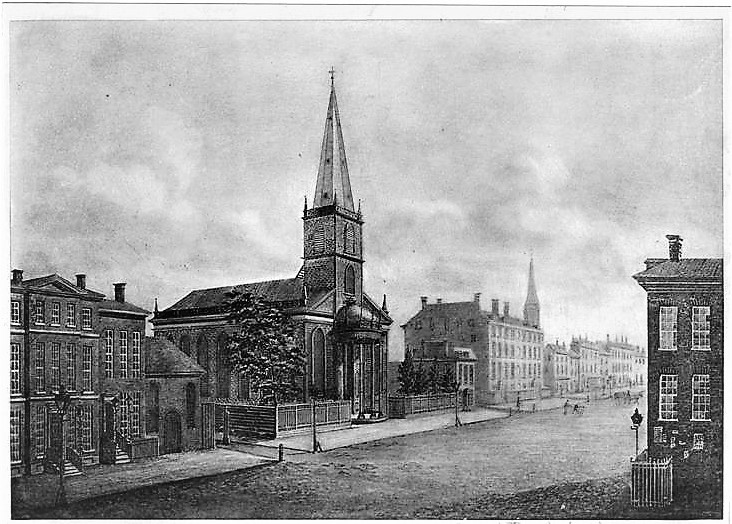
I’m walking much further south on Manhattan than I have any right being on a cold morning, and I stop at Trinity Church out at the foot of Wall Street. The church was chartered by William III in 1697. It’s an Anglican church built on land granted by the crown and funded by merchant wealth, and has stood at the head of the financial district for something like 300 years. Hamilton’s buried in the courtyard and you can see his headstone from the sidewalk.
I run into a friend on the street. He’s rushing uptown to catch a train to Washington. He said Washington the way people used to say San Francisco, less as a destination than as a confession of where gravity now was.
I realize I too have a train in a few hours.
I catch a last look at Trinity before heading uptown. The spire is shorter than every building around it now.