On the Political Economy of Language Models
On the Political Economy of Language Models
Apr 08, 2026
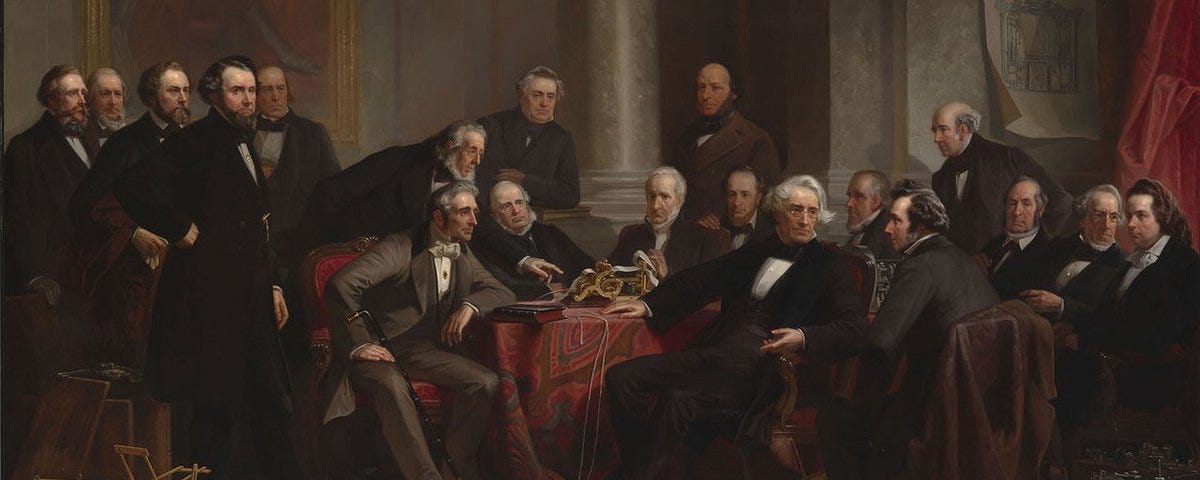
The political impact of the acceleration of a language model seems oddly under-discussed to me. I wanted to publish five short sketches from my notes and emails over the last few months that I’ve abstracted below on language models and their political economy.
I. On the Unusual Coalition
The Republican Party won the 2024 presidential election with the most demographically diverse working-class coalition assembled in modern history, or at least since the New Deal. Between 2016 and 2024, Democrats suffered a 23-point decline amongst moderate Hispanic voters, alongside an 8-point decline amongst conservative Black women, and an 11-point decline amongst moderate Asian voters. It’s easy to think that these shifts were confined to white voters or confined to men, but they weren’t. Across every racial category in every region, voters with college degrees moved towards Democrats and voters without them moved towards Republicans.
62% of American adults don’t hold a bachelor’s degree. The party’s survival and margin comes from a non-college majority.
The coalition that won in 2024 is weird in an important way: it formed an alignment of interests between a capital class and a labor class within the same party.
The MAGA coalition was not like this. The venture capitalists and the plumber in Ohio, the allocator and the machinist in Nevada, the CEO preparing for an IPO and a claims adjuster in Ohio. They all voted for the same candidates and they all attended the same events and most importantly they all share the same enemies.
Over the last decade, the economic interests of capital and labor on the right have run together. Both sides want re-shored production, both sides want tariffs on foreign competition, both sides want cheap energy and reduced regulation. Even if the employer captures these margins, the employee captures increased wages. Their interests are not identical, but they are pointed in the same direction and they share hostility towards a common adversary: the credentialed professional managerial class, the regulatory state, and the cultural establishment.
Thatcher’s coalition was built from capital plus an aspirational middle class — industrial labor opposed her. The BJP’s is capital plus Hindu majoritarian politics mediated through a complex caste regime. In none of these cases did the capital class and the labor class sit at the same table and argue for the same candidates.
The Bureau of Labor Statistics classifies something like 20 million Americans in office and administrative support occupations, the single largest occupational group in the economy. This includes 3.5 million secretaries and administrative assistants, 2.9 million customer service representatives, 1.3 million information clerks, 1.5 million bookkeeping and accounting clerks. The median wage across this group is a little north of $46,000, below the national median of $49,000. The typical educational requirement is a high school diploma. These are, at least in demographic terms, the non-college workers who form the Republican base.
BLS projections show employment in this entire category set to sharply decline over the 2024–2034 period. The agency specifically attributes this to AI and automation, noting that the integration of existing and new AI technologies into workflows will constrain demand for billing clerks, procurement clerks, credit authorizers, customer service representatives, and administrative assistants. Keep in mind federal employees did these projections, not bay area freaks.
Beyond administrative support, the national economy employs 5.7 million workers in sales and related occupations earning below the national median, 4.4 million in food prep and serving at a median wage of $30k, and 7.7 million in transportation and material moving. These are occupations that AI and AI-adjacent automation — autonomous vehicles, automated logistics, AI-driven ordering systems — will put pressure on over the next decade. These are disproportionately held by workers without college degrees, and disproportionately held by the coalition that delivered the Republicans their majority.
On stages and in interviews and in earnings calls, the lab leads say things as aggressively as: customer support will be fully automated, white-collar work has 12 to 18 months left, 50% of entry-level positions could be eliminated within five years. The capital markets are pricing these in as fact.
The employer’s interest in AI adoption is simple cost reduction. If a model can perform the work of a claims processor at a fraction of the cost, the employer’s fiduciary obligation is to use the AI. But the claims processor’s interest is to continue being employed. There is no tariff on the deployment of language models. There is no reshoring strategy for cognitive automation. The tension between capital and labor that AI introduces cannot be managed by the policy instruments that currently align the coalition.
II. On Attacker’s Advantage
AI is overwhelmingly attacker-advantaged.
It costs a lifetime to build a political career and institutional credibility, but an individual with a laptop in a few hours can produce a synthetic audio recording that can destroy one. The recording doesn’t need to be perfect or undetectable or even survive forensic analysis — it just needs to circulate for long enough before an election. By the time the analysis arrives, the news cycle has moved on and the damage is baked into the priors of the electorate.
Synthetic media disproportionately harms incumbents. The party in power requires institutional credibility and has a greater surface area to smear with the blood of libel and impropriety. The opposition benefits from chaos, from distrust, from the collapse of legitimacy. When the information environment degrades to the point where nothing can be confirmed, the public response is to blame whoever is currently in charge.
The Republican Party currently controls the White House, the House of Representatives, the Senate, and the majority of governorships. Every piece of synthetic media that erodes trust in institutions erodes trust in the institutions the Republican Party currently operates.
The current deepfake detection systems identify artifacts of known models. This works against frontier models that are properly documented, disclosed, and have verifiable examples. It doesn’t work against models that have never been publicly released, possibly distilled, possibly new architecture, or trained from scratch by actors with sufficient compute. A state-level adversary, an individual with enough funding, or a former frontier lab employee with access to models that are not publicly known could produce synthetic media that existing detection tools cannot detect, because it’s hard to detect something you don’t know exists.
And the incentive structure for a lab to leak such a model to an aligned actor is only becoming greater. The labs and their adjacent research organizations employ workforces that are, by every available survey, concentrated on the left of the political spectrum. The nonprofits that receive the compute grants from the labs are not politically neutral.
III. On Insurgency
The modern MAGA movement was the first online political insurgency in American history.
The 2024 cycle extended this advantage onto new platforms. David Shor’s data shows that voters who identified TikTok as their primary news source swung nearly six points away from Democrats between 2020 and 2024. Short-form video, podcasts, creator-driven media were all channels where the right reached young men, first-time voters, and assorted low-information constituents.
But the institutional left has now had a decade to react — two complete election cycles. They understand the techniques and the platforms and the network structures. Academic research programs, trust and safety teams, other EA-funded circus shows, and NGO infrastructure have all invested heavily in defensive postures. These are imperfect defenses, but the 2016 playbook is now a case study.
The next political insurgency, that is the one enabled by AI, will not resemble the last one. The meme war required thousands of participants producing and distributing content with wide appeal. An AI-enabled operation can require only a handful of operators and customize content to target ultra-narrow areas of resentment.
The right won the last information war with these tools and these people, but the next information war will be fought with people who don’t share its commitments and deployed through channels it can’t monitor with models it can’t detect.
IV. On Displacement
The demographic most immediately threatened by AI automation in the U.S. is not blue-collar workers. Blue-collar workers have already faced their day of job elimination and reduction and horrible offshoring and destruction of communities as a result of automation. They never got justice for any of this. The class that AI is most likely to dispose of is the professional managerial class: the college-educated, urban, white-collar workforce that forms the operational core of the Democratic Party.
This should be, in theory, good news for the right. The people being displaced are the other side’s voters.
Young white college graduates, approximately 5% of the electorate, constitute what seems like a majority of people who actively work in Democratic machine politics. They staff campaigns, they run nonprofits, they file lawsuits, they organize protests, they write policy and they navigate bureaucracies. They are the left’s standing operational infrastructure with nothing better to do. They are concentrated in metro areas where political organization is easy and are networked through institutions that function as permanent campaign infrastructure.
Unlike the non-college worker whose job either exists or it doesn’t, the professional managerial worker’s position is much more likely to be hollowed out than to vanish. They have enough political power that AI may automate the outputs of their jobs - the reports, the emails, the analysis -- while the positions themselves face political opposition to total elimination, because eliminating them requires managers to acknowledge that the role was unnecessary, which threatens the manager’s own job. Return-to-office mandates keep these workers physically present amongst their peers, even if there is no work to do at all. What remains are salaried professionals with institutional access, organizational skills, political experience, geographic proximity to similarly oriented professionals, and a newly found excess of unoccupied time.
When the credentialed professional class perceives a threat, the response generates new credentialed professional positions — make-work jobs. The regulatory response to AI displacement creates employment for the displaced.
The factory worker who was displaced by offshoring in the 1990s did not get a federal oversight apparatus staffed by former factory workers.
What this produces is a large, underemployed, politically experienced, concentrated, and institutionally connected class on the left with time, resources, and capacity, and a grievance which deepens every quarter. On the right, displaced workers with grievances, without organization, without density, without institutional access, or without time.
The non-college worker who loses their job to AI has a grievance but no infrastructure. Organized labor was their only defense and has already failed them. They don’t have density, they don’t have a political network, they don’t have institutional affiliation. The professional managerial worker who is underemployed by AI has grievance and infrastructure.
V. On the Periphery
The international consequences of the coming intelligence wave are, if anything, more severe, and they arrive at our borders whether or not the political class wants them.
India’s IT and business process management sector employs 5.4 million people directly and represents 7.5% of GDP. The BPO workforce alone is 1.6 million people. The Philippines has 1.9 million IT-BPM workers with total employment including induced and indirect jobs of 6.3 to 7.7 million — 13 to 15 percent of the entire employed population. The sector is 9% of Philippine GDP, comparable in scale to overseas remittances. The median BPO worker in Manila is 20 years old.
The work these industries perform — customer service, data processing, claims adjustment, technical support, back-office administration — are cognitive tasks that AI systems can automate most effectively. The IMF’s own analysis classifies Philippine BPO workers as highly exposed with low complementarity, meaning the tasks are automatable and the skills do not easily complement AI systems. The BPO sector accounts for 7.4% of Philippine GDP, macro-critical as the IMF says, and changes within it will collapse the broader economy.
These are young men, urban, concentrated in countries with limited social safety nets and histories of political instability when economic expectations are violated.
When the primary formal employment pathway for young men in their 20s disappears in countries with weak institutions, the result is not an orderly labor adjustment. The Arab Spring was preceded by a decade of rising youth unemployment in countries where young men had been educated to expect middle-class outcomes and the economy could not deliver them. Central American migration surges correlate with constrictions in the formal employment sectors that absorb young male labor.