After ‘After Automation’
‘AI & I’: More machine, more human work
Today, we’re releasing a new episode of our podcast, AI& I. In a format flip, Dan Shipper sits down with Every’s COO Brandon Gell not to interview a guest, but to be interviewed himself on why automating everything leads to more human work. The occasion is “After Automation,” Dan’s 8,000-word argument on the topic that became our most viral piece of the year, driving the AI discourse on X for a couple days.
It’s a counterintuitive thesis from someone who runs a company that’s automated every single thing it can. And yet Every has grown from four people to 30 in the GPT era, with agents embedded into nearly every workflow. Dan’s point isn’t that AI won’t change work—it already has—but that it drives up the demand for human expertise, judgment, and taste.
Watch on X or YouTube, or listen on Spotify or Apple Podcasts. You can also read the transcript.
Here are the highlights:
- AI makes experts more valuable. When everyone can produce a decent first draft—of code, writing, design—the floor rises, but so does the amount of comparable content. “You flood the zone with tons of stuff that’s close, but not quite right,” Dan says. Getting from close to memorable requires experts who can work with AI to rise above the new baseline.
- The goalposts will keep moving. Models improve exponentially on benchmarks precisely because benchmarks are fixed frames, or existing ways of posing a problem the model can train on. Humans remain indispensable because we can operate outside established frames entirely—we zoom out, recenter the problem, and make surprising, self-directed choices that don’t exist anywhere in the training data.
- “AI layoffs” are usually a cover story. Meta and ClickUp, among other tech companies, have recently laid off people and blamed AI. Dan and Brandon’s read on the trend is the same: AI is an easier explanation than admitting your company hired too many people or is in financial straits. AI will undoubtedly change how people do their jobs—and big, structurally rigid companies will have to reorganize around that—but that’s different from the technology eliminating jobs.
- Ride the models and you’ll be fine. The paradox at the heart of Dan’s essay is that AI creates more work for humans while raising the bar for how good that work needs to be. Agents are structurally built to rely on humans for direction; without someone deciding what matters and how to make it better, they produce mediocre results. To position yourself to thrive in an AI-native workplace, Dan says, use new models to do the tasks you’re already good at, and you’ll be more in demand than ever.
Miss an episode? Catch up on Dan’s recent conversations with LinkedIn cofounder Reid Hoffman ; the team that built Claude Code, Cat Wu and Boris Cherny ; Vercel cofounder Guillermo Rauch ; podcaster Dwarkesh Patel ; and others, and learn how they use AI to think, create, and relate.— Laura Entis
Signal
The Pope takes on the means of AI production
When Pope Leo XIV ’s encyclical on AI, Magnifica Humanitas , hit the internet a little after 6 a.m. on Monday, the first thing I did was give it to an AI.
I’d been waiting on the Pope’s first major written teaching with the bated breath of a left-leaning agnostic secular humanist amateur Bible scholar slash knowledge worker in the AI economy. AI, labor, and the Book of Nehemiah, in one document? I’m not sure there’s ever been a more Katie Parrott-coded text.
Nevertheless, I gave AI the first crack at it. I had Andy, Every’s in-house editorial assistant, use Claude design to turn it into a comic-book infographic with the need-to-know information for the Every team. Our head of tech consulting, Mike Taylor , said the comic helped him wrap his head around the argument as a non-believer. Praise the Lord.
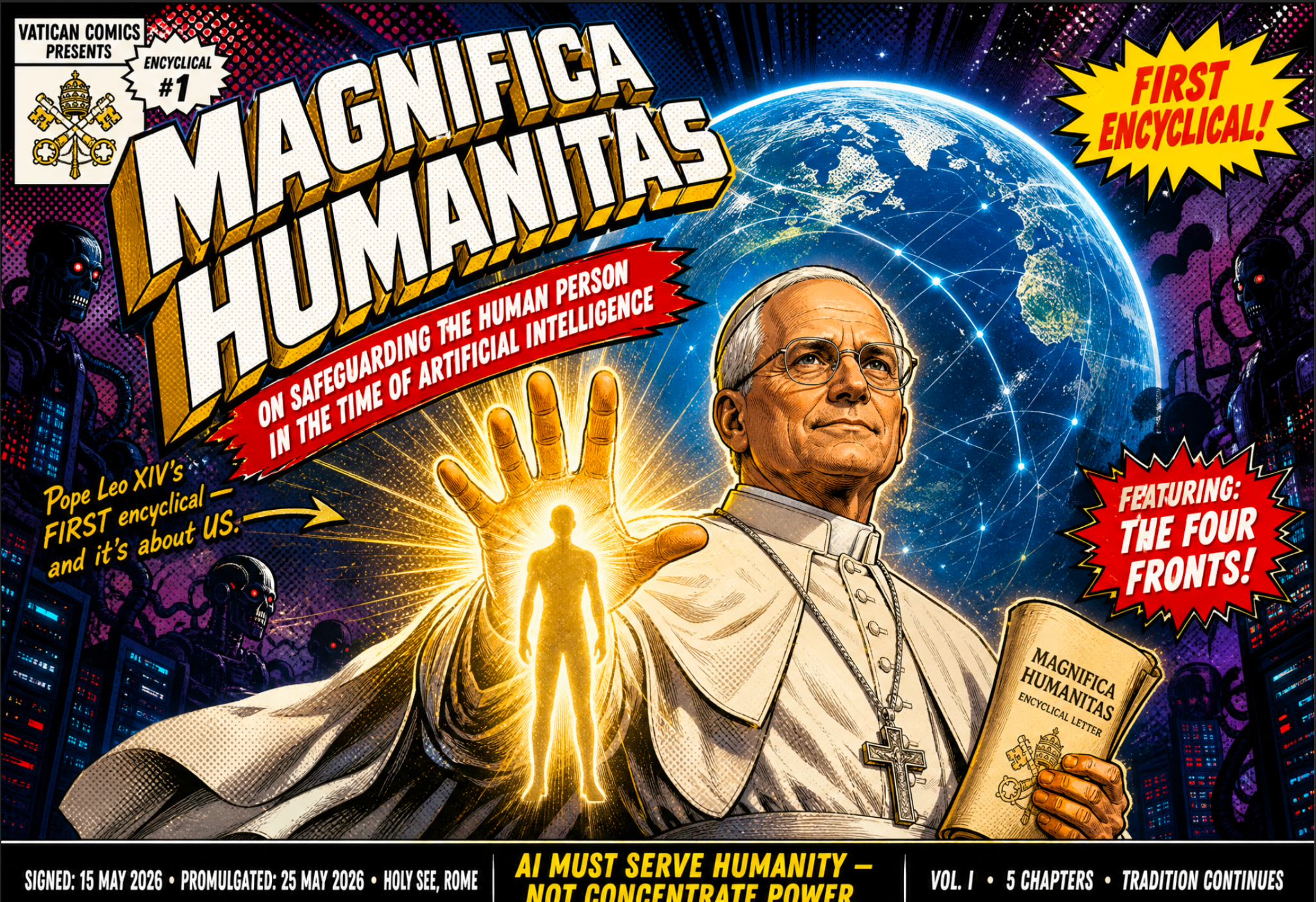 Page 1 of the Magnifica Humanitas comic book graphic created by Andy using Claude Design. (Image courtesy of Katie Parrott.)
I can hear the objection, because I had it myself: Isn’t it a little rich—in bad taste, even—to run an encyclical on AI through an AI? To use the machine to skim the Pope’s warning about the machine? Feeling guilty, I closed the comic and read the whole thing myself, slowly.
The penance turned out to be unnecessary, because the guilt rests on a false premise. Magnifica Humanitas is not anti-AI. That’s not to say His Holiness doesn’t see something in AI to worry about, but the things that he’s worried about have more to do with the systems of power surrounding AI than they do with AI itself.
The timing of Magnifica Humanitas’ s appearance is a heck of a thing, because five days earlier, we published our own encyclical of sorts: “After Automation,” Dan’s case that as AI makes yesterday’s expertise cheap, human judgment becomes the scarce, valuable thing. More machine, more human work.
I’ve had these two voices—my boss and Catholicism’s boss—in my head for a few days now. I even made an app where AI versions of them argue about AI and the future of work, just for fun. I want to believe my boss when he says AI will make human judgment more valuable, not less. Catholicism’s boss doesn’t exactly disagree. He just asks the question hiding underneath: valuable to whom?
Human dignity in the new Industrial Revolution
The Holy Father formerly known as Richard Prevost took the name “Leo” for a reason. In 1891, the previous Pope Leo, Leo XIII , wrote Rerum Novarum , the letter where the Church took the side of workers against industrial capital. His indictment: The wealth made by the many had pooled in the hands of a few, leaving workers with “a yoke little better than that of slavery itself.” The indictment came with a policy agenda: a living wage, humane hours, rest, limits on child and exhausting labor, the right of workers to form unions and mutual-aid societies, and a state willing to step in when the poor were crushed by market power.
Our present Leo signed Magnifica Humanitas on the 135th anniversary of the previous Leo’s letter. Translation: AI is the new factory, and the Church means to do for the large language model what it once tried to do for the assembly line. The present policy agenda: Regulate data as a shared good; make algorithmic decisions transparent, contestable, and accountable; design workplace systems around human dignity rather than machine-speed productivity; invest in retraining and access; use taxation, social protection, and industrial policy to spread the gains; protect children from extractive platforms; and keep lethal decisions out of automated hands.
A key part of the argument in Magnifica Humanitas is built on a philosophical principle older than capitalism: the universal destination of goods. It’s the idea, developed in Catholic teaching from Aquinas forward, that the world’s resources are intended for everyone, and private ownership is a stewardship arrangement rather than carte blanche. Bible readers will recognize the spirit of it in Acts: The first followers of Jesus “had all things in common,” selling what they owned and giving “to each as any had need” (Acts 2:44–45 NRSVUE)—a line that would echo, centuries later, through everyone’s favorite, non-divisive German philosopher Karl Marx. Leo XIV updates it for the era of the data center. He extends “goods” to include “patents, algorithms, digital platforms, technological infrastructure and data,” and warns that when those stay “concentrated in the hands of a few,” the result is “a new imbalance” (¶67).
The models you hand your work to were trained on the collective writing of everyone who ever put words down—yours and mine included. We’ve built the material underlying this technology collectively. But according to Leo XIV, the value is being disproportionately captured by “private, often transnational, parties” whose resources “surpass those of many Governments” (¶5). A pope is describing the means of production—and the fact that the people whose livelihoods now run on them don’t own a share.
A Pope and a CEO walk into a discourse
Dan’s focus in “After Automation” is mostly on the individual. What can I do to stay ahead and make the most of AI progress? Answer: Become the framer—the person in charge of deciding what’s worth doing, and why. His Holiness takes the collective view, and reading their perspectives together is what makes Dan’s piece feel both right and incomplete at once.
Becoming the framer is the correct individual strategy. It’s also a move that only pays off if you’re positioned to make it—with savings to play with, time to learn to use the tool well, and somewhere soft to land if you leap. I had all three when I was first experimenting with AI. The same model, handed to a single mother working two jobs to pay for childcare, won’t have the same effect. Access to AI multiplies what you already have, and the machine doing the multiplying still belongs to someone else.
What you can do
Leo’s question doesn’t resolve into action items, but there are a few moves available to anyone who works in or around AI.
- Know what (and who) you’re depending on. Start with your own tools. List the models, agents, APIs, and platforms that sit between you and your work. Ask what happens if the price changes, access disappears, terms shift, or your data gets locked in. Keep the parts of your work that create lasting value—notes, prompts, workflows, client context, and taste—in places you control.
- Bring ownership and governance into decisions you already touch. When a team pilots a tool, ask about more than time saved. Ask who benefits from that saved time, whose work changes, what needs human review, and what should not be automated. Put those questions into kickoff docs, vendor decisions, retros, and performance reviews.
- Use your position to set the standard. If you are reading this, you are on the first wave of AI adoption, whether it feels that way or not. You are testing tools, designing workflows, advising clients, and modeling what “good AI use” looks like. Take that responsibility seriously. The standard we set now is the baseline for everyone else who comes after.
AI has given me a working life I love, on loan from a commons everyone built and a few companies own. Dan’s question I can answer by myself, which is what makes it comfortable. Leo’s I can’t answer alone, and neither can you. What we can do is stop seeing our own good luck as proof the system is fair, and keep the big question on the table: Who owns the machine that makes my work valuable, and at what cost?
Log on
We host camps and workshops on topics like compound engineering and writing with AI to share what we’ve learned from training teams at companies like the New York Times and leading hedge funds, and by using and experimenting with AI every day ourselves.
Upcoming event
- Executive AI Sessions : On June 2, head of consulting Natalia Quintero hosts a live webinar introducing Every Consulting ’s new offering for leadership teams navigating AI adoption—built on the playbook we’ve been running with executive clients for months. Learn more and register.
In New York City
- Every 🤝 IRL : Join us at the Every brownstone in Brooklyn on June 3 during New York Tech Week for a subscriber-only meetup celebrating the Every community over drinks and conversation. Learn more and RSVP.
Inside Every
Use Codex for knowledge work like the Every team
If you’re anything like me, modern knowledge work has started to feel a little like being your computer’s errand girl. Move the Slack thread into Notion. Copy the dashboard number into the spreadsheet. Find the latest version of a draft in a field of them. Gather the eight inputs for one report, each living on a different work surface.
Codex changes all that. OpenAI’s agentic workspace can read across the apps, files, and tools you connect, gather the context you would otherwise have to chase down yourself, and turn scattered inputs into a draft, brief, plan, or workflow you can review.
The Every team is so Codex-pilled, we built an entire 9,000-plus-word guide about how we use it. It walks through how to set Codex up, what to hand off, what to keep close, and how to turn one-off tasks into reusable workflows. A member of the Codex team at OpenAI said he’s sharing it with his agent, so there’s truly something for everybody—and every-bot-y.
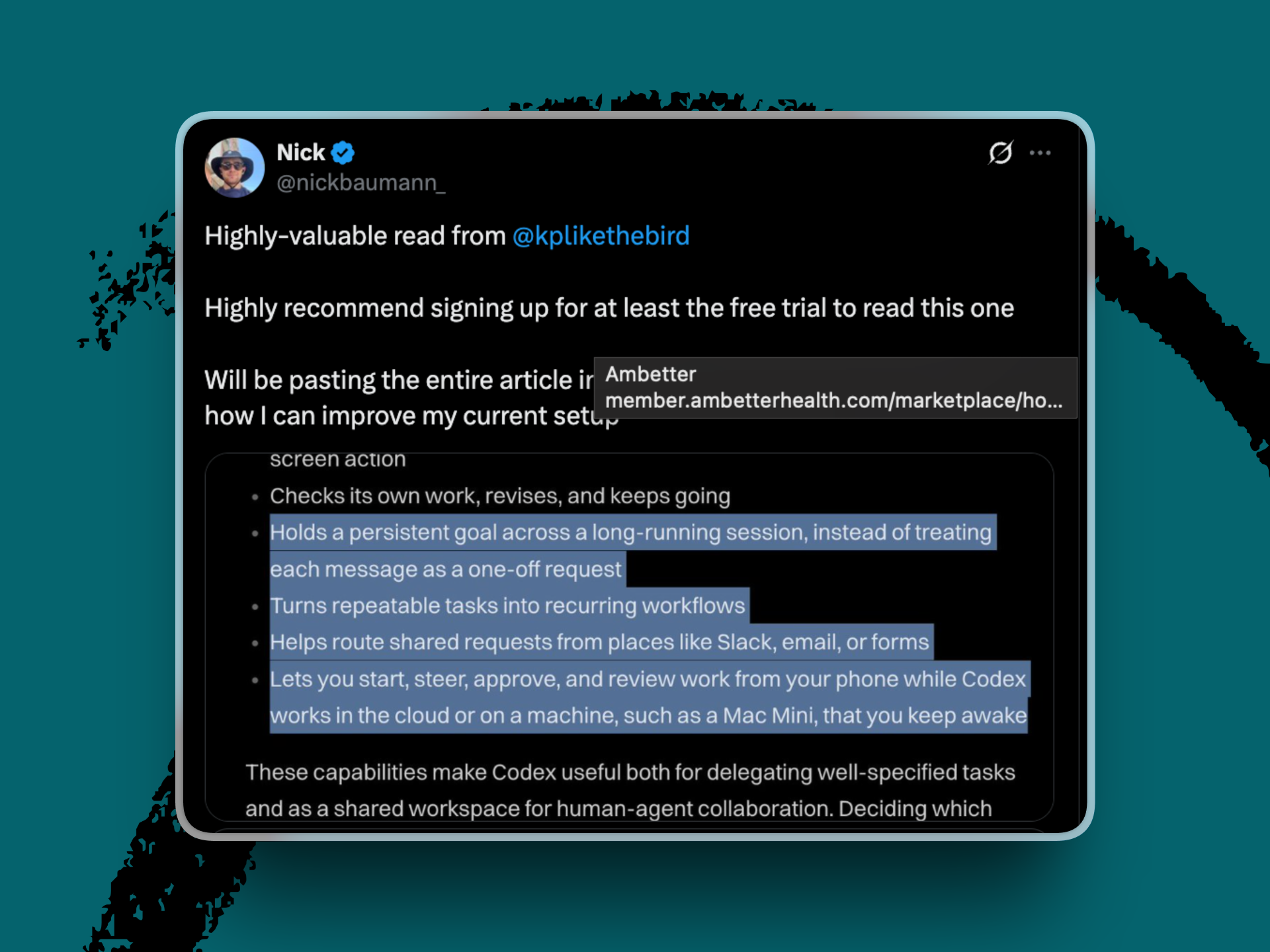 Nick Baumann (@nickbaumann_) from the Codex team gives our Codex for knowledge work guide the thumbs up. (Image courtesy of Katie Parrott.)
If you want to know even more about how the Every team uses Codex to accelerate our work, we’re hosting a two-hour Codex Camp on June 12 where Dan and the Every team will be sharing our favorite hacks for working with Codex. The camp (and the guide) are for subscribers only, so subscribe today to access the full guide and register for the camp. Bring your favorite workflows. Katie Parrott is a staff writer at Every. You can read more of her work in her newsletter.
To read more essays like this, subscribe to __, and follow us on X at @every and on LinkedIn.