An Executive’s Guide to Implementing AI - Every
An executive’s guide to imlementing AI
Sitting across from the chief operating officer of a health tech company earlier this year, I watched her name a problem many executives are feeling but few say out loud.
“Our junior employees are probably much more native with this technology,” she said. “And we need to make sure we’re sticking with it. Makes me feel like a dinosaur to say that, but it’s true.”
Confessions like this come up regularly during our executive training sessions: Leaders aren’t working directly with AI on sophisticated tasks, even as they’re guiding planning decisions about the technology. They know they should spend more time learning the tools, but they haven’t committed to it yet. That’s understandable; executives are incredibly busy. But what we see in our sessions is that leaders who haven’t gotten their hands dirty don’t clearly understand the practical opportunities and challenges of AI. That health tech executive’s admission sparked an important conversation about how a coordinated company-wide approach to AI implementation starts with executive AI fluency—but doesn’t stop there.
We see this pattern in every engagement we run in our consulting work. Over the past two years, we’ve trained thousands of people at companies including the New York Times , Ripple, Headway, and Thumbtack, and at investment firms managing over $100 billion in assets. We’ve done the workshops and watched what changed six months later. AI usage in the workplace is now widespread, but it’s an altogether different ballgame to build organizational capability that truly realizes financial gains.
McKinsey defines AI high performers as organizations that report both significant value from AI and more than a 5 percent impact on earnings before interest and taxes (EBIT). These companies are nearly three times as likely as others to have fundamentally redesigned their workflows, but they remain a minority: Only 6 percent of the nearly 2,000 organizations surveyed met the criteria for success.
Of course, no outside firm can implement AI into your company for you. But we can provide a playbook for how to build organizational capability that endures: leaders that work directly with the tools, empower the right champions, and build the muscle across teams for what great looks like, one painful workflow at a time. By the end of this guide, you’ll have no excuse not to be one of them.
Riding the waves of AI adoption
In three short years, AI has gone from performing party tricks to completing an entire day’s worth of human work.
In 2022, models could answer basic questions, tasks that take a human four seconds. By mid-2023, GPT-4 could handle tasks that take humans about six minutes. By late 2024, o1-preview was tackling hour-long work. And by late 2025, Claude Opus crossed into tasks that take humans 10 hours or more. That progression has been exponential and transformed what “AI implementation” means for companies again and again.
Here are the three rough waves of AI adoption since ChatGPT’s launch:
- The license wave (late 2022 to early 2024): Companies bought licenses for ChatGPT Enterprise, Claude, and Microsoft Copilot in the hopes that they would increase employee productivity. Some employees found value in using the tools to draft emails, summarize documents, and conduct research, but gains were uneven and individual.
- The prompt wave (early 2024 to mid-2025): Companies ran prompt-training sessions, created internal prompt libraries, built resource documents, and encouraged teams to experiment with custom GPTs. That helped move AI beyond pure individual tinkering, but it rarely created durable organizational change—custom GPTs and libraries often had no owner and no way to evaluate their results.
- The implementation wave (mid-2025 to now): Following its launch in research preview in February 2025, Claude Code helped shift enterprise adoption to where we are now: away from chat-based AI and prompt libraries and toward AI agents that can increasingly be configured to perform longer, multi-step tasks within defined constraints. Prompt libraries are giving way to skills libraries: reusable workflows with instructions, examples, reference materials, scripts, evaluation criteria, and named owners. Suddenly, non-technical people can build sophisticated automations in tools like Claude Cowork; implementation isn’t just for engineers anymore.
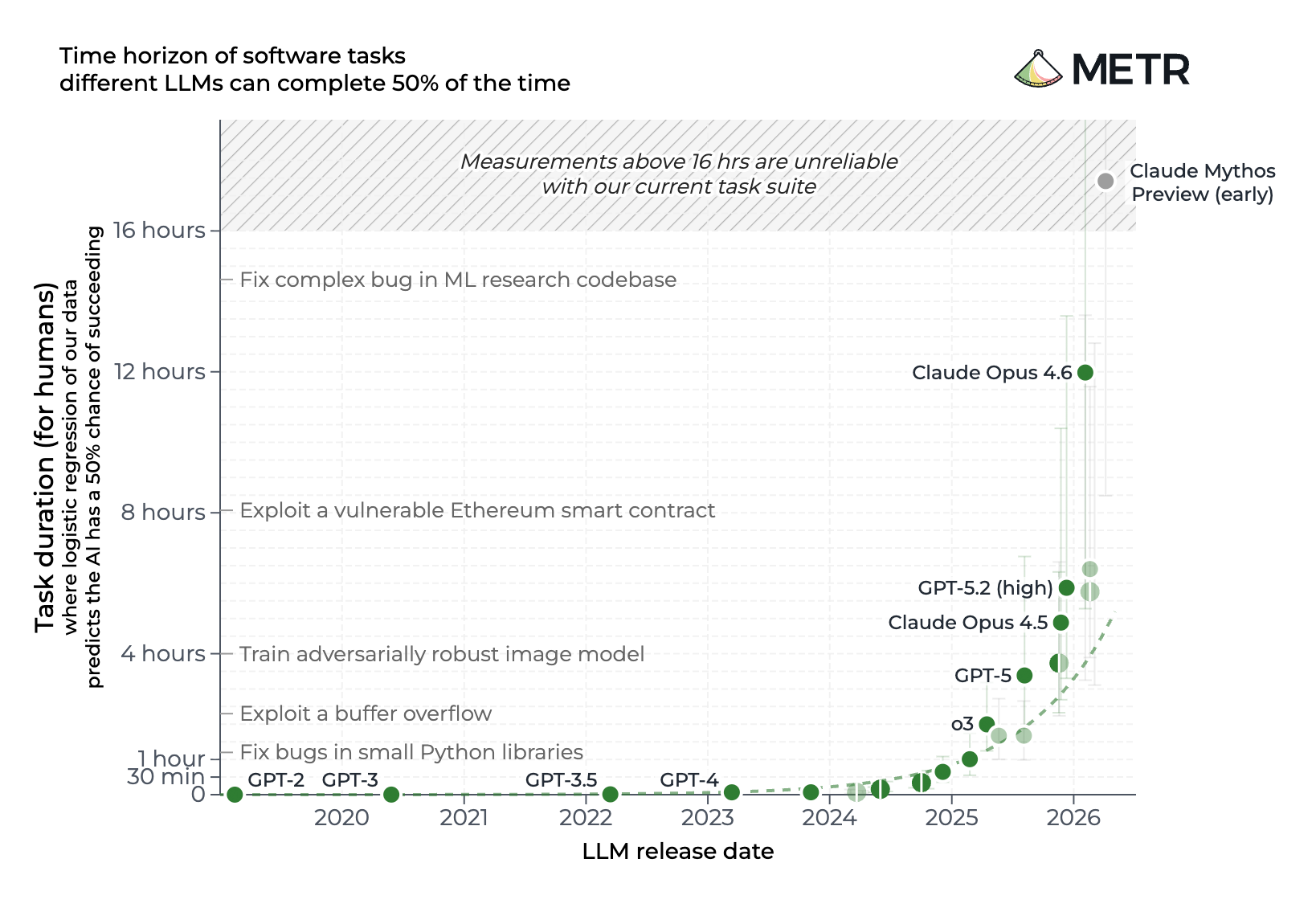 The chart plots each model release against the complexity of software tasks it can reliably complete, measured by how long those same tasks take a human. (Source: METR, an independent research organization that evaluates AI model capabilities on real-world tasks.)
The METR chart shows just how far the technology has progressed, but we’ve seen that many organizations implementing AI haven’t kept up with the sea change.The bottleneck for AI adoption has moved from model capability to chart shows just how far the technology has progressed, but we’ve seen that many organizations implementing AI haven’t kept up with the sea change. The bottleneck for AI adoption has moved from model capability to organizational capability. On our end, we’ve fundamentally altered our trainings to support executives and teams in this new era. For instance, we’ve retooled our sessions on prompting into workshops on setting up agents, skills, and workflows that can be owned, tested, and maintained. We’re working with executives on building that organizational muscle and turning raw model capability into reliable, repeatable workflows.
We know it’s making a difference. One investment firm we worked with now runs 100-plus agents across the organization through Copilot Cowork. At an e-commer ce company client, Claude’s Opus handled financial variance analysis that previously took a week. After working with us, a private equity firm decided to hire full-time AI champions to continue their AI implementation process.
Here are the five steps we’ve found that can carry you and your company into the next era, too:
Keep reading this guide
Create a free Every account to unlock the rest of this guide—and get our best agent-friendly guides in your inbox.

Continue reading
Already have an account? Log in.
Step #1: Get fluent
Guide workflow
Step #2: Assign AI champions
Guide workflow
Step #3: Pick one painful workflow
Guide workflow
Step #4: Build to 95 percent
Guide workflow
Step #5: Scale what works
Guide workflow
A 60-day plan for leader-enabled AI implementation
Guide workflow
What we’ve learned
Guide workflow