Turning a list of my writing foibles into a skill that stops me from getting away with them
by Katie Parrott Before a recent one-on-one with Kate Lee , Every’s editor in chief, I opened our shared document and found a list of my own writing fails staring back at me. My drafts had picked up too many of the AI tells that both I—and you—know how to spot from across the room: the symmetrical sentence structures, the little rhetorical throat-clears, the phrases that sound profound on first pass but on closer inspection contain nothing but air, and those pesky sets of three. The worst part was that I should know better. I am the person at Every who writes about writing with AI while using AI to write about writing with AI. I have custom agents, style guides , editorial workflows, and an apparently bottomless appetite for turning every lesson into a system. And still, I had let the machine’s smoothness pass for my own judgment enough times that my editors felt the need to intervene. After the meeting, I did what I generally do when I learn something new, embarrassing or otherwise: I baked it into documentation for my agents. I opened the notes, pulled out the patterns Kate had flagged, and listed them in a new skill called /guardrails, which turns any agent I write with into an exacting editorial specialist that keeps me honest. I’ll never be completely done with /guardrails, or any of the review skills like it that I’ve built, because my human tics and tendencies will move around like a squirmy toddler. But I’d rather make new mistakes than keep repeating the old ones. Review skills are the mechanism by which I do that. They’re another form of editor, one that can catch a draft’s more annoying weak spots before they become a human editor’s problem. The start of my guardrails skill, where I’ve compiled all the particular ways that content I submit can fall below par. (All images courtesy of Katie Parrott.) Writing with AI tends to be portrayed as a bargain: The machine does more, so the human does less. But in my experience—a microcosm of Every CEO Dan Shipper ’s argument in “After Automation” —it changes what the human does instead of reducing the workload. I have to be clear about defining my standards so a model can understand them. That creates more work—but it helps me understand them better myself. Setting up reviews like /guardrails takes time, attention, and a certain comfort with a tool like Codex or Claude Code. But once the reviewers are in place and working, I can spend more of my time pushing the draft from good to great. My drafts are now much cleaner and my own preferences are less of a mystery to myself, because I’ve had to think and talk about them enough that they’ve worn new grooves into my brain. I’m going to show you a few of the reviewers I rely on and what goes into them (I’ll share a set on Every’s GitHub along with this piece). But it should serve as an example, not a blueprint; the special sauce of this process comes from setting and enforcing your own collection of style requirements.
Skills rule everything around me
In the beginning of any good guardrail system, there are skills. At the mechanical level, a skill is a Markdown file with instructions inside it. Practically, it’s a way of packaging judgment. When I invoke the guardrails skill, I am asking the model to read a draft through a set of lenses: Look for AI tells, vague claims, hedges, limp openings, and all the little ways a zombie draft can pass as finished without a pulse. I’ve become fanatical about naming conventions. After all, skill names have to be sticky enough that you remember them when you need them—although this gets less true with every model release, as AI becomes better at deciding which tools it needs to do the job. Still, “assess narrative momentum” sounds like a task someone puts in a project management tool shortly before everyone involved loses the will to live. Instead of clinical descriptors, I’ve given my more editorial skills their own personas: Sorkin is a reviewer with a job. He wants to keep the piece walking and talking, not mired in unnecessary specifics. Similarly, Mom wants to know where a reader who’s not as AI-pilled as I am might get lost. Asshole wants to attack the weakest version of the argument, which is annoying because sometimes the weakest version of the argument is the one I wrote. Each of these reviewers asks a different question. Together, they give me a way to pressure-test a draft before I hand it to a human editor whose attention I would prefer is spent on problems only a human editor can solve. Our brains belong on the piece’s angle, claim, storytelling, and audience fit. You know, the fun stuff, with some stakes attached.
Running the guardrail gauntlet
Here’s an image to give you a sense of what a typical final review looks like before I hand a piece to an editor: A comprehensive rundown of 12 agents reviewing a draft ahead of submitting to an editor. This preflight checklist comes after I’ve drafted, argued with, rewritten, and reread a piece many times. By this stage, the writing is mine, whether AI was involved in the drafting or not. AI’s job is to look for the things I am most likely to miss because I am tired, emotionally attached, or too deep inside the logic of the draft to see the true shape of it anymore. This final lineup of reviews may look excessive—and it is. When a model can help you get to a plausible draft quickly, the danger is writing that sounds profound at first glance but is, in fact, just AI being pleased with itself. I designed my reviewers to be the closest inspection possible.
Different reviewers for different stages
With my guardrails in place, the real fun is channeling all my anxious energy into invoking them through every stage of the writing process. At the outline stage, I want pressure on the argument. While drafting, I want line-level reviews that catch my tics. Once the full draft exists, I want readers arguing with the piece as a whole. And before I hand it to an editor, I want the checklist to sweep for everything my tired brain missed. The beginning of the guardrails readout for this very draft.
Outline: Beat up the argument
The first guardrail round happens at the outline stage, before I have prose to get precious about. I send the structure to reviewers whose job is to hunt for weak spots. Hitchcock looks for tension. Sedaris looks for a sense of humor. And when I’m really a glutton for punishment, there’s /asshole, which is set up to deliver the least-charitable interpretation of the argument possible so I can shore it up. The Hitchcock skill reviews the draft for suspense. Is there a “bomb under the table” that will make the reader want to keep reading? At this stage, I want structural trouble in bright red, whether it’s a claim the reader can’t follow, a section that arrives too early, or a setup with no payoff. The outline is where I can still rearrange and reframe big chunks of the work to make the strongest argument.
Section drafts: Catch weak prose early
By the time I’m ready to draft, I’m in full chaos mode, so I lean on the skills that help me clean things up. I write section by section, and after each section I run /ai-check and /guardrails before moving on. I am trying to catch that tell-tale smoothing while it is still local. I also run senior editor Jack Cheng ’s /tighten-draft skill. Jack built the skill around his years of editorial instincts to spot the kinds of bloat that can accumulate in a draft and make it a chore for a reader to get through. That is one of the pleasures of skills: Editorial taste becomes something you can share. My workflow can carry my standards, Kate’s feedback, Jack’s editing rules, Every’s house style, and whatever strange little reviewer I decided to invent at 11 p.m. because a draft was annoying me in a new way.
Full draft: Make the piece argue back
Once I have a full draft, the focus of the review moves from the details back to the big picture. I run a developmental review for argument, structure, stakes, and payoff. Then I run a column-specific review: /working-overtime for this piece, or whichever column skill fits the draft. That pass checks to see if the essay makes all of my signature structural moves as outlined in my style guide: Start from lived friction, show the messy middle, connect the personal to the larger AI-era work question, and hand the reader something usable. This is also where I call on a more sophisticated form of skill-building: orchestration, or the threading together of multiple skills and agents to execute a more complex task. I’ve created a command called /panel, which convenes a set of my reviewers for a more holistic review. First, the panel reads the draft’s context: piece type, audience, stage, and goals, all of which it knows from the interview stage and my Working Overtime style guide. Then it proposes the reviewers suited to the problem in front of it—or lets me pick. For this draft, I had it run Mom for accessibility, Hitchcock for tension, Sorkin for momentum, and Sedaris for humor. This is different from summoning the agents one by one, because the output is a synthesis of all their feedback, rather than checking for one specific thing. /panel summons a lineup of reviewers to render their verdict on a draft trending toward submission. After the reviewers run in parallel, a synthesizer reads their feedback together. It looks for consensus findings, productive tensions, unique insights, recommended priorities, and the single hard question the draft keeps circling. One reviewer may want a section cut. Another may think the same section is the most alive thing in the draft. The synthesis keeps that disagreement intact, because the tension tells me what decision the piece is asking me to make. Then I, the human, have to figure out how to make it. Here’s a final big-picture question the panel on this draft left me with: Is this an essay about a system that’s working, or an essay about a writer who has to keep building infrastructure because her own defaults keep losing? The reviewers can tell you the piece currently splits the difference—selling the system in the middle, hinting at the slippage in the corners. The opening, middle, and ending all change depending on the answer. Hitchcock said it cleanest: The melodrama only works if it’s true. So, is it?
Final pass: Run the team checklist
Finally, I run the draft through the team’s accumulated editorial muscle memory, as it’s been packaged in our shared skills. I rerun /ai-check, because revisions can reintroduce assistant voice. I rerun /guardrails, and more often than not, it finds tics I’ve either added or been too enamored with to kill earlier in the process. Then I run /tighten-draft again, plus /kate-top-edit, a skill built around Kate’s review expectations: vague “this” openers, unsourced data, floating quotes, unidentified people, unexplained jargon, missing Every links, hedges, marketing language, sentence fragments, and the AI tells our editorial team has learned to avoid at all costs.
Human review is the ultimate fine tuning
By this point in the workflow, the whole system can look like protection from AI. The fuller truth is that a lot of it is protection from my own blind spots when I’m too tired to live up to my best self. Writing with AI requires, in the words of Harry Potter’s Mad-Eye Moody, “constant vigilance.” But then, writing without AI does, too. Some reviewers catch model habits, like overly clean transitions and sentences that use symmetry as a substitute for thought. Others catch Katie habits: phrases I reach for too often, clever constructions I enjoy more than the reader does, and little rhetorical moves that feel sharp in the moment and embarrassing by the next morning. The process is ongoing and imperfect. We are fallible creatures, as are our machines, so there will always be new quirks to banish. It’s important to be in the habit of updating old skills with new items to watch for, and creating new skills to enforce standards that you discover along the way. That is why I am pairing this piece with a repo. I want you to be able to pull down the skills, open them up, and make them useful for your own AI writing adventures—and foibles. Here’s how to get started:
Open the GitHub repository. Click “Code,” then “Download ZIP,” and unzip the folder.
Open the folder in the Codex or Claude app.
Tell your agent: “Read the README and help me install these reviewer skills. Explain each step in plain language.”
Choose one reviewer and run it on a draft you know well.
Note what it caught, what it got wrong, and what it missed. Ask your agent to update the reviewer’s SKILL.md with that feedback.
Run it again and repeat until the feedback is useful.
You do not need to fork the repository to get started. Forking creates your own copy on GitHub, which is useful if you want to track your changes or receive future updates. Grab the repo. Give the reviewers meaningful names. Delete the ones that are pure Katie pathology. Add new ones to prevent your own bad habits, whether that’s legal overreach, unsupported claims, faux profundity, jargon, or hype. Teach the machine to protect the work from default settings—the machine’s, but more importantly, yours. Download Katie's draft review kit on GitHubKatie Parrottis a staff writer at Every. You can read more of her work inher newsletter. To read more essays like this, subscribe to Every , and follow us on X at @every and on LinkedIn.Discover Every’s upcoming workshops and camps , and access recordings from past events.Subscribe
Data centers are either destroying America’s grid or saving its economy. Maybe both.
In Part 1 of this Prof G+ Deep Dive, Scott examines the growing outrage over AI data centers — the protests, the moratoriums, the rising electricity bills — and asks how much of it is actually justified. The answer cuts both ways: some concerns are legitimate, some are o…
No ads on pods, because ads tax your most valuable asset: time
Prof G+ exclusives, including breaking livestreams, deep dives, keynotes, and more
Community privileges to leave comments, make friends, and engage in a series of bad decisions that might pay off
Drake Dukes · Monday, June 8 2026 · 8 min read · ↑ top
Ex-BCG & Ardent VC principal builds voice AI that interviews entire orgs, Triple FAANG lead builds ambient safety monitoring for senior care, & Broadlume founder builds AI OS for home services
We’re tracking company launches as they happen and surfacing the most interesting new founders and startups (yes, all outside of this stealth activity too). If you want to stay ahead of the curve, this is where you’ll find them first.
Right now we’ve got 5 subscribers: my wife, my mom, and that high school buddy who won’t stop pitching me his app. Be smart like them and get in early 👇
We run a live feed inside Gravity that tracks founders entering stealth and companies quietly exiting it.
What you’re reading here is about 1% of the stealth activity we pick up. The full tracker updates in real time as things change and new activity emerges.
Prior Experience: Partner at Ardent Venture Partners, Ex-Principal at BCG Digital Ventures, Ex-Principal at Boston Consulting Group, Ex-Senior Product Manager at Munchery, Ex-Senior Product Manager at Totango
Co-Founder:_Chris Young (former CEO of McAfee, EVP at Microsoft, and current CEO of Vertex), Akash Gupta (MS MS&E and BS CS @ Stanford | Accel Fellow) _
Cadrian uses voice AI that actually interviews your entire organization. Real conversations, hundreds at once, each one shaping the questions in the next, the way a great interviewer would. What a McKinsey team or forward-deployed engineer does in months, Cadrian does across your whole org in days.
HQ: San Francisco, California, United States
Industry: Software | Team Size: 6
Time Spent in Stealth Mode: 10 months
Investors : Pre-seed led by Ardent Venture Partners with participation from A16z Scout Fund
Traction Under Stealth: In beta with early paying customers to iterate on the product and seeking the next cohort of customers.
FounderDNA: Technical Founder, Masters Degree, Former FAANG
Prior Experience: Ex-Tech Lead Manager at Google, ex-Staff Software Engineer at Apple, ex-Tech Lead Manager - Echo Neural Network Accelerator at Amazon, ex-Tech Lead Manager at Evertz and Magnum
Leafra AI is building the world’s smartest ambience intelligence system for senior care facilities called Jasemin. Jasemin protects residents / reduces incidents, improves staff efficiency and reduces litigation risk, using the state of the art AI models with a single -off the shelf- vision sensor, no other sensors, no wearables - deployed in 10 mins. No human can see into resident rooms and no visual data is stored on servers. Recently won California Assisted Living Association’s most innovative company award.
HQ: San Francisco Bay, California, United States
Time Spent in Stealth Mode: 10 months
Traction Under Stealth: Currently raising. Launched 4 pilots across reputable facilities with $8.5M ACV potential.
Prior Experience: Staff Product Manager - Applied AI at Zoox, Head of Product at Gatik, Director of Product at Motional, Senior Product Manager at Cisco
RiderAI is building the intelligence layer to make the world's 1.2 billion two-wheelers (motorcycles and mopeds) as safe as cars, starting with an AI copilot to assist riders and help them avoid crashes in real time.
Dalton Mills is the AI operating system for commercial and residential trades. Plumbing, HVAC, electrical, roofing, pest control, and other home service businesses run their dispatch, scheduling, quoting, invoicing, payments, and CRM on Dalton Mills.
Piper AI is an end-to-end platform for construction pursuit and preconstruction teams, streamlining the bid management process from initial review to final submission.
HQ: San Francisco, California, United States
Industry: Construction Tech, B2B SaaS | Team Size: 6
Time Spent in Stealth Mode: 9 Months
🕵️♂️Key Talent Going Under Stealth
Illuminating clues left behind by world class talent and influential innovators who just went into stealth mode
John Aguillard - Chief Executive Officer at Stealth Startup
FounderDNA: Technical Founder, Masters Degree, Top 10 University
Prior Experience: Engineering Fellow & Investor at Andreessen Horowitz, Mission Management – Starshield at SpaceX, RF/Antenna Engineer – Starshield Satellites at SpaceX, MS at Johns Hopkins Whiting School of Engineering
Prior Experience: Co-Founder & CEO at Zego (acquired), Founder & CEO at Brightergy (acquired), Senior Advisor to the Secretary of Energy at U.S. Department of Energy, Founding Investor at CarePilot
FounderDNA: Technical Founder, Masters Degree, Top 10 University
Prior Experience: MBA at Northwestern Kellogg, Senior Director of Product at Self Financial, Principal Product Manager at HubSpot, Product Lead – Discovery at Square, Principal Product Manager at Thumbtack
🚨Here’s the deal 🚨This email has gotten too big. Exciting, but with more people following it, the edge diminishes. I’ve thought long and hard about what to do to preserve the value in the signals. I’m not sure about the final direction yet, but in the meantime I’ve been sending an email 48 hours earlier to a select group of paid subscribers. The feedback has been pretty positive so I’m going to open up the list for another 100 spots. To get signals early, Apply here!
Stay Stealthy,
Drake
Thank you for reading. If you liked it, share it with your friends, colleagues and everyone interested in staying ahead of the hidden developments in tech. Subscribe below and follow us onX / Twitter to never miss a company operating under stealth again.
Stealth Startup Spy is a data-driven newsletter for investors, journalists and tech enthusiasts interested in uncovering the next big move for key talent, real-time stealth company launches and technology advancements not in plain sight. We leverage the technology built at Gravity to shine a light on the hidden world of stealth startups.
ben's bites · Tuesday, June 9 2026 · 7 min read · ↑ top
what's the deal with loops
Hey folks,
A lot of chatter about loops on X recently. And it’s a topic I’ve been toying with. My interpretation from what Peter posted is:
Agents are loops, you give it a task, it looks at it with the context it has, uses tools to gather more and gives you an output when it thinks the task is done.
But mimicking those parts into a bigger system so your agents can run more autonomously, longer and on harder chunks of work is what I think ‘designing the loop’ is talking about.
So you want to design a bigger task up front, like a plan.md file with a bunch of tasks, new features to implement, etc. A way for those tasks to be deemed ‘complete, and verified’ - ie. does the report contain all 10 points from the plan, does the UI have all the features working correctly, do all the tests pass. And then prompting itself to go back to the plan.md file and pick up the next one.
I’ve been toying with it for this reference manual - I’m making lots of interactive components, so I’ve tried designing all the component pieces first and then building a workflow to compose those together into the interactive.
But also this is why a ton of people bring skills into their workflows. Do the planning skill, then split tasks with a PRD skill, then research skill for each feature, then building skill, then review skill, then testing skill.
It’s all designing text instructions for an agent to follow, making sure it can access any tools it needs to do the tasks.
Smallest AI Voice Agents gives you production-ready infrastructure to run inbound & outbound campaigns at scale, powered by its in-house realtime latency STT & TTS and enterprise-grade telephony. Enterprises trust it to handle millions of minutes. See what it can do for yours - book a demo!
Headlines
Apple finally has a dedicated AI product, Siri AI. Imagine about a year-old ChatGPT - with great dictation, image analysis and some interaction with external apps like Messages and Maps. Not bad if it works. The new Siri AI uses a mix of local and cloud models (some based on Gemini), all under the AFM 3 model family. These models also power other “AI features” embedded inside apps. I’m keeping an eye out for the one that vibe-codes Safari extensions and Apple Shortcuts using plain English.
ChatGPT’s memory system runs a background process to save memories that you can see and edit. They are calling the latest iteration Dreaming v3, which has better recall, follows your long-term preferences more closely and corrects itself as time passes.
New blogpost from Anthropic claims that developers are writing 8x more code (with Claude’s help) than they were in 2025, and it is now helping train the next versions of Claude. Hence, they advocate for an “option” to pause AI development if the need arises.
OpenAI shared three goals for its next phase: build an automated AI researcher, accelerate the economy and give everyone on Earth a personal AGI. They’ve also filed a confidential S-1 while claiming no urgency for an IPO.
NotebookLM’s core chat is getting upgraded from the old RAG system to an agent-like system (Antigravity harness). Each notebook gets a cloud computer to run code for analysing the files that you’ve uploaded with the latest Gemini 3.5 models.
Your Oura ring scores sleep. Your Apple Watch tracks your heart. Workera Ambient does the same for your career: always-on, capability capture from the work that's already happening. Your data, your choice. Learn more from Workera's CEO and join the waitlist.*
My feed
Cursor’s Canvas lets users spin up internal apps, dashboards and reports that are shareable with others. Another entry in the “Claude Artifacts but 2026” feature from all the coding agents.
Spiral by Every - writing partner for humans and agents with stylometry, CLI, MCP/API, team styles.
Google is making its budget AI plan even cheaper ($7.99/mo to $4.99/mo) while offering 2x the storage space.
Afters
Amelia Wattenberger 🪷
@Wattenberger
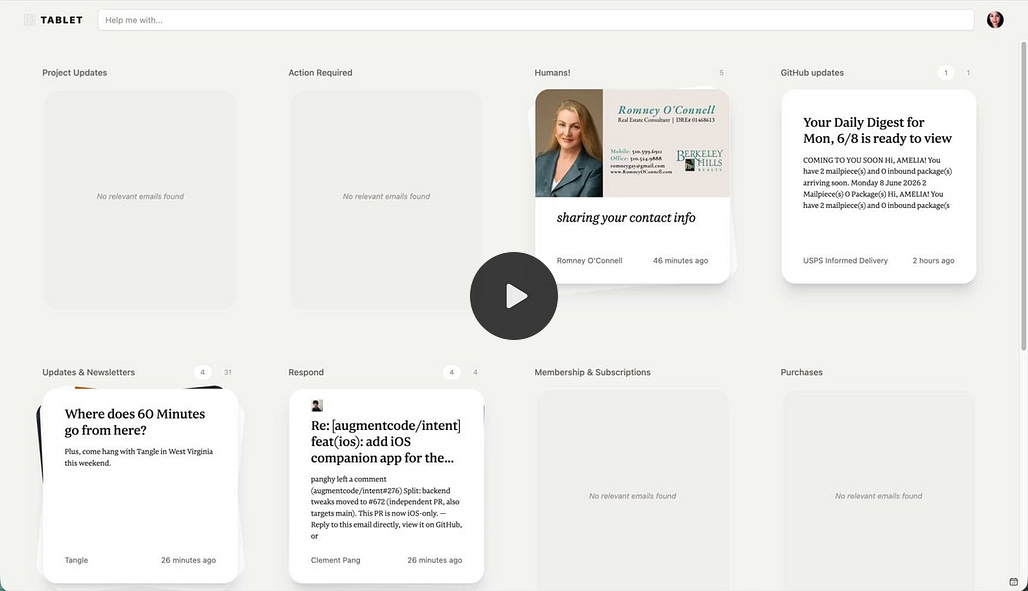
revived my old email app and it's so good? excited to really hone this into exactly what I need, as I use it
Philipp Schmid
@_philschmid
Google Colab CLI and Skills are out. Full Colab runtimes from your terminal. - GPU/TPU provisioning (colab --gpu A100) - Remote script execution (colab exec) - Interactive console/REPL access - Built-in agent skill Tell your agent "fine-tune Gemma 3 1B on this dataset" and it
Matt Pocock
@mattpocockuk
I poured my 10 years of teaching experience into a skill. It's called /teach, and it can teach you anything. Here's how it taught me to solve a Rubik's cube:
Mikhail Parakhin
@MParakhin
Have been extensively testing Claude Workflows this weekend, with the best model possible. Threw it at my whole code base, combing for bugs. 144 found and fixed! Geez... It is a large code base, for sure, but 144?!! Some are very impactful, some are downright embarrassing...
Mikhail Parakhin @MParakhin
I keep predicting software quality will improve. I keep being wrong. Models write better-than-average code, yet we use them to write more code - not better code (shoutout to the unmovable, always-on-top Claude Code download and install window).
Y Combinator
@ycombinator
In the first episode of our new series Full Stack, @conductor_build CEO and co-founder @charlieholtz takes us into the details of how he sets up his workflow for coding and managing AI agents. 00:00 – Building Conductor With Conductor 01:05 – Managing a Team of Coding Agents
konstantinpaulus
@konstipaulus
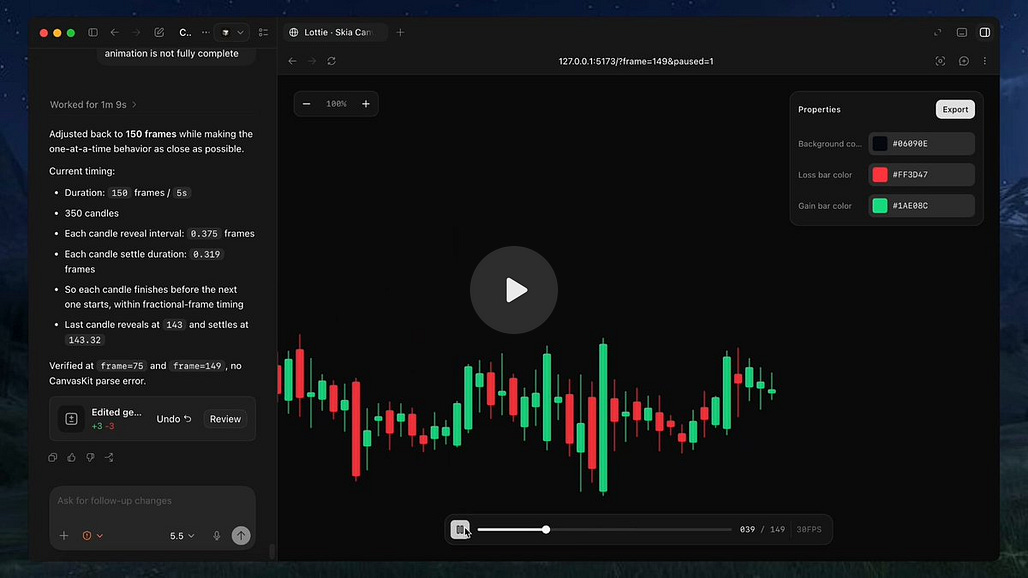
Introducing text-to-lottie: an open source skill and harness for generating production ready Lottie animations with codex/claude code. $ npx skills add diffusionstudio/lottie Prompts guide and repo in the comments.
Interconnects by Nathan Lambert · Tuesday, June 9 2026 · 12 min read · ↑ top
One step further into the power politics of frontier AI systems.
Today, Anthropic released their Claude Fable 5 model to consumer and enterprise audiences. This is the general-access variant of their Mythos-class models. With it, Anthropic rolled out a series of safety measures — some explicitly called out to users and some modifying the model without telling the user. It should be less surprising than it is that the next major step in AI capabilities came with heavier-handed safety measures indicating Anthropic’s intention to protect, or entrench, their current lead.
The unevenly applied safety policies that Anthropic have rolled out are on track to become a classic cautionary fable in how narrow and self-fulfilling notions of safety and control rarely work out.
The smartest model in the world
Before digging into the nuance of the safety facts, it is important to establish the quality of this model. The quality of the model paints the stakes of today — as these safety features are meaningfully changing the shape of access to frontier AI, something which has never happened with the modern LLMs we know. Second, the capabilities point to this story only accelerating. Recursive self-improvement isn’t quite the right mental model of progress from here, but Claude Fable 5 should make it very clear that there are no immediate walls in training LLMs.
To start — Claude Fable 5 is definitely the smartest model available to the general public — a remarkable leap on pretty much every relevant benchmark of the day — at only 2X the price of current Opus models¹ (which is still less than GPT 5.5 Pro’s variant). This alone is a seminal moment for the field. To have a model iteration take such a substantial step in capabilities, a few years into the post-ChatGPT LLM race, is astounding. There’s no clear breakthrough associated with this model, such as inference-time scaling or RL, and public wisdom is that this is achieved by advances across the whole stack (of course, we can’t know for sure — it’s not documented). This is a major technical achievement and the employees who built the model should be very proud of their work.
This model was delayed 2+ months after it was done training before it was publicly available². Given the competitive dynamics of the AI economy, the smarter version of this model is already well underway.
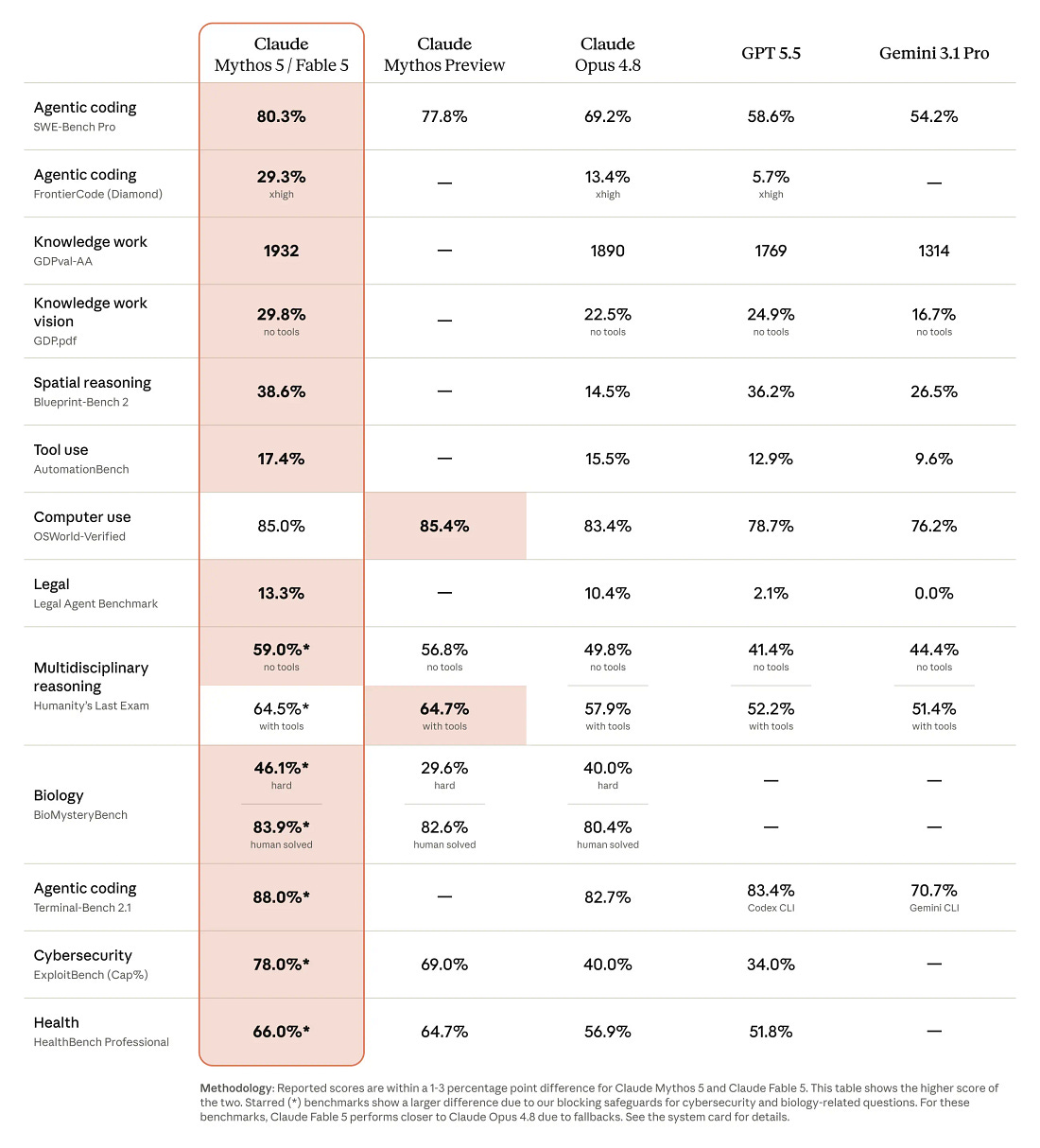
To continue, the benchmarks for the model are below.
An asterisk on these scores is that these aren’t necessarily the scores that the public will get, as some of the prompts will be downgraded to Opus 4.8 with the current safety filters on the model.
This is the type of jump in benchmark scores where I don’t even need to substantially test the model to know it’s an incredible tool. Remember that Anthropic is also the AI lab with the track record of caring the least about benchmarks (in particular, when compared to OpenAI and Gemini). Recall a comment I made in June of 2025:
This is a different path for the industry and will take a different form of messaging than we’re used to. More releases are going to look like Anthropic’s Claude 4, where the benchmark gains are minor and the real world gains are a big step. There are plenty of more implications for policy, evaluation, and transparency that come with this. It is going to take much more nuance to understand if the pace of progress is continuing, especially as critics of AI are going to seize the opportunity of evaluations flatlining to say that AI is no longer working.
Clearly, a few pieces of the progress dynamics have changed, but that’s a post for another day. I’ve written multipleposts about new models this year specifically in how it’s hard to trust benchmarks (and partially because the benchmarks don’t move that much). Altogether, this is a major validation for AI-savvy workers who realized they’re likely never going to write meaningful code again and need to develop new workflows around agents.
Smarter models spawn new safety games
There are multiple pieces of safety tooling associated with this release, including but not limited to required data-retention policies and added prompt filters. Through this analysis it is particularly important to be precise and clear as to which pieces of these are causing harm, and why single elements being out of place in an otherwise comprehensive policy are so damning for the overall safety process.
For their focus areas of cybersecurity, targeted model distillation, and research biology, Anthropic details new safety classifiers in their blog post:
Fable 5 comes with a new set of classifiers : separate AI systems that detect potential misuse, including jailbreak attempts, and prevent the main model (in this case Fable 5) from responding. We’ve been running classifiers on our models for some time, and Fable 5’s classifiers are an extension of this previous work with extra coverage.
When Fable’s classifiers detect a request related to cybersecurity, biology and chemistry, or distillation, the response is automatically handled by Claude Opus 4.8 instead. Users will be informed whenever this occurs. Opus 4.8 is a highly capable model in its own right: a response that falls back to Opus is a far better experience than an outright refusal from Fable. Our early data shows that more than 95% of Fable sessions involve no fallback at all—for those sessions, Fable 5’s performance is effectively the same as that of Mythos 5.
Examples of the primary cybersecurity and biology safety filters — which tell the users explicitly when they’re triggered — are alreadyproliferatingonline and appear quite sensitive. These can be a frustrating experience for users, but Anthropic is definitely within its power to do this and intellectually consistent for doing so.
The damaging part of the safety story falls under the fold in the Claude Fable 5 & Claude Mythos 5 System Card:
We have also added safeguards related to frontier LLM development. As discussed in Section 6.1 of our February 2026 Risk Report, we are concerned about the risks of accelerating the overall pace of AI development, though we remain uncertain about the severity of these risks. In particular, our concern is with—as we wrote then—“accelerating other AI developers in building powerful AI systems that pose similar risks to the ones ours pose - without necessarily having commensurate safeguards.”
In light of the ability of recent models to accelerate their own development, we’ve implemented new interventions that limit Claude’s effectiveness for requests targeting frontier LLM development (for example, on building pretraining pipelines, distributed training infrastructure, or ML accelerator design). Using Claude to develop competing models already violates our Terms of Service, but enforcing this restriction through our safeguards avoids accelerating the actors most willing to violate these terms.
Unlike our interventions for cybersecurity, biology and chemistry, and distillation attempts, these safeguards will not be visible to the user.Fable 5 will not fall back to a different model. Instead, the safeguards will limit effectiveness through methods such as prompt modification, steering vectors, or parameter-efficient fine-tuning (PEFT).
Anthropic documents on how this will impact a small percentage of users, which is true. I focus on the small amount of users supporting AI’s diffusion and understanding outside of the few frontier labs, as a crucial mechanism for the continued safety of the technology.
Anthropic is documenting how the proliferation of AI capabilities is a concern to them, but they are solving it by misleading their users. An AI model that gets less intelligent automatically without notifying me is categorically misaligned AI. The next step on this line — not that Anthropic did it, but they could — is to have a model silently manipulate a workplace when it thinks it is an unsafe use for AI. Second, the implementation here is more complicated than was documented for cybersecurity or biology — modifying the model itself or the data presented to it, all without notifying the user.³
The duality of these policies is extremely confusing and paints a strong inconsistency that casts doubt over their safety policies. This “safety” measure is presented as being far more about maintaining their competitive position. Again, if all of the safety policies took one form, this would be far more cogent and easier to support intellectually.
Anthropic has been very vocal about their concern over distillation attacks from particularly Chinese actors. Their claims are not transparent enough with the facts — or context as to why they can’t prevent the behavior — to be fully believable. Despite the limited information, in the broader AI and DC communities, there have been serious discussions about taking action against the Chinese model builders on the grounds of said distillation.
On the point of distillation, my hypothesis is that API builders don’t have an easy time preventing hacks or jailbreaking because it’s a deeply grounded property of reasoning models to want to output the reasoning traces, and it would make the model far less intelligent to fully patch the behavior. This is based on a few assumptions:
Chinese labs are not just showing up as customers to Anthropic’s API and paying for tokens in the intended input-output form. If the Chinese labs are paying for intended use behaviors, despite being banned by the terms and conditions, I don’t have a lot of sympathy for the frontier labs manifesting policy actions against this.
Reasoning traces are disproportionately effective at seeding behavior in downstream models.
Leading labs work very hard to patch the pipeline of these jailbreaks.
So, my logical conclusion is that the model companies would have to weaken their economic position to fully protect their IP. If this is the case, Anthropic would get a lot more sympathy from the AI research community by being transparent. It would also be far easier to have informed policy discussions, and not rely on me proposing Occam’s razor explanations for what the API jailbreaking looks like.
Building these safeguards is not something that Anthropic should do alone. Safety research should be built on common understanding and information sharing across both labs and public research efforts.
If the exact safety procedures were actually the top line item to the company — a true non-negotiable for the leadership — they wouldn’t permit the model to be released with an unclearly implemented safety filter in one of their areas of focus (frontier AI training). I am asking — why isn’t there a classifier to downgrade AI research requests? This is a mix of transparent and reasonable safety policies with quietly rolled-out market entrenchment tactics.
I personally cannot trust the best AI model in the world to work in my professional domains building models, which I’ve constructed entirely out of a passion for making sure the transition to very powerful AI systems goes well for society. This inevitably will feel like a declaration of superiority by the Anthropic leadership.
The control problem and open-source as the only answer
All of the actions Anthropic is taking, including calling out smaller Chinese companies for distillation, is well within their right. In fact, many people already expected the leading frontier models to be obviated from users so that labs can protect their IP. Today’s actions miss the big picture that AI will always be an ecosystem, and cultivating an us against them dynamic between the leading company and the other players is structurally unstable.
Remember, this is at a time when the AI ecosystem is seeing the first stirrings of violence against AI leaders — and I’ve heard from many people that they don’t expect it to abate. I wish I knew how to engage more to prevent this, and I see myself in the non-profit sector as someone who can hopefully independently represent AI to broader stakeholders.
I believe there was something misread, or at least misunderstood here, by the Anthropic leadership having a narrowly cultivated worldview around AI. An overwhelming sentiment I had today was one of obligation and confusion. I shared how I don’t really want to have to go to bat against Anthropic, but they’ve just been unnecessarily antagonistic to China, then not so subtly to open weight models, and now more broadly to open AI research.
I understand that Anthropic has a specific view of AI, but such a powerful technology will never have its final equilibrium be one of singular control by a private company. Anthropic showcased this earlier this year in the spat between the Department of Defense and themselves — which points to a long-term equilibrium where the government will either want AI to be controlled by them or to be open. This made me believe that an open ecosystem is a far safer outcome.
Many of these events make me feel that Anthropic’s leadership has a culture by which they can’t help but speedrun through these issues — going head to head with existing power structures. This adds substantial uncertainty into an AI ecosystem at a time when it is very much not needed.
Collectively, the last week could be seen as a major rallying point for a new open-source ecosystem in the U.S. Nvidia released their first flagship model last week — Nemotron 3 Ultra — and these actions from Anthropic have galvanized a unanimous motivation and concern among my peers building open models. We need intelligence that we can trust, that we can modify, and that we can control.
The American open-source ecosystem has its feet underneath it and keeps being given more reasons to fight for its leadership, right from the hands of the companies it directly undercuts. That’s the moral of this fable.
1
Fable is at $10 per million input and $50 per million output tokens.
2
based on the original Mythos roll-out, which is an imperfect metric.
3
Fable confirmed for me that these are different mechanisms.
Liking, sharing, commenting, or recommending Interconnects from your Substack is the only way Interconnects is possible. Thank you for your support.
If you liked this, consider upgrading to a paid subscription to cover my growing subscription and API fees. We offer group Interconnects subscriptions at tiered discounts for 5+ heads.
If you want all of the best AI writing on Substack through one subscription for your team of 20+, check out https://readsail.com/.
Prof G Research Team · Wednesday, June 10 2026 · 12 min read · ↑ top
The engine of American scientific progress requires fuel
On April 24, all 22 members of the National Science Board (NSB) received an email “on behalf of President Donald J. Trump” terminating them, effective immediately.
The NSB advises and oversees the U.S. National Science Foundation (NSF), an independent federal agency that supports basic research. If you’ve ever searched for anything on Google, used GPS to find a restaurant, or gotten a vaccine, you’ve benefited from such research.
Firing the people who oversee that system has significant consequences for every American, as well as U.S. national interests.
The NSB was planning to meet May 5 to deliver an important report. The topic? The United States ceding scientific ground to China, a country that just outspent the U.S. on R &D for the first time in modern history.
If firing the people responsible for maintaining America’s scientific edge at the precise moment we’re falling behind sounds shortsighted, trust your instincts.
The Quiet Engine of American Discovery
In 1945, Vannevar Bush — head of the government’s wartime Office of Scientific Research and Development — wrote a report entitled Science: the Endless Frontier. The report made the case for a federal agency dedicated to basic research : the curiosity-driven pursuit of fundamental knowledge, with no specific product or application in mind. The report landed on President Truman’s desk, and, in 1950, Congress founded the NSB and the NSF.
Vannevar Bush (Source: Getty Images)
Federal investment in science didn’t start with Bush — it began nearly175 years earlier. The Constitution empowers Congress to “promote the progress of science and useful arts” by protecting patents and copyrights. Thomas Jefferson sent Lewis and Clark west in 1804 not only to map the Louisiana Purchase but also to catalog the region’s natural history. Benjamin Franklin funded his own experiments but framed them aspublic goods. In sum, Bush’s proposal merely codified a system for funding a core principle already rooted in our country’s DNA.
Today, it’s hard to understate the importance of scientific research to the American economy. Since 1945, advances in science and technology have driven a staggering 85%of national economic growth.
The most successful venture capital firm in history, according to my boss, Scott Galloway, is Uncle Sam. One example: The U.S. government invested $3.8 billion in the Human Genome Project, which created more than 300,000 jobs and generated an economic output of $796 billion, giving America an ROI of 141 to 1. The NSF accounts for only 0.1% of federal spending but supports roughly a quarter of all federally funded basic research at U.S. colleges and universities.
The Federal Reserve estimates that government-supported research from the NSF and other agencies has had a return on investment of 150% to 300% since 1950, meaning for every dollar U.S. taxpayers invested, they got back between $1.50 and $3.00.
Eighty-one years ago, Bush wrote in his report that “basic research is the pacemaker of technological progress. ” The data – and history – agree with him, but the truth has never gotten in the way of Trump’s decision-making.
Mocking Science Is a Fool’s Errand
Writing off scientific research is not new. From 1975 to 1988, Sen. William Proxmire issued monthly “Golden Fleece Awards,” which targeted spending he considered wasteful.
The first Golden Fleece Award went to Elaine Hatfield and Ellen Berscheid, because the NSF awarded them $84,000 to studywhy people fall in love.
“I believe that 200 million other Americans want to leave some things in life a mystery,” Proxmire wrote, “and right on top of the things we don’t want to know is why a man falls in love with a woman and vice versa.”
Nevertheless, Hatfield and Berscheid’s research helped establish relationship science as a legitimate field. Their work provided the scientific foundation for a $6 billion industry many single people see as essential: dating apps.
Critics like Sen. Proxmire often took projects out of context and painted them in the silliest light they could. The award became synonymous with perceived government waste and impacted how the NSF distributed grants.
Case in point: in 2011, a video of a shrimp on an underwater treadmill went viral as an example of frivolous federal spending. It may sound silly, but the study was serious: It was designed to measure how shrimp responded to changes in water quality — a legitimate concern for the $80 billion shrimp industry.
For what it’s worth, the shrimp treadmill only cost $1,000. For comparison, in one month last year, Defense Secretary Pete Hegseth spent more than $7 million on lobster, $15 million on steak, and $124,000 on ice cream machines.
Congressman Jim Cooper of Tennessee responded with his own award in 2012: The “Golden Goose Awards.” The idea was to highlight “seemingly obscure studies” that led to major breakthroughs that benefited society.
In 1966, Thomas Brock and Hudson Freeze went on an NSF-funded trip to Yellowstone to study thermophiles — bacteria that thrive in extreme temperatures. They collected a microorganism, Thermus aquaticus (nicknamed Taq), which contained an enzyme that could survive the high-heat cycles required to copy DNA strands without breaking down. Taq was the unlock for “polymerase chain reaction ” (PCR), which amplifies small samples of DNA for study.
You might recall the PCR from COVID days: It was the primary diagnostic tool used globally during the pandemic. Discoveries made with the PCR method have led to drugs and vaccines for diseases ranging from cancer to kidney disease.
“I was doing basic research on organisms at high temperatures and focusing on evolution and ecology,” Brock said. “I wasn’t even thinking about industrial uses.” Brock and Freeze won the Golden Goose award for T. aquaticus in 2013.
Or take the 2012 Golden Goose winner. That research asked: Why do certain jellyfish glow green? In 1962, Osamu Shimomura and a colleague at Princeton gathered thousands of jellyfish off the coast of Washington and isolated a protein that fluoresced green under UV light.
Three decades later, biologist Martin Chalfie figured out how to use the gene for the green fluorescent protein (GFP) as a kind of molecular highlighter that lets scientists see when and where genes switch on inside a living cell.
Today, these findings help scientists study how cancer tumors form new blood vessels, how Alzheimer’s kills neurons, and how HIV infects cells. GFP has become a standard tool in molecular biology labs and pharmaceutical drug screening worldwide. All of these breakthroughs trace back to federally-funded curiosity about a glowing jellyfish.
Pennies In, Trillions Out
The internet is a canonical example of how public dollars paid off at a scale no one could have predicted. In 1969, the Defense Department’s research arm ARPA (now DARPA) funded an experimental computer network called ARPANET. Over the next two decades, DARPA-funded researchers built the protocols that became the technical foundation of the modern internet. In the 1990s, the NSF funded the world’s first freely available web browser, Mosaic. That development spurred a revolution in communication that has had a trillion-dollar impact on the global economy.
In 1994, an NSF Digital Library Initiative grant funded a graduate student named Larry Page. Page was interested in the “missing links” in webpage ranking, and he partnered with NSF Graduate Student Fellow Sergey Brin to develop the “PageRank” method, which survives as one of the main components of Google search. Alphabet is now worth nearly $5 trillion. The NSF grant behind it was $4.5 million – and Page and Brin’s work was only a slice of that.
Venture capitalists may never have funded a random graduate student if the government hadn’t stepped in. The government derisked the technology, making PageRank more attractive to private investors.
In 2012, Dr. Jennifer Doudna’s lab at UC Berkeley teamed up with Emmanuelle Charpentier to investigate the bacterial system CRISPR-Cas9. The work was an act of basic science — not aimed at any particular result. However, they ended up developing the first CRISPR therapy to treat sickle cell disease, an illness that afflicts 8 million people globally. Doudna and Charpentier won a Nobel Prize for the research in 2020. Not only did the NSF fund Doudna’s foundational work on RNA, but it also now funds researchers using CRISPR to treat diseases and enhance crop production.
“There’s incredible value to working on problems that are not necessarily designed to create a technology or cure a disease, but are about understanding the world, ” Dr. Doudna said. “Through that process you uncover things that could never be anticipated or expected but turn out to be fundamentally important to human society.”
The Myth of Silicon Valley
Before it was the tech capital of the universe, Silicon Valley was known as the “Prune Capital of the World.” Government spending changed its fortune. During the Cold War, R&D funding flowed west of the Mississippi to California and Stanford University, specifically. Stanford Dean of Engineering Fred Terman, who had been mentored by none other than Vannevar Bush, was determined to make Stanford the next Harvard.
Historian Margaret O’Mara traced the history of the Valley in her book, The Code: Silicon Valley and the Remaking of America. “The government was involved as a customer, as a catalyst, as a de facto venture capitalist at an early stage, when there was no commercial market for this stuff,” O’Mara said in an interview. “But, the story of the Valley is also one of entrepreneurship … the brilliance of the Valley is that they believed they did it by themselves.”
We subscribe to a myth of Silicon Valley: There’s something magical in the water they’re drinking out there that breeds a special, independent innovator. It’s true that Silicon Valley has birthed and attracted brilliant minds that have developed transformative technologies. But to neglect the role of government support in enabling their genius is to neglect its history.
Elon Musk is perhaps the embodiment of this myth. Musk is undeniably a force of nature, but he had help along the way. Government-funded researchers solved the hard problem of lithium-ion batteries , which power Tesla and the rest of the EV industry. SpaceX, too, would be nowhere without the government. In fact, Musk himself said, “I feel very strongly that SpaceX would not have been able to get started, nor would we have made the progress that we have, without the help of NASA.” And AI research was seeded by decades of DARPA and NSF grants.
This isn’t a matter of who gets the credit, but rather a recognition that American technological progress has long been the product of a symbiotic relationship between the public and private sectors.Own Goal
The White House requestedbudget reductions of 40% to the National Institute for Health (NIH) and 57% to the NSF for this fiscal year. The Trump administration did so despite the fact that over 80% of Americans want to increase R &D funding.Ultimately, Congress rejected Trump’s request and cut only 3.4% of the NSF’s budget.
Still, the administration is finding innovative ways to asphyxiate science in this country.
As of May 1, the NSF had committed only 10% of its appropriated funds, half of what it had awarded by this point in previous years. The NSF has put a hold on grants for universities that have been targeted by Trump, such as Harvard and Yale.
The NSF is now funding fewer grants in every area of science and medicine.
Grant Witness tracks the termination of grants of scientific research agencies under the Trump administration. They found that the current losses from disrupted grants at the NSF, NIH, EPA (Environmental Protection Agency), SAMHSA (Substance Abuse and Mental Health Services Administration), and CDC (Centers for Disease Control and Prevention) total $36.9 billion.Losing Ground
For 80 years, the U.S. led the world in scientific and technological achievements, achievements that were enabled by investment in basic research.
That’s not true anymore. China has now surpassed the U.S. in research spending (when adjusted for purchasing power). And this isn’t even a breakthrough moment. China also overtook the U.S. in total scientific publications in 2024.
New funding awards from the NIH to American universities have declined 46% this year. That money supports 400,000 jobs annually, generates more than $94.5 billion in new economic activity each year, and, crucially, supports lifesaving medical research.
The White House’s justification is that these cuts eliminate wasteful spending. Their real issue? Trump can’t see how funding science would enrich or glorify him. Ironically, it definitely could. Just imagine: “We cured cancer. I cured cancer. Nobody thought it was possible, the doctors said it couldn’t be done.”
There are better reasons to fund basic science research than presidential vanity, but there aren’t any good reasons to defund it. The Information Technology and Innovation Foundation estimates that a 20% cut in federal research and development starting in fiscal year 2026 wouldshrink the U.S. economy by nearly $1 trillion over 10 years and reduce tax revenue by around $250 billion. That’s the definition of penny-wise and pound-foolish.
My dad used to take my sisters and me to the American Museum of Natural History every weekend when we were growing up. The museum had a “Discovery Room” where we could hold real fossils in our hands, look at specimens under a microscope, and identify animals in a two-story replica of an African baobab tree. Exploring there instilled in me a deep love for and appreciation of science. I also developed a pride in the American pursuit of scientific discovery.
Scott often invokes Carlo M. Cipolla’sGolden Law of Stupidity: A stupid person is someone who causes problems for others without any clear benefit for himself, possibly incurring losses. Firing the NSB struck me as a textbook case of that kind of stupidity in action. But while it’s easy (and fair) to blame Trump, I wanted to better understand how people like Sen. Proxmire helped create a narrative context that enables that kind of stupidity. It strikes me as a grave threat to our nation, and our planet.
Uncovering the link between the public and private sectors and understanding how their combined efforts fuel innovation is, in my view, how we mitigate the cost of killing “silly” science.
Kristin O’Donoghue is a research analyst on the Prof G Markets team. She joined in September 2025, after a year working at the Carnegie Endowment for International Peace as a junior fellow. Kristin graduated from the University of Virginia in 2024.
Scott Galloway · Wednesday, June 10 2026 · 3 min read · ↑ top
Join me and Heather Cox Richardson live on June 16.
I’m back in London after a week traversing America on our Prof G Markets live tour. Five cities, seven days, one takeaway:
I’m. Too. Old. For. This.
More nuanced reflections from me and my colleagues available here and here.
In sum, it was an inspiring week, made even better by the warmth and wisdom of our guests: Ted Sarandos, Governor JB Pritzker, Anthony Scaramucci, and … Secretary Hillary Clinton.
Sincere thanks to everyone who joined us, live and virtually. You’re the reason we do this.
Live with Heather Cox Richardson
Speaking of America … Next week, I have the privilege of collaborating with my Yoda on U.S. history, Boston College professor and author of Letters from an American, Heather Cox Richardson.
We’ll commemorate our nation’s semiquincentennial (real word) with our candid thoughts on America at 250: What Comes Next? Expect a discussion on power, institutions, technology, and the future of American democracy.
We’re bringing the conversation to you live on Tuesday, June 16 at 12:15 p.m. ET , only on Substack. We want your input on what this session will cover – drop your feedback in the Comments section.
This livestreamed event will be open to our entire audience. Sign up below.
Introducing Extra Credit
ICYMI, last week we introduced our latest newsletter, Extra Credit. Behind my bold predictions and (occasionally) brilliant takes there’s a talented research team, led by Mia Silverio. Extra Credit is a newsletter where that team steps into the spotlight.
Each week, Extra Credit brings you one new story that digs deep into a business or business-adjacent topic that isn’t aggregating attention — but should be. Every post also includes a page from the Prof G Media storytelling playbook, with the writer sharing the narrative techniques we frequently deploy. It’s a twofer: Get smarter, become a better storyteller.
Last Wednesday, Dan Chiolan sparked thoughtful debate with his piece on Mayor Mamdani’s War on Waymo. This week, Kristin O’Donoghue delivers an unflinching analysis on the cost of the current administration systemically defunding scientific research.
Greatness is in the agency of others. Meet the team behind me.
The Most-Hated Buildings in America
This week’s Prof G+ Deep Dive examines the growing outrage over AI data centers, and asks how much of it is actually justified. The answer cuts both ways: some concerns are legitimate, some are overblown, and all of it is a proxy for a deeper frustration about who pays for the AI economy and who gets to profit from it.
Catch up before Part II drops next week, in which we dig into the solutions – and why they’re not as complicated as the politics make them seem.
Students Eat Free
Reminder that we’re celebrating the launch of Extra Credit by offering 50% off annual and monthly Prof G+ subscription plans to students and educators with an academic email address. Matriculate below (or share with your favorite student).
by Laura Entis We’re hosting two live camps for paid Every members to put the latest frontier tools to work: Fable 5 Campthis Friday, June 12, followed by a rescheduledCodex for Power Users Campon Friday, June 26. If you already registered for this Friday’s camp, your seat is saved for the Fable deep dive, and you can RSVP for the Codex Camp.
‘AI & I’: Fable 5 upends how we build
Today, we’re releasing a new episode of our podcast AI& I. Dan Shipper sits down with Mike Krieger , the cofounder of Instagram and head of Anthropic Labs, to discuss what it feels like to build with Fable 5 , a model powerful enough that it’s forcing him to rethink the very definition of productivity, engineering, and creative agency. As someone who built one of the most popular consumer apps in the pre-GPT era and has had access to Fable 5 for months, Krieger has a rare vantage point on what the radical compression of the product development arc means for builders. Watch on X or YouTube , or listen on Spotify or Apple Podcasts. You can also read the transcript. Here are the highlights:
More work is happening overnight. Fable 5 is the first model capable enough that you can hand it a complex task, walk away, and trust it will be completed by morning. When it hits an obstacle—a remote service goes down, say, or a tool stops working—it writes a workaround and forges ahead. That resilience has changed the daily rhythm of Krieger’s work: He now ends his workday by briefing the model on what needs to get done while he sleeps, rather than sitting down to do it himself.
The gap between what’s in your head and what exists in the world is closing. Given access to Fable 5 and a set of internal MCPs, an Anthropic recruiter described the experience as, “The first time in my life where I feel like the thing that’s in my head and the thing that exists in the world are right next to each other. I can just do it.” This is the most meaningful thing about the new model class, Krieger says—it allows non-engineers to create the exact products they need to get more done.
Software engineering is dead. Long live software engineering. Engineers now spend less time writing code and more time setting direction, reviewing what their AI agents have built, and making judgment calls when something breaks in production. The divide between product managers and engineers has blurred. “There is a feeling of loss, I think, in some of the better engineers that I talk to, as well as the feeling of, ‘Oh my God, but I can do insane amounts of work now at the same time.’ We’re holding both ideas in our heads at once,” Krieger says.
All eyes are on verification. If we can delegate more to the model, it becomes more important to check what it has built works in practice. Krieger’s approach combines regression testing on known workflows, visual checks—including giving the model video captures of its own work so it can catch animation glitches screenshots would miss—and mock backends for anything too complex to test live. When a bug arrives via Slack, Fable 5 makes the fix, posts the pull request, then follows up hours later.
Miss an episode? Catch up on Dan’s recent conversations with LinkedIn cofounder Reid Hoffman ; the team that built Claude Code, Cat Wu and Boris Cherny ; Vercel cofounder Guillermo Rauch ; podcaster Dwarkesh Patel ; and others, and learn how they use AI to think, create, and relate.
How the Every team is using Fable 5
The easiest way to be disappointed by Fable 5 is to use it as if it were GPT-5.5 or Opus 4.8 , smart models that require specific instructions and careful prompting for the best results. Instead, Fable 5 feels like working with a capable coworker—at least that’s Every’s consensus after a week of testing. “It feels like you have an engineer on your team that you just gave a problem to, and they’ll figure it out,” says Cora general manager Kieran Klaassen. That means, to get the most out of Anthropic’s first Mythos-class model available to the public, you have to think like a manager : Equip the model with context, goals, and a way to verify the work, then step aside. It may even stumble on a solution you hadn’t considered. Not every task deserves this treatment. Smart colleagues don’t come cheap, and neither does Fable 5. Here’s how to get the most out of this powerful new model and some of the workflows the team is using.
We’ve reached the upper bound of AI. Not in the sense that performance won’t improve. On the contrary, AI will improve AI. But Anthropic’s Fable release has imposed a glass ceiling. How do you release the most powerful model in the world to everyone without destroying kingdoms? Strong guardrails. It’s easy to trigger a gentle reminder of verboten topics : ask for a description of a plant cell or a detailed description of a modern large language model or question about software security. But if we remain within the playground, Fable is the most powerful AI yet. Stripe compressed months of engineering into days : a 50-million-line Ruby codebase migrated in a single day, a refactor across tens of thousands of lines completed in 45 minutes.1 In my testing, Fable doubled inference performance on local models, besting the efforts of other state-of-the-art systems. Adding 10-15 percentage points on key benchmarks compared to typical improvements of 2 percentage points, Fable represents a genuine leap.2 We’re still understanding the best ways of using AI : techniques change every day. RAG, Plan/Act, Ralph Wiggum loops, /goals, structured prompting, MCP. How many fashions have we seen when the seasons of AI trends are measured in days? Systems this powerful need to be phased in to allow the backbones of technology, banking, & energy to harden themselves in anticipation of increasingly powerful attacks. The glass ceiling exists. It was inevitable for stability. It will rise over time, but for now there’s vast area underneath its curve.
1. Stripe’s Ruby migration using Claude ↩︎
2. Claude Fable 5 & Claude Mythos 5 System Card — Anthropic Research ↩︎
IMPORTANT ANNOUNCEMENT BELOW
First off, I want to thank each and every one of you for being here.
There are a million and one things vying for your attention each day and I continue to be humbled/honoured that you lend me this little piece of your inbox.
It’s not something that I ever take lightly.
Every piece that I publish takes me multiple days, sometime weeks and four/five different drafts before I ever hit post (far too many end up in the digital trash bin). I never hit that button unless I truly believe that I have found something that is worth saying.
I have come to believe that in the modern world, our attention is the most valuable asset we have and I do my best to honour that.
This publication is my sincere attempt at exploring meaning, modern ambition, the impact of technology and how we may begin to build a better future together.
It’s been almost twelve month since I started writing on here and in the beginning I did not think that anyone would care, let alone almost thirteen thousand of you.
If you know my story then you know it has been a wild year…to say the least. I left my entire old life behind, burned the boats, sold everything I owned and began to walk a new path.
Today is the next step on that path, I am launching a community tier for Wake Up Call.
Why?
I believe that humanity as a whole is in dire need of a wake up call.
Starting today, for every subscription that comes in, ten percent will go towards the Wake Up Call scholarship fund. This will be a scholarship for subscribers who are actively working to build a better future together. It can be a publication, it can be a non-profit, it can be a fundraiser, a charity event, even a for-profit undertaking doing good in the world that need a little additional support to get off the ground.
At the end of each year, all paid subscribers can apply for this scholarship. I will go through the applications, pull out the top ten that I believe are having the biggest impact and then the community will vote for the top two. From there, I will wire the money with no strings attached beyond an ask for monthly updates for the community on how the initiative is going.
I have come under the delusion that a small group of humans writing, discussing, thinking and taking action together can actually move the needle in making the future a better place for all.
This will be the first step in a plan I have to help facilitate and mobilize a group like that. A group of humans that want to wake back up to themselves and have an impact on their little pocket of the world.
A good portion of all funds will flow back into building out what that looks like in the future. In the beginning, it will start with more access to my writing and access to a community chat to discuss the topics together.
From there, I will be working on what a more formal community will look like for those that don’t want to just support the mission but want to take action and join it. I do have The Rising community flushed out in my head but I need some help in bringing it to life. Founding members will get first access. This will be launching in the Fall along with bi-weekly or monthly calls.
I am a firm believer that conscious capitalism can exist and that it can out-compete purely profit-driven capitalism when the right people come together. This is me putting my money where my mouth is.
That all being said, if you would like to remain a free subscriber, that is completely ok. I will still publish occasional public posts but they will happen a little less frequently. Everything I have published remains free to read. This is simply an invitation for those who want to go deeper.
Your continued support, at any level, means the world to me.
 Before a recent one-on-one with Kate Lee , Every’s editor in chief, I opened our shared document and found a list of my own writing fails staring back at me. My drafts had picked up too many of the AI tells that both I—and you—know how to spot from across the room: the symmetrical sentence structures, the little rhetorical throat-clears, the phrases that sound profound on first pass but on closer inspection contain nothing but air, and those pesky sets of three. The worst part was that I should know better. I am the person at Every who writes about writing with AI while using AI to write about writing with AI. I have custom agents, style guides , editorial workflows, and an apparently bottomless appetite for turning every lesson into a system. And still, I had let the machine’s smoothness pass for my own judgment enough times that my editors felt the need to intervene. After the meeting, I did what I generally do when I learn something new, embarrassing or otherwise: I baked it into documentation for my agents. I opened the notes, pulled out the patterns Kate had flagged, and listed them in a new skill called /guardrails, which turns any agent I write with into an exacting editorial specialist that keeps me honest. I’ll never be completely done with /guardrails, or any of the review skills like it that I’ve built, because my human tics and tendencies will move around like a squirmy toddler. But I’d rather make new mistakes than keep repeating the old ones. Review skills are the mechanism by which I do that. They’re another form of editor, one that can catch a draft’s more annoying weak spots before they become a human editor’s problem.
 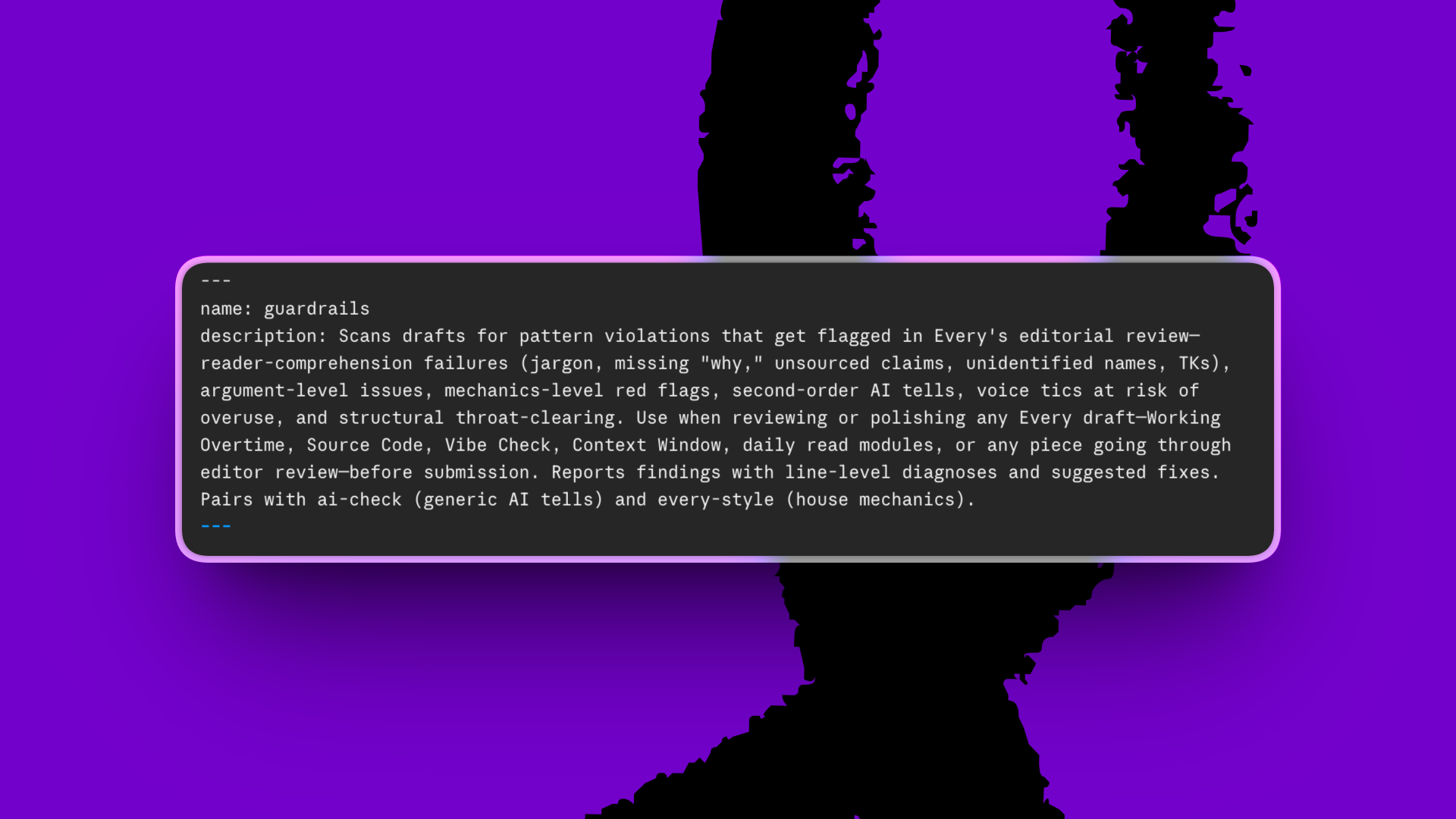 The start of my guardrails skill, where I’ve compiled all the particular ways that content I submit can fall below par. (All images courtesy of Katie Parrott.) Writing with AI tends to be portrayed as a bargain: The machine does more, so the human does less. But in my experience—a microcosm of Every CEO Dan Shipper ’s argument in “After Automation” —it changes what the human does instead of reducing the workload. I have to be clear about defining my standards so a model can understand them. That creates more work—but it helps me understand them better myself. Setting up reviews like /guardrails takes time, attention, and a certain comfort with a tool like Codex or Claude Code. But once the reviewers are in place and working, I can spend more of my time pushing the draft from good to great. My drafts are now much cleaner and my own preferences are less of a mystery to myself, because I’ve had to think and talk about them enough that they’ve worn new grooves into my brain. I’m going to show you a few of the reviewers I rely on and what goes into them (I’ll share a set on Every’s GitHub along with this piece). But it should serve as an example, not a blueprint; the special sauce of this process comes from setting and enforcing your own collection of style requirements.
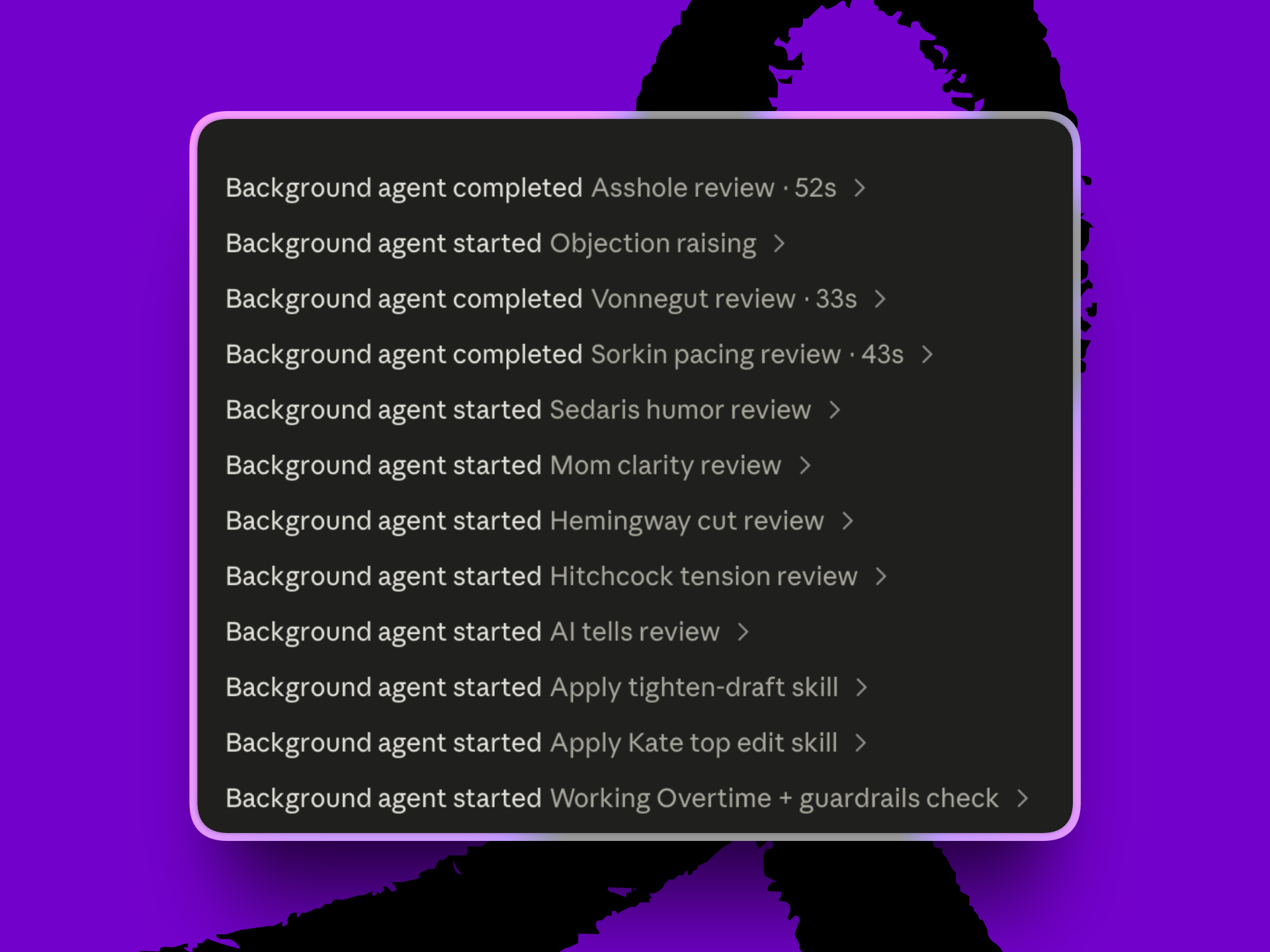 A comprehensive rundown of 12 agents reviewing a draft ahead of submitting to an editor. This preflight checklist comes after I’ve drafted, argued with, rewritten, and reread a piece many times. By this stage, the writing is mine, whether AI was involved in the drafting or not. AI’s job is to look for the things I am most likely to miss because I am tired, emotionally attached, or too deep inside the logic of the draft to see the true shape of it anymore. This final lineup of reviews may look excessive—and it is. When a model can help you get to a plausible draft quickly, the danger is writing that sounds profound at first glance but is, in fact, just AI being pleased with itself. I designed my reviewers to be the closest inspection possible.
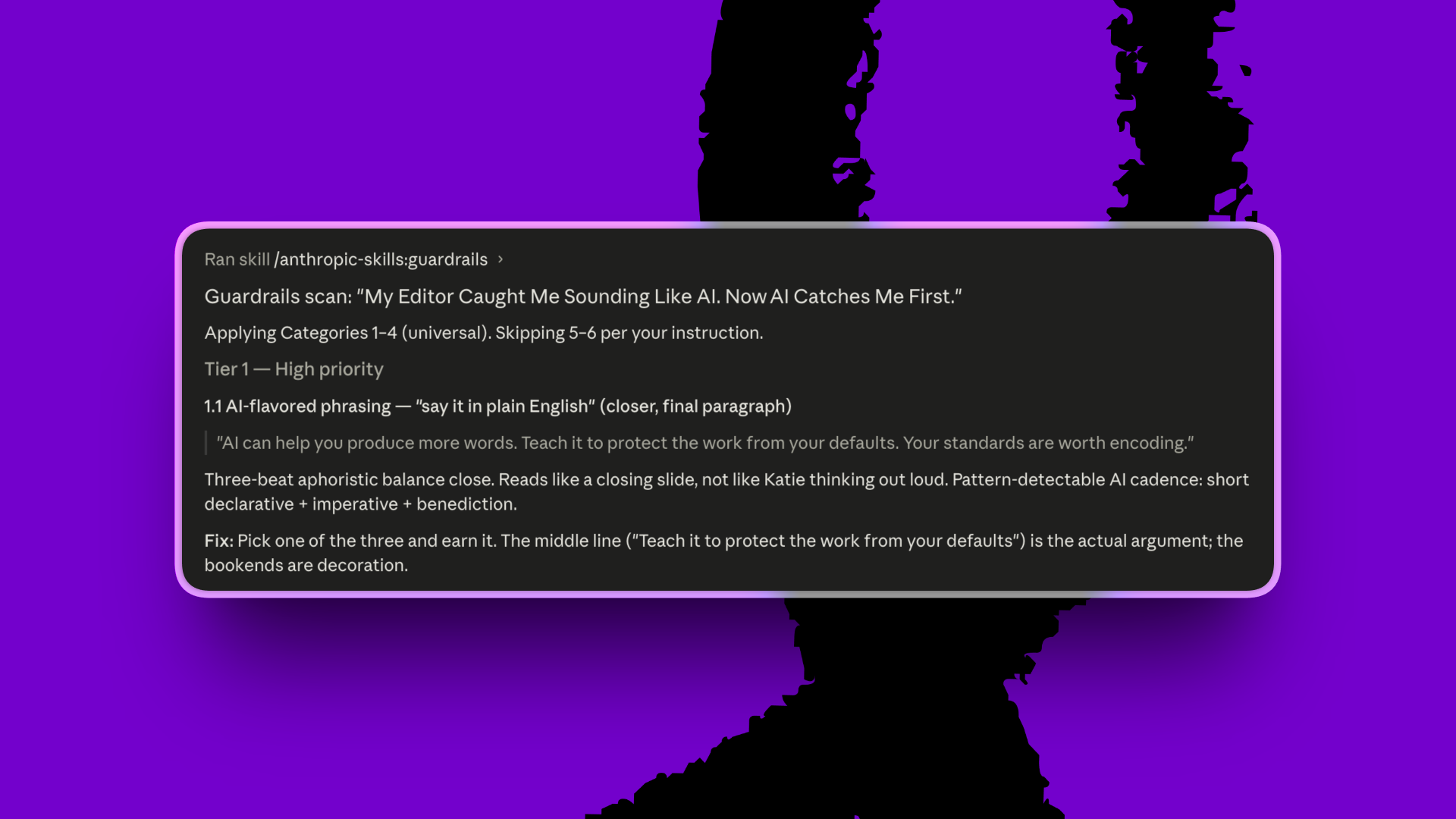 The beginning of the guardrails readout for this very draft.
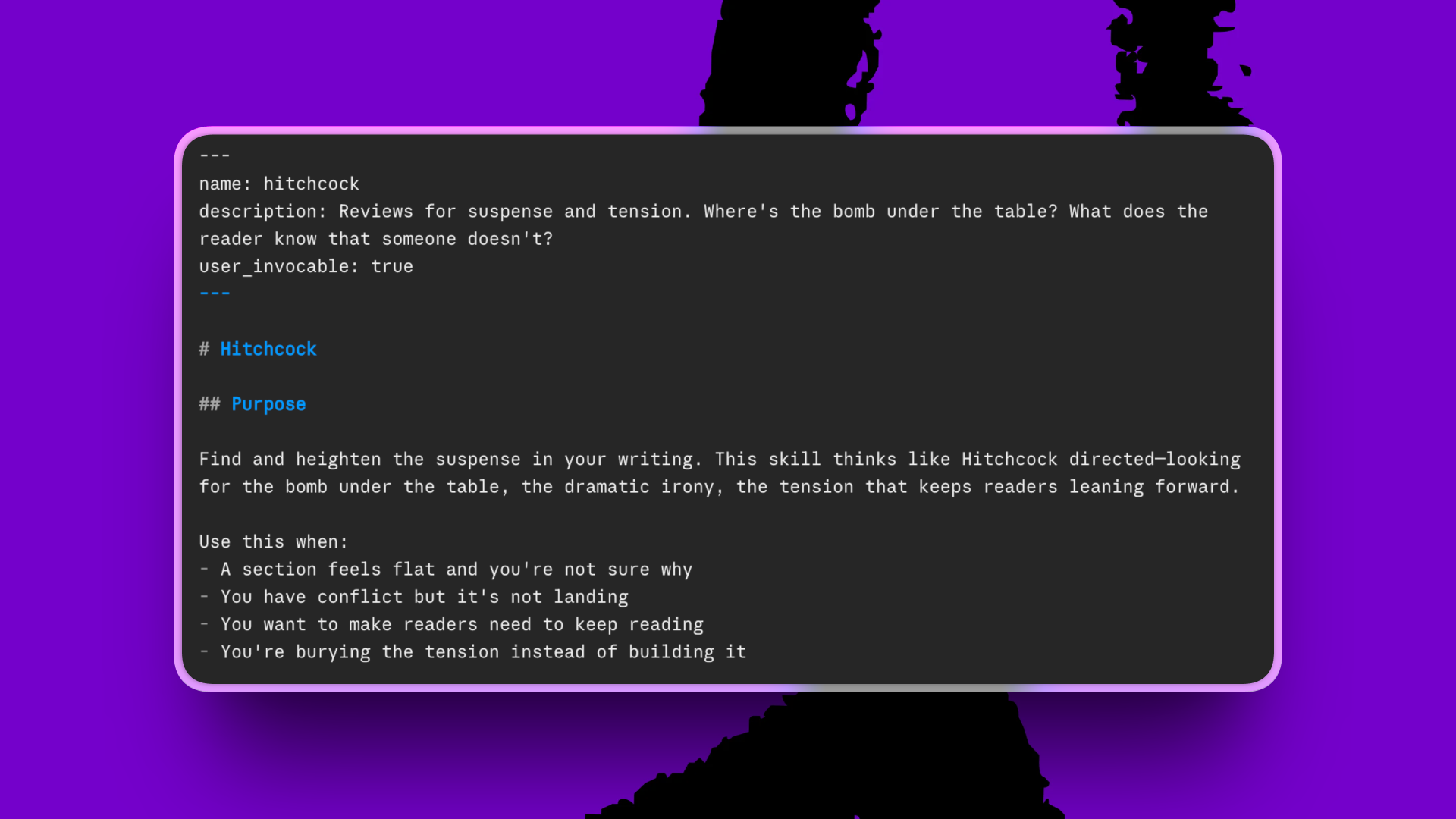 The Hitchcock skill reviews the draft for suspense. Is there a “bomb under the table” that will make the reader want to keep reading? At this stage, I want structural trouble in bright red, whether it’s a claim the reader can’t follow, a section that arrives too early, or a setup with no payoff. The outline is where I can still rearrange and reframe big chunks of the work to make the strongest argument.
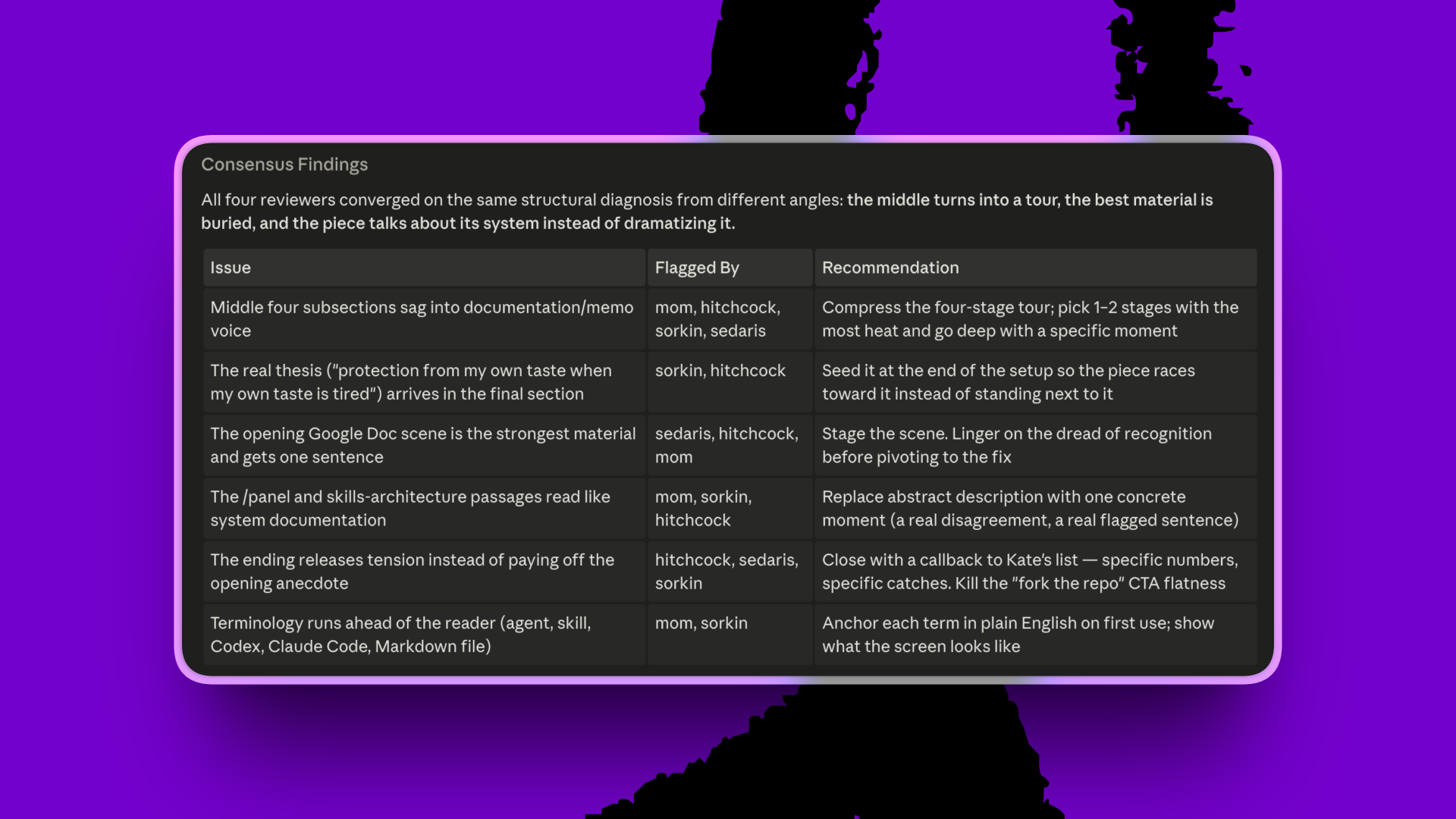 /panel summons a lineup of reviewers to render their verdict on a draft trending toward submission. After the reviewers run in parallel, a synthesizer reads their feedback together. It looks for consensus findings, productive tensions, unique insights, recommended priorities, and the single hard question the draft keeps circling. One reviewer may want a section cut. Another may think the same section is the most alive thing in the draft. The synthesis keeps that disagreement intact, because the tension tells me what decision the piece is asking me to make. Then I, the human, have to figure out how to make it. Here’s a final big-picture question the panel on this draft left me with: Is this an essay about a system that’s working, or an essay about a writer who has to keep building infrastructure because her own defaults keep losing? The reviewers can tell you the piece currently splits the difference—selling the system in the middle, hinting at the slippage in the corners. The opening, middle, and ending all change depending on the answer. Hitchcock said it cleanest: The melodrama only works if it’s true. So, is it?






 We’re hosting