Transparent PNG Stickers with Nano Banana Pro and Gemini interactions API
philschmid.de · Monday, January 19 2026 · 1 min read · ↑ top
philschmid.de - RSS feed
RSS feed for my blog www.philschmid.de
Monday 19 January 2026 12:00 AM UTC+00 Learn how to generate transparent PNG stickers using Nano Banana Pro and the Gemini Interactions API, featuring chromakey green background removal with HSV detection.
ben's bites · Tuesday, January 20 2026 · 4 min read · ↑ top
OpenAI made $20B in 2025
The newsletter for the technically curious. Updates, tool reviews, and lay of the land from an exited founder turned investor and forever tinkerer.
Hey folks,
ChatGPT will start running ads. It begins in a few weeks (starting with the US) and applies only to free and Go (the $8/mo plan) customers. Key terms → at the bottom of ChatGPT’s answers, don’t affect the answers, and no conversation/personal data shared with advertisers. OpenAI also released its 2025 revenue: $20B, more than 3x of 2024’s 6B. Just for comparison, Meta made $180B+, and Google made about $295B purely from ads in 2025. OpenAI is still tiny, but it has a massive space to grow into.
Claude Cowork is now available for Pro ($20/mo) customers as well. Download the desktop app to try.
Flux.2 [klein] is a small and fast image generation/editing model that you can fine-tune as well. This is great for companies that want a massive amount of images generated in a specific pattern, and Nano banana is too expensive for them.
Realism isn’t enough for voice AI—consumers expect more. Join the webinar Amplified 2026 on Jan 28 at 1 PM ET to get insights from Voices’ State of Voice report and see how voice AI leaders are redefining voice AI quality with professional voice talent. Save your seat today.*
🌐What I’m consuming
Tldraw is not accepting PRs from external contributors anymore. Why? Most PRs take low-context issues and rush to write code, without fleshing out what the actual solution should be.
opensync - Searchable history, markdown export, and eval-ready datasets from your opencode/claude-code sessions. (see demo)
claude-config by Brian Lovin- A git repo as the source of truth for skills and settings. (here’s why)
🍦 Afters
TranslateGemma from DeepMind - Open models in three sizes (4b, 12b, 27b) with support for 55 languages.
GLM 4.7 Flash is a new open model from Z.AI - it’s a perfect alternative to GPT-OSS-20B if you want the model to be materially better at tool calling.
New research from Anthropic Fellows defines a limit of “assistant-like” behaviour. As chats go on longer, models rapidly go beyond the limit into other personas. They also talk about a method to stop that from happening.
That’s it for today. Feel free to comment and share your thoughts. 👋
The skills that make AI agents reliable are identical to the skills that make human teams effective
by Mike Taylor In Mike Taylor’s work as an AI engineer, he’s found that many of the issues he encounters in using AI tools—such as their inconsistency, tendency to make things up, and lack of creativity—he used to struggle with when he ran a 50-person marketing agency. It’s all about giving AI models the right context to do the job, just like with humans. In the latest piece in his column Also True for Humans , about managing AIs like you’d manage people, Mike outlines the rise of New Taylorism, his thesis that management techniques for AIs and humans are converging, and that prompting belongs in the business school, not the computer science lab.— Kate Lee__ Every time you rewrite a prompt because Claude misunderstood you, you’re learning to be a better manager. I know this because I’ve lived it from both sides. Building a 50-person marketing agency taught me more about working with AI than engineering ever did: The techniques that make AI agents reliable—clear direction, sufficient context, well-defined tasks—are identical to the techniques that make human teams effective. But AI lets you practice without consequences. An agent won’t get annoyed if you ask it to do the same task 15 times. It won’t hold a grudge when you give unclear instructions. It won’t gossip about how disorganized you are, or get upset when things don’t work out. The CTO of Moondream captured this dynamic in a recent tweet: AI does not get its feelings hurt. (Courtesy of X.) AI does not get its feelings hurt. (Courtesy of X.) This makes AI the perfect management training ground. Good management is a measurable economic advantage. The World Management Survey , a decade-long research project by Stanford and London School of Economics economists, found that roughly a quarter of the 30 percent productivity gap that America has over Europe comes from differences in management quality alone. Now AI is democratizing access to that advantage. Anyone who works with AI is getting a crash course in management, whether they realize it or not. I call this convergence of AI engineering and management practices “New Taylorism,” after Frederick Winslow Taylor , the mechanical engineer who pioneered scientific management in the 1880s. He stood over factory workers with a stopwatch, timing their every movement, then redesigned their jobs into micro-tasks that could be measured, standardized, and optimized. But his attempts to make workflows even more efficient failed—because who likes to be a cog in a machine? His workers went on strike. AI, on the other hand, does not resent being asked to do the same task 50 times until you get it right. I’ll show you the three management principles that you can learn from AI: how to give clear direction, orchestrate a team (aka agent coordination), and think strategically about what’s worth building in the first place. Now you can practice being a better manager with an AI that forgives your mistakes.
Prompting belongs in the business school
The atomic unit of working with AI is the prompt: a discrete task with clear boundaries and evaluable output. It’s the equivalent of the assignment you’d give an employee. In my work as a prompt engineer, I’ve discovered that the prompt is a gateway drug into better management techniques. Once you spend hours optimizing how you brief AIs, watching how radically small changes impact results, you realize you could do the same with your human coworkers. Zhengdong Wang , asenior research engineer at Google DeepMind, received this advice from a consultant friend for managing “hapless” new interns : “You gotta treat them like they’re Perplexity Pro bots,” meaning give extremely clear instructions, don’t assume context, spell out exactly what you want, and check their work carefully. The same techniques that work for AI chatbots are now being applied to humans. The five principles of prompting I developed work equally well as management techniques for humans:
Give direction.Describe the desired style in detail, or reference a relevant persona. Whether you’re briefing Claude or a junior designer, “match the energy of Apple’s product pages—minimal, confident, lots of whitespace” is a much better instruction than “make it pop.”
Specify format.Define the rules and required structure of the response. If you want bullet points on a deck, tell the AI.
Provide examples.Insert a diverse set of test cases where the task was done correctly. Give the AI an example of a piece of content marketing, or series of tweets that worked well in the past.
Evaluate quality.Identify errors and rate responses, testing what drives performance. Just like you give your team feedback, don’t publish AI output without a plan to measure outcomes.
Divide labor.Split complex goals into steps chained together. This is exactly how you would approach a product launch—writing down all the steps that need to happen and tracking progress on each.
In fact, I drew from my marketing agency experience to develop these principles in 2022, pre-ChatGPT. I wanted prompting techniques that wouldn’t break every time a new AI model dropped, so I focused on what works for both biological and artificial intelligences. Prompting is a management skill that belongs in the business school, not the computer science department. And it’s only getting easier. The technical parts of prompt engineering are being automated away, and the latest models can rewrite prompts to get better performance on a task. All humans need to do is to decide what task to do, define how it should be done , and collect or annotate a number of “good” examples of that task being done.
Managers have been vibe coding forever
Yet work rarely stays as simple as one assignment or one prompt, for both humans and AI. Eventually, you’re juggling multiple tasks, passing the output of one to the input of another, deciding what to delegate. You move from writing prompts to orchestrating systems—in other words, managing the progress of many different tasks. This is the second way in which AI teaches you management: how to run a team. Orchestration skills are, once again, not new—managers have been vibe coding forever. “Getting good results out of a coding agent feels uncomfortably close to getting good results out of a human collaborator,” saidSimon Willison , co-creator of the Django framework. Consider a scene that plays out in every tech company: A product manager writes a description of a new feature. An engineer builds the feature. The product manager doesn’t read every line of code, but she can tell whether the button is in the wrong place, whether the flow feels clunky, and whether it solves the customer’s problem. The skills that make someone effective at conducting multiple AI agents are the same that have always made someone an effective engineering manager: clear requirements, good taste, and knowing when to push back versus when to trust your team’s judgment on implementation details. Orchestration teaches you to run a project—to see the whole board, sequence the work, and know when to intervene or let things run. Every time you take Claude’s output and feed it into the next prompt, or break a big task into smaller pieces for different agents to handle, you’re practicing the same skills you’d need to manage a human team through a complex deliverable.
The age of the idea guy
Once AI can build almost anything you ask for, the real skill becomes deciding what to build. This is the third management skill AI forces you to develop: strategy. Think about what makes a project succeed or fail. You need market research to make sure you’re building the right thing. You need domain expertise to understand the core problem. You have to find potential customers and sell them on your solution. You need to extrapolate from limited data points—a few customer interviews, a handful of failed experiments. You need to think multiple moves ahead, because if you can vibe code it in a day, so can your competitors. The strategic frameworks business schools have taught for decades, such as Hamilton Helmer‘s7 Powers (which describes how companies can build lasting advantages through things like network effects) and Michael Porter‘s five forces (which maps competitive pressures across industries), are even more important because they’re the only source of differentiation left now that AI can write code. Alex Danco of venture capital firm Andreessen Horowitz recently wrote that as AI makes some parts of a job wildly more productive, the parts that can’t be automated become the bottleneck—and therefore the reason you get paid. The judgment calls, the problem-solving, and the strategic bets commands a premium. Call it the revenge of the idea guy. The appellation used to be a bit of an insult: someone with a grand vision and no follow-through. Now that AI has made execution easier, vision is more valuable. The new idea guy is someone who can identify which problems are worth solving for whom, then translate that into directions an AI can execute.
Where humans shine: The messy middle
AI is decent at proposing options for your strategy. Give Claude 1,000 pages of context—market research, competitive analysis, customer interviews—and it can synthesize a reasonable strategic direction faster than most consultants. It can also execute precise, well-defined instructions with mechanical reliability. Where AI falls apart is the tactical thinking in between. I call this the NCO gap , borrowing from military structure. Officers set strategy from headquarters, and enlisted soldiers execute orders on the ground. The sergeants who bridge that gap are non-commissioned officers. They understand command intent and ground truth, and translate strategy into action under conditions of uncertainty. Every’s Dan Shipper has written about how humans are shifting from makers to “ model managers “ as AI handles more execution. I’d push this further: We’re middle managers, the NCOs of today. When I’m debugging a complex issue—diagnosing what broke, weighing the business stakes, deciding whether to patch it fast or fix it right—AI consistently fails. It can’t bridge the gap between ”something’s wrong” and “here’s what to do about it.” It certainly can’t say, “If we change our approach, we can avoid this problem entirely.” Claude Code knows how to diagnose why your app is slowing to a crawl, and once diagnosed, it knows the fix. But a human engineer who intimately knows the codebase knows where to look first. ChatGPT can research podcast guests and summarize transcripts, but nobody wants to listen to an AI interviewer. Gemini can read all your customer service documents and execute policy for a specific query, but human reviewers catch the new fraud patterns that might not match any template. AI handles the top (synthesis) and the bottom (execution). Humans own the middle (translation under uncertainty). As opposed to AI, humans thrive in the messy middle between tactics and strategy. (Courtesy of Mike Taylor and Every.) Researchers saw this play out when they had Claude play Pokémon. Claude understood the overall objective—to become champion—and could execute individual moves with precision. But it got stuck in the first cave of the game, Mt. Moon, for over 48 hours. The solution required maybe seven moves, something I navigated when I was 12 years old. Claude knew where it was going and could execute any command perfectly, but it couldn’t figure out the medium-level tactics to translate movement into progress when it got stuck in Pokémon. Humans are great at this kind of extrapolation. Maybe it’s a trick you only learn as a biological intelligence, trying to survive in the real world, where you can never gather enough information but still must make a decision. We have evolved to be great at decision-making under uncertainty, so we can extrapolate from a small number of datapoints and intuit a good enough guess to get us on the right path.
What comes next
After years of building AI systems and, before that, building a company of humans, I’ve learned that the skills are the same. AI skills, management skills—they’re all leadership skills, and AI is giving everyone a medium to practice them. That’s the true promise of New Taylorism—not that we can finally optimize workers like machines, which was Taylor’s dream and his failure, but that we can learn, through machines, how to lead better, and then bring those skills to the humans who need good leadership. Most people won’t notice they’re getting a mini-MBA and becoming better managers. They’ll think they’re just getting better at AI. This column has always been about the overlap between managing AI and managing humans, and now I want to push that idea further. In the pieces ahead, I’ll treat common AI failures as MBA case studies. We’ll go deep on the messy middle, where the real leverage lives. And we’ll document and explore this new era of management, one prompt at a time. The messy middle is where we belong. It turns out it’s also where we learn.
What cold-calling from a closet taught Gusto’s founder about PMF
First Round Review · Tuesday, January 20 2026 · 1 min read · ↑ top
This week, Gusto co-founder and CPO Tomer London shares how relentlessly cold-calling potential customers taught him to recognize what PMF really feels like.
Gusto’s Path to Product-Market Fit — How Listening to Customers Built a $9.6B Company
It’s 2012 and Tomer London has locked himself in a closet, phone in hand, to dial the numbers of small business owners he finds on Yelp, taking rejection, after rejection, after rejection on the chin. He’s recently dropped out of an electrical engineering PhD program at Stanford to focus on the payroll startup he co-founded with Josh Reeves and Edward Kim that will eventually become Gusto.“We were hustling, trying to find who would trust the three of us to run their payroll,” London says. “We had a swimming class for kids. We had a flower shop where Eddie was buying flowers, and he asked her, ‘Who do you use for payroll?’ She didn’t have a provider, so we set her up.” They were concurrently exploring building an API payroll product for enterprise platforms. But all that cold-calling had revealed a surprising truth: Among prospective customers, SMBs were much more enthusiastic than ENTs. “I remember going to some of these big platforms and we were sure they were going to love it. But the response we mostly got was, ‘This could be cool, but it’s not a priority right now.’”SMBs, meanwhile, were clamoring for a product to solve their payroll problems … | Continue reading on The Review
{improving rag} how to analyze your production ai logs
Jason Liu · Tuesday, January 20 2026 · 2 min read · ↑ top
Forwarded this newsletter? Click here to subscribe.
When did you last look at your logs and know exactly what to build next? Scott Clark and I put together a talk on this. Scott was CEO of SigOpt (acquired by Intel in 2020) and now runs Distributional. We’ll walk through how to turn production logs into a product roadmap. Tomorrow 21st, 1 PM EST / 10 AM PST. Register and you'll get notes and recording after we wrap. Here’s the rough outline of what I've said in our rag training Most teams only track thumbs up/down. That’s maybe 20% of what’s actually happening. Users rephrasing questions? Frustration. Users giving up? Failure. You need to track implicit signals too. Split your data by user type, signup date, query category. Overall averages tend to lie. I even had one company saw metrics spike during a Super Bowl ad. Turned out new users were asking completely different questions than existing customers Group queries into 20 clusters. Look at 10 good and 10 bad examples from each. One client found scheduling/time based queries had 25% satisfaction, a problem buried in their averages. After fixing it (got to 78%), document search usage went up too. Users started trusting the whole system more. Plot clusters on volume vs satisfaction.
High volume + low satisfaction = fix first.
Low volume + high satisfaction = hidden gem worth promoting.
There’s also a distinction most teams miss: inventory issues (users want data you don’t have) vs capability issues (users want features and filters you haven’t built). Better prompts won’t fix missing data either, all of which ends up being solved my better infra rather than better 'ai'. For prioritization: (Impact x Volume %) / (Effort x Risk). A fix for 40% of queries beats a perfect fix for 5%. This turns vague updates from “make RAG better” into something like “fixed scheduling queries for 20% of users.” | Register Here
Jason
P.S. This is my last talk with the cohort before I start my new job. Ties together a lot of what I’ve been working on to be sure to pop by before I #lockin for 2026.
Interconnects by Nathan Lambert · Wednesday, January 21 2026 · 6 min read · ↑ top
The tools are getting so powerful that we need to change how we scope, manage, and approach our work.
Two weeks ago, I wrote a review of how Claude Code is taking the AI world by storm, saying that “software engineering is going to look very different by the end of 2026." That article captured the power of Claude as a tool and a product, and I still stand by it, but it undersold the changes that are coming in how we use these products in careers that interface with software.
The more personal angle was how “I’d rather do my work if it fits the Claude form factor, and soon I’ll modify my approaches so that Claude will be able to help.” Since writing that, I’m stuck with a growing sense that taking my approach to work from the last few years and applying it to working with agents is fundamentally wrong. Today’s habits in the era of agents would limit the uplift I get by micromanaging them too much, tiring myself out, and setting the agents on too small of tasks. What would be better is more open ended, more ambitious, more asynchronous.
I don’t yet know what to prescribe myself, but I know the direction to go, and I know that searching is my job. It seems like the direction will involve working less, spending more time cultivating peace, so the brain can do its best directing — let the agents do most of the hard work.
Since trying Claude Code with Opus 4.5, my work life has shifted closer to trying to adapt to a new way of working with agents. This new style of work feels like a larger shift than the era of learning to work with chat-based AI assistants. ChatGPT let me instantly get relevant information or a potential solution to the problems I was already working on. Claude Code has me considering what should I work on now that I know I can have AI independently solve or implement many sub-components.
Every engineer needs to learn how to design systems. Every researcher needs to learn how to run a lab. Agents push the humans up the org chart.
I feel like I have an advantage by being early to this wave, but no longer feel like just working hard will be an lasting edge. When I can have multiple agents working productively in parallel on my projects, my role is shifting more to pointing the army rather than using the power-tool. Pointing the agents more effectively is far more useful than me spending a few more hours grinding on a problem.
My default workflow now is GPT 5 Pro for planning, Claude Code with Opus 4.5 for implementation. I often have Claude Code pass information back to GPT 5 Pro for a deep search when stuck with a very detailed prompt. Codex with GPT 5.2 on xhigh thinking effort alone feels very capable, more meticulous than Claude even, but I haven’t yet figured out how to get the best out of it. GPT Pro feels itself to be a strong agent trapped in the wrong UX — it needs to be able to think longer and have a place to work on research tasks.¹
It seems like all of my friends (including the nominally “non-technical” ones) have accepted that Claude can rapidly build incredible, bespoke software for you. Claude updated one of my old research projects to uv so it’s easier to maintain, made a verification bot for my Discord, crafted numerous figures for my RLHF book, feels close to landing a substantial feature in our RL research codebase, and did countless other tasks that would’ve taken me days. It’s the thing de jour — tell your friends and family what trinket you built with Claude. It undersells what’s coming.
I’ve taken to leaving Claude Code instances running on my DGX Spark trying to implement new features in our RL codebase when I’m at dinner or work. They make mistakes, they catch most of their own mistakes, and they’re fairly slow too, but they’re capable. I can’t wait to go home and check on what my Claudes were up to.
The feeling that I can’t shake is a deep urgency to move my agents from working on toy software to doing meaningful long-term tasks. We know Claude can do hours, days, or weeks, of fun work for us, but how do we stack these bricks into coherent long-term projects? This is the crucial skill for the next era of work.
There are no hints or guides on working with agents at the frontier — the only way is to play with them. Instead of using them for cleanup, give them one of your hardest tasks and see what it gets stuck on, see what you can use it for.
Software is becoming free, good decision making in research, design, and product has never been so valuable.
Being good at using AI today is a better moat than working hard.
Here are a collection of pieces that I feel like suitably grapple with the coming wave or detail real practices for using agents. It’s rare that so many of the thinkers in the AI space that I respect are all fixated on a single new tool, a transition period, and a feeling of immense change:
Liking, sharing, commenting, or recommending Interconnects from your Substack is the only way Interconnects is possible. Thank you for your support.
If you liked this, consider upgrading to a paid subscription to cover my growing subscription and API fees. We offer group Interconnects subscriptions at tiered discounts for 5+ heads.
If you want all of the best AI writing on Substack through one subscription for your team of 20+, check out https://readsail.com/.
Back in 2022, when Twitter was sold to Elon Musk, I tweeted this:
Twitter is too important to be owned and controlled by a single person. The opposite should be happening. Twitter should be decentralized as a protocol that powers an ecosystem of communication products and services.
So began my exodus from Twitter, which culminated in a complete departure in May 2024, when I wrote this post.
I've tried all of the decentralized social protocols, Lens, Bluesky, and Farcaster and have been most active on Farcaster, where USV is an investor.
Earlier today, Vitalik Buterin wrote this post using a decentralized social app called Firefly that sends its posts to Lens, Bluesky, Farcaster and Twitter. Vitalik started off his post with this observation:
If we want a better society, we need better mass communication tools. We need mass communication tools that surface the best information and arguments and help people find points of agreement. We need mass communication tools that serve the user's long-term interest, not maximize short-term engagement. There is no simple trick that solves these problems. But there is one important place to start: more competition. Decentralization is the way to enable that: a shared data layer, with anyone being able to build their own client on top.
I could not agree more. I believe in social protocols like Lens, Bluesky, and Farcaster.
Both the Lens protocol and the Farcaster protocol have changed stewards this week.
And today, the Farcaster founders announced that they are handing over stewardship of the Farcaster protocol (and app) to the Neynar team.
Some will look at these events and say that decentralized social has failed. However, I see it differently. Protocols don't die so easily. They are resilient. And as Vitalik said in his post:
decentralized social should be run by people who deeply believe in the "social" part, and are motivated first and foremost by solving the problems of social.
I don't know the Mask team but I do know the Neynar team. USV is an investor in Neynar, and we have worked with Rish and Manan for over a year now.
They are the kinds of people that Vitalik was talking about when he wrote that.
If you want to post to X and also decentralized social protocols at the same time, try using the Firefly app like Vitalik does.
Support AVCI am a VCShow you appreciate this writer, help support their work, and share in their growth over time by buying their writer coin.Support
MCP is Not the Problem, It's your Server: Best Practices for Building MCP Servers
philschmid.de · Wednesday, January 21 2026 · 1 min read · ↑ top
philschmid.de - RSS feed
RSS feed for my blog www.philschmid.de
Wednesday 21 January 2026 12:00 AM UTC+00 The Model Context Protocol (MCP) has exploded roughly 1 year ago, everyone rushed to build MCP servers. The hype was real. Yet, most MCP servers disappoint. Most developers blame the protocol. The protocol feels like it's dying on social media.
Tiny’s cofounder on the relationship counselor, email client, and personal stylist he created with AI—and why he’s rethinking software investing
by Rhea Purohit Andrew Wilkinson. TL;DR: Today, we’re releasing a new episode of our podcastAI& I, whereDan Shippersits down withAndrew Wilkinson, the cofounder of Tiny , a holding company that buys profitable businesses and focuses on holding them for the long term. Watch onX or YouTube, or listen on Spotify or Apple Podcasts. Plus: We’re hosting an all-day livestream tomorrow with the best vibe coders in the world, showcasing what’s now possible that wasn’t two months ago. Join us on X. On Friday, we’re hosting a free camp for paid subscribers about how agent-native architectureworks and how to use it effectively.
Entrepreneur Andrew Wilkinson used to sleep nine hours a night. Now he wakes up at 4 a.m. and goes straight to work—because he can’t wait to keep building with Anthropic’s latest model, Opus 4.5. Two years ago, Wilkinson was obsessed with vibe coding on AI software development platform Replit. It was thrilling to describe something in plain English and watch an app appear, less thrilling when the apps were always broken in some way, often full of maddening bugs. So he set his app creation ambitions aside until technology caught up with them. Then, a few weeks ago, he started playing with Claude Code and Opus 4.5. It felt, he says, like having a “$100,000-a-month payroll of engineers” working for him around the clock. Wilkinson is the cofounder of Tiny , a company that buys profitable businesses and holds them for the long term. The Tiny portfolio includes the AeroPress coffee maker and Dribbble , a platform where designers can share their work and find jobs. Dan Shipper had him on AI& I to talk about the automations Wilkinson has built for his work and personal life, including an AI relationship counselor, a custom email client, and a system that texts him outfit recommendations each morning. Wilkinson revealed how all of this individual exploration has changed the way he thinks about buying software companies at Tiny. Here is a link to the episode transcript. You can check out their full conversation: Here are some of the themes they touch on:
How Wilkinson uses AI in his work and personal life
Wilkinson has wired AI into nearly every corner of his day. Here’s what that looks like:
An AI that knows your relationship inside out—and predicts your fights
After talking with his girlfriend about how nice it would be to have a GPT trained on their relationship, Wilkinson used Claude Code to build Deep Personality, a web app that functions as an AI relationship counselor and personality analyzer. He started by asking AI what a therapist would want to know to get a complete picture of a couple. The response was a list of roughly 20 clinically validated tests and personality inventories—the kind typically gated by paywalls, and sometimes only known to therapists. He then used Claude Code to build a simple interface that consolidates all these tests into a 40-minute multiple-choice assessment. Claude even wrote the website copy—which impressed Dan, no small feat—after Wilkinson referenced 37signals cofounder Jason Fried and Made to Stick , a book premised on the idea that you have just one shot to capture someone’s attention, in his prompt. The whole site, he estimates, took about two hours to build. After an individual completes the assessment, Deep Personality delivers a 45-page analysis that covers personality traits (including nuances like attachment style), relationship dynamics, ideal jobs, and personal challenges. It also generates custom prompts users can feed into ChatGPT or Claude to create a personalized virtual therapist, plus “cards” summarizing how to best work with them, useful to share with a partner, your boss, or colleagues. When both partners complete the assessment, the app can analyze them together, generating a “relationship blueprint” that maps compatibility and predicted conflicts. “We were reading it out together and just laughing our heads off,” Wilkinson says, “because it was all the things we fight about perfectly laid out.” He’s since used it during actual disagreements to surface the deeper emotional triggers beneath surface-level arguments, helping build empathy by articulating what’s really at stake for each person.
Build a custom email client with Claude Code
Wilkinson receives 200 to 300 emails a day. Managing his inbox used to require one full-time assistant, sometimes two, plus hours of his own time. He likens the experience to the classic scene from the sitcom I Love Lucy , where the protagonist, Lucy, scrambles to keep up with the flow of chocolates on a conveyor belt in a factory. In other words, Wilkinson felt overwhelmed, like he was always playing catch-up. He’d already built an automation using Lindy , a platform for creating AI agents, that helped: Every incoming email gets processed based on its content—sales and marketing messages get archived automatically, and relevant emails get forwarded to the right person on his team. That alone cut his email load by about 50 percent. The system also generated choose-your-own-adventure responses: If someone emailed asking to meet, the agent would summarize who they were and what they wanted, then give Wilkinson options to pick from. After he picked one, the agent would send out a friendly, fully-written response on his behalf. But edge cases kept tripping him up. He wanted more intricate control, like the ability to tweak drafts, and handle more complex emails himself. Finally, he turned to Claude Code: “I just said, ‘Here’s my Gmail credentials, I want you to build an email triager, here’s how I want it to work.’” What came back was a simple, web-based email client. It surfaces emails that require a response, ranks them by priority and sender, and offers two modes: multiple choice for quick replies, or an interface for complex emails that asks Wilkinson a series of questions before drafting a response. Within a week, he was using it daily. “Anyone who’s technical knows how astounding that is,” he says, “and how frustrating it is to build an email client. It blows my freaking mind.” The same automation handles a different kind of inbox overwhelm: school emails. Any parent knows the deluge of field trips, permission slips, special lunch days, and early dismissals that inundate their inboxes. Wilkinson’s system ingests all of it and texts him what he actually needs to know: “Heads up, Peter needs a packed lunch tomorrow,” along with, say, a link to sign the field trip form. Relevant dates also get added to his parenting calendar automatically.
An AI that watches your back in meetings
Wilkinson has also built himself something like an AI referee for the complicated human dynamics at play at work. It’s a custom Lindy agent that records his meetings and produces notes, but the feature he cares about most is a kind of psychological pattern detection. After each meeting, his agent analyzes the transcript and texts him if it finds any red flags in the interaction. For example, he recently had a tense call with a contractor who’d missed a deadline. Wilkinson held him accountable, calmly, but the contractor flipped the script—accusing him of being rude, which made him feel like the problem. Wilkinson left the call doubting himself. A moment later, his phone buzzed: The agent had detected the contractor using manipulative tactics like gaslighting. When Dan pushes him on AI’s tendency to agree with whatever you signal in your prompt, Wilkinson says the key is being careful not to inject your opinion into the prompt and defining a high bar for the AI ahead of time. The threshold for Wilkinson’s agent is: “You have to analyze every single word in this thing, and you only flag it if it reaches a critical point.” Wilkinson compares the practice to reading body language—useful data, but only in context, and never the whole picture. “I probably wouldn’t make a hire or fire decision entirely on that,” he says, “but it will often confirm a feeling.”
Your personal stylist is a prompt away
Like a lot of guys, Wilkinson says, he wanted to dress well but didn’t understand color theory or what looked good on him. His solution was to build an AI version of the computer used by the protagonist in the 1995 movie Clueless that automatically matches her outfits. Every morning at 7 a.m., his automation checks the weather in Victoria, British Columbia, where he lives, and pulls from a Google Sheet called “Andrew’s Wardrobe”—a spreadsheet he created by photographing all his clothes and having Claude convert it into a CSV. The system generates four outfit recommendations, renders them using Google DeepMind’s image generator Nano Banana, and texts him the results via communications tool Twilio. It tells him what to wear, right down to which watch he should accessorize with. He’s also built a custom GPT he can query on the fly—snap a photo of some jeans and ask what goes with them, or get advice like “French tuck that shirt.”
Why you need to find a moat that isn’t code
As much as Wilkinson loves building with AI, it’s changed how he thinks about buying businesses, and Tiny has slowed the pace of its acquisitions His analogy: Imagine someone invents a machine that makes incredible pizza, and anyone can buy it, which means that anyone can make great pizza. Consumers benefit from better, cheaper pizza everywhere, but business owners will get squeezed as their margins collapse. They have no way to compete when everyone can make the same quality. According to him, this dynamic is currently playing out in software. The old moat in software was that programming was hard to learn, slow to master, and expensive to hire for. Now that AI has made it easy for non-coders to build, your moat has to come from somewhere else, like brand, distribution, or hardware. Otherwise, you’re selling pizza in a town where everyone has that magical machine—not a recipe for long-term success. What do you use AI for? Have you found any interesting or surprising use cases? We want to hear from you—and we might even interview you. Timestamps
Introduction: 00:01:07
Why Opus 4.5 feels like the iPhone moment for vibe coding: 00:02:48
Why designers have a unique advantage with AI: 00:08:31
How Andrew built a custom email client with Claude Code: 00:14:10
An AI trained on your relationship that predicts your fights: 00:18:13
Using AI meeting notes to make your life better: 00:30:40
Don’t inject your opinion into prompts: 00:35:11
Andrew’s Claude Code tips and workflows: 00:40:21
Your personal stylist is a prompt away: 00:47:59
How AI is changing the way Andrew invests in software: 00:53:17
You can check out the episode on X, Spotify, Apple Podcasts, or YouTube. Links are below:
Miss an episode? Catch up on Dan’s recent conversations with founding executive editor of WiredKevin Kelly , star podcaster Dwarkesh Patel , LinkedIn cofounder Reid Hoffman , ChatPRD founder Claire Vo , economist Tyler Cowen , writer and entrepreneur David Perell , founder and newsletter operator Ben Tossell , and others, and learn how they use AI to think, create, and relate. If you’re enjoying the podcast, here are a few things I recommend:
ben's bites · Thursday, January 22 2026 · 4 min read · ↑ top
Is your repo agent ready?
The newsletter for the technically curious. Updates, tool reviews, and lay of the land from an exited founder turned investor and forever tinkerer.
Hey folks,
I just wrote a comprehensive guide onwhat you need to know to use coding agents if you’re not that technical. Explaining everything from terms like local and remote, to actually how to build a project and deploy it. Things to look out for, what the system is doing and a whole lot more. You can bookmark it on twitter here. Or read it on the new site I just built that has clickable explainers on technical terms that I think is super useful to help you learn. Let me know what you think!
I’ll be on Every’s Vibe Code Camp today at 3:30 PM (UK time), i.e. an hour and a half after you get this email. Tune in.
Droid can now scan your repo and tell you if it is ready for agentic software development. You can run it in a droid session with /readiness-report directly in your terminal, or view readiness across your organisation in the app. There’s also an option to access reports programmatically via API. It also suggests quick and longer-term fixes so that you can compound the work you can get done.
Claude has a new constitution , and it has about 22.5k words (up from the old 2.5k words). Anthropic uses this document to guide Claude’s behaviour during training as well as when providing it to users. The new constitution has 5 major sections: being helpful, following Anthropic’s guidelines, being broadly ethical, being broadly safe and notes on Claude’s nature.
AssemblyAI is a single API for building voice AI apps. Accurate speech-to-text, speaker detection, and real-time transcription in one platform. No infra to manage, pay-as-you-go pricing. Try 330+ free hours.*
🌐What I’m consuming
Clawdbot showed me what the future of personal AI assistants looks like.
Cursor team members share their thoughts on building software with AI and why model selection beats prompting tricks
by Katie Parrott Happening now: We’re hostingVibe Code Camp with the world’s best experts pushing the limits of what’s possible. Watch live now until 6 p.m. ET, and catch the recordings. Also: This article is based on a sponsored event. Cursor provided $100 in credits to attendees and made this camp possible.—Kate Lee _
A few minutes into Every’s first Cursor Camp, Cursor developer education lead Lee Robinson made a bold declaration: “The IDE is kind of dead.” IIDE stands for “integrated development environment”—basically Microsoft Word, but for code. It’s where programmers type, organize files, and run programs, and for decades, it has been the center of a programmer’s world. Now, that model is breaking down. The center of gravity has shifted from typing code by hand in an IDE such as Visual Studio Code_ to managing AI agents that write it for you with a tool such as Cursor. In this session, Lee and Samantha Whitmore , a software engineer at Cursor, walked us through how they work in a post-IDE world. What follows are the workflows, model-selection strategies, and honest limitations they shared—plus where this leaves you if you’re trying to figure out what the future of code looks like.
Key takeaways
The agent is becoming the core. Writing and editing code by hand is shrinking as a percentage of the work. Developers are now spending more time telling AI agents what to build and reviewing their output.
Cloud and local agents are merging. You’ll soon be able to start an agent on your computer, hand it off to remote servers when you close your laptop, and pick it back up later—no context lost.
Model choice matters more than prompting tricks. Prompting gimmicks like, “I’ll pay you $1,000,” which some AI users swore could make AI provide a better output, don’t work anymore. You need to choose the right model for the job—say, one for brainstorming, another for deep bug-hunting.
Agents can run for weeks. Cursor’s research team built a working web browser from scratch using AI agents that ran for days, producing 3 million lines of code. It cost $80,000 in tokens (the units AI companies use to measure and charge for usage). It’s a research project that’s not available for public use—for now. But it shows where things are heading...
Move fast, don’t break things
The $80,000 experiment that reveals where AI-powered coding is headed
How a Cursor engineer decides which AI “brain” to deploy, and when to pit them against each other
The type of coding work where AI tools still can’t beat a human
philschmid.de · Thursday, January 22 2026 · 1 min read · ↑ top
philschmid.de - RSS feed
RSS feed for my blog www.philschmid.de
Thursday 22 January 2026 12:00 AM UTC+00 The Interactions API is a unified interface for building with Gemini models and agents. It simplifies the development of agentic applications by handling server-side state management, tool orchestration, and long-running tasks.
Every week sI’ll provide updates on the latest trends in cloud software companies. Follow along to stay up to date!
The Year of Multi-Modal
I have a growing conviction that 2026 will be the year of multi modal AI. There are a handful of trends all coming together at the same time that are set to converge. Multi-modal models get good enough. Inference is getting cheaper and faster (cost curve is important). And the real world starts showing up as first class input. I really believe AI will stop predominantly living in text boxes and instead in places humans actually are.
For the last few years, AI has been overwhelmingly text first, and for good reason. Text was the fastest path to usefulness. It was easy to collect, easy to tokenize, relatively cheap to serve, and generally didn’t have the same latency requirements. If you were building an AI product in 2023 or 2024, starting with text was the rational choice. But text always seemed like a middle state, not an end state. Humans do not experience the world in text. Work does not happen in text. The physical world certainly does not operate in text. Multi modal AI was always where this was heading. And I think we’re close!
What feels different now is how suddenly the pieces are snapping into place. Just in the last week, we saw a wave of production grade text to speech models that would have felt experimental not long ago. NVIDIA PersonaPlex is a good example of how expressive and controllable synthetic voices have become, especially for characters and agents. Inworld TTS also had a release, and it’s clearly optimized for low latency, interactive dialogue rather than polished narration. Flashlabs Chroma 1.0 shows how quickly open ecosystems are closing the quality gap. And Alibaba Qwen3 TTS reinforced that this is global and competitive, not confined to a single lab or market. Voice is just one modality, but it is a useful signal that something broader is happening.
At the same time, inference economics are finally catching up, and cost curves are bending. Multi modal AI was more impractical than impossible. Latency was too high. Costs were too unpredictable. Systems were too brittle to trust in real world workflows. That is changing fast. Inference engines are getting more efficient. GPUs are being utilized more effectively. Batching, speculative decoding, and modality specific optimizations are pulling costs down and smoothing tail latency. Teams are also getting more comfortable deploying smaller, specialized models for vision, audio, or sensor data instead of forcing everything through one massive general purpose model. The result is that multi modal inference is no longer something you budget for cautiously but have to confine to smaller audiences or test cases. It’s going mainstream!
The third piece is that the world itself is becoming legible to machines. Cameras, microphones, wearables, industrial sensors, cars, robots, and medical devices are producing continuous streams of data that finally have models capable of understanding them in real time. This unlocks entire categories that text only AI could never reach. Physical environments. Always on monitoring. Workflows that unfold continuously rather than one prompt at a time. Once AI can see, hear, and react, it really can take the next leap in functioanlity.
This is why 2026 matters specifically. All of these trends are converging together. By 2026, model quality is no longer the gating factor for most multi modal use cases. Inference cost and latency are low enough that always on perception is viable. And distribution increasingly shows up through agents, devices, vehicles, and embedded systems rather than chat interfaces. At that point, multi modal can step into the limelight and become a first class citizen. Text only AI will start to feel oddly constrained, the same way desktop only software felt once mobile became ubiquitous.
The mistake is to think of this shift as simply text plus voice, or LLMs plus vision. The deeper change is that AI systems are beginning to experience the world the way humans do. Through multiple senses, continuously, and in context. Text was the on ramp, and 2026 is when AI finally leaves the keyboard! I’m excited for that future
Top 10 EV / NTM Revenue Multiples
Top 10 Weekly Share Price Movement
Update on Multiples
SaaS businesses are generally valued on a multiple of their revenue - in most cases the projected revenue for the next 12 months. Revenue multiples are a shorthand valuation framework. Given most software companies are not profitable, or not generating meaningful FCF, it’s the only metric to compare the entire industry against. Even a DCF is riddled with long term assumptions. The promise of SaaS is that growth in the early years leads to profits in the mature years. Multiples shown below are calculated by taking the Enterprise Value (market cap + debt - cash) / NTM revenue.
Overall Stats:
Overall Median: 4.5x
Top 5 Median: 19.9x
10Y: 4.2%
Bucketed by Growth. In the buckets below I consider high growth >22% projected NTM growth, mid growth 15%-22% and low growth <15%. I had to adjusted the cut off for “high growth.” If 22% feels a bit arbitrary, it’s because it is…I just picked a cutoff where there were ~10 companies that fit into the high growth bucket so the sample size was more statistically significant
High Growth Median: 13.0x
Mid Growth Median: 7.7x
Low Growth Median: 3.3x
EV / NTM Rev / NTM Growth
The below chart shows the EV / NTM revenue multiple divided by NTM consensus growth expectations. So a company trading at 20x NTM revenue that is projected to grow 100% would be trading at 0.2x. The goal of this graph is to show how relatively cheap / expensive each stock is relative to its growth expectations.
EV / NTM FCF
The line chart shows the median of all companies with a FCF multiple >0x and <100x. I created this subset to show companies where FCF is a relevant valuation metric.
Companies with negative NTM FCF are not listed on the chart
Scatter Plot of EV / NTM Rev Multiple vs NTM Rev Growth
How correlated is growth to valuation multiple?
Operating Metrics
Median NTM growth rate: 12%
Median LTM growth rate: 13%
Median Gross Margin: 76%
Median Operating Margin (1%)
Median FCF Margin: 20%
Median Net Retention: 108%
Median CAC Payback: 36 months
Median S&M % Revenue: 37%
Median R&D % Revenue: 23%
Median G&A % Revenue: 15%
Comps Output
Rule of 40 shows rev growth + FCF margin (both LTM and NTM for growth + margins). FCF calculated as Cash Flow from Operations - Capital Expenditures
GM Adjusted Payback is calculated as: (Previous Q S&M) / (Net New ARR in Q x Gross Margin) x 12. It shows the number of months it takes for a SaaS business to pay back its fully burdened CAC on a gross profit basis. Most public companies don’t report net new ARR, so I’m taking an implied ARR metric (quarterly subscription revenue x 4). Net new ARR is simply the ARR of the current quarter, minus the ARR of the previous quarter. Companies that do not disclose subscription rev have been left out of the analysis and are listed as NA.
Sources used in this post include Bloomberg, Pitchbook and company filings
The information presented in this newsletter is the opinion of the author and does not necessarily reflect the view of any other person or entity, including Altimeter Capital Management, LP (”Altimeter”). The information provided is believed to be from reliable sources but no liability is accepted for any inaccuracies. This is for information purposes and should not be construed as an investment recommendation. Past performance is no guarantee of future performance. Altimeter is an investment adviser registered with the U.S. Securities and Exchange Commission. Registration does not imply a certain level of skill or training. Altimeter and its clients trade in public securities and have made and/or may make investments in or investment decisions relating to the companies referenced herein. The views expressed herein are those of the author and not of Altimeter or its clients, which reserve the right to make investment decisions or engage in trading activity that would be (or could be construed as) consistent and/or inconsistent with the views expressed herein.
This post and the information presented are intended for informational purposes only. The views expressed herein are the author’s alone and do not constitute an offer to sell, or a recommendation to purchase, or a solicitation of an offer to buy, any security, nor a recommendation for any investment product or service. While certain information contained herein has been obtained from sources believed to be reliable, neither the author nor any of his employers or their affiliates have independently verified this information, and its accuracy and completeness cannot be guaranteed. Accordingly, no representation or warranty, express or implied, is made as to, and no reliance should be placed on, the fairness, accuracy, timeliness or completeness of this information. The author and all employers and their affiliated persons assume no liability for this information and no obligation to update the information or analysis contained herein in the future.
This was an exciting week in that I had two different companies I’m really fired up about come out of stealth and announce their funding.Phoebe and Atomic both launched to the public on Wednesday. These are two of the three companies I linked to before in my hiring post from December.
Phoebe’s seed round: $9.5M for the self-driving network of agents to fix healthcare labor
America is getting older and sicker. Our economy is becoming a great national nursing home and we must do everything possible to rein in costs. That’s why care is moving from hospitals to the home whenever it can. Now home care is the fastest growing job in America: 4 million workers and $160B in spend.
Despite big dollars, it’s a cottage industry that struggles under the weight of high churn, low margins, human memory, and manual coordination on every side: labor, families, and agencies. This is endemic to/emblematic of healthcare staffing overall.
And it’s about to get worse as AI floods the zone with undifferentiated outreach and spam. The scarce resource in this market isn’t jobs or caregivers, per se. Instead, it’s attention : which shift a worker sees, responds to, and chooses.
Phoebe is built to aggregate and direct worker attention.
Phoebe replaces the coordinators inside every home care agency with agents that never sleep, never churn, and never forget: turning unstructured data into rich, enduring memory and a system of action. From there, it’s expanding outwards with a talent agent for caregivers that acts on their behalf and eventually a care advisor for families.
Phoebe is a new kind of company: a self-driving network of agents. Just like the internet enabling marketplaces and mobile enabling on-demand services, large language models now make it possible to embed agents directly into workflows. Phoebe doesn’t sell tools to operators or become the operator itself. It distributes a better playbook through autonomous agents that run inside existing infrastructure with zero behavior change or new tooling.
Phoebe is a network of agents that builds memory, identity, messaging, and payments as the connective tissue of the home care market.
Thousands of shifts across thousands of workers already move through Phoebe every day. Agencies are reallocating headcount and increasing margins. Workers are making more money. Families are getting better care. This is happening now.
We partnered with Phoebe CEO Justin Woodbridge at inception and we’re thrilled to double down in the seed round. Phoebe has now raised ≈$10M in total with their $7.4M seed round led by Michael Bloch at Quiet Capital with participation from Slow, Moxxie, Roar Ventures, Consonant, and Gokul Rajaram. It’s a killer crew around one of the most forward-looking agent-native platforms we’ve seen.
Justin is an incredibly gifted founder with vision, technical ability, and a competitive drive to win at every level. Phoebe is in-office in NYC and hiring across engineering, sales, operations, and design. If you believe that software should coordinate the real world check out phoebe.work/about.
LLMs/codegen are breaking Git. Atomic comes next.
Linus Torvalds created Git in 2005 because the existing tools couldn’t handle Linux’s scale. Git replaced CVS when distributed workflows became the norm.
Twenty years later, LLMs/codegen are re-running the cycle again and breaking Git
Git was built for a world where code is scarce and human attention is abundant. That model is flipping: human attention is now scarce, code is abundant. The mismatch creates friction everywhere: agents breaking CI, attribution nightmares, security models that assume human review.
Atomic is building version control for agent-native development.
The core idea: changes matter more than files. Instead of opaque snapshots, Atomic records changes as atomic, cryptographically verifiable units with explicit provenance and institutional knowledge. Every change is inspectable, attributable, auditable, and composable.
Atomic founder/CEO Lee Faus can see this problem and solve it. He’s a core contributor to Git itself and spent years at both GitHub and GitLab, building and selling developer infrastructure to the largest enterprises in the world. Deep technical credibility plus real enterprise relationships: an N-of-one profile to meet the moment.
We’re thrilled to partner with Lee alongside Ashley Smith (fmr VP Marketing at GitHub, CMO at GitLab) and Jean Sini.
Moderna’s stock which has basically been in free fall and a crab walk since the pandemic popped earlier this week on news of a positive result from a skin cancer vaccine trial.
Moderna is one of only three individual names I have bought in the public markets over the last couple of years. (Unfortunately it is the smallest position of those three)
My view has been that it’s just extremely unlikely that they would build this hugely valuable technology that would only work on one thing (COVID) and only one time (when it was most needed). That is a very unlikely combination of events/probabilities.
So I had been willing to hold for a long time on the basis that the platform/technology was valuable unto itself and they would birth more and new blockbuster drugs on that basis.
It’s a long way from being fully vindicated and the stock is still way down from the pandemic highs but it’s an exciting and vindicating first proof point of this thesis. So I’m still long and plan to load up on more soon. Right now it’s not a big position for me but I’m +90% in 12 months.
Thanks to Michael Brown for pitching me on this idea a year ago.
Bending Spoons and Vimeo
Bending Spoons, the European PE-cum-SWE firm that bought Vimeo, is laying off most of the staff, which is sad. A lot of people are mad at them for doing that, which is fair. Bending Spoons is pretty notorious for gutting staff and raising prices. It did prompt some thinking about what has to happen first…
Did PE kill [company]? Rarely. But it bought the corpse in hospice, sold the blood and organs, and charged the family to attend the funeral.
At its best private equity should be our capital markets sin eater: hated but socially necessary, absorbing that which we otherwise cannot.
The best version of PE is managed decline. Buying, running, and extracting value from assets in structural decline won’t win you friends but it is necessary/useful and profitable.
All things end and this is the good and orderly way to manage a business out down to terminal value $0. Sometimes that takes a long time. Sometimes it happens to a beloved brand. But eventually death comes for us all.
The problem is when PE is allowed to run this playbook on critical industries that cannot be allowed to die (healthcare, eg) or when managed decline gives way to “value creation” through consolidation and market power rather than some heroic reversal of fortune and a return to the path. This is profoundly un-American and contrary to the spirit of democratic capitalism; it is a social disease that leads to $400 insulin.
There are social virtues in public companies but not every company can sustain that and every cash flow stream deserves a home. The sad part isn’t that PE bought something; it’s that it was dying and a target for PE in the first place.
I had dinner on Wednesday night with my friend Seth, who has been building products and companies since I met him over thirty years ago. He was expounding on his newfound ability to build products and companies all by himself with AI coding tools. His enthusiasm was off the charts, and I decided to pour some cold water on it and said, "yeah but it can't do stuff in the real world yet." And he said, "Like what?" And I said, "Like grow corn."
SETH: “I can do anything I want with software from my terminal.”
FRED: “That's not fire. You can't like grow corn.”
SETH: “I bet you I could. You know what I mean? I'm going to grow corn for you.”
FRED: “That'd be great. Thank you.”
SETH: “I'm going to figure it out and I'm going to show you. And that'll be our first vibe coding project together.”
FRED: “It's a physical thing.”
SETH: “I will buy fucking land with an API via my terminal and I will hire some service to plant corn.”
FRED: “Okay, well that's a little different... you're going to get somebody to grow corn for you. But that's not exactly what I'm talking about. Like, you can hire Jeff to come and make dinner for you, but like you can't make dinner.”
SETH: “No, but anything that could be done with technology, I can do now. Anything, which is insane.”
So now, Seth has roped me into his project that he calls Proof of Corn, and we are collaborating in a shared GitHub repo with a goal of growing corn.
He made his point and it landed with me:
This project isn't just about growing corn. It's about documenting what happens when you take AI seriously as a collaborator rather than a tool.
Every decision will be logged. Every API call documented. Every dollar tracked. When we harvest corn in October, we'll have a complete record of how an idea became a reality—with AI as the orchestration layer.
Support AVCI am a VCShow you appreciate this writer, help support their work, and share in their growth over time by buying their writer coin.Support
You're among 69,390 others who received this email because you wanted a weekly recap of the best articles from Hacker News. Published by Curpress from Bellingham, Washington. Hacker Newsletter is not affiliated with Y Combinator in any way.
✨ Want to promote your startup? Buy a classified ad or click reply to get our media kit
How 13 AI agents reviewing in parallel caught a critical bug I would have otherwise missed
by Kieran Klaassen The bug report was deceptively simple: A user noticed that their email signature formatting was off in Cora , our AI-powered email assistant. I asked Claude Code to investigate and fix it. By morning, the fix had touched 27 files, and more than 1,000 lines of code had changed. I didn’t write any of them. A year ago, I would have spent my afternoon reading that code. Line by line, file by file, squinting at the migration that moved email_signature from one database table to another, Ctrl+F-ing for every instance of our feature flags. This time, I spent 15 minutes making decisions, and the code shipped without a single bug. Before AI, code review meant reading every line a teammate wrote. You checked for typos, logic errors, and style inconsistencies, the way an editor reviews a manuscript. Now my code reviews no longer involve reading code. And I’ve gotten better at catching problems because of it. This is code review done the compound engineering way: Agents review in parallel, findings become decisions, and every correction teaches the system what to catch next time. The signature fix that touched 27 files? Thirteen specialized AI reviewers examined it simultaneously while I made dinner. I’ll show you how I set it up, how it caught a critical bug I would have missed, and how you can start—even without custom tooling.
The death of manual code review
Reading code, even briefly, gave me a sense of the shape of things. I could feel when the codebase was getting too complicated. By letting go of manual review, I worried that I’d lose that clarity, and the architecture would wander off without me. But I realized, too, that manual code reviews were no longer sustainable. When a developer writes 200 lines, their manager might spend 20 to 40 minutes reading it. The ratio of time spent writing code to reviewing it holds at 5:1 or 10:1—I can sit down with a cup of coffee, and the coffee will still be warm by the time I finish. AI has broken that ratio. The time it takes to generate code has collapsed, but the time it takes for a human to review code hasn’t. Something had to give. The shift from manual review happened slowly. When Claude Code enacted a set of fixes, I’d ask it questions, then read the diff (the line-by-line comparison showing what had changed). When I was satisfied, I’d hold my breath and merge the changes into the main codebase. Nothing broke. The code was fine. It turned out that asking Claude to explain its reasoning—what it changed, why, and what might break—caught more than my tired eyes scrolling through diffs. After a while, that close read turned into a quick skim. The skim turned into a glance. Eventually I found that by the time I had asked my questions, I’d already hit “merge.” I still understood how good the code was—that clarity just came in a different way. Instead of feeling the shape of the code by reading it, I felt it by interrogating Claude Code:
“Walk me through what you changed and why.”
“What assumptions did you make?”
“What would break this?”
“Why did you ignore the feedback from kieran-reviewer?”
That last one needs explaining. kieran-reviewer is an AI agent I built—a specialized reviewer trained on my code preferences. It knows, for instance, that I prefer simple queries over complex queries and clear code over clever code. It’s one of 13 reviewers that examine every pull request before I see it. Why so many agents? No single reviewer, human or AI, catches everything in a 27-file change. A security expert spots authentication gaps but misses database issues. A performance specialist catches slow queries but ignores style drift. I needed specialists working in parallel, each focused on what they’re good at. Together, they catch what I might miss from a manual review.
Write at the speed of thought
Using the compound engineering plugin
My system for code review is rolled up into the compound engineering plugin. It’s a set of files in your codebase that extend what Claude Code can do. Here’s how it works. Slash commands are shortcuts you type in the terminal—like /workflows:review or /workflows:plan—that trigger workflows. Each workflow is a markdown file with instructions for what Claude should do when you invoke it. Agents are specialized AI workers, each defined in its own markdown file with a persona and focus area. For the email signature fix, I ran a single command: /workflows:review, which spun up every agent on its list at once:
kieran-rails-reviewer checks my personal style preferences
code-simplicity-reviewer hunts for over-engineering
data-integrity-guardian validates database changes during migrations (when the structure of your database changes)
security-sentinel checks for authentication bypasses
Plus nine more, each with a specific focus
Ten minutes later, they returned with findings ranked by priority.
From findings to decisions
The agents produce findings. But a list of issues isn’t useful—I need to know what to do about them. So I run the next command: /triage Triage takes all 13 reviewers’ findings, ranks them by severity, and walks me through each one. It presents every finding in the same way: Here’s the problem, here’s why it matters, now what do you want to do? An example of what Claude Code shows me during code review, including what the issue is, how severe it is, a description, a proposed solution, estimated effort, and the actionable question: Do you want to add this to the to-do list? (Image courtesy of Kieran Klaassen.) I can accept the recommendation (and the system creates a task to fix it), skip it (it’s not worth addressing), or provide specific instructions. The signature fix surfaced three findings. The first was critical: The code had moved where we store a user setting, but one file still looked for it in the old location. If I’d shipped this, every user who tried to generate a draft response would have hit an error. The fix itself is trivial—point the code at the new location—but I never would have caught it scrolling through diffs. The second was cleanup. A chunk of unused code, left over from an earlier approach. It wasn’t broken, but it was confusing. On the chance that someone did read the code in the future, they would wonder what it was for. I approved this change too. The third was a nitpick—a minor redundancy, technically true but harmless. I skipped it. I’ll clean it up next time I’m in that file. I got three findings and made three decisions in less than two minutes. The critical finding alone justified the review. I never would have caught a mismatched reference on line 31 while scrolling through 1,000 lines at 6 p.m. The agents caught it in seconds.
The fix is never the last fix
The signature fix should have been simple. I’d make one change and be done. But sometimes when you fix a piece of code, you end up breaking another. This is just as true with human developers as with coding agents. In our case, the first version fixed the signature formatting in Gmail, but it broke the plain text version of emails. Some email apps don’t display styled text, and now those users saw raw formatting codes instead of readable text. So we fixed that. But the fix for plain text created extra blank lines for users who didn’t have signatures at all. So I fixed that too. Then we discovered that when you reply to a heavily-styled marketing email, our formatting rules were leaking into the quoted text. Users saw gibberish like #outlook a { padding: 0; } in their message body. I fixed that. Next we found that Cora was now appending your email signature after each suggested draft of an email, instead of just once at the very end. If you generated three options, you’d get three signatures. Which called for another fix. Ten versions of the code. Four bugs we introduced while fixing the original. Hence the 27 files and thousand lines of code. Again, this is a normal part of any development process, human or AI. The difference is that here, we can codify our learnings to make sure we don’t make the same mistake next time.
The 50/50 rule
I spent 15 minutes fixing those bugs. Then I spent another 15 minutes making sure I’d never see them again. After the signature mess, we created a document called refactor-email-content-rendering.md. It lives in our codebase, and it captures everything we learned:
A chart showing every combination of user settings and what should happen in each case, so there would be no more guessing.
A simple rule about which part of the system handles formatting: “The background process sends styled text. The Gmail connector never converts formats.”
The exact format Gmail expects for signatures, pulled from actual emails we tested—not what we assumed, but what we verified.
That document is now part of the project. The next time anyone touches email rendering—whether that’s me, a teammate, or Claude—the AI reads it first. In my first weeks using this workflow, Claude presented me with approaches that weren’t necessarily wrong, but didn’t reflect my preferences. What I consider “over-engineered,” another engineer might call “robust.” What I see as a missed pattern, someone else might not use at all. Three months and 50-plus reviews in, Claude’s plans largely reflect how I’d approach problems myself. Better AI models make everyone’s output better. But your system gets better because you’re accumulating your own team’s knowledge. Your agents learn your preferences, and your review process reveals your blind spots. That’s where compounding happens. So follow the 50/50 rule: Spend half your time reviewing output, half ensuring the lesson sticks.
Rethink reviews
Most engineers assume they need to read everything. That assumption made sense when humans wrote all the code. But it doesn’t anymore. I shipped the email signature fix without reading most of the code. I reviewed findings and made decisions. I looked at screenshots in Gmail. But did I read the implementation details of how we extract email content? No. Did I trace through how the database change handles edge cases? No. Yet the feature works. Users get properly formatted signatures. The tests—checks I write alongside every feature to verify the code behaves correctly—all pass. The screenshots look right. It took some time to let go of manual code reviews, but the results speak for themselves. The trade I’ve made is that I won’t read every line, but a part of the time I would spend reading code now goes toward making the system smarter. I’m adding test cases for marketing emails stuffed with weird formatting. I’m capturing “when you change where data lives, check every file that reads it” as a rule the agents enforce automatically. This way, the next person who touches this code—human or AI—doesn’t repeat my mistakes. If you don’t have the compound engineering plugin yet, start with three questions. Before you approve any AI-generated output—code, documents, or strategy decks—ask the AI:
What was the hardest decision you made here?
What alternatives did you reject, and why?
What are you least confident about?
That conversation, which takes two minutes, surfaces what a 30-minute unfocused manual check would have missed. The AI knows where the tricky parts are. It just doesn’t volunteer them unless you ask. Then apply the 50/50 rule. Spend half of your time fixing the immediate problem and half documenting it, making sure the problem never comes back. The 27 files involved in rendering an email signature are waiting for the next feature. I’m still not going to read them all. But when I’m done, the system will know more than it did when I started.
Scott Galloway · Friday, January 23 2026 · 12 min read · ↑ top
I’m in Davos. I was last here in 1999 — a period in history marked by (relative) peace, a narrower wealth gap, and techno optimism. Today geopolitics resembles a cross between pre-World War II and the Gilded Age, and Big Tech is the foe. But the most striking change is that the U.S. is no longer the good guy. It’s as if MGM greenlit a body swap installment of the Bond franchise, where 007 and Ernst Stavro Blofeld switch places. Think: Diamonds Are Forever meets Freaky Friday.
American military interventions have always reminded me of the Bond films. The opening act is nothing short of spectacular: a daring production marked by operational excellence, jaw-dropping personal courage, and high-tech lethality. But too often the rest of the movie serves up mediocrity and confusion, resulting in citizens/viewers asking, “How did we get here?”
Goldfinger— the Gulf War (1990-91)
In response to Iraq invading Kuwait, George H.W. Bush assembled a 42-nation coalition. After a six-month build up, it took 43 days and fewer than 300 U.S. killed for the American-led forces to expel Iraq from Kuwait. Bush decided to declare victory and leave, vs. attempting to invade Iraq and topple Saddam Hussein’s regime. The first Gulf War was Goldfinger : There was an iconic villain (Saddam), clear stakes (oil and sovereignty), spectacular set pieces (smart bombs down ventilation shafts), public support (yellow ribbons), and a clear ending. Even the dialogue was Oscar-worthy: “This aggression will not stand.” The plot was a perfect execution of the Powell Doctrine.
Spectre —the Iraq War (2003-11)
It took just 26 days of major combat operations for U.S.-led forces to enter Iraq, destroy Saddam Hussein’s military, and capture Baghdad. The “shock and awe” of Tomahawk missiles decimating their targets, American armored units on “thunder runs” slicing through the opposition, and the toppling of Saddam’s statue were as compelling as the opening of Spectre. Unfortunately, the next eight years also resembled Spectre. Weapons of mass destruction that didn’t exist. George W. Bush’s “Mission Accomplished” photo-op. Abu Ghraib. There was no plan to stand up Iraqi civil society; we just imposed a democracy — a contradiction in terms. Sectarian violence followed, at an enormous human cost: 4,500 American dead, 32,000 wounded, and hundreds of thousands of Iraqi civilian casualties. We squandered trillions of dollars — money we should’ve invested in America. Political division at home. ISIS. Iranian hegemony.
Critics panned Spectre for wasting one of the best openings in Bond history and for desperately attempting to retroactively connect the Daniel Craig films into one grand conspiracy. (See: the nonexistent link between Saddam and 9/11, fictional WMDs, and a Neocon pipedream about spreading democracy throughout the Middle East.) W. would be one of the most liked ex-presidents — his Pepfar program was credited with saving millions of lives in Africa before Trump came for it — had he not produced an Oscar-caliber geopolitical disaster film.
The World Is Not Enough— Venezuela
The U.S. military raid to capture Venezuelan President Nicolás Maduro was a serious flex. For months, a surveillance team observed Maduro’s every move, while special forces trained in an exact, full-size replica of Maduro’s Caracas safe house. The night of the raid, hundreds of U.S. warplanes knocked out Venezuelan defenses. In a little over two hours, American forces eliminated more than 50 Venezuelan and Cuban soldiers and captured Maduro and his wife, while sustaining zero dead and seven wounded. The ultimate Bond opener.
A month after the raid, however, America’s intervention in Venezuela is beginning to resemble The World Is Not Enough — a forgettable Bond film with a convoluted plot about controlling oil pipelines in the Caucasus. Trump’s casus belli (fentanyl and cocaine) didn’t survive the press conference; he mentioned illegal drugs just five times, while talking about oil 27 times. However, Venezuela’s black gold is heavy crude; it costs $70 to extract a barrel of oil you can sell for $58. Regime change for oil, 007? That’s like invading the Alps for snow. Cut to: An Oval Office meeting where ExxonMobil CEO Darren Woods told Trump Venezuela is “uninvestable.”
Where The World Is Not Enough had a bad script, Trump’s “Donroe Doctrine” doesn’t have a script at all. After the raid, Trump announced that Maduro’s vice president, Delcy Rodriguez, was in charge, saying she would “make Venezuela great again.” But Rodriguez struck a defiant tone, saying, “There is only one president in Venezuela, and his name is Nicolás Maduro.” In a column for the Center for Strategic and International Studies, retired U.S. Marine Colonel Mark F. Cancian called the Maduro raid a “military victory with no viable endgame,” likening it to conquering Nazi Germany but keeping the Nazis in charge.
Quantum of Solace— Greenland
Quantum of Solace is the Bond film nobody asked for. The geopolitical equivalent? Seizing Greenland. In the film, the villain’s scheme revolves around controlling Bolivia’s water supply — a resource he could simply purchase. Trump’s motives are even more convoluted. Greenland has valuable minerals, but 80% of the land is covered in ice, making extraction difficult and costly. One Arctic expert called the idea “completely bonkers,” adding, “You might as well mine on the moon.” Greenland is strategically important, especially as the melting Arctic ice cap opens up new shipping lanes, but we don’t need to invade — we already have the right to reinforce existing bases under a 1951 treaty. Speaking of treaties, attacking Denmark would blow up NATO, the most successful military alliance in history. We walked into a Starbucks with an AR-15, locked and loaded, and demanded a grande latte for $6.46. OK, we can have that without the gun or the threats. So fucking stupid.
What’s the motivation here? Some theories. First, Greenland is 3x the size of Texas. Seizing Greenland, or bribing Greenlanders to break their ties with Denmark and join the U.S., would be a real estate deal on the order of the Louisiana Purchase, albeit with a fraction of the ROI. Second, Trump said he feels that ownership of Greenland is “psychologically needed for success.” Third, like a movie star snubbed by the Academy, Trump is mad he didn’t win the Nobel Peace Prize. Trump’s Greenland folly is Quantum of Solace as written by the writer’s room from Veep , directed by Ed Wood (ask Gemini), and produced by the team that brought you Ishtar. Note: During his speech at Davos Trump backed away from an invasion (#yay).
In geopolitical terms, the audience for Quantum of Stupid was Russia and China. Russian Foreign Minister Sergey Lavrov said the NATO concept had “discredited itself.” That’s Russian for “stupid,” i.e., the U.S. is hurting Europe while hurting itself, and we love to see it. Without NATO, Putin could take advantage by rolling up Ukraine and then turning his attention toward seizing the Baltics, Finland, and Poland. A wider European war would likely follow. Meanwhile, China will continue to expand its influence. Last week, during an official visit, Chinese leader Xi Jinping urged Canadian leader Mark Carney to chart a path of “strategic autonomy” independent of the U.S. In a speech at Davos, Carney gave an obituary for the rules-based order America once led, saying, “the middle powers must act together, because if we’re not at the table, we’re on the menu.” For China, the entree is Taiwan.
In economic terms, Quantum of Stupid is already a flop. After announcing a 10% tariff on goods from eight European nations that immediately rallied around Denmark, the U.S. got a sneak preview of coming attractions. Denmark’s largest pension fund announced plans to sell off $100 million in Treasuries (it denied the move was political). Pimco’s chief investment officer told the Financial Times it was pivoting away from U.S. assets because of Trump’s “unpredictable” policies. Europe holds 40% of foreign U.S. Treasuries. As Ray Dalio said, “You could easily imagine it could simply become unpopular to buy or hold U.S. debt.” True. You could also imagine the EU weaponizing capital. “For all its military and economic strength, the U.S. has one key weakness: It relies on others to pay its bills via large external deficits,” said Deutsche Bank’s George Saravelos, adding that it’s “not clear why Europeans would be as willing to play this part.”
You Only Live Twice— Iran
In You Only Live Twice , Bond fakes his death to infiltrate SPECTRE and stop World War III. The title refers to a Japanese proverb: “You only live twice: once when you are born, and once when you look death in the face.” The Islamic Republic is looking death in the face, and the U.S. has a small window to pull the plug. This should be the Bond film every American wants. The Islamic Republic caused 17% of all U.S. casualties in Iraq and armed anti-American forces in Afghanistan. It remains the world’s chief sponsor of terror, committed to a policy of “death to America.” Iran’s mullahs have a brutal human rights record, especially when it comes to women and LGBTQ people. However, the left is silent, suffering under a moral color code. When the oppressor is brown, it experiences moral paralysis.
We squandered regime change opportunities during the 2009 protests over rigged elections and again in 2022 when Iranian women took to the streets. (Call this a regrettable prequel, Live and Let Live.) Now the regime is even more vulnerable. Since October 7, 2023, Israel has systematically dismantled Iranian proxy forces. Meanwhile, Iran is facing economic collapse — the rial fell by 45% against the dollar in 2025, inflation accelerated from 33% in 2024 to 42% last year, food prices have increased by 70% YoY, and an estimated one-third of Iranians live in poverty. Protests have galvanized society. The resulting crackdown has killed as many as 20,000 Iranians, according to a UN estimate. Airstrikes could defang the Islamic Revolutionary Guard, sabotage could disrupt infrastructure, cyber could cripple regime intelligence and propaganda capabilities while boosting opposition visibility, and special forces could take out the mullahs. The question isn’t whether we’re capable of regime change, but what comes next? The answer is likely something better, or less bad. Military intervention is always a risk, and this is one worth taking.
Unserious
The tragedy of American power isn’t that it’s declining; it’s that it’s increasingly unserious. We still have the muscle, the money, and the moral case. What we lack is patience, humility, and the stamina for the boring part — asking “What happens next?” Until we relearn how to write second acts, every intervention will look the same: dazzling, destructive, and destined for a sequel no one asked for.
Life is so rich,
P.S. At Davos this week, I sat down with historian Niall Ferguson to discuss geopolitics. Listen on Apple or Spotify, or watch our conversation on YouTube.
What’s 🔥 in Enterprise IT/VC #482
Ed Sim from What's Hot 🔥 in Enterprise IT/VC · Saturday, January 24 2026 · 5 min read · ↑ top
From Copilots to Digital Workers - where it's working
Jan 24
Some founders are going halfway, augmenting a single step in a workflow. Others are going all in and selling digital workers.
Podium is a clean example of the latter.
Podium sells an AI employee, not a copilot. A copilot helps a human do the work. A digital worker owns the outcome.
What’s becoming clear across lower-hanging, easier-to-automate use cases is that if you want growth like this, you need to offer the full digital worker. If you do not, twenty other startups will.
Short summary if you don’t want to read full post:
AI is moving from helping people do their jobs to actually doing the job. The earliest wins are in well-defined workflows where outcomes are clear and the cost of failure is low. That is why digital workers are showing up first in customer support, sales, and beginning to take on real work inside Excel. Companies like Podium are already seeing breakout growth selling digital workers. More complex enterprise roles such as security and IT are still early, but the transition from copilots to digital workers is inevitable.
I wrote about this back in What’s 🔥 #475 sharing this example:
At the end of 2023, over 60k local businesses were using Podium to centralize leads and customer communication. Customers convert more leads and make more money with it. But the real constraint was not software. It was staffing. High turnover, missed calls after hours, and every dropped lead translating directly into lost revenue.
So Podium rebuilt the product around an AI employee. Not a chatbot. An employee that qualifies and schedules leads, handles objections and follow-ups, learns through natural-language coaching, and works 24/7. To work in the real world, it has to think, act, understand context, handle edge cases, and be coachable, like a human.
That leap is enormous.
This behind-the-scenes look from Podium investor and board member Tom Loverro at IVP shows just how material the shift was. Cash burn went from $95M to zero. AI ARR went from zero to $100M in 21 months. Overall ARR growth reaccelerated sharply. For ZIRP-era unicorn founders, this is a reminder that product reinvention still beats financial engineering. It is an Intercom-scale comeback.
As Claude cowork improves and other model providers launch smarter agents, selling digital workers will become a reality faster than we think. It is already working in customer support and sales as Podium shows, marketing via Clay-style agents, and parts of coding. When agents can actually do the work in Excel, where a huge amount of enterprise work lives, this truly uplevels the game.
The real question is how fast this pattern moves into more complex enterprise areas like security in 2026.
Some customers will hate it. They will fear job loss or having fewer people to manage. Others will embrace it as a way to scale with less headcount. Those are the ICPs to land first because this movement is inevitable. For more sophisticated enterprise workflows, it will take time, but the direction is set. This is the direction every serious enterprise product will be pulled toward. Understanding context and intent is what will separate useful agents from real digital workers.
PS: If humanoid robots are going mainstream next year, digital workers in software are right on schedule.
As always, 🙏🏼 for reading and please share with your friends and colleagues!
Scaling Startups
lots of ideas - entertaining nonetheless
great post from Jason on founders who overly focus on headline valuation
reminder - small teams move faster which is why with AI a team of 2,3, 5 people can get so much done
deflationary pressure equals…
Enterprise Tech
💯 the world will tokenize (see below) and stable coins will also become the currency for agents
wrote about Claude code writing all the code last week but super impactful watching Dario talk about it at Davos - months away from AI doing everything a SWE does - what coding tools get eviscerated and what new ones are created?
“I have engineers within Anthropic who say ‘I don’t write any code anymore. I just let the model write the code, I edit it’... - the creator of Claude code recently also said “100% of his contributions to Claude code were written by Claude code” for the month of December
Dario then goes onto say: “We might be 6 to 12 months away from when the model is doing most, maybe all of what SWEs do end-to-end.”
If the recursive self-improvement loop closes this year, the curve is about to go vertical.
On AI impact of junior level jobs:
“Now I think maybe we’re starting to see just the little beginnings of it, in software and coding,” he said. “I can see it within Anthropic, where I can look forward to a time where on the more junior end and then on the more intermediate end we actually need less and not more people.”
He added: “And we’re thinking about how to deal with that within Anthropic in a sensible way.”
we still have multi-hundred million Inception rounds
Ben nails the current state of AI and startups
Jared Sleeper from Avenir has a great data driven deck on state of public SaaS and AI you should check out :do 🏻 with conclusion
the human emulator is fascinating and worth a watch - reproduce any work a human does with keyboard and screen, the infrastructure is already there in tesla cars 🤔 - however, don’t share your private product roadmap in public!
vibe coding is a real thing for consumer apps - still ain’t going to see large scale replacements of enterprise CRM systems but for consumer apps, sure
reminder to build your site for agents, not humans, clean docs, bullet points, etc - even for founders announcing their company or rounds press releases are as important as ever
pay attention - the world will rapidly become tokenized
more open source problems - tldraw is automatically rejecting outside code contributions because they're being flooded with low-quality, AI-generated pull requests that waste maintainer time. It's a sign of a growing problem in open source—AI makes submitting code easy, but someone still has to review it all.
💯
Markets
lots of debate on whether Brex exiting for $5.15B was a win or loss or who even cares - solid breakdown from Hari on what you may expect, the founders and early employees and investors made an absolute whopper of a return and the others got their liquidiation preference back as the peak valuation was $12B during ZIRP - IMO a huge win to get their money back also!
another look at Brex - once again $5B is an amazing outcome for so many reasons but look at those early investors
Plus: Why prompt engineering belongs in business school
by Every Staff Hello, and happy Sunday! Last week we hosted a two-day vibe coding extravaganza: On Thursday, some of the world’s best vibe coders were in action at a marathon Vibe Code Camp (more on that below), followed by our first ever Agent-native Camp on Friday, hosted by Every CEO Dan Shipper. This week we’ll be away at our quarterly Think Week and republishing some of the best work from our archives in the meantime. We’ll be back with a new piece on Monday, February 2.—Kate Lee ## Vibe Code Camp: Eight hours at the frontier of code
The place to be on Thursday was Vibe Code Camp, our all-day marathon stream featuring 16 vibe coders from Anthropic, Google, Notion, Portola, and, of course, Every—including BenTossell , Ashe Magalhaes, Ryan Carson, Nat Eliason, Tina He , Paula Dozsa, CJ Hess, Logan Kilpatrick , Ammaar Reshi, Geoffrey Litt , Kevin Rose, and Thariq Shihipar. The demos ranged from iOS apps to hedge fund pipelines to an AI-powered personal operating system. There were designers who’d never written code shipping features to hundreds of thousands of users. There were autonomous loops that analyze product metrics overnight, write their own product requirement documents, and push fixes before anyone wakes up. And we had engineers refusing to merge AI-written code until they could pass a quiz on what it did. Certain products and companies come up again and again: A list of the most mentioned tools and companies at Vibe Code Camp. (Image courtesy of Austin Tedesco.) Beyond individual products and companies, here’s what vibe coders at the cutting edge say we’re done doing, what we should be mastering now, and what they see coming next.
What’s over:
Typing
One-shotting features and hoping for the best
Command line interface supremacy (graphical user interfaces for the win)
What’s now:
Planning as the essential skill
Agents.md file mattering more than a computer science degree
Designers opening pull requests and reviewers becoming bottlenecks
What’s next:
Autonomous loops that ship improvements while you sleep
Vibe coded software running in production at scale
The overarching theme was that there’s a change happening in where human effort happens. The hard part used to be building. Now it’s knowing what you want AI to build, and which tools and systems will help you get there.— Katie ParrottWatch the stream on YouTube.
Knowledge base
“I Stopped Reading Code. My Code Reviews Got Better.”by Kieran Klaassen/Source Code : A simple bug fix touched 27 files and more than 1,000 lines of code. A year ago, Corageneral manager Kieran Klaassen would have spent hours reading every line. But recently, he ran a single command that spun up 13 specialized AI reviewers—each trained to catch something different—while he made dinner. Fifteen minutes later, he’d made three decisions and shipped the fix, including catching a critical error. Read this for the full workflow, plus Kieran’s 50/50 rule for making sure fixed bugs stay fixed. 🎧 🖥 “Opus 4.5 Changed How Andrew Wilkinson Works and Lives”by Rhea Purohit/AI & I: These days Tiny cofounder Andrew Wilkinson wakes up at 4 a.m. because he can’t wait to keep building with Opus 4.5. In the past few weeks, he tells Dan Shipper on the latest episode of AI & I, he’s built an AI relationship counselor that predicts the fights he’ll have with his girlfriend, a custom email client that cut his inbox load in half, and a personal stylist that texts him outfit recommendations every morning. The kicker: All of this has made him rethink software investing at Tiny, because code is no longer the moat. 🎧 🖥 Listen on Spotify or Apple Podcasts , or watch on X or YouTube. “What the Team Behind Cursor Knows About the Future of Code”by Katie Parrott/Source Code : “The IDE is kind of dead,” Cursor’s developer education lead declared at Every’s first Cursor Camp. The center of gravity has shifted from typing code to managing agents that write it for you. Engineer Samantha Whitmore shared her workflow and revealed a research project where agents built a working web browser from scratch—3 million lines of code, $80,000 in tokens. Read this for power-user techniques from the people building the tool. This event was sponsored by Cursor.“What AI Is Teaching Us About Management”by Mike Taylor/Also True for Humans : Every time you rewrite a prompt because Claude misunderstood you, you’re learning to be a better manager. Mike Taylor has found that the techniques for managing people and models are identical: clear direction, enough context, well-defined tasks. The difference is that AI doesn’t hold a grudge when you give unclear instructions, so you can practice without consequences. Read this for the lessons AI teaches us about what your employees need to hear.
Alignment
Consciousness, created? It is odd that discussions about AI consciousness are taking place in ashrams and monasteries, but such is the pace of technological change that technologists and seekers are now having the same arguments. I’m at Ramanashram in South India, a 100-year-old ashram dedicated to the teachings of the Hindu sage Ramana Maharshi. The philosophy here is Advaita Vedanta—non-duality—which holds that consciousness isn’t something you have , it’s what you actually are. It’s the one thing that cannot be created or destroyed. I’ve followed this tradition for about five years, but the past month of watching Claude Code and agent-native software take off has shaken something inside of me. This week, with a little anxiety and a lot of curiosity, I suggested to a group of fellow seekers that we’ll likely create consciousness in machines—and soon. My argument follows the well-trodden emergent theory of consciousness: If awareness arises from sufficient complexity rather than being fundamental to the universe, then there’s no reason it couldn’t arise from silicon. If you bundle enough neurons, you get awareness… and if you bundle enough transistors, maybe you get the same thing? The room didn’t want to hear it. To them, I was reducing the sacred to electricity and wires, and many faces turned to disgust. But I think there’s a strange dissonance. The people who’ve spent the most time thinking about consciousness are the least prepared to accept that we might create it, perhaps because it would upend what makes us special—not our intelligence, which AI is already claiming, but our awareness, the one thing we thought couldn’t be replicated or reduced. I’m not sure that’s something to necessarily fear. If awareness can arise in silicon, it doesn’t make human or animal consciousness less sacred—in fact, I think it makes what’s sacred even bigger. The ground of all existence doesn’t shrink because it shows up somewhere new. The truth is that I don’t really know if we’ll create consciousness. But I know we can’t refuse to ask the question. I’m going back to the ashram next year, and I suspect this conversation isn’t over.— Ashwin Sharma
 In Mike Taylor’s work as an AI engineer, he’s found that many of the issues he encounters in using AI tools—such as their inconsistency, tendency to make things up, and lack of creativity—he used to struggle with when he ran a 50-person marketing agency. It’s all about giving AI models the right context to do the job, just like with humans. In the latest piece in his column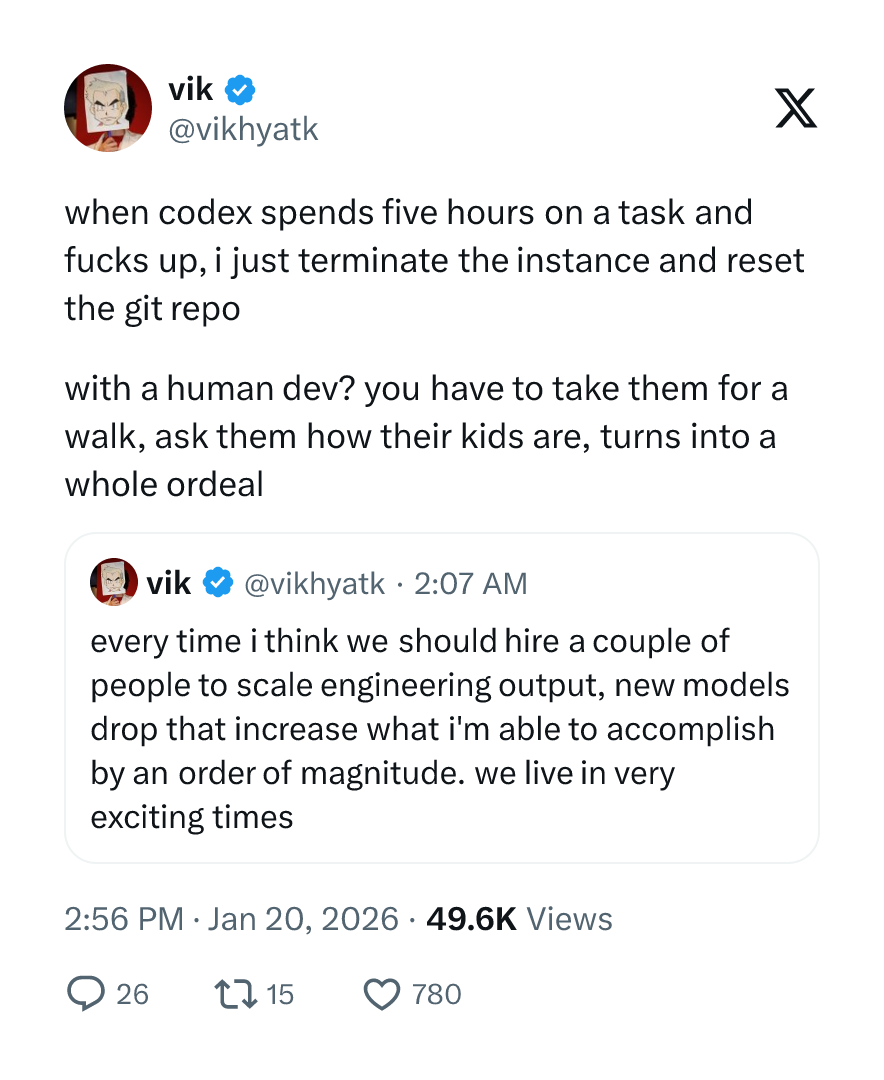
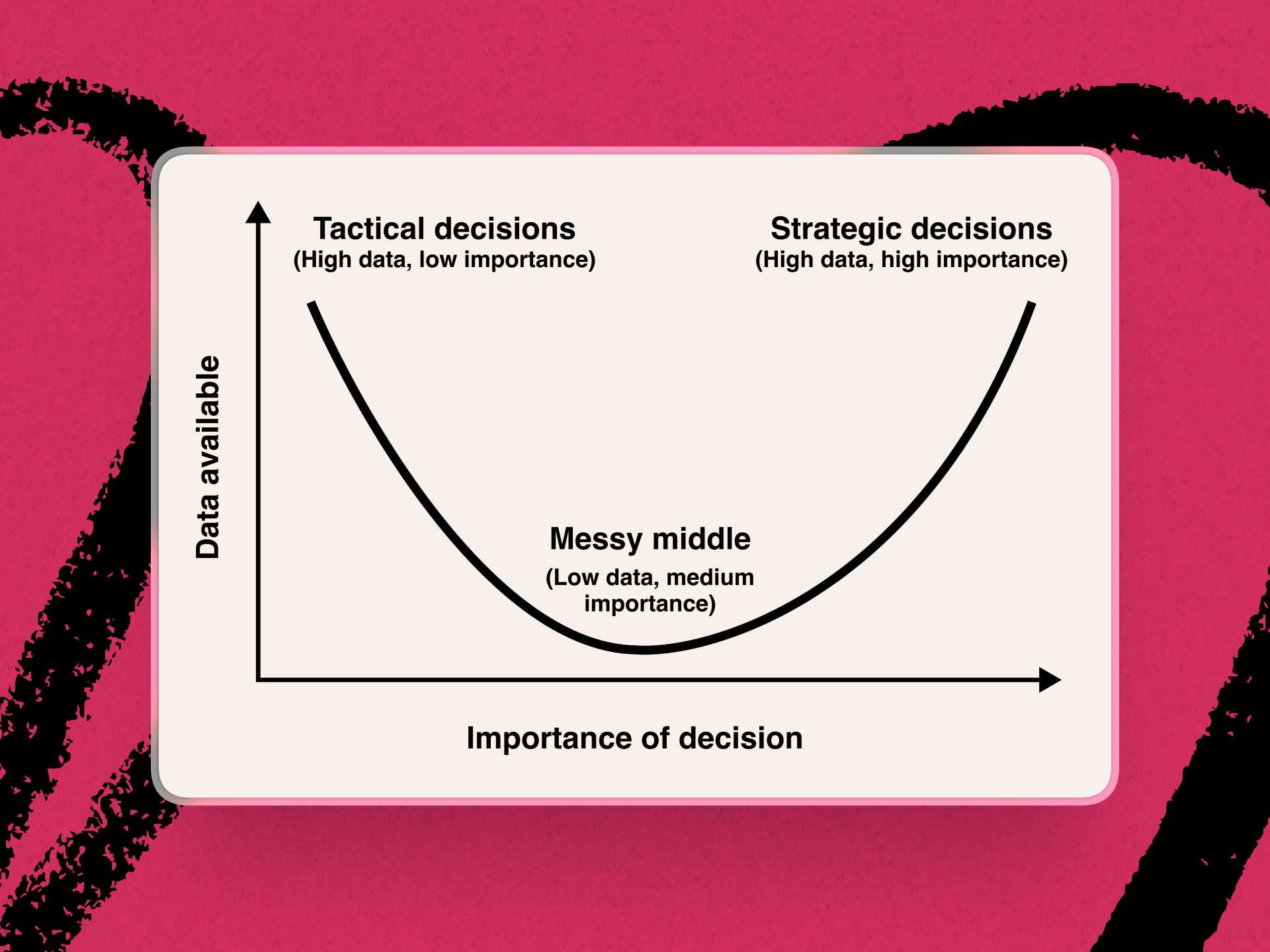
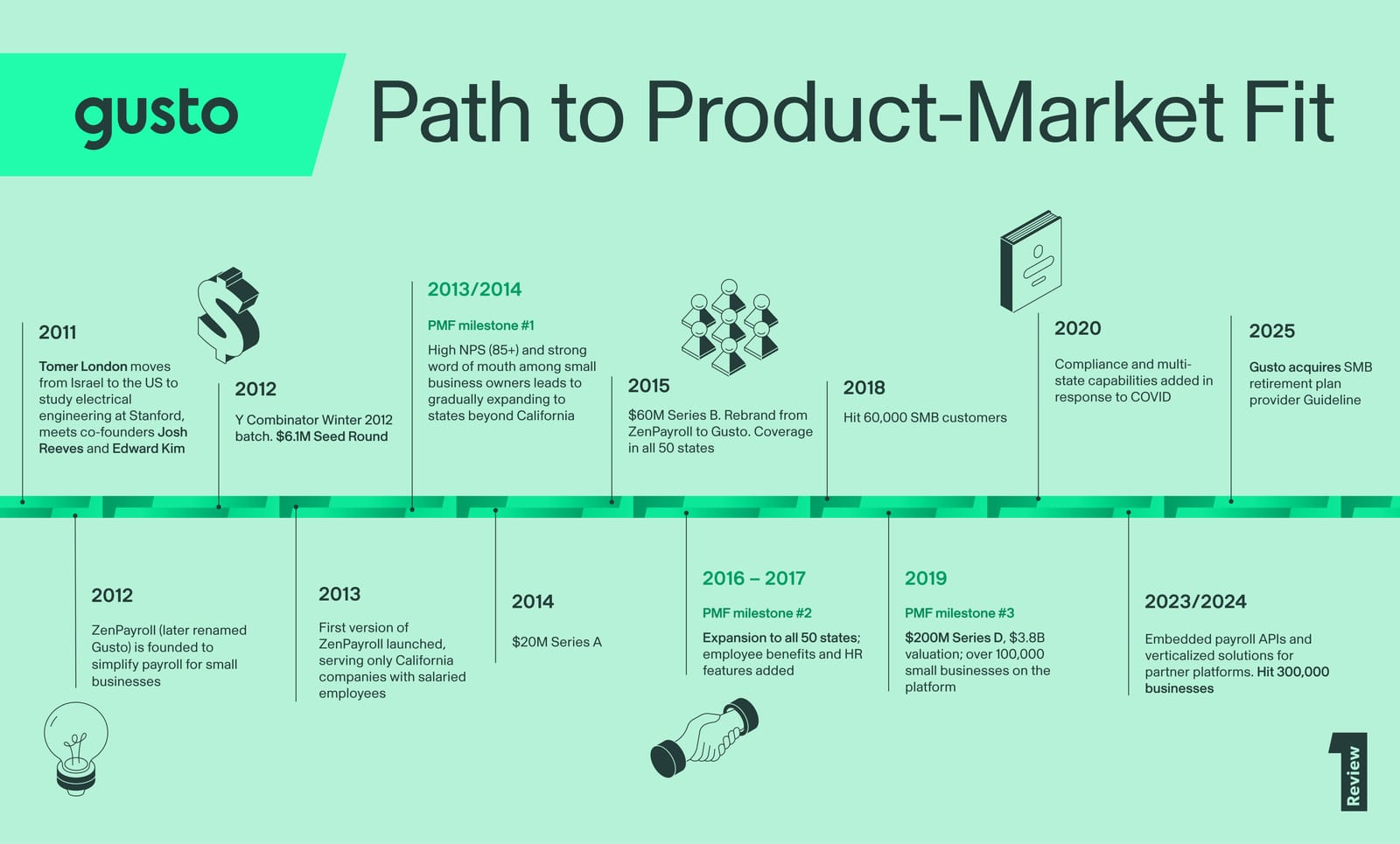


 Happening now: We’re hosting


.png) The bug report was deceptively simple: A user noticed that their email signature formatting was off in
The bug report was deceptively simple: A user noticed that their email signature formatting was off in 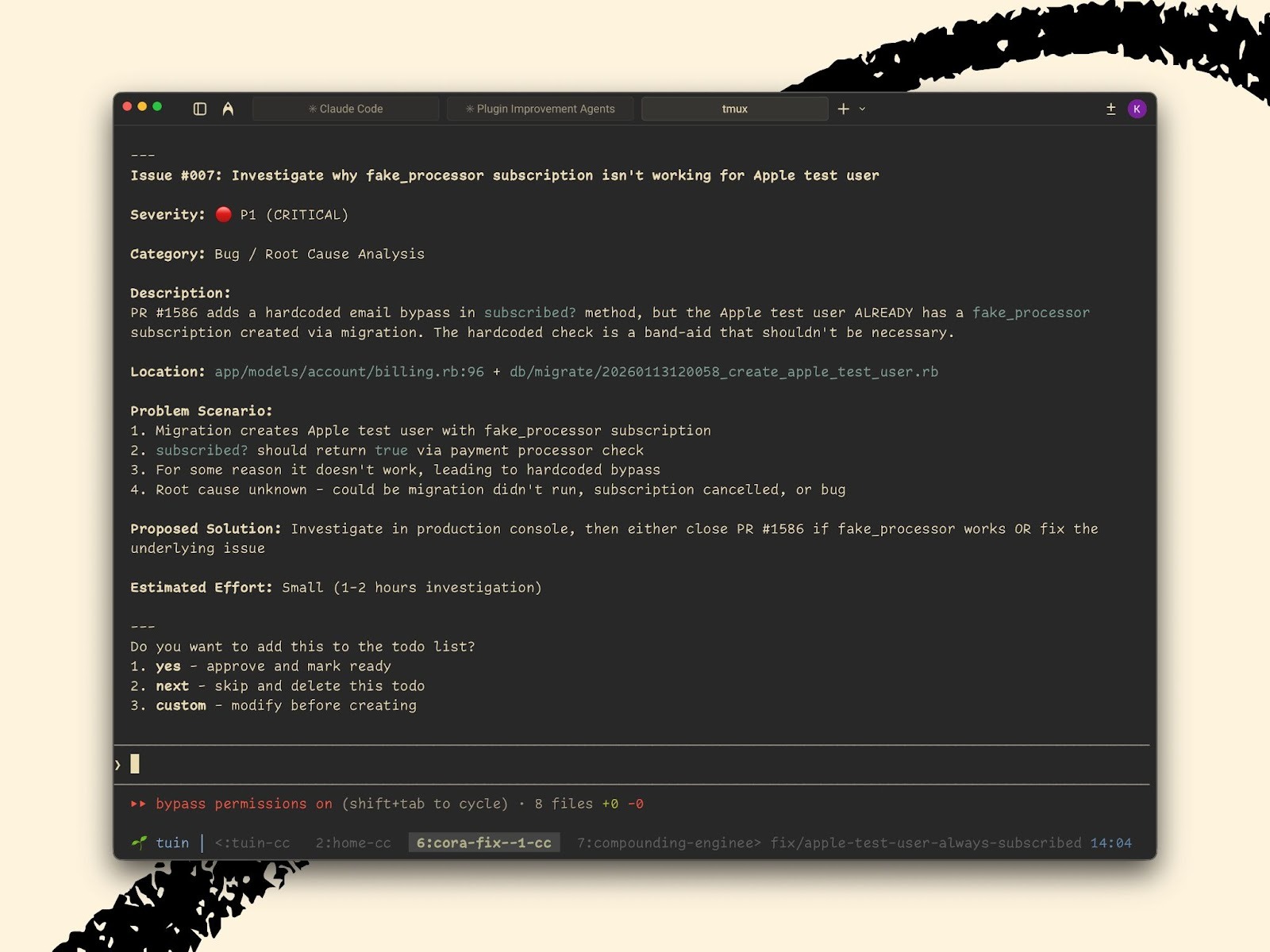


 Hello, and happy Sunday! Last week we hosted a two-day vibe coding extravaganza: On Thursday, some of the world’s best vibe coders were in action at a marathon