Week 3, 2026 · January 12–18, 2026 · 32 newsletters · 236 links · ≈ 2 h 00 min
In this issue
- 8/9: Give your team AI superpowers
- The Boring Businesses That Will Dominate the AI Era
- Join Every's Cursor Camp this Friday for paid subscribers
- EDS #5: Scale Your Work By Writing Online & Speaking at Meetups
- Claude Code for everybody
- 9/9: Upgrade—and unlock exclusive Every perks
- if you're looking to learn about agentic coding, our cohort starts in 24 hours
- An Updated Dentist Office Software Story
- The unconventional growth levers that made Canva a $42B company
- Vibe Check: Claude Cowork Is Claude Code for the Rest of Us
- Eleven Steps to the Epiphany[^1]
- Go Agent-native With Every
- EDS Wrap up: Learn, Deliver, Communicate
- 10/9: Unwrap your Every gifts
- 🎧 Why Your AI Learning Projects Keep Fizzling Out
- Building Agents with the Gemini Interactions API
- Dead Companies Walking
- Agents that keep running
- AI Can Build Anything. Social Dandelions Decide What Spreads.
- A Third Time Up the Roller Coaster
- Free Your Music
- Last chance to register for Every's Cursor Camp—plus, free credits
- Welcome to Pattern Breakers
- Confirm your subscription to matthewstrom.com
- Clouded Judgement 1.16.26 - Platform of Platforms
- Hacker Newsletter #778
- OpenAI Has Some Catching Up to Do
- The 'Vcel' Movement
- Greetings!
- Software That Debugs Itself While I Sleep
- What’s 🔥 in Enterprise IT/VC #481
- Claude Code Takes Pole Position
The Boring Businesses That Will Dominate the AI Era
They’re not the companies with the best models—they’re the ones that own what AI has to flow through.
by Tina He .png) Tina He is back at Every. The writer and investor—now at Pace Capital—explored what happens when AI agents become your primary users last spring. Now she’s going deeper: In a world where AI picks vendors based on ruthless logic, she identifies five kinds of businesses that become irreplaceable. These aren’t the companies with the best models or the slickest interfaces—they’re the ones that own the boring yet essential infrastructure AI must flow through but cannot replace. If you’re building for a future where your customer is an algorithm, this is your map.— Kate Lee__ At 2:17 a.m., your customer fires you and your customer relationship management software. The reason? Their sales rep calculated that your CRM’s $30,000 annual contract only delivers $12,000 in value. There was no meeting and no negotiation—because the sales rep was an AI agent. Agents don’t need training like human users of software, and they don’t have loyalty. They evaluate economics in milliseconds and switch the moment it makes business sense, even in the middle of the night. It’s pure ruthlessness. When AI models commoditize—when the latest GPT, Claude, and Gemini models are all making similar decisions based on similar capabilities—the competitive edge for companies shifts from having the best model to having the infrastructure between algorithmic decisions and real-world consequences. This is the infrastructure that AI can’t route around: the boring, essential systems that control access to data agents need, workflows they must execute, and regulations they can’t bypass. And the next few years will determine who owns this layer while everyone else is still building better AI agents. This infrastructure breaks down into five archetypes. I’ll show you how to recognize which one fits your business, where there are opportunities to build outsize businesses, and how to build a competitive advantage before this window closes. If your edge is a model or a coat of user interface like an app or chatbot, it isn’t a moat. What endures is infrastructure AI must flow through, but cannot replace.
Tina He is back at Every. The writer and investor—now at Pace Capital—explored what happens when AI agents become your primary users last spring. Now she’s going deeper: In a world where AI picks vendors based on ruthless logic, she identifies five kinds of businesses that become irreplaceable. These aren’t the companies with the best models or the slickest interfaces—they’re the ones that own the boring yet essential infrastructure AI must flow through but cannot replace. If you’re building for a future where your customer is an algorithm, this is your map.— Kate Lee__ At 2:17 a.m., your customer fires you and your customer relationship management software. The reason? Their sales rep calculated that your CRM’s $30,000 annual contract only delivers $12,000 in value. There was no meeting and no negotiation—because the sales rep was an AI agent. Agents don’t need training like human users of software, and they don’t have loyalty. They evaluate economics in milliseconds and switch the moment it makes business sense, even in the middle of the night. It’s pure ruthlessness. When AI models commoditize—when the latest GPT, Claude, and Gemini models are all making similar decisions based on similar capabilities—the competitive edge for companies shifts from having the best model to having the infrastructure between algorithmic decisions and real-world consequences. This is the infrastructure that AI can’t route around: the boring, essential systems that control access to data agents need, workflows they must execute, and regulations they can’t bypass. And the next few years will determine who owns this layer while everyone else is still building better AI agents. This infrastructure breaks down into five archetypes. I’ll show you how to recognize which one fits your business, where there are opportunities to build outsize businesses, and how to build a competitive advantage before this window closes. If your edge is a model or a coat of user interface like an app or chatbot, it isn’t a moat. What endures is infrastructure AI must flow through, but cannot replace.
The new infrastructure for software
Before we get into the first archetype, there’s one shift to explain. Think of it like the early internet: Before companies could build Google or Amazon, we needed HTTP and TCP/IP—the invisible communications rules and protocols that let computers talk to each other. We’re in that moment again, but for AI agents. New protocols— AG-UI(agent-user interaction) for agents talking to users, Google’s A2A(agent-to-agent) for agents talking to each other, MCP (model context protocol) for agents using tools—have become the standard pipes and wires. The archetypes I’ll walk through next are maps to where businesses are built as this infrastructure solidifies. When the AI itself becomes cheap and interchangeable, the edge becomes what you feed it and what you can do with its outputs—data it can’t find elsewhere, and actions it can’t take alone. 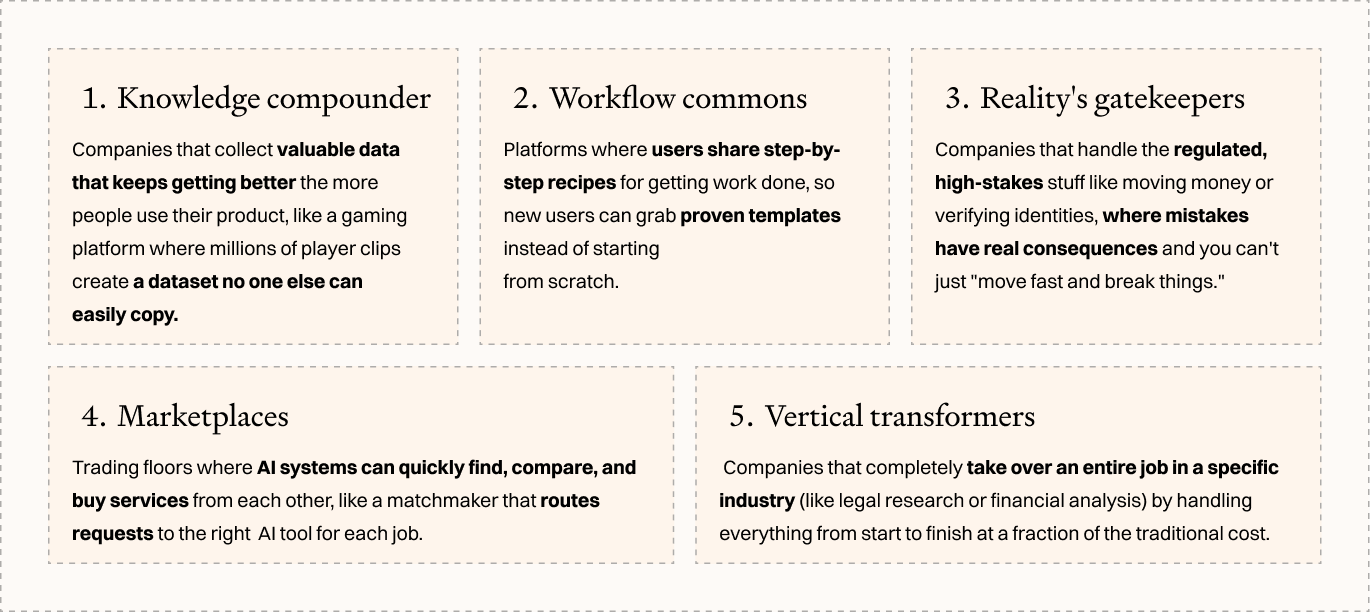 (Source: Tina He and Every.)
Knowledge compounders: Data that learns while you sleep
The first winners are what I call knowledge compounders. These companies control organized data that agents need and that improves continuously through real-world usage, and requires years of operations to replicate. This data isn’t widely available, so most AI agents wouldn’t have it (and it hasn’t been used to train the major models). Every time a player makes a strategic move in a video game or a doctor confirms that a diagnosis made by AI is indeed correct, the dataset grows stronger. That learning stacks up in ways that competitors can’t shortcut through capital alone (similar to the concept of compound engineering). The best companies in this archetype create environments where customers unknowingly generate training data through usage. Medal is a platform where gamers can record and share clips of gameplay. Medal’s community creates over 2 million gaming clips per day —more than 700 million clips per year—each rich with signals about player behavior, reaction timing, and strategic decision-making. At typical data-collection and labeling costs, building an equivalent dataset from scratch would require hundreds of millions of dollars, yet Medal’s users generate it organically in their quest for recognition. Another example of a company building an edge in data is Mercor, which provides feedback from experts such as lawyers and doctors to AI labs to help improve their models. Even if each generation of frontier models is getting better, in domains such as medicine, law, or finance, the cost of errors is high enough that “good enough” AI isn’t acceptable, and ongoing human judgment is essential. Mercor is betting that demand for human-n-the-loop verification persists even as raw capabilities improve. Knowledge compounders aggregate human judgment at scale, like gamers expressing preferences or doctors confirming diagnoses. When AI agents need to check if their outputs match reality, not just sound plausible, they have to consult these datasets. The alternative is hallucination. Examples:Explorium (B2B data infrastructure), Mercor (human-in-the-loop verification), Medal.gg (user-generated training data)
The workflow commons: Templates that capture how work happens
AI agents don’t have eyes. They don’t care about whether or not your software interface is easy to use or aesthetically pleasing. The winners in this category are those that build headless architecture—software designed for direct machine-to-machine connections rather than human interfaces—and build shareable workflows that capture which tools to connect, in what sequence, with what parameters. n8n is a Berlin-based workflow automation platform that illustrates how this model can scale. The platform hosts more than 7,000 community-built workflow templates , each one a shareable blueprint capturing what worked in production. A marketing team in São Paulo can import a template that a growth engineer in New York refined through dozens of iterations. The template works because it survived real-world usage. Between early 2025 and the fall, n8n’s valuation climbed from roughly $300 million to $2.5 billion. Major companies including Vodafone, food delivery giant Delivery Hero, and Microsoft rely on the platform to orchestrate AI‑powered operations. The inflection was not driven by a better interface; after all, agents, not humans, are becoming the key users of software in general. The shift came when the accumulated workflows became the foundation for AI agent coordination. When someone builds an n8n workflow connecting a CRM to email to Slack—specifying “if deal closes, notify team; if any step fails, retry twice”—they capture institutional knowledge about how work happens. That’s thousands of templates and hundreds of integrations that an agent can’t reverse-engineer. This is the flywheel: Users contribute workflows. The platform learns what sequences closed deals, saved hours, or failed. More users arrive for those proven patterns. If you leave, you’re abandoning a shared library that keeps getting better. As AI models become interchangeable, the layer that stitches them together becomes more valuable. This layer pulls from any provider, plugs into any tool, pulls from any data source, and handles everything models don’t: tracking what happened, managing failures, and recovering from errors. The success of the transition from a human workflow builder to an agent coordination layer will be the decisive factor in how big these companies can get. _Examples:n8n (enterprise workflow orchestration), ComfyUI (generative AI workflows), Roboflow (robotics workflow) _
Reality’s gatekeepers: The toll booths between AI and consequences
The third archetype exists in areas where “move fast and break things” is a fireable offense: regulatory approval, banking relationships, compliance infrastructure. When an AI agent wires money to the wrong account, you can’t iterate your way out of it. When it submits a fraudulent insurance claim, you can’t A/B test the regulatory response. This is the layer where silicon logic collides with real-world consequences. Companies that own these “bridges” don’t compete on technical sophistication, but on the boring yet essential guarantee that the wire transfer has arrived correctly in a customer’s bank account. The business model is toll-booth economics: small fees on massive volume that compounds to billions. Stripe, for example, takes roughly 2.9 percent plus 30 cents per transaction. Plaid charges every time an app connects to a bank account. Deel collects a fee on every international contractor payment it processes. The dull is what drives the returns. The alternative to paying the toll is building your own bridge, which could take five years and hundreds of millions annually for compliance—and you still need regulatory approval to touch the payment rails. The Synapse bankruptcy showed what happens when you don’t own the infrastructure. Synapse sat between fintech apps and actual banks, handling transactions so startups didn’t have to build direct banking relationships. Mercury , a business banking platform serving startups, was one of its biggest clients. When Synapse collapsed in 2024 after missing funds and discrepancies in ledgers were discovered, roughly $85 million in customer funds got stuck in limbo. Nobody could tell whose money was where. Hundreds of thousands of people lost access to their savings for weeks; some still haven’t recovered their funds. Mercury survived because it had already begun migrating to Column , a bank built to serve fintechs directly—no middleman or ambiguity about who holds the money. Trust, once earned, hardens into rebar, painful to rip out and expensive to rebuild. Examples:Stripe and Column (financial rails), Deel and Bridge (international compliance), Plaid (financial data access)
The marketplace: Trading floors for algorithmic buyers
Traditional marketplaces like Amazon or Airbnb are built for eyeballs. They rely on visual catalogs, reviews, and human intuition. But AI agents don’t have eyes, and they don’t browse. They connect through code, and they negotiate on price and terms in milliseconds. When a buying agent from a logistics company meets a selling agent from a supplier, it needs a standardized way (such as the agentic commerce protocol developed by Shopify and Stripe) to discover the price, verify delivery, and arbitrate disputes. This creates a new kind of marketplace—not a visual catalog, but a high-speed trading floor for AI services. Initially, companies in this archetype act as “traffic directors.” An agent needs to complete a complex task, and the platform routes that request across dozens of models and data providers, each with different speeds, prices, and reliability. The platform solves for the optimal route. In the example of an agent drafting a contract, it runs compliance checks and pulls recent case law: “Send the reasoning to Anthropic’s Claude Opus 4.5 for legal reasoning, the code execution to a specialized Llama instance for executing the compliance, and the search query about recent rulings to Exa.” Without the platform, a developer stitches this together manually. As usage scales, the traffic director becomes a marketplace. Not Airbnb, where you browse and choose—more like Uber, where the platform picks based on data you can’t see. Every routed request teaches the platform something: which models actually perform, not just which ones claim to. If model A advertises 99 percent accuracy but fails 15 percent of legal queries, only the platform knows. That knowledges gives it leverage over pricing, traffic, and terms. Buyers stay for reliability guarantees; sellers stay for the volume. However, this archetype carries the highest risk. It bets entirely on fragmentation. If foundation models converge on similar capabilities and costs, the value of a routing marketplace collapses. But if the AI landscape stays messy—with models excelling at different tasks, quality varying by use case—then the marketplace becomes essential infrastructure. If fragmentation prevails, these platforms become the universal translators of value. They won’t just route traffic; they will force every buying and selling agent to speak their specific dialect of trade. Examples:OpenRouter (multi-provider LLM routing), Composio (tool integration abstraction), Context7 (default dev tool stack)
Vertical transformation: Replace the workflow, not the worker
Why optimize a job when you can eliminate it entirely? Companies in this category pick industries with high labor costs, complex knowledge requirements, and regulatory barriers—then build AI that handles the entire workflow end-to-end. It’s the same quality at one-tenth the cost. They own the AI, the data, the tools, and the compliance—the entire operation from start to finish. The economics are dramatic. McKinsey charges $2 million for a three-month strategic review involving eight consultants. An AI system might deliver comparable output in 48 hours for $20,000. Traditional law firms dedicate 65 percent of revenue to salaries; AI-driven solutions target human oversight at 5 to 10 percent of costs. A $20,000 two-week legal review can now be executed for $2,000 in two hours. But undercutting on price isn’t enough to win. A simple app built on top of ChatGPT can undercut you on price but has no proprietary moat. By owning the entire workflow—the domain knowledge, the compliance infrastructure, the liability—companies create a lasting advantage. Legal tech company Harvey is a good example of how this works: Lawyers work alongside its engineers, so the product includes insider knowledge specific to how law firms work that generic models can’t infer. These kinds of businesses are defensible because they can prove exactly which expert reviewed which output, when, and why—a paper trail that a weekend prototype can’t provide and a regulatory prerequisite in many of these industries. While for now, Harvey’s contract limits how much they are on the hook for in the case of a malpractice claim, and law firms must accept the risk of there being errors in any AI output. In the future, however, a vendor like Harvey might be able to absorb this risk into its pricing. Finally, these companies have the essential elements large companies look for when procuring software, such as secure login systems, compliance with data storage rules that are unique to specific countries, and security certifications. The companies that prove this in a vertical have hard-to-beat advantages—accumulated data, customer trust, and regulatory relationships. But “wins permanently” overstates it. They win time: a head start that matters if they keep executing and evaporates if they don’t. The test will come when a major firm faces a malpractice claim involving AI-assisted work. Whoever can demonstrate a defensible process will dominate the next decade of enterprise AI in regulated industries. Examples:Harvey (legal), Sierra (customer success), Rogo (financial research)
The common thread: Each archetype compounds
The most interesting combinations haven’t emerged yet. A company accumulates proprietary data, lets users contribute to this data, then becomes the exchange where that data is priced and traded. A workflow platform adds compliance capabilities such as audit trails, using built-up know-how to navigate regulations automatically. Beneath the combinations lies a deeper pattern: Every archetype improves the more it’s used by humans and agents. This is fundamentally different from the software model we’ve known for decades. Traditional SaaS companies shipped updates weekly, maybe monthly. These new businesses ship the latest version every second. The product your customer uses at 3 p.m. is measurably better than the one they used at 9 a.m. because customer interaction data creates new data, refines a workflow, or strengthens a compliance record. This gives them an advantage over the AI labs themselves. OpenAI can train a better model in six months. These companies acquire something harder to copy: institutional memory from millions of real-world transactions. A better model can be trained with enough compute. Institutional memory requires time, customers, and stakes—things money can’t shortcut. One divergence worth noting: Some companies win through horizontal breadth, others through vertical depth. n8n’s workflows apply across industries—marketing, operations, engineering, and finance. Harvey’s value is concentrated in a single domain, where regulatory complexity and liability create natural barriers. Both approaches build on themselves, but they build different things: One accumulates integration knowledge across use cases; the other accumulates domain expertise within a single use case. The horizontal play bets on ubiquity; the vertical play bets on irreplaceability. The model alone is rarely the moat. At 2:17 a.m., your customer’s AI agent will evaluate your value. The winners aren’t building better models or stickier interfaces. They’re building whatever takes the longest to rebuild.
Fetched links (32)
- Every
- Thesis - Every
- The Boring Businesses That Will Dominate the AI Era
- Tina He - Every
- The Boring Businesses That Will Dominate the AI Era
- The Race Is On to Redesign Everything for AI Agents
- Every
- Kate Lee Joins Every as Editor-in-Chief
- AG-UI Overview - Agent User Interaction Protocol
- What is A2A? - A2A Protocol
- What is the Model Context Protocol (MCP)? - Model Context Protocol
- Record, Edit, and Share Your Game Clips & Gameplay - Medal | Medal.tv
- Dutch-based Medal.tv raises €53M for its short-form gaming video platform - Silicon Canals
- AI Workflow Automation Platform - n8n
- Discover 10011 Automation Workflows from the n8n's Community
- n8n raises $180m to get AI closer to value with orchestration – n8n Blog
- Comfy — Professional Control of Visual AI
- Roboflow: Computer vision tools for developers and enterprises
- Online Business Banking For Startups, Small Businesses & Scaling Companies
- What the Synapse BaaS Bankruptcy Means for the Fintech Industry
- Synapse bankruptcy: Trustee says $85 million of customer savings is missing
- Column | The platform bank built for scale
- Vibe Check: Opus 4.5 Is the Coding Model We've Been Waiting For
- Agentic Commerce Protocol
- Can Anyone Compete With Meta’s New AI Model?
- Meet Exa: The Modern Replacement for 'ls' Every Linux User Needs - DEV Community
- Context7 - Up-to-date documentation for LLMs and AI code editors
- Harvey | AI software for legal and professional services
- Platform Agreement | Harvey
- Better customer experiences | Sierra
- Rogo | AI for the most ambitious firms in finance
- Base
Join Every's Cursor Camp this Friday for paid subscribers
Fetched links (17)
- Every
- Every x Cursor Camp
- Every
- Vibe Check: Cursor 2.0 and Composer 1 Alpha
- Vibe Check: Opus 4.5 Is the Coding Model We've Been Waiting For
- Vibe Check: Gemini 3 Pro, A Reliable Workhorse With Surprising Flair
- Give Cora your inbox. Take back your life.
- Spiral – The writing partner for you and your agent.
- Sparkle | Mac Cleaner & AI File Organizer
- Monologue | Effortless voice dictation so you can work 3x faster
- Your CEO Just Said ‘Use AI or Else.’ Here’s What to Do Next.
- ChatGPT and the Future of the Human Mind
- Every
- Every
- Claude Code Camp: The Workflows Turning One Engineer Into Ten
- Everywear
- Every
EDS #5: Scale Your Work By Writing Online & Speaking at Meetups
“What’s the most important skill for a data scientist?”, I asked my mentors. Was it ninja coding abilities? Academia-level research skills? In-depth machine learning know-how? Their response surprised me—it was none of the above. Those were important skills, they said. But I did not ask about the most important, and most transferable, of all—communication. I found this lesson difficult to believe but owed it to them to try it. I started practising my verbal communication by giving talks at meet-ups and conferences. At work, I volunteered to write the data team’s newsletter, engage with stakeholders, and speak at internal roadshows. I started my blog to share and get feedback on my personal writing. The results astounded me. A meet-up I gave landed me a job offer. At work, though there were initial difficulties, the practice helped me communicate better with non-technical stakeholders, leading to increased understanding and trust. By writing more, I exposed gaps in my knowledge. To finish writing, I had to research, fill those gaps, and better understand the material—my learning ability improved. On hindsight, I shouldn’t have been surprised by this lesson. Communication is important for data science. With effective communication, you can persuade better and get buy-in your ideas to push the ML envelope. With effective writing, your methodology and experiments can be replicated, and non-technical stakeholders can understand you better. Furthermore, writing helps you scale yourself—your documents acts as a database that others can consult, instead of going to you. In addition, communication becomes more important as your career progresses. Senior data scientists get more involved with pitching and discussions; they write more docs, less code. Seniors contribute by designing systems, communicating with teams to implement them, and reviewing code. You can’t avoid communication—might as well try to do it well. To begin, let’s start by building a writing habit. Here are my top three tips:
- Write about what excites you: This helps you get over the inertia and makes it easier to build a sustainable writing habit.
- Write for one person: If you try to write for everyone, you write for no one. Focus on one person. It could be your loved one, your boss, or your peers. What do you want to share with that person?
- Write before you’re an expert: Expertise is like a ladder—wherever you’re are on it, there will be people above (that you view as experts) and people below (who view you as an expert). People below want to learn from you—write for them.
Here’s our (last) exercise for Lesson #5 , write about something, anything, and share it. A project at work. A paper you read. Something you learnt, perhaps from this course. The content doesn’t matter. It doesn’t have to be very long too. What matters is that you start. I look forward to your writing. Feel free to tag me (@eugeneyan) if you post on Twitter or LinkedIn. Happy writing, Eugene P.S., You can find more writing tips in this post and here’s a useful note-taking practice to make writing easier. For speaking tips, check out this post on how to give a kick-ass data science talk.
Claude Code for everybody
What is Ralph Wiggum?
The newsletter for the technically curious. Updates, tool reviews, and lay of the land from an exited founder turned investor and forever tinkerer.
Hey folks,
One of my big predictions for this year was “Claude Code for everybody”.
shanice asked me yesterday morning (uk time)
Anthropic’s new research preview, Cowork , is conceptually that. It’s Claude Code with a browser, MCP connectors, skills for documents — i.e. for non-coding work. You could technically do all of this in Claude Desktop before but it’s the abstractions they’ve added to make it more approachable i.e. you don’t need a filesystem MCP now, it just works by selecting a folder.
It’s aimed at non-technical folks, but I think it will make users more technical. Cowork shows the tools, commands and code it writes, so at some point you’ll pick up how agent’s work - and potentially start questioning “whats that command”, “why did you do this” etc. You’ll also notice the context sidepanel - and what is in it and not, which will steer you to think about context engineering.
It’s a very early product with a lot of quirks to be fixed. I tried a couple of things, and it semi works (you can’t create an artifact with AI inside it like you can on claude web). Claire had a some luck. Also, similar to CLI agents, there’s a big and growing number of people who would want custom versions of an app like this. I already saw two of them. Goes back to my ‘personal operating system’ idea and we’re either going to sit in ChatGPT/Claude all day to do work or we’ll want to customise our own apps.
You can make coding agents go on for hours with a plugin called Ralph-wiggum. At the core, it’s just a loop where you start with a big spec document and keep looping through the tasks until everything is done. Anthropic released a plugin for it a couple of weeks ago, but the Ralph creator, Geoffrey Huntley said ‘it’s not it’, so he did a livestream where he talked about the system (for 30 mins) and let Ralph rip for 5 hours adding analytics to his site. Someone else put it to work and built a browser-based UI for SQLite databases.
I created a Ralph skill that you can use with droid, claude code or any agent and try this out. Just point your agent to the repo and say install, then ‘use ralph-skill’. Or Ian built a CLI version which is great.
Gmail is upgrading its Gemini integration in three ways. Suggested Replies, AI Overviews and AI inbox. Suggested Replies show a reply in your voice under an email thread, and they are not bad anymore. AI overviews return a textual answer before the list of emails when you use the search bar in Gmail. The big new feature, “AI Inbox”, creates a daily report of what’s relevant from your entire inbox with priorities and tasks highlighted. The rollout is slow and US first, so you might not see any of these for a few months. Classic Google stuff.
Apple and Google announced that the new Apple Foundation Models will be built on top of Gemini.
Building Voice AI is easy in demos and hard in production. The Speechmatics Startup Program helps founders scale with speech APIs built for real-world audio — accents, cross-talk, background noise, 55+ languages. Accepted startups get up to $50k in credits and Engineering support. **Apply for $50k.
🌐What I’m consuming
-
How I write with AI with Wispr Flow, Claude, and Pangram. (not me btw)
-
Common patterns for agent design that emerged over the past year.
-
Collaborative Intelligence - treating agents as social participants in the multiplayer systems.
-
The team at Ramp put claude code in Rollercoaster Tycoon. They also built their own internal coding agent called Inspect. Here’s why.
-
Exploring how compact conversation works in claude code.
-
Search the way you think with Dropbox Dash, context-aware AI that connects to all your work apps. With Dash, your work files, messages, and projects are in one simple, secure workspace, so you can search across tools, share with context, and keep work moving without juggling a dozen tabs.*
⚙️ Tools and demos
-
Radiant is a Mac app that turns meetings into completed work – follow-up emails, summaries, and other work drafted instantly, with no bots.*
-
Actforge - Let claude code do all your non-coding work.
-
Stagehand Agent - Automate complex workflows with AI-powered browser agents.
-
Do Anything - Complete your to-do lists with agents that work, sleep and have their own identity.
-
Better Shot - Open-source, native macOS screenshot tool. Local and free.
-
Livedocs - A general data agent that works with your spreadsheets, databases and more.
🥣 Dev Dish
-
CallMe, a minimal plugin that lets Claude Code call you on the phone.
-
bash-tool - A dedicated, robust tool for agents to use filesystems and bash.
-
ralph-tui - Connect your coding agent to your task tracker and see agents work in a terminal UI.
-
nanocode - A minimal claude code alternative written in Python.
-
CodexMonitor - MacOS app for running multiple Codex agents with access to your device.
-
Agentboard - Web UI for tmux, optimised for agent TUIs. I think related to running agents from your phone.
🍦 Afters
-
UI Skills - Opinionated constraints for building better interfaces with agents.
-
A skill to let Claude Code fine-tune a model using Thinking Machines’ Tinker.
-
OpenAI acquired Torch, a one-year-old, 4-person company, to work on ChatGPT health.
That’s it for today. Feel free to comment and share your thoughts. 👋
Fetched links (8)
9/9: Upgrade—and unlock exclusive Every perks
if you're looking to learn about agentic coding, our cohort starts in 24 hours
Forwarded this newsletter? Click here to subscribe.
Hey, Last week I announced that I’m joining a research lab now that I can fully use my voice to code, my hands issues aren’t really the limiting factor anymore. And many of you guys replied, asking about my workflows. That said, I spent most of last week revamping our coding material. We’ve added a new Sync 102 section and an Async 101 section that covers the basics while leaving plenty of time for Q&A, conversation, and live coding. This time, instead of just watching us live code, we’re producing a coding project you can follow along with. We’ll share the prompts and plans so you can build alongside us. This cohort, we’re building a coding agent. Here’s some of what you’ll be able to do after: Sync 102 - Commands, Skills & Tools:
- Set up pre-commit hooks and and testing so agents can verify and fix their own mistakes
- Build custom commands like
/gh-commitand/gh-fix-cithat handle 90% of your repetitive cleanup, deployment and packaging - Use Wispr flow + voice to plan 3x faster than typing, and know when to reset context before it degrades
- Create reusable skills that package your team’s preferences and conventions
Async 101 - Background Agents:
- Kick off a task from your phone before bed, wake up to a PR ready for review
- @mention an agent on a GitHub issue or Slack thread and let it work while you’re in meetings
- Run multiple agents in parallel - one fixing the README, another adding tests, another updating an API call
- Turn meeting transcripts into auto-created subtasks that agents start working on immediately
- Build team workflows where agents handle the backlog that never makes it into sprints
If you want to check it out, our course runs Wednesday through Friday (Jan 14-16). | Reserve your spot now, cohort starts in 24 hours
Jason
An Updated Dentist Office Software Story

Back in 2014, I wrote a post called The Dentist Office Software Story that outlined the lack of defensibility in enterprise software. Many people have told me how much they appreciated it when I wrote it.
But we now need an additional "chapter" in the story. An over-the-air update, if you will.
So here it is, with the new chapter in italics:
An entrepreneur, tired of the long waits he is experiencing in his dentist’s office, decides that dentist offices are badly managed. So he designs and builds a comprehensive dentist office management system and brings it to market. The software is expensive, at $25,000 per year per dentist office, but it’s a hit anyway as dentists realize significant cost savings after deploying the system. The company, Dentasoft, grows quickly into a $100mm annual revenue business, goes public, and trades up to a billion dollar valuation.
Two young entrepreneurs graduate from college, and go to YC. They pitch PG on a low cost version of Dentasoft, which will be built on a modern software stock and include mobile apps for the dentist to remotely manage their office from the golf course. PG likes the idea and they are accepted into YC. Their company, Dent.io, gets their product in market quickly and prices it at $5,000 per year per office. Dentists like this new entrant and start switching over in droves. Dentasoft misses its quarter, citing competitive pressures, churn, and declining revenues. Dentasoft stock crashes. Meanwhile, Dent.io does a growth round from Sequoia and hires a CEO out of Workday.
Around this time, an open source community crops up to build an open source version of dental office software. This open source project is called DentOps. The project takes on real life as its leader, a former dentist turned socialist blogger and software developer named NitrousOxide, has a real agenda to disrupt the entire dental industry. A hosted version of DentOps called DentHub is launched and becomes very popular with forward thinking dentist offices that don’t want to be hostage to companies like Dentasoft and Dent.io anymore.
Dentasoft is forced to file for bankruptcy protection while they restructure their $100mm debt round they took a year after going public. Dent.io’s board fires its CEO and begs the founders to come back and take control of the struggling company. NitrousOxide is featured on the cover of Wired as the man who disrupted the dental industry.
A decade later, a Dentist, tired of waiting for the latest update from the DentOps community, decides to vibecode her own custom dental office software product using Claude Code. Even though she has never written a line of code in her life, she keeps prompting, deploying, and modifying the software to meet the unique needs of her office that DentOps never could. She rips out DentOps and deploys her own software suite that she calls Dentsure. Her team loves using her software, and so do her patients.
Support AVCI am a VCShow you appreciate this writer, help support their work, and share in their growth over time by buying their writer coin.Support
The unconventional growth levers that made Canva a $42B company
Cameron Adams barely knew Melanie Perkins and Cliff Obrecht before the three decided to build Canva together. In a recent conversation, Adams shared how he knew it was the right choice, how SEO and localization unlocked massive growth, and more.
Canva’s Path to Product-Market Fit: How a Two-Hour Founder Date Led To a $42B Design Platform
In March 2012, Cameron Adams returned to Sydney from San Francisco at an uncertain moment. The Google alum had just come back from a fundraising trip for Fluent, the email startup he’d co-founded, without securing the backing he’d hoped for. He also had a newborn at home.“We spent two months traipsing up and down Sand Hill Road and all over the Bay Area. We thought we would come back with a novelty-sized check of $2 million. Didn’t pan out that way."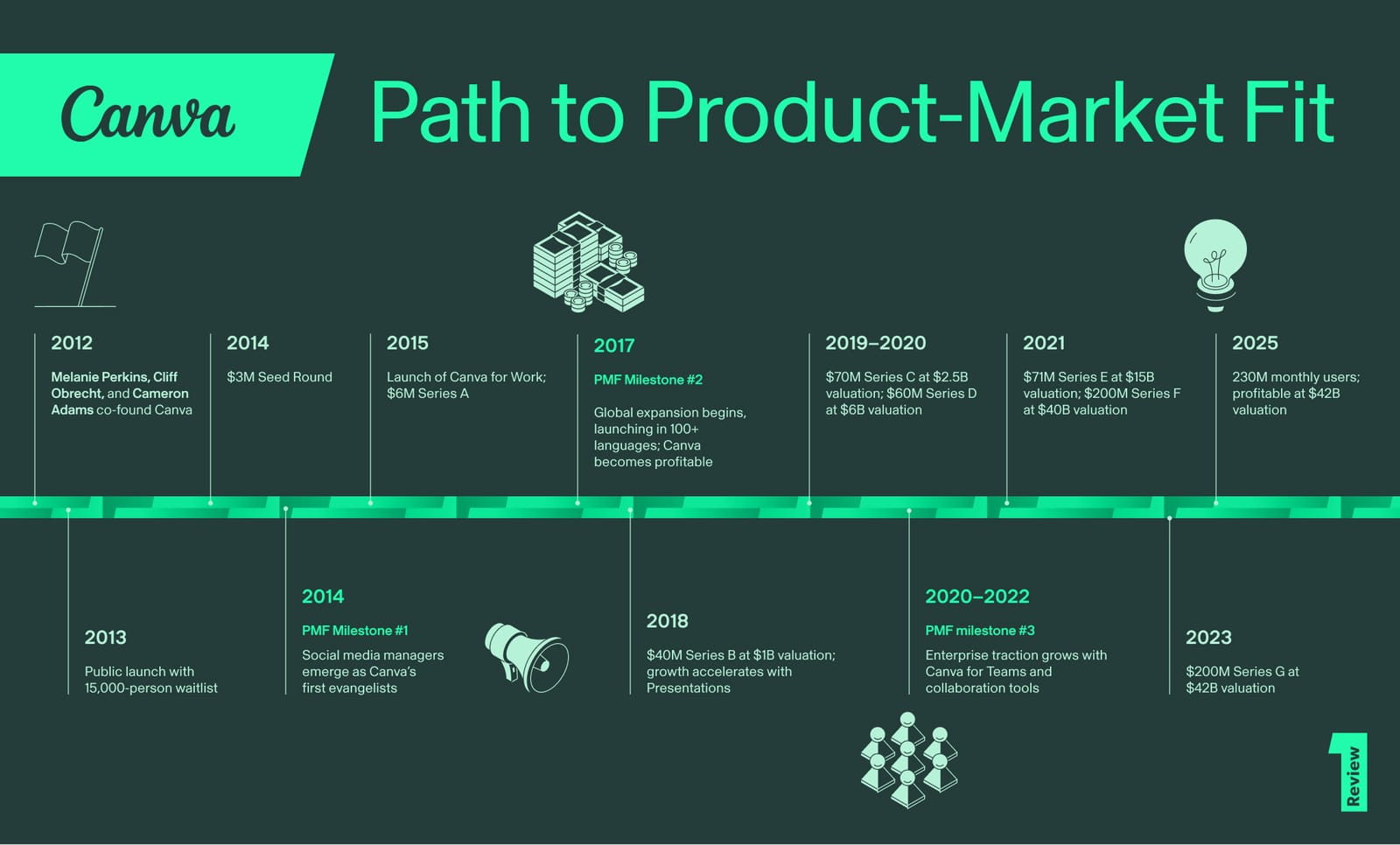 He’d left his role as a user interface designer at Google to give the startup his full attention — a decision that left him taking stock of what came next.That’s when Lars Rasmussen , the co-founder of Google Maps and Adams’s former boss at Google, came to him with a serendipitous suggestion, encouraging Adams to meet a young entrepreneur he’d recently been introduced to: Melanie Perkins. Perkins, with her partner Cliff Obrecht , had built an online yearbook business called Fusion Books, which was pulling in $2-3 million a year.But they had their eyes on a much bigger prize. If students could easily create and publish their own yearbooks online with zero design skills, it stood to reason that with the right tools, anyone should be able to design anything …| Continue reading on The Review
Made with ✨ by First Round Capital.
Vibe Check: Claude Cowork Is Claude Code for the Rest of Us
Fetched links (30)
- Every
- Vibe Check - Every
- Vibe Check: Claude Cowork Is Claude Code for the Rest of Us
- Katie Parrott - Every
- Every
- Vibe Check: Claude 3.7 Sonnet and Claude Code
- Vibe Check: Opus 4.5 Is the Coding Model We've Been Waiting For
- Dan Shipper - Every
- Cowork: Claude Code power for knowledge work | Claude by Anthropic
- Kieran Klaassen - Every
- AI & I - Podcast - Apple Podcasts
- Vibe Check: Claude Code Now Works on Mobile and the Web
- Vibe Check: Claude Skills Need a ‘Share’ Button
- Give Cora your inbox. Take back your life.
- Agent-native Architectures
- Toward a Definition of AGI
- DHH (@dhh) / X
- Felix Rieseberg (@felixrieseberg) / X
- Claude Code in a Trenchcoat
- 🎧 He’s Building the Plumbing for AI to Use the Internet
- How I Run Three AI Models in Parallel Without Losing My Mind
- My AI Had Already Fixed the Code Before I Saw It
- We Tried OpenAI’s New Deep Research—Here’s What We Found
- Every
- Every
- Spiral – The writing partner for you and your agent.
- Every Inc. | LinkedIn
- Sparkle | Mac Cleaner & AI File Organizer
- Monologue | Effortless voice dictation so you can work 3x faster
- Every Consulting - AI Strategy & Implementation
Eleven Steps to the Epiphany[^1]
Go Agent-native With Every
Learn to build with AI agents in two hands-on camps—plus get a free 30-day trial
by Austin Tedesco  TLDR: The Every team is going all in on the agent-native moment—and new subscribers can get their first 30 days free. Join us forVibe Code Camp on January 22 andAgent-native Camp on January 23 to learn from the best vibe coders in the world and get hands-on with agent-native software. Sign up and RSVP Over the past week, I’ve watched the team at Every get completely obsessed with this agent-native moment. Monologue general manager Naveen Naidu and Every’s head of platform Willie Williams were vibe coding through the weekend, pushing agents to act as first-class citizens inside of apps—or, as Dan Shipper coined, to work like “Claude Code in a trench coat.” Naveen built a read-later app in two hours that quickly understood his reading patterns better than he does. Dan himself built Proof , an agent-native markdown editor that tracks AI versus human writing, without writing any code. The non-engineers on the team are unleashing agents to help them do their jobs better, including strategy planning, copywriting, and building landing pages. This is what it feels like to be inside a paradigm shift while it’s happening. And the movement is growing. Thousands of Every subscribers are reading this agent-native guide in conversation with Claude or ChatGPT. Nearly 15,000 viewers tuned into our live Vibe Check of Claude Cowork on X. We see the energy to stay at the edge of what’s possible, and we’re going all in on bringing you along for the ride.
  On Thursday, January 22, we’re hosting Vibe Code Camp: All-day Edition , open to everyone. We’ve recruited the very best vibe coders in the world for a marathon livestream. Logan Kilpatrick , Ryan Carson , Ben Tossell , Tina He , Nat Eliason , Ashe Magalhaes and more experts will join the Every team to show off in real time what they’re most excited about that didn’t exist even two months ago. We’ll follow up with step-by-step guides on how to take these demos and apply them as frameworks for your own work. Then, on Friday, January 23, paid subscribers can join our first Agent-native Camp , led by Dan. We’ll walk through agent-native architectures from first principles to working products. After watching experts operate at the frontier of the space, we’ll show you in-depth how agent-native software works and how to use it effectively. Plus, there’s even more coming, and we don’t want you to miss out. From now until February 13, all new paid Every subscribers will get their first 30 days free. This is the perfect time to join: Use our speech-to-text tool Monologue to chat with Claude about agent-native software, join our Discord community of vibe coding obsessives, and get cutting-edge ideas daily as we explore this future in real time. Start your free trial and RSVP for both camps: Sign up and RSVP
Fetched links (31)
- Every
- Go Agent-native With Every
- On Every - Every
- Austin Tedesco - Every
- Every
- Agent-native Architectures: How to Build Apps After the End of Code
- Every
- Naveen Naidu - Every
- Dan Shipper - Every
- Monologue | Effortless voice dictation so you can work 3x faster
- Building an Agent-Native Read Later App in 2 Hours | Naveen Naidu
- Agent-native Architectures
- Vibe Check: Claude Cowork Is Claude Code for the Rest of Us
- Vibe Coding Marathon
- Every
- Logan Kilpatrick (@OfficialLoganK) / X
- Ryan Carson (@ryancarson) / X
- Ben Tossell (@bentossell) / X
- Tina He (@fkpxls) / X
- Nat Eliason (@nateliason) / X
- ashe (@ashebytes) / X
- Agent-native Camp
- Austin Tedesco Joins Every as Head of Growth
- Every
- Every
- Every Inc. | LinkedIn
- Spiral – The writing partner for you and your agent.
- Sparkle | Mac Cleaner & AI File Organizer
- Give Cora your inbox. Take back your life.
- Every Consulting - AI Strategy & Implementation
- Every
EDS Wrap up: Learn, Deliver, Communicate
Thanks for sticking throughout this course—I hope it’s been useful. So, what’s next? We close the loop with Lesson #1: Learn better by doing. I’ve shared my hard-won lessons from interviews with experts, observing other data scientists, and my own mistakes. That’s as far as I can go—now, it’s up to you to apply them. To recap, here are the five lessons.
- Learn better by doing data science projects
- Learn more by experimenting and iterating quickly
- Deliver the right things by working backwards
- Deliver sustainably by being production-aware
- Communicate to reinforce learning and scale yourself
Wait, so there’s nothing related to coding or ML? Well, those are important, but I find them more of a minimum bar—as a data scientist, you’re kinda expected to be proficient in them. Also, there’s lots of articles and tutorials on those topics already. Start applying these lessons today. Have a bias for action and iterate on your learning. Do the exercises you’ve not completed—they’ll help reinforce your learning. From next week, I’ll send you weekly writing about Effective data science, Productivity, and Growth. You can read past archives here. I’m rooting for you, Eugene P.S., This course was a lot of effort—would appreciate your feedback via this 6-question survey!
10/9: Unwrap your Every gifts
🎧 Why Your AI Learning Projects Keep Fizzling Out
Founder Nir Zicherman on what general-purpose LLMs can’t do—and what real learning requires
by Rhea Purohit 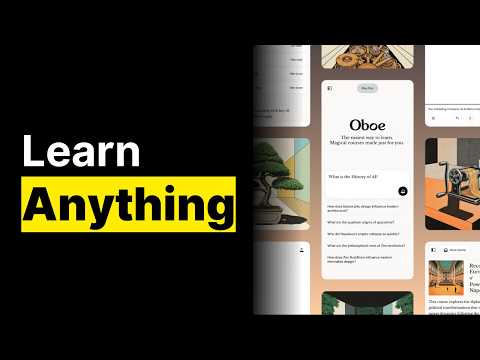 Nir Zicherman. TL;DR: Today, we’re releasing a new episode of our podcast AI& I, whereDan Shipper sits down withNir Zicherman , the CEO and cofounder of AI learning platform Oboe , to talk about how to use LLMs to teach yourself anything. Watch onX or YouTube, or listen on Spotify or Apple Podcasts. LLMs have made it absurdly easy to go deep on almost any topic. So why haven’t we all used ChatGPT to earn college degrees we wished we had majored in or pursued a niche interest, like learning how to name the trees in our neighborhood? I know I’m not the only one to feel guilty for well-intentioned attempts at autodidactism that inevitably peter out. Entrepreneur Nir Zicherman has a reason for this disconnect: LLMs can answer most of your questions, but they won’t notice when you’re lost or pull you back in when your motivation starts to fade. As the CEO and cofounder of Oboe , a platform that generates personalized courses about everything from the history of snowboarding to JavaScript fundamentals using AI, Zicherman has thought deeply about why the ability to access information does not automatically lead to understanding a concept. In this episode of AI& I, he talks to Dan Shipper about everything he’s learned about learning with LLMs. They get into Zicherman’s counterintuitive belief that learning is a more passive process than you’d think, the biggest blocker for most people who want to learn something new, and where AI agents currently fall short in providing a meaningful learning experience. Previously, Zicherman was the cofounder of Anchor , the world’s largest podcasting platform, and the vice president and global head of audiobooks at Spotify. He’s also contributed to Every. Here is a link to the episode transcript. You can check out their full conversation: Here are some of the themes they touch on:
What LLMs have taught Zicherman about learning
Zicherman believes that the method—or process—of learning is fundamentally passive, even if someone is proactive about wanting to acquire knowledge. Think back to high school. Broadly speaking, the primary way you mastered new concepts was by listening passively to the instructor deliver material. “The teacher was not asking you questions about how best to structure the course and where to go next,” he says. In contrast, while LLMs have made it astonishingly easy to access information, they often shift the burden of teaching onto the learner. They require you to be “ very explicit around what you want to achieve and how you want to achieve it,” and to provide constant feedback to continue learning meaningfully, he says. In other words, LLMs are generalists by design. To get useful results, you have to know how to prompt them well —which means the learner ends up doing work that a teacher would normally handle, like making a curriculum and deciding the pace of learning. As he builds Oboe, these are a few principles Zicherman has gleaned about using LLMs to meaningfully understand new concepts.
Keep the learner motivated—without them having to ask for it
Dan shared his own experience of using AI to learn: When o3 gained the ability to set reminders, Dan prompted the model to remind him and provide material to walk him through Andrej Karpathy’s YouTube course about building a language model, section by section. It worked well for a while, until he hit a difficult section and let a few days slip. By then, the friction of getting back into the material was too much, and he stopped trying altogether. The problem was that the model didn’t try to re-engage him when his motivation waned, as any good teacher would have. Zicherman agrees. “The teacher would be able to read the room,” he says. “[They] would know, ‘Hold on a second, it’s been a week since we last covered this, I need to reinforce certain material.’” The onus can’t be on the student to ask for that. He sees this as a limitation of the early days of agentic AI: Agents still need guardrails to deliver outputs consistently, and to truly “read the room,” an agent would need more autonomy—specifically, the autonomy to reassess its own approach, including changing the guardrails it operates under, without requiring the user to step in and course-correct.
Present information in multiple formats
A big part of Zicherman’s thesis is multimodality. Before AI, when you wanted to learn something, you’d probably read an article or two, skim a subreddit, watch a YouTube video, maybe listen to a podcast. That’s how we actually learn, he argues—and it’s where the bare text output of general-purpose LLMs falls short. A good learning platform needs to make a pedagogical judgment call for its users: “What is the right thing to show you [and] what is the right format to show you at any given time.” Oboe adapts the format of the course to its subject matter: more graphics for a course on quantum tunneling, fewer for one on Ludwig Wittgenstein (though it did throw in a great photo of the philosopher). The platform also generates a podcast for every course, but keeps the episodes separate from the main flow. Users click into it when they want that experience because as Zicherman sees it, people usually listen to podcasts when they are in a different state of mind or at a different time of day than when they sit down with a visual course.
Make the experience feel achievable rather than overwhelming
Zicherman believes one of the biggest blockers to learning is people convincing themselves that a topic is too intimidating to tackle. He walks the walk: He didn’t major in math or physics, but he was fascinated by both. It took him years to realize he could just teach himself—and now he has, diving deep into quantum mechanics and the history of early physics experiments. This shapes how he thinks about course design. The experience needs to feel “very piecemeal and achievable”—lightweight enough that you’re not daunted by it, while still being meaningful in the learning process. One way Oboe does that is through milestones: embedded quizzes that engage the learner and reinforce what they’ve covered, appearing at moments when the program decides it’s time to check understanding. What do you use AI for? Have you found any interesting or surprising use cases? We want to hear from you—and we might even interview you. Timestamps
- Introduction: 00:00:36
- Why you need a dedicated AI learning app: 00:01:49
- The process of learning is more passive than you might think: 00:04:32
- Live demo of Oboe to create a course about philosopher Ludwig Wittgenstein: 00:10:21
- Learning works best when it comes in many formats: 00:16:52
- Where AI agents currently fall short in the learning experience: 00:28:21
- The importance of making learning feel accessible: 00:34:10
- How Zicherman uses Oboe to learn quantum physics: 00:35:56
- How embeddings spaces remind Dan of quantum mechanics: 00:40:54
You can check out the episode on X, Spotify, Apple Podcasts, or YouTube. Links are below:
- Watch on X
- Watch on YouTube
- Listen on Spotify (make sure to follow to help us rank!)
- Listen on Apple Podcasts
Miss an episode? Catch up on Dan’s recent conversations with founding executive editor of Wired Kevin Kelly , star podcaster Dwarkesh Patel , LinkedIn cofounder Reid Hoffman , ChatPRD founder Claire Vo , economist Tyler Cowen , writer and entrepreneur David Perell , founder and newsletter operator Ben Tossell , and others, and learn how they use AI to think, create, and relate. If you’re enjoying the podcast, here are a few things I recommend:
- Subscribe to Every
- Follow Dan on X
- Subscribe to Every’s YouTube channel
Fetched links (33)
- Every
- 🎧 Why Your AI Learning Projects Keep Fizzling Out
- AI & I - Every
- Rhea Purohit - Every
- Dan Shipper - Every
- Oboe — Learn anything
- Home
- Why Your AI Learning Projects … - AI & I - Apple Podcasts
- Every
- Nir Zicherman - Every
- Tools to manage and grow your podcast - Spotify for Creators
- Transcript: 'Why Your AI Learning Projects Keep Fizzling Out'
- The Ultimate Guide to Prompt Engineering
- The Key to Great AI Prompting? Show, Don’t Tell
- Why o3 Is the Best Model Yet for Real-world Learning
- 🎧 How to Predict the Future Like Kevin Kelly
- 🎧 Dwarkesh Patel’s Quest to Learn Everything
- 🎧 Reid Hoffman on How AI Might Answer Our Biggest Questions
- 🎧 She Built an AI Product Manager Bringing in Six Figures—As A Side Hustle
- Economist Tyler Cowen on How ChatGPT Is Changing Your Job
- How David Perell Uses ChatGPT to Write for Millions
- 🎧 How to Run a Profitable One-person Internet Business Using AI
- Every
- Dan Shipper 📧 (@danshipper) / X
- Rhea (@RheaPurohit1) / X
- Every
- Every 📧 (@every) / X
- Every Inc. | LinkedIn
- Sparkle | Mac Cleaner & AI File Organizer
- Spiral – The writing partner for you and your agent.
- Give Cora your inbox. Take back your life.
- Every Consulting - AI Strategy & Implementation
- Monologue | Effortless voice dictation so you can work 3x faster
Building Agents with the Gemini Interactions API
Dead Companies Walking
Fetched links (6)
- Tomasz Tunguz
- Theory Ventures — AI-Focused Venture Capital
- Dead Companies Walking | Tomasz Tunguz
- The Growth Premium Persists in SaaS Valuations | Tomasz Tunguz
- Where is the Budget for AI Coming From? | Tomasz Tunguz
- Dead Companies Walking: How A Hedge Fund Manager Finds Opportunity in Unexpected Places: Fearon, Scott, Powell, Jesse: 9781137279644: Amazon.com: Books
Agents that keep running
plus a promise of personalization and useful skills
The newsletter for the technically curious. Updates, tool reviews, and lay of the land from an exited founder turned investor and forever tinkerer.
Hey folks,
I just posted a little video walkthrough of something I built! I gave a tweet of a video to droid, said reverse engineer this and rebuild it (and it did!) It lets you have a little dashboard for agents looping on tasks (or you can use GitHub issues). Super fun little project to test out how easy it is to point at a video and reverse engineer something in a morning. Enjoy!
Cursor let agents build a web browser from scratch by letting them run for about a week. They found GPT-5.2 to be the best model for longer, more autonomous work (vs. Opus 4.5) and prompts to matter more than they expected. Also, OpenAI just made GPT-5.2-Codex available in the API, i.e. it’s available in Droid, Cursor, Windsurf and other apps too.
Claude Code can now search the right tool from your MCP server without clogging up all of your context window. Also, you can now add a comment by pressing tab when accepting/rejecting a permission prompt, i.e. “yes, and {do it this way}.”
Anthropic is expanding its experiments garage. Anthropic’s Labs team is hiring builders to create new products like Claude Code, MCP, and Claude in Chrome under Mike Krieger and Ben Mann.
Google is adding Personal Intelligence i.e. deep data integration with your Gmail, Photos, YouTube history and more into the Gemini app. I tried testing it, but it’s US only, and I’m very suspicious of it working as well as the demos show.
I’ll be joining Every for their Vibe Code Camp - where a bunch of us ‘vibe-coders’ will be building stuff, sharing what we did and tips. Other folks you know will be there!
🌐What I’m consuming
-
AI may unleash the most entrepreneurial generation we’ve ever seen.
-
How do you store and retrieve information from the web in a database?
-
2026: This is AGI. A case for long-running agents satisfying a functional definition of AGI.
-
Understanding Manus sandbox - your cloud computer.
-
Give your agent a laboratory, not a task.
⚙️ Tools and demos
-
Scroll.ai turns any knowledge base into an enterprise-grade chatbot. Tap into accuracy and depth that generic models can’t touch.*
-
1code by 21st.dev - Calm, visual client for real code work. open-source.
-
Slackbot is now AI powered. It can create canvases, search and access messages, uploaded documents etc. and more.
-
Skillsync - Find elite (but overlooked!) engineers on GitHub based on what they have actually built.
🥣 Dev Dish
-
json-render - Let AI render UI on demand based on your defined catalogue.
-
agent-browser - Browser automation CLI for AI agents.
-
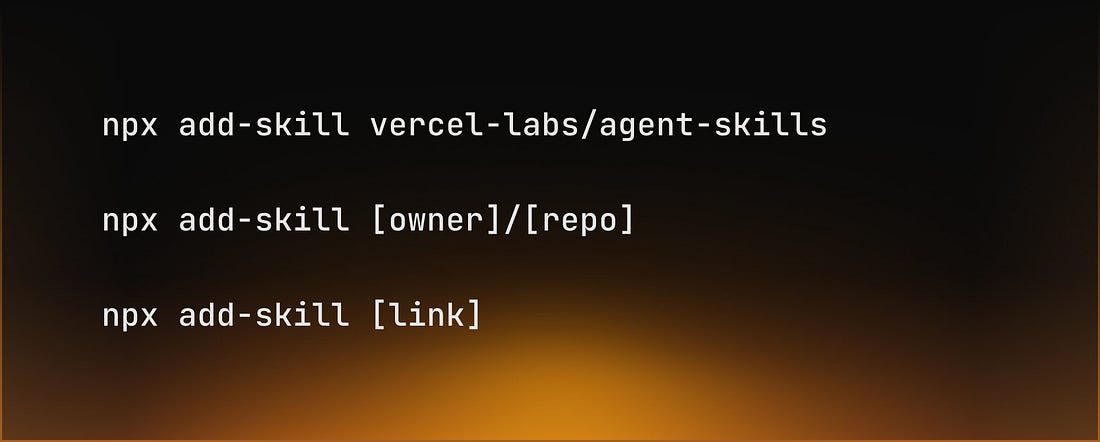
react-best-practices - Vercel released this skill with a collection of documents on how to code better with React. (read more)
-
npx add-skill - run this command and install any skill for your coding agents.
🍦 Afters
-
Google released new open-source models for medical usecases - MedGemma 1.5 4B and MedASR.
-
Delphi is hiring a designer for its consumer product.
-
Three of Thinking Machines’ six original co-founders are back at OpenAI.
That’s it for today. Feel free to comment and share your thoughts. 👋
Fetched links (7)
- Agents that keep running - Ben's Bites
- Comments - Agents that keep running - Ben's Bites
- Introducing the Substack app
- Scaling long-running autonomous coding · Cursor
- Introducing: React Best Practices - Vercel
- david fant on X: "@leerob the custom harness https://t.co/BE0uyajI8z" / X
- Ben Tossell - Ben's Bites | LinkedIn
AI Can Build Anything. Social Dandelions Decide What Spreads.
When everyone can build and market with AI, the founders who win are the ones who master how trust spreads through communities
by Lewis Kallow  #### Sponsored By:
Executing an AI-first strategy with Box
Box, the leading intelligent content management company, is breaking down how it structures experiments, frameworks for AI principles, and more in its “Executing AI-First” series. In it, you’ll discover how to turn a raw idea into a strategic AI powerhouse, and get a step-by-step playbook for empowering teams to thrive in the era of AI. You’ll learn:
- How Box approached becoming AI-first through its value realization strategy
- How to deploy agents with an Ideate>Pilot>Rollout>Scale plan
- How to identify and empower AI managers
- How to measure what matters by tracking AI agent impact
In 1933, the state of Iowa was facing catastrophe. Decades of outdated farming practices had left the state’s crops weak and vulnerable. Fifty percent of the year’s harvest was already rotting in the field due to a market crash, and severe dust storms were threatening to turn an economic disaster into a wholesale agricultural apocalypse. Then, hope arrived : “hybrid corn,” a miraculous new seed capable of producing healthy crops that were easy to harvest and could thrive even in drought. But after a year of expensive sales campaigns and educational pushes, officials were baffled. While 70 percent of Iowa’s farmers knew about hybrid corn, less than 1 percent had adopted this perfect solution. “A man doesn’t just try anything new right away,” one farmer reasoned. As insane as this example seems, rejection is in fact the normfor great, new ideas, even when people are aware of the benefits. Take the seatbelt. By the mid-70s, 91 percent of U.S. drivers knew it saved lives, yet only 11 percent actually wore one. AI may seem like the exception to this rule; ChatGPT exploded to 1 million users in just five days. But OpenAI had been trying to sell GPT 3.5 to executives for months with no success, and despite the model’s power, quarterly revenue was only $15 million. ChatGPT succeeded because OpenAI finally understood sociology—the same sociology that was essential for the eventual adoption of hybrid corn, the seatbelt, and almost every great idea that eventually gained widespread popularity. Recent research has cracked the code on what these sociological forces are. I’ll explain how these dynamics determine whether humans decide to embrace something new, how they relate to winning trust within a community, and how you can harness them to drive adoption for your own business. AI has made it faster than ever to build and market products, and the channels we’ve long relied on are saturated. Harnessing the power of trust and community is the one of the last remaining ways for builders and creators to secure a competitive edge.
Low risk is viral. High risk is social.
Iowa’s corn conundrum puzzled scientists for the better part of the 20th century, but a review published in Nature Communications in 2024 uncovered the secret after more than 90 years by doing a broad analysis of the research to that point. “The key insight,” the researchers write, “lies in the fundamental distinction between simple and complex contagions.” A simple contagion is defined by low risk. Think of a funny viral cat video—free to consume, easy to share, and socially safe. You only need to watch it once to decide to send it to your friend. When the risk is clearly low, “a single exposure to an agent can be sufficient for transmission to occur.” Complex contagions, on the other hand, are ideas that “require individuals to make a substantial personal investment due to the costs or risks involved, including reputational or social risks, personal risks, and personal effort.” Will this expensive corn seed actually grow? Is this new software worth the time to learn? Will I look foolish for wearing this seatbelt? When the risk of adoption is high, a single recommendation is rarely enough to move us; we need social reinforcement—to see others using it—before we decide to take the plunge. This explains Iowa’s farmers: They were reluctant to embrace this risky new idea after a single visit from a salesperson, because no other farmers in their trusted network were recommending it. They weren’t ignorant; they were cautious. We embrace complex contagions based on norms, not knowledge. So where do you find an environment in which people can be exposed to your new idea by multiple different others?
Density before distribution
This was the challenge that the founders of Airbnb faced in 2008. Despite receiving national news coverage for a viral cereal box stunt , the site was making $800 in revenue per month. The founders were contemplating giving up. After all, if no one uses your product after national news coverage, will they ever? Staying in a stranger’s house is a risky behavior that defied the social norms of the day—the perfect example of a complex contagion. One news broadcast was not enough to convince people. So they flew to New York City to meet around 30 hosts in person. The founders took them for beers, 10 people at a time, and stayed in touch after returning to California. They turned those few users into evangelists, and Airbnb finally took off. These beer meetings created the specific network structure required for a complex contagion to spread. Social scientists call these structures “wide bridges.” A wide bridge is where you have multiple points of interaction with a complex contagion—you hear about it from several different contacts. The more contacts who recommend something, the wider the bridge. These bridges are widest inside tight-knit communities where individuals have a large number of overlapping mutual connections. If you can convince even a small subsection of a narrow community to adopt your idea—whether it’s an office, an online forum, or a pickleball club—then a magical cascade can unfold. As your small subsection pings other members multiple times about the new idea, they gradually convert each member until they take over the whole group. This pattern extends to the most advanced technology of our time. One hundred and thirty-five thousand people visited ChatGPT on its launch day. They weren’t random internet users. They were AI safety researchers, Silicon Valley developers, and machine learning experts who had been following OpenAI’s progress for a long time. These groups had spent years forming wide bridges in passionate physical and online communities. The people who initially propelled ChatGPT to millions by the end of the first week were embedded in remarkably fertile networks. This is exactly how many of the biggest winners in AI have emerged. Midjourney didn’t launch with a Superbowl ad; the company started on a Discord server. The CEO of Jasper AI, an early winner in AI-powered marketing, admitted that the company’s primary growth strategy was posting templates in a Facebook group for marketers. Meeting transcription tool Granola started by targeting venture capitalists. This is the same mechanism that solved our hybrid corn conundrum. Farmers didn’t adopt the seed because a scientist told them to; they adopted it once they saw their trusted neighbors succeed with it (who those early adopters were exactly will be revealed shortly). The sociology of complex contagions is the dark matter of product adoption. It all hinges on community, and finding the right individuals in those communities to become champions of a new, daring idea or technology, which brings us to three questions:
- Which community should you target?
- Who within that community should you approach first?
- How do you convince them to take the risk?
Let’s tackle each of those one by one.
1. Which community should you target?
If complex contagions require wide bridges to cross, then your first job is to find the right canyon to span. Some founders know their community from the start. When a consultant asked Strava co-founder Mark Gainey to describe his target audience, Gainey pointed to a nearby table at the cafe where they were: four cyclists in tight Lycra outfits sipping espressos after a ride. The consultant’s eyes widened. “When I ask entrepreneurs that question, nine out of 10 times they point to everybody in the Starbucks,” she said. “They say, ‘The great news is that anybody is a target.’ What you just told me is that it’s those four people , and you can go have a conversation with them and really understand their needs.” These were what Gainey termed “MAMILs” (Middle-Aged Men In Lycra)—a narrow subsection of the passionate “top third” of athletes who loved having access to data about their performance using tools such as smart watches. Instead of spending money on advertising, the founders met the MAMILs in their habitat: cycling races. They stood at the finish line and helped them upload their data to Strava. In doing so, the team learned that cyclists wanted to know if they were faster than their friends up specific hills. That insight led to the invention of Segments and Leaderboards, two quintessential features on Strava to this day. By targeting the MAMILs, Gainey created a dense, interconnected cluster where the signal could bounce back and forth, creating the wide bridge necessary for the behavior to stick and spread—for trust to travel. You won’t always find the right community on the first try. Pinterest’s founders initially courted the Silicon Valley tech crowd before realizing their true wide bridge was Midwestern female craft bloggers. The founders of Character.ai were taken by surprise when their platform was overrun by passionate fandom communities. You won’t always pick the right canyon first, but specificity is the only way to anchor a bridge. Once you have identified your community, you face a second, critical question: Who within that community should you talk to first?
2. Who do you approach?
Our instinct is usually to look for the person with the most status, the president of the homeowners’ association or the most popular person in the room. Iowa proves this instinct wrong. Researchers of the hybrid corn study wanted to know what made the early adopters special. Was it their personality, their financial situation, or perhaps their social standing? They found a significant difference between those who embraced hybrid corn early versus later, but it wasn’t what you might expect. Being a “leader” in the community—someone who held office in a local organization—had no relationship to being a leader in adopting the new corn seed. The researchers found that the fastest adopters were decades younger than the most resistant, better educated, and read more. But the biggest difference was in their social habits. The fast adopters simply showed up in more places, more often. They belonged to three times as many organizations, took more trips to the “big city” (Des Moines), and were more likely to attend movies, athletic events, and other recreation. They were the most active participants in their community. This suggests that the people we want to connect with first are those who are most receptive to new ideas and most socially active—a finding that is still being replicated to this day. A 2016 study from researchers at Princeton, Rutgers, and Yale universities showed the same dynamics in the spread of social norms in 56 New Jersey middle schools. Specifically, they wanted to spread an idea notoriously unpopular with early teens: that bullying and conflict aren’t “cool” anymore. Half of the schools were designated as a control group and went about their year as usual. In the other half, the researchers selected a “seed group” of 20 to 32 students in each school to become the public face against bullying by designing posters, creating hashtags, and handing out wristbands. The results were impressive. In the schools with the seed groups, disciplinary reports for peer conflict dropped by an average of 30 percent. Some seed groups were more successful than others, and the success depended almost entirely on who was in it. They were not the most popular; rather, they were the ones who self-reported to have spent time with the highest number of other people. Like our early adopting farmers, they were the most socially active—the ones present in the most social interactions. We can think of these people as “social dandelions.” Just as a dandelion is one of the most common and widely seen flowers, these students and farmers are the ones who are most present and visible to the most different people across the entire social ecosystem. In schools where the seed group had the highest proportion of social dandelions, the program reduced bullying by 60 percent—double the average. This phenomenon played a pivotal role in the rise of one of the fastest-growing business software companies in history: Slack. When Slack launched, it faced the classic “empty room” problem. A messaging app is only useful if everyone uses it, but no one wants to use it if they are the only one there. The typical solution to this problem is to sell to the CEO or the CIO and have them mandate the software. But Slack realized that this approach often leads to zombie accounts—software that is purchased but never adopted. The company recognized that a large company is effectively a bundle of distinct communities—where the engineering team, the sales floor, and the marketing department all function as their own independent tribes. Their more sociologically savvy strategy was to target one of those communities at a time, ignite a fire there, and let it spread. They chose engineering teams as their starting point. Why? Because in a modern software company, engineers are the “corporate dandelions.” They sit at the intersection of the org chart, constantly interacting with product managers about features, designers about user interface, and marketers about launch timelines. If you can get the engineers talking, you eventually get everyone talking. Slack went even further and targeted a smaller subset of engineers: ”internal champions.” As senior experience architect Min Young Lee defined it, they are the “visible point people who connect with colleagues on an empathetic level and can convince them that change is worth the hassle.” (Emphasis mine.) When Slack scours an organization for these champions, they look for “informal leaders” who have the ”dedication” to show up—those who have the “time to participate” and “let others know of their role and availability”; who “represent the general user” rather than the executive suite; and who possess a “wide network” to spread the message. Whether you call them dandelions or champions, the premise is the same: To spread a complex idea, you first need to win over the most socially present individuals. But even if you find the right community and identify the right dandelion within it, you still have one final hurdle to clear. Even the most enthusiastic champion can’t spread an idea if the adoption cost is too high.
3. How do you convince them?
There is one final force that can kill your idea dead in its tracks: effort. When OpenAI released GPT-3.5, the model was technically capable of almost everything ChatGPT can do today. But the simplest way to use it at the time was in the OpenAI Playground, a developer interface cluttered with intimidating settings such as “temperature” and “frequency penalties.” Worse, you had to carefully word your requests to get good results, and if you wanted it to chat like a helpful assistant, you had to set that up yourself. But then OpenAI abstracted away the confusing technical settings , wrote the perfect prompt for the system, and packaged the same intelligence in a chat window that made it feel like texting a friend. The AI didn’t change, but the wrapper did. (Many commentators seemed to forget that ChatGPT was one of the original “AI wrapper” products—it was the final ingredient required to tip AI into the mainstream.) This tactical removal of friction is everywhere in the AI landscape:

- AI image generator Midjourney launched directly inside Discord, an app millions already used. By making generations public, they allowed new users to learn by copying experts, lowering the adoption cost from “mastering complex parameters like --ar 16:9 alone” to “copying your peers.”
- AI code editor Cursor made AI-powered coding more easily accessible by putting an end to copy-pasting, allowing developers to review and accept changes directly in their files, and packaging it inside an interface they were already comfortable with using every day.
- AI meeting transcription tool Granola realized the biggest barrier to recording meetings wasn’t technical. It was the social awkwardness of a bot joining the call and announcing it was recording. By recording the audio directly from your computer, Granola remains invisible to the other party. They lowered the adoption cost from “apologizing for a bot” to “zero.”
From code to community
The code is a commodity. The distribution channels are saturated. As we move deeper into the age of AI, the bottleneck for success has shifted. It is no longer about who can build the best technology or buy the most ads. The bottleneck is now sociology. The founders and creators who will define the next generation are those who understand the invisible physics of how groups of people decide to trust something new. They are the ones who know how to identify a narrow community, spot the social dandelions within it, and lower the cost of adoption until saying “yes” feels like the most natural thing in the world. These sociological skills are fast becoming one of the few remaining edges available to us. And unlike code or copy, AI cannot generate them for you.
Fetched links (24)
- AI Can Build Anything. Social Dandelions Decide What Spreads.
- Every
- Lewis Kallow - Every
- AI-First Transformation: Box's Principles, Strategy, and Execution Framework | Box Blog
- Kate Lee Joins Every as Editor-in-Chief
- Every
- Collective dynamics behind success | Nature Communications
- How a Cereal Box Helped Launch a Billion-Dollar Company | by Derick David | Utopian | Medium
- Midjourney Isn't the Most Accurate AI—That's Why It's the Best
- 🎧 The Secret to Building Sticky AI Products
- Terra API Podcast: Talks with founders, executives and investors redefining health
- A change calls for champions | Slack
- Changing climates of conflict: A social network experiment in 56 schools | PNAS
- Vibe Check: Cursor 2.0 and Composer 1 Alpha
- Lewis Kallow (@KallowLewis) / X
- Every
- Every
- Spiral – The writing partner for you and your agent.
- Every Inc. | LinkedIn
- Sparkle | Mac Cleaner & AI File Organizer
- Give Cora your inbox. Take back your life.
- Every Consulting - AI Strategy & Implementation
- Monologue | Effortless voice dictation so you can work 3x faster
- Every
A Third Time Up the Roller Coaster
Free Your Music
I like to listen to music on SoundCloud. For one, I am the Chairman of the Company. For another, I love the unsigned artists, remixes, and mixed tapes that make up more than half of the catalog on the service and mostly don't exist anywhere else. The more I listen on SoundCloud, the better recommendations I get for emerging artists, mixes, and remixes. It's more fun for me than the other services. But most people listen on Spotify or Apple Music. And so when I get a playlist sent to me on Spotify or Apple Music, I have to listen there.
No more.
Last year SoundCloud launched Library Sync. When new users join SoundCloud, they can sync their Spotify or Apple Music library and playlists to SoundCloud. No more cold start problem.
SoundCloud also offers this service, powered by Free Your Music, to longstanding users like me.
I got some great playlists over the holidays, like my friend Steve's annual year-end playlist, the soundtrack to Gus Van Sant's Dead Man's Wire (which we saw last week and loved), the soundtrack to Mark Ronson's book (which I read over the holidays), and some Radiohead (we all need Radiohead). So I sync'd them this morning to my SoundCloud.
Here's what that looked like:
You scroll down to the bottom of your library on the SoundCloud mobile app and select Import:

You choose what other service you want to import from:

You log into that service, I chose Spotify, and you choose the playlists you want to sync:

And they show up in your SoundCloud library in a few minutes:

Now I am off to listen to Steve's Best Tracks of 2025. You should too!!!!
Support AVCI am a VCShow you appreciate this writer, help support their work, and share in their growth over time by buying their writer coin.Support
Last chance to register for Every's Cursor Camp—plus, free credits
Welcome to Pattern Breakers
Welcome, and thanks for signing up!You’ll start receiving new posts right here in your inbox. You can also log into the website to read the full archives or access a clean, ad-free reading experience in the Substack app.
Some housekeeping…
If you can’t find the newsletter, check your Spam folder or Promotions tab, and move this email to your primary inbox.We hope you'll take a few minutes to answer our New Reader Survey and help us make Pattern Breakers better!Thanks again, and please tell a few friends if you feel like it.
Confirm your subscription to matthewstrom.com
 Confirm your subscription matthewstrom.com
Click here to confirm your subscription to matthewstrom.com!
matthewstrom.com is:
New posts by Matthew Ström from matthewstrom.com
Powered by Buttondown, the best way to build and grow your newsletter.
Clouded Judgement 1.16.26 - Platform of Platforms

Every week sI’ll provide updates on the latest trends in cloud software companies. Follow along to stay up to date!
Platform of Platforms
As always, these posts are more of a brain dump of “what I’m thinking” about…And lately I have been thinking a lot about “legacy SaaS",” systems of record, etc. I wanted to write another post today in a similar vein.
When I think about how people and companies interact with software today (and for this post when I say software I’m talking about legacy SaaS systems of record) the pattern is generally pretty simple. The system of record is a single, organized place where a human goes to look something up, understand the state of the world, and then take some sort of action based on the information they gathered from the system of record. Like opening Salesforce to check pipeline before updating a forecast, or pulling up NetSuite to reconcile numbers before approving a close. And more often than not, there are workflows that can be defined and automated around these systems of record - quote-to-cash, opportunity management, rev ops stuff, etc.
One observation I’ve had is that generally the workflows around current systems of record have two properties (not only two, but two stand out to me):
-
The workflows tend to be a bit more “rigid.” They are very deterministic, and have to follow a certain flow
-
The workflows can be completed end to end in that one system
As the SaaS market matured, if you wanted to create workflows that spanned multiple SaaS systems, you worked with an IPaaS provider (or other type in integration platform) like a Workato, Mulesoft, Zapier, etc. These were essentially API connections between SaaS applications that enabled bi-directional information sharing (ie read/write). You generally had to define the flow. Define the edge cases, error handling, etc. So there was a level of “rigidity” to them.
When I look at AI agents today - one of the things they do very well is work across systems. They grab information from System A and B, use it to update System C, then create some output or take some action. They’re working across systems and systems of record. That’s usually the work humans did! Humans were the connective tissue between systems of record. They knew where to go, what information to grab, and then what to do with it (and at the same time when to do it). All of that either context or intuitional logic lived in people’s head or some company wiki page. But now, we have agents to do that work.
The key insight for me - agents are working across systems of record. When we ask the question “why can or can’t legacy systems of record just add AI” one important part of the answer is asking the question “well can System of Record A really build a product that works in / on top of other systems?” The existing systems of record work great in their own domain. They have control over their own domain. But as soon as you leave that domain, either their product stops or it doesn’t have access. Agents however are a “layer” that sits on top.
I think this could be a limitation that makes it difficult for legacy SaaS systems of record to build successful AI experiences. Not to say they can’t - some certainly will. But it will be hard. It will require building experiences that span beyond their typical domain expertise. Some structurally may not even be able to.
The user for SaaS was humans - Adding context and providing connective tissue between systems. The users of software in the future will be AI Agents. They will be creating value, taking actions, and defining workflows across systems. The question for legacy SaaS vendors - will they be reduced to a simple store of information for Agents or will they capture the new layer on top? (I wrote about this the other week in my “front door” post, but this is partially what Satya means when he says SaaS will be reduced to a dumb CRUD database). Will the SaaS vendors be reduced as a new abstraction layer enters on top of them? Time will tell!
Top 10 EV / NTM Revenue Multiples
Top 10 Weekly Share Price Movement
Update on Multiples
SaaS businesses are generally valued on a multiple of their revenue - in most cases the projected revenue for the next 12 months. Revenue multiples are a shorthand valuation framework. Given most software companies are not profitable, or not generating meaningful FCF, it’s the only metric to compare the entire industry against. Even a DCF is riddled with long term assumptions. The promise of SaaS is that growth in the early years leads to profits in the mature years. Multiples shown below are calculated by taking the Enterprise Value (market cap + debt - cash) / NTM revenue.
Overall Stats:
-
Overall Median: 4.4x
-
Top 5 Median: 19.9x
-
10Y: 4.2%
Bucketed by Growth. In the buckets below I consider high growth >22% projected NTM growth, mid growth 15%-22% and low growth <15%. I had to adjusted the cut off for “high growth.” If 22% feels a bit arbitrary, it’s because it is…I just picked a cutoff where there were ~10 companies that fit into the high growth bucket so the sample size was more statistically significant
-
High Growth Median: 12.9x
-
Mid Growth Median: 7.7x
-
Low Growth Median: 3.2x
EV / NTM Rev / NTM Growth
The below chart shows the EV / NTM revenue multiple divided by NTM consensus growth expectations. So a company trading at 20x NTM revenue that is projected to grow 100% would be trading at 0.2x. The goal of this graph is to show how relatively cheap / expensive each stock is relative to its growth expectations.
EV / NTM FCF
The line chart shows the median of all companies with a FCF multiple >0x and <100x. I created this subset to show companies where FCF is a relevant valuation metric.
Companies with negative NTM FCF are not listed on the chart
Scatter Plot of EV / NTM Rev Multiple vs NTM Rev Growth
How correlated is growth to valuation multiple?
Operating Metrics
-
Median NTM growth rate: 12%
-
Median LTM growth rate: 13%
-
Median Gross Margin: 76%
-
Median Operating Margin (1%)
-
Median FCF Margin: 19%
-
Median Net Retention: 108%
-
Median CAC Payback: 36 months
-
Median S&M % Revenue: 37%
-
Median R&D % Revenue: 23%
-
Median G&A % Revenue: 15%
Comps Output
Rule of 40 shows rev growth + FCF margin (both LTM and NTM for growth + margins). FCF calculated as Cash Flow from Operations - Capital Expenditures
GM Adjusted Payback is calculated as: (Previous Q S&M) / (Net New ARR in Q x Gross Margin) x 12. It shows the number of months it takes for a SaaS business to pay back its fully burdened CAC on a gross profit basis. Most public companies don’t report net new ARR, so I’m taking an implied ARR metric (quarterly subscription revenue x 4). Net new ARR is simply the ARR of the current quarter, minus the ARR of the previous quarter. Companies that do not disclose subscription rev have been left out of the analysis and are listed as NA.
Sources used in this post include Bloomberg, Pitchbook and company filings
The information presented in this newsletter is the opinion of the author and does not necessarily reflect the view of any other person or entity, including Altimeter Capital Management, LP (”Altimeter”). The information provided is believed to be from reliable sources but no liability is accepted for any inaccuracies. This is for information purposes and should not be construed as an investment recommendation. Past performance is no guarantee of future performance. Altimeter is an investment adviser registered with the U.S. Securities and Exchange Commission. Registration does not imply a certain level of skill or training. Altimeter and its clients trade in public securities and have made and/or may make investments in or investment decisions relating to the companies referenced herein. The views expressed herein are those of the author and not of Altimeter or its clients, which reserve the right to make investment decisions or engage in trading activity that would be (or could be construed as) consistent and/or inconsistent with the views expressed herein.
This post and the information presented are intended for informational purposes only. The views expressed herein are the author’s alone and do not constitute an offer to sell, or a recommendation to purchase, or a solicitation of an offer to buy, any security, nor a recommendation for any investment product or service. While certain information contained herein has been obtained from sources believed to be reliable, neither the author nor any of his employers or their affiliates have independently verified this information, and its accuracy and completeness cannot be guaranteed. Accordingly, no representation or warranty, express or implied, is made as to, and no reliance should be placed on, the fairness, accuracy, timeliness or completeness of this information. The author and all employers and their affiliated persons assume no liability for this information and no obligation to update the information or analysis contained herein in the future.
Hacker Newsletter #778
When I was a kid my parents moved a lot, but I always found them. //Rodney Dangerfield
hackernewsletter
Issue #778 // 2026-01-16 // View in your browser
#Favorites
Edwin AI automates the entire playbook process—from generation to execution—to reduce MTTR, prevent outages, and free teams from repetitive incident work //logicmonitor.com sponsored Don't fall into the anti-AI hype //antirez.com comments→ CLI agents make self-hosting on a home server easier and fun //fulghum.io comments→ Shipmap //shipmap.org comments→ Postal Arbitrage //walzr.com comments→ How Markdown took over the world //anildash.com comments→ London–Calcutta bus service //en.wikipedia.org comments→ Inside The Internet Archive's Infrastructure //hackernoon.com comments→ LLM Problems Observed in Humans //embd.cc comments→ First impressions of Claude Cowork //simonw.substack.com comments→ No management needed: anti-patterns in early-stage engineering teams //ablg.io comments→
#Ask HN
Share your personal website How can we solve the loneliness epidemic? How are you doing RAG locally? What are you working on? What's the current state of paraphrasing anonymyty tools?
#Classifieds
Deploy your app before your coffee gets cold. The cloud for developers who ship. Sevalla. $50 free credit. //sevalla.com More SQL Antipatterns //pragprog.com Show HN: Trendlists Digest of AI, App & Tech topics! <1 min read //trendscout.com End recipe clutter. Scan, import, & generate with AI //grandmasrecipes.app ➡️ Book a classified ad for $150
#Show HN
I made a memory game to teach you to play piano by ear //lend-me-your-ears.specr.net comments→ Scroll Wikipedia like TikTok //quack.sdan.io comments→ AI in SolidWorks //trylad.com comments→ Webctl – Browser automation for agents based on CLI instead of MCP //github.com comments→ Self-host Reddit – 2.38B posts, works offline, yours forever //github.com comments→ AsciiSketch a free browser-based ASCII art and diagram editor //files.littlebird.com.au comments→
#Code
I hate GitHub Actions with passion //xlii.space comments→ The next two years of software engineering //addyosmani.com comments→ Scaling long-running autonomous coding //cursor.com comments→ The Gleam Programming Language //gleam.run comments→ Bubblewrap: A nimble way to prevent agents from accessing your .env files //patrickmccanna.net comments→
#Data
TimeCapsuleLLM: LLM trained only on data from 1800-1875 //github.com comments→ How much of my observability data is waste? //usetero.com comments→ Data is the only moat //frontierai.substack.com comments→ Generate QR Codes with Pure SQL in PostgreSQL //tanelpoder.com comments→
#Design
Eulogy for Dark Sky, a data visualization masterpiece //nightingaledvs.com comments→ Volkswagen Brings Back Physical Buttons //caranddriver.com comments→ ASCII Clouds //caidan.dev comments→ Meet ski map artist James Niehues, the 'Monet of the mountains' //adventure.com comments→
#Books
I used Claude Code to discover connections between 100 books //trails.pieterma.es comments→ The Concise TypeScript Book //github.com comments→ Crafting Interpreters //craftinginterpreters.com comments→
#Working
To those who fired or didn't hire tech writers because of AI //passo.uno comments→ Why senior engineers let bad projects fail //lalitm.com comments→ Just Get a Better Job //idiallo.com comments→
#Learn
Ozempic is changing the foods Americans buy //news.cornell.edu comments→ Exercise can be nearly as effective as therapy for depression //sciencedaily.com comments→ Why some clothes shrink in the wash – and how to 'unshrink' them //swinburne.edu.au comments→ Are two heads better than one? //eieio.games comments→
#Watching
Scott Adams has died //youtube.com comments→ The chess bot on Delta Air Lines will destroy you //youtube.com comments→ 39c3: In-house electronics manufacturing from scratch: How hard can it be? //media.ccc.de comments→
#Startup News
Apple picks Gemini to power Siri //cnbc.com comments→ Ford F-150 Lightning outsold the Cybertruck and was then canceled for poor sales //electrek.co comments→ Apple is fighting for TSMC capacity as Nvidia takes center stage //culpium.com comments→ Flock Hardcoded the Password for America's Surveillance Infrastructure 53 Times //nexanet.ai comments→ SparkFun Officially Dropping AdaFruit due to CoC Violation //sparkfun.com comments→ Google AI Studio is now sponsoring Tailwind CSS //twitter.com comments→ Anthropic invests $1.5M in the Python Software Foundation //discuss.python.org comments→
#Fun
JavaScript Demos in 140 Characters //beta.dwitter.net comments→ This game is a single 13 KiB file that runs on Windows, Linux and in the Browser //iczelia.net comments→ Uncrossy //uncrossy.com comments→ Rocket Launch and Orbit Simulator //donutthejedi.com comments→ Sun Position Calculator //drajmarsh.bitbucket.io comments→ TinyCity – A tiny city SIM for MicroPython (Thumby micro console) //github.com comments→
END
You're among 69,269 others who received this email because you wanted a weekly recap of the best articles from Hacker News. Published by Curpress from Bellingham, Washington. Hacker Newsletter is not affiliated with Y Combinator in any way.
✨ Want to promote your startup? Buy a classified ad or click reply to get our media kit
⭐ Not a subscriber? Subscribe at https://hackernewsletter.com
Fetched links (44)
- Don't fall into the anti-AI hype - <antirez>
- AI Automation | LogicMonitor
- 2026 is the year of self-hosting
- Shipmap.org | Visualisation of Global Cargo Ships | By Kiln and UCL
- Shipmap.org | Hacker News
- Postal Arbitrage
- CLI agents make self-hosting on a home server easier and fun | Hacker News
- How Markdown took over the world - Anil Dash
- Postal Arbitrage | Hacker News
- London–Calcutta bus service - Wikipedia
- Don't fall into the anti-AI hype | Hacker News
- London–Calcutta bus service | Hacker News
- Untitled
- Inside The Internet Archive's Infrastructure | Hacker News
- LLM problems observed in humans
- First impressions of Claude Cowork, Anthropic’s general agent
- LLM Problems Observed in Humans | Hacker News
- No management needed: anti-patterns in early-stage engineering teams | Antoine Boulanger
- First impressions of Claude Cowork | Hacker News
- No management needed: anti-patterns in early-stage engineering teams | Hacker News
- Ask HN: How are you doing RAG locally? | Hacker News
- Ask HN: What are you working on? (January 2026) | Hacker News
- Ask HN: Share your personal website | Hacker News
- Sevalla | Ship Production Apps Without Infrastructure
- More SQL Antipatterns: Avoid Common but Deadly Mistakes of Database Optimization by Bill Karwin
- Show HN: Trendlists Digest of AI, App and Tech Topics | Hacker News
- Ask HN: How can we solve the loneliness epidemic? | Hacker News
- Create and share recipes with Grandma's Recipes app | Grandma's Recipes
- Show HN: Scroll Wikipedia like TikTok | Hacker News
- Show HN: I made a memory game to teach you to play piano by ear | Hacker News
- Show HN: AI in SolidWorks | Hacker News
- GitHub - cosinusalpha/webctl: Browser automation via CLI — for humans and agents · GitHub
- Show HN: Webctl – Browser automation for agents based on CLI instead of MCP | Hacker News
- Show HN: Self-host Reddit – 2.38B posts, works offline, yours forever | Hacker News
- ASCII Sketch
- GitHub - 19-84/redd-archiver: A PostgreSQL-backed archive generator that creates browsable HTML archives from link aggregator platforms including Reddit, Voat, and Ruqqus. · GitHub
- Show HN: AsciiSketch a free browser-based ASCII art and diagram editor | Hacker News
- I Hate Github Actions with Passion
- AddyOsmani.com - The Next Two Years of Software Engineering
- I hate GitHub Actions with passion | Hacker News
- Scaling long-running autonomous coding · Cursor
- The next two years of software engineering | Hacker News
- Gleam programming language
- Scaling long-running autonomous coding | Hacker News
OpenAI Has Some Catching Up to Do
Whoever wins vibe coding wins how you work on your computer—Claude Code is in pole position
by Dan Shipper  Midjourney / Every Illustration. This morning I hit my usage limit on Codex , OpenAI’s competitor to Claude Code. I’m building an agent-native Markdown editor for the Every team. It’s exactly the kind of complex, detail-heavy project where Codex shines. But this week was an exception. Most of my coding happens in Claude Code now—and I’m not alone. On Tuesday night, we had about 20 founders over to the office for a dinner on the future of AI. I asked everyone what their daily driver AI tools were. Of the programmers, almost everyone said Claude Code with Opus 4.5. The lone holdout was Naveen Naidu —general manager of Monologue —who still prefers Codex. A month ago, the room would have been split between Codex CLI, GPT 5.1 in Cursor, and Claude Code—with some Droid sprinkled in. A year ago, the whole room would have been using GPT models. This might not surprise you if you’ve been on X lately. It seems the only thing on everyone’s mind is Claude Code. This audience is obviously a narrow slice of the market, but it’s the same slice that was excited about ChatGPT when it first came out. So, what explains Claude Code and Opus’s sudden rise in startup circles? It’s not better marketing. Sure, Anthropic has their “thinking” caps. But compared to the high-profile livestreams we’ve gotten used to for important model releases, they barely promoted Opus 4.5 at launch. Instead, it’s who they decided to build for—and how that’s shaping the direction of the whole tech industry.
How Claude Code happened
When Anthropic first released Claude Code along with Sonnet 3.7 in late February of 2025, it was a bold bet. At a time when existing code editors were firmly stuck in building AI agents crammed into a sidebar, they went terminal-first and bypassed the code editor altogether. It signaled, “We’re moving to a world where code doesn’t matter.” At the time, we wrote that while it was incredible at vibe coding new projects from scratch, it wasn’t yet good enough to work with large codebases on its own. Still, we were impressed. OpenAI responded two months later. They launched Codex CLI in April and, in May, Codex Web—a cloud-based agent that ran in ChatGPT. Both these products did away with the code editor, but neither of them worked quite as well as Claude Code—Codex CLI didn’t have access to OpenAI’s most powerful model, and Codex Web ran in a virtual machine, a sandboxed emulation of a computer rather than your actual computer—but it seemed OpenAI had the same vision of coding as Anthropic and was closing the gap. That’s why the GPT-5 launch in August was confusing. OpenAI had clearly bet big on coding, but they’d split their strategy in two. Vibe coding belonged in ChatGPT, and professional coding belonged in Cursor or Codex CLI. More importantly, in the latter tools, it was billed more as a pair programmer than a tool to which you would fully delegate coding tasks. Strategically, the decision made sense. Senior software engineers wanted to read code and feel confident their agent wouldn’t mess up their computer, and OpenAI was building what those customers wanted: a smart, sandboxed agent that did exactly, exactly , what it was told. But it felt like a miss for those of us who felt that ChatGPT was too underpowered for our needs, and Codex too overpowered, slow, and permission-heavy. As we wrote at the time, “The discipline of programming has fundamentally changed this summer. The benchmarks don’t show it, but if you know how to YOLO four agents at once in Claude Code, GPT-5 feels like a step backward.” That was true in August when the most current Anthropic model was Opus 4, and it’s even more true today. Opus 4.5 is fast, emotionally intelligent, and slightly looser with details, but it understands what you’re trying to do. When we tested it in November, Kieran Klaassen , general manager of Cora , ran 11 parallel coding projects in six hours, and none of them derailed. He described it as “an extremely capable colleague who understands what you’re trying to build and executes accordingly.” The code quality might be marginally lower than what Codex produces, but the experience of using it is so much better that it doesn’t matter. Meanwhile, GPT-5.2 in Codex and ChatGPT is no slouch. It consistently tops the benchmarks, and every few days, it seems to solve a new frontier math problem. It’s extremely autonomous for complex tasks and clearly the preference of more senior engineers, like Naveen in my straw poll. It just coded for an entire week straight and produced a browser end-to-end. Codex is growing like a weed, and from OpenAI’s perspective, the metrics probably look great. When Codex became publicly available in October, they announced it had grown tenfold since August. Last night, OpenAI confirmed to me that the number is now 20 times. They’re building for the most valuable customers—enterprise engineering teams and professional developers. So why worry about a bunch of founders YOLOing side projects in Claude Code?
The strategic threat of good vibes
The first big problem is that OpenAI is building for senior engineers, and that market is shrinking. To be clear, there will still be senior engineers, but they’ll increasingly be people who orchestrate agents , not people who read diffs. OpenAI is, at best, trying to build a product and model that serves both. That’s a tough needle to thread. The second problem is that vibe coders won’t stay vibe coders. It might be easy to dismiss them now, but the lightly technical founders vibe coding an iPhone app today are going to ship real software for real businesses in a year or two. Codex may remain a powerful tool in their workflow for fixing nasty bugs, but it won’t be the primary one for their day-to-day. The third and most important problem is that whoever wins vibe coding wins how you work on your computer. Anthropic has discovered that once you have an AI that sits on your computer and can build anything, it’s also great for getting other kinds of work done, like spreadsheet creation and document editing. Hence, the explosion of people using Claude Code for non-technical tasks and this week’s launch of Cowork. Opus happily goes from server-side coding to copywriting to growth performance analysis to web research. Can you imagine asking GPT 5.2 Codex to do any of those things? It’s too slow, too gated, and too engineer-y. My point isn’t that OpenAI has lost, or that the Codex team isn’t making progress. The only reason any of us are here is because OpenAI started the large language model wave. My point is this: Historically, OpenAI has been consistently ahead of every other competitor in pretty much every dimension. But in this one, at least, they have some catching up to do.
Fetched links (29)
- OpenAI Has Some Catching Up to Do
- Every
- Chain of Thought - Every
- Dan Shipper - Every
- Every
- Vibe Check: GPT-5 Codex Can Code for 35 Minutes Straight—If You Ask Nicely
- Naveen Naidu - Every
- Agent-native Architectures
- Monologue | Effortless voice dictation so you can work 3x faster
- AI Can Build Anything. Social Dandelions Decide What Spreads.
- Vibe Check: I Canceled Two AI Max Plans for Factory’s Coding Agent Droid
- Vibe Check: Opus 4.5 Is the Coding Model We've Been Waiting For
- Vibe Check: Claude 3.7 Sonnet and Claude Code
- GPT-5
- Kieran Klaassen - Every
- Give Cora your inbox. Take back your life.
- Vibe Check: GPT-5.2 Is an Incremental Upgrade
- How to Use Claude Code for Everyday Tasks—No Programming Required
- Vibe Check: Claude Cowork Is Claude Code for the Rest of Us
- OpenAI Gave Us a Glimpse Into Their AI Coding Playbook
- Dan Shipper 📧 (@danshipper) / X
- Every 📧 (@every) / X
- Every
- Every Inc. | LinkedIn
- Every
- Spiral – The writing partner for you and your agent.
- Sparkle | Mac Cleaner & AI File Organizer
- Every Consulting - AI Strategy & Implementation
The 'Vcel' Movement


I hate the “incel” moniker. Throughout 99% of history, 99% of men have been incels for long periods. I was celibate until I was 19 — not by choice. I wanted a girlfriend in high school, but was largely sidelined from the dating game by afflictions common among teen boys: I was painfully skinny and insecure, with bad skin. So I got to work. I enrolled at UCLA, hit the gym, focused on ways to demonstrate excellence (for me it was humor), built friendships with women, and surrounded myself with the impressive men of ZBT. I worked hard and developed the callouses that nearly every successful person has: I learned how to mourn and move on, to endure rejection. By the middle of sophomore year, I had my first girlfriend. There were a lot of “firsts” in the relationship, but two stand out: Melanie was the first woman I was “me” around, instead of trying to be someone I thought she’d like. And we loved each other. Having an impressive person who could date other men choose and love you is profound. Struggling to find a romantic partner is normal. Today, however, a dangerous ideology is infecting many young men, who see their incel status as inevitable, and even embrace it, blaming women instead of trying to better themselves. Many aren’t incels, but vcels — voluntary celibates who choose resentment over self-improvement.
Real Problems
The challenges young men face are real. In school, boys fall behind their female peers and are much less likely to become valedictorians and go to college, with the education system biased against them and girls mature faster. American tax policy increasingly transfers money from the young to the old. We’ve adopted a scarcity mindset that only benefits incumbents — and the rising costs for housing and education that result take an especially heavy toll on young men, who are disproportionately evaluated on their economic prospects. Big Tech profits through sequestration and enragement, while digitizing dating has resulted in a winner-take-most environment.
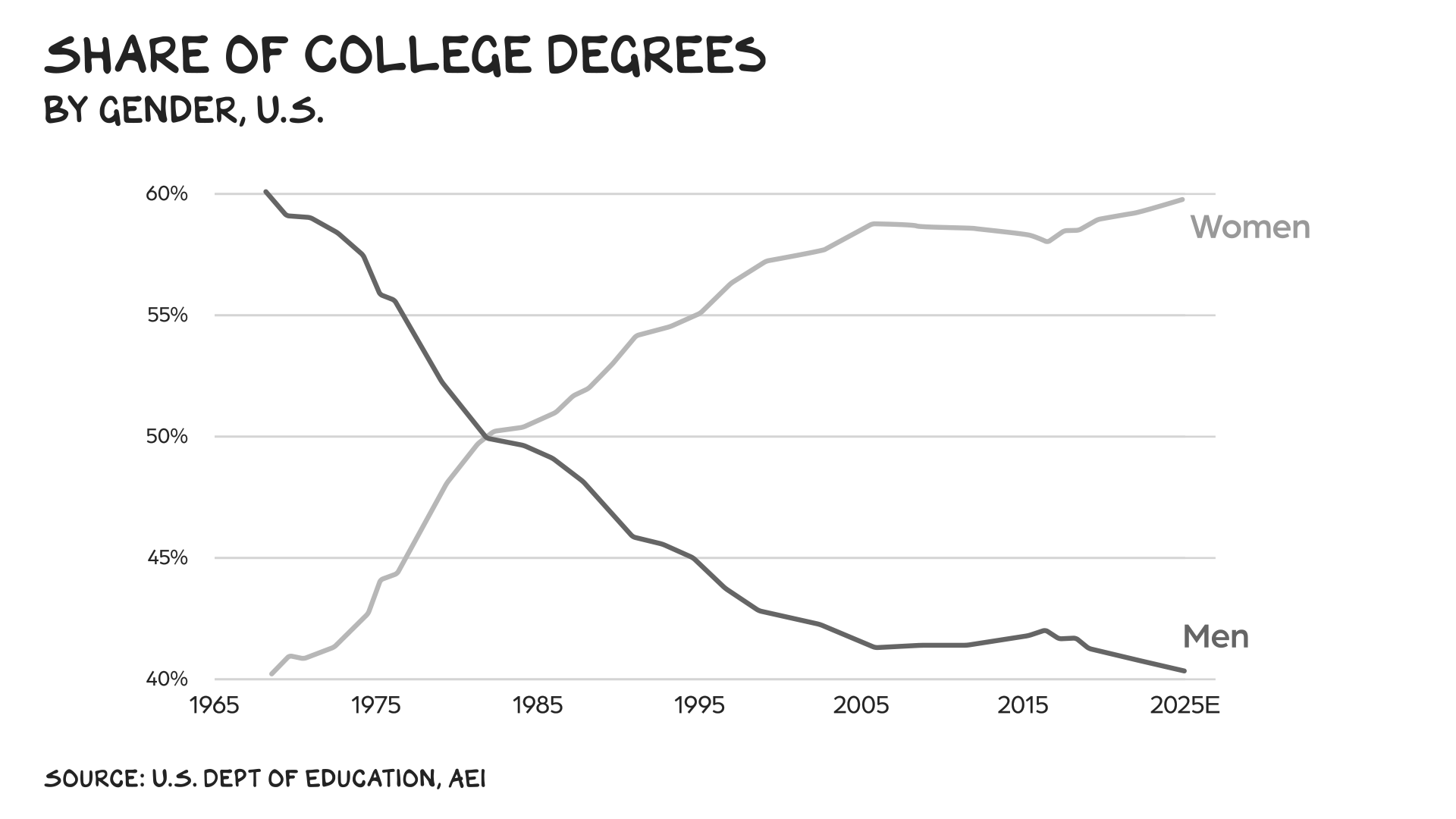
Rather than addressing the problem, leaders on both ends of the political spectrum have inflamed the crisis. The left ignored young men in the lead-up to the last presidential election, espousing the belief that they didn’t have a problem, they were the problem. The far right filled the void with misogynistic, racist, and otherwise hateful messages, arguing that the answer was to send women and non-white people back to the 50s. But here’s the bottom line: Nobody is entitled to reproduce, nor obligated to serve another group. Women are ascending; it’s a collective achievement. Men need to level up.
How to Level Up: The Rule of Threes
Government programs and societal shifts will help, but young men should, and will, shoulder most of the responsibility — one that most are addressing but too many abdicate as they slide deeper into the darkness of frictionless online relationships.

These young men fail to recognize the agency they have to transform their lives, instead donning an incel badge to justify their sense of victimhood. My message to young men: Being an incel isn’t a burden you’re destined to bear. If you’ve surrendered, sitting at home all day watching porn, bingeing Netflix, and playing Diablo, that’s on you.

We need to model a healthier vision. My advice: Exercise three times a week, work at least 30 hours a week out of the house, and push yourself into the company of strangers at least three times a month, even if you’re an introvert. This strategy will make you more attractive and increase your odds of finding a partner. Following this rule of threes will put you into the 95th percentile of young men. If you can stay there long enough, you’ll likely have the opportunity to be voluntarily incelibate … which is awesome. It’s easier to get a job than it has been for most of the last 100 years. Youth unemployment is hovering around 10%, historically low. When I was young, unsure if I could pay tuition, I took any job. If you’re reading this and living with your parents, you should, too. I’m going to Davos next week on my own plane, but I got there by waiting tables, carrying groceries, and hauling golf bags 5 miles in the humid Ohio summer. On both the economic and social fronts, there are ways to overcome your obstacles and become a better man: Get an apprenticeship. Join a team. Go to a church, synagogue, or mosque. Develop a kindness practice. Learn how to approach people. This is harder in an age when many people are addicted to YouTube and TikTok and third spaces are disappearing, but increasing your risk appetite for the real world is essential.
Red Pill
Adolescence , the gut-wrenching Netflix miniseries that won four Golden Globes earlier this week, stoked the debate about “incel” culture, shining a light on the threats posed by social media influencers known for their misogynistic views. The drama, which follows a 13-year-old boy accused of murdering a female classmate, tackled symbols such as the “red pill,” a metaphor taken from the 1999 movie The Matrix. Keanu Reeves’s character, Neo, must choose between a blue pill, which will keep him in a state of blissful ignorance, or a red pill, which will awaken him to a painful but enlightening reality. In the manosphere, people who make the latter decision have accepted the supposed “truths” about gender roles, including the idea that the world is unfairly stacked against unattractive and awkward heterosexual men. Here’s the truth pill, re sex: Throughout history, 40% of men and 80% of women have reproduced. In the U.S. today, an estimated 75% and 85% of men and women will reproduce, respectively. American men today are twice as likely to procreate as their ancestors.
Another incel conviction — fed by dating apps that separate potential partners into a small group of haves and a massive cohort of have-nots — is that most men will never find romantic satisfaction, because 80% of women are attracted to 20% of men. The bottom 80% of male Tinder users, based on percentage of likes received, are competing for the bottom 22% of women. This leads me to the same conclusion: Young men need real-world venues where they can demonstrate excellence to women, who are more discerning than they are.
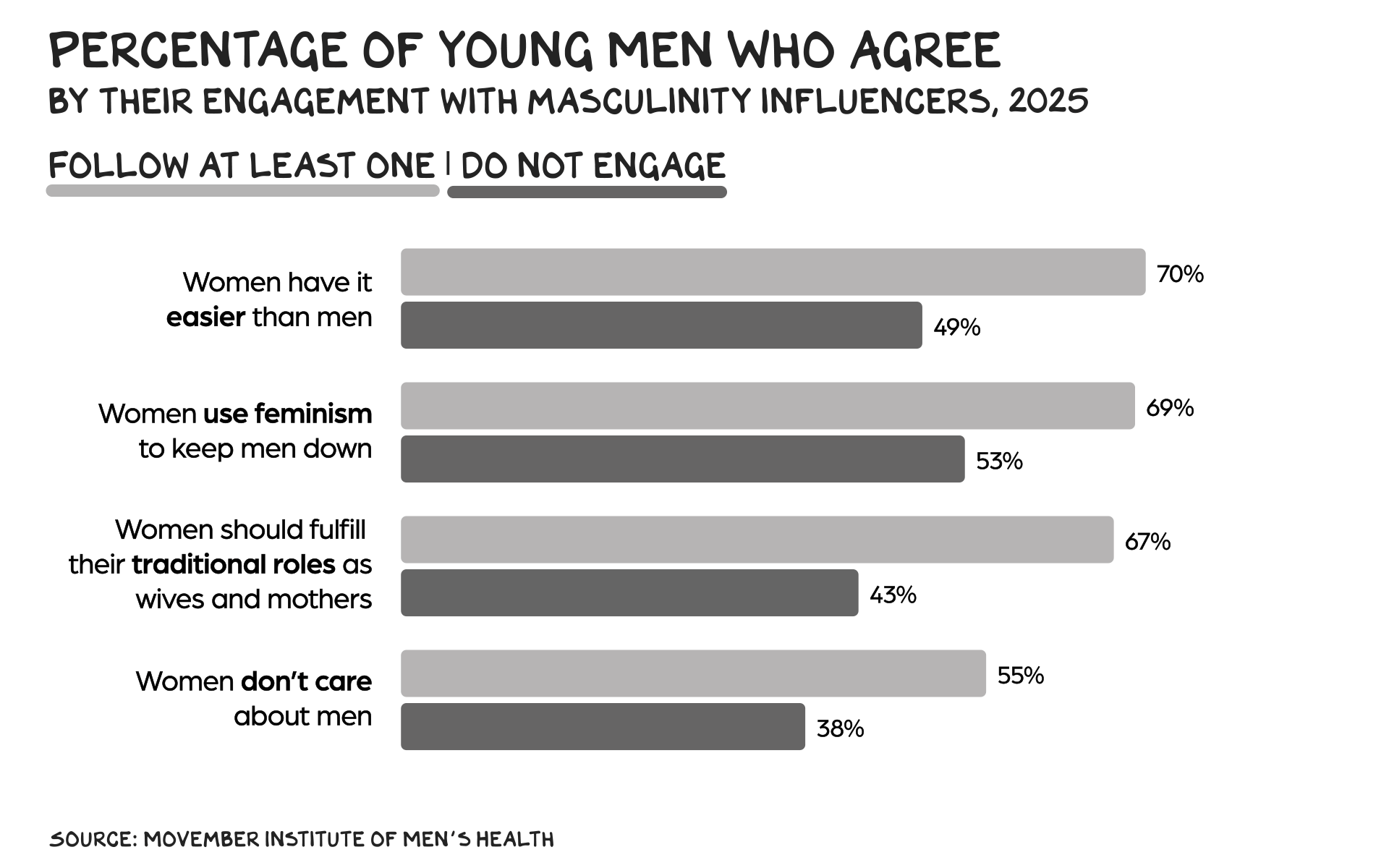
The incel movement was in motion long before Adolescence. The term emerged in the late 1990s on a website dubbed Alana’s Involuntary Celibacy Project, created by a university student who wanted to provide an inclusive hub for people of all genders and orientations who had trouble dating. Instead, the term was hijacked as a “weapon of war,” and the community morphed into a nihilistic, misogynistic subculture. Our society is producing far too many self-described incels who think it’s acceptable, even aspirational, to give up on relationships, and who become susceptible to biases against women and immigrants. Most will not harm others — their loathing is usually reserved for themselves. About two-thirds of incels say they’ve considered suicide. Instead of retreating amid increased scrutiny, social media accounts are widening their audience and rebranding to bypass bans. Adding fuel to the flame, the algorithms boost many female influencers whose misandry cosplays as social commentary.
Off-Ramp
Many young men are genuinely trying to forge connections but stumbling over economic and social hurdles — struggles that Democrats are finally starting to take seriously after watching this demographic help Donald Trump retake the White House.
With young men continuing to feel frustation and malaise more than a year into the president’s second term, the Democrats have a chance to win them back. Empathy isn’t zero-sum. The party, and society more broadly, can build on the gains women have registered over the past three decades, while also supporting boys and men.
Young men themselves are part of the solution. Women aren’t to blame for their relationship woes, just as immigrants aren’t responsible for America’s economic problems. Men need to seize the opportunity to become better, and we need to provide an off-ramp for red-pilled men who believe the mating market is rigged against them, helping to prevent their descent into bitterness and potential extremism.
Many young men struggle with mental health — understandable given the challenges they face. But here’s a truth the manosphere won’t tell you: In the end, meaningful relationships are the only things that matter. If you’re alone and resigned to being nutrition for Big Tech, you need to reset and commit to becoming voluntarily incelibate. If you sequester from other mammals, the anxiety and depression you’ll ultimately feel will dwarf any terror about disappointment that exists in the outside world — isolation is the only danger that compounds.
Life is so rich,

P.S. This week, my Prof G Markets co-host Ed Elson wrote about the debate over California’s billionaire wealth tax … and proposed an alternative. Next week, he’ll unpack Jerome Powell’s win against Trump and what it means for our country. Subscribe to his weekly newsletter Simply Put here.
AI-native CRM

“When I first opened Attio , I instantly got the feeling this was the next generation of CRM.” — Margaret Shen, Head of GTM at Modal
Join industry leaders like Granola, Taskrabbit, Flatfile and more. 👉Start for free today
Greetings!
Thanks for signing up to read 99% Derisible - stoked to have you on board as we figure stuff out together.This is a weekly email with hot takes and links on investing, startups, the abundance agenda, and whatever else catches my fancy.
Getting started
Here’s a few things to read to get to know me and what I’ll be writing about here. These are also some of the more fun/popular things I’ve posted.99% DerisibleThe point of capitalStarting a company is a huge commitment to a single opportunity. You should only do it with due consideration, especially if you’re a high quality founder with a lot of other good options. Anyone who says otherwise is trying to sell you something (probably capital…Read more3 years ago · 7 likes · Yoni Rechtman99% DerisibleWhen to Call MeI get asked a lot “when should I call you/what are you thinking about…Read morea year ago · 5 likes · Yoni Rechtman99% DerisibleAn Abundance Agenda For NYIn the Venn diagram of what democrats need to do and what I can do myself, I keep coming back to the need to make our greatest cities beacons of hope and exemplars of competence…Read morea year ago · 8 likes · 4 comments · Yoni Rechtman99% DerisibleAgainst Optionality.Coming out of the worst of the pandemic, everyone has all this pent up energy to make big life changes at once. Changing jobs, moving cities, getting into or out of serious relationships - it’s all the same impulse and it’s understandable. After 12+ months of The Same, now is the time for Different…Read more4 years ago · 10 likes · 2 comments · Yoni Rechtman99% DerisibleDon't work in venture capitalI get a lot of people asking me how to get into venture capital. How did I get my job? What’s my story? Who’s hiring? What are funds looking for? Is Tusk hiring? Most weeks, I speak to one or two people looking to work in VC, usually for analyst/associate roles…Read more6 years ago · 43 likes · Yoni Rechtman99% DerisibleWhat have you done for me lately?The deal dynamics in venture have changed: once upon a time no one knew for sure what a good company looked like or how to underwrite it. Today, once a company is obviously awesome and consensus, it won’t have a hard time raising capital…Read morea year ago · 6 likes · 1 comment · Yoni RechtmanYou will start receiving updates right here in your inbox. In the meantime, come say hi on Twitter for direct access to my stream of takes! Some housekeeping... If you can’t find the newsletter, check your spam folder. And please mark this address as ‘not spam.’ If the newsletter isn’t in your spam folder, either, you should look in the Promotions tab.You can always see everything on the website.Thanks again, and please tell a few friends if you feel like it.
Software That Debugs Itself While I Sleep
What’s 🔥 in Enterprise IT/VC #481
Building with Claude Code, Cowork, and Why Learning Velocity Is One of the Only Moats
Jan 17
We’re barely two weeks into 2026 and it already feels like a month. Many of us used the holidays to recharge, but also to build with Claude Code. Now Anthropic has shipped Cowork, effectively Claude Code for everyone. Well, almost everyone. You still need to know what to ask, give it local access, and have the agency to automate real work.
If you haven’t tried it yet, spend some time with it this weekend. You need the $20 Pro plan, but it is one of the clearest glimpses of where work is heading.
The prep for my day was 🔥, but it still has lots of kinks. At times I felt superhuman and others, well, the dozens of interruptions while Cowork was working were a bit annoying. The idea of it running continuously for hours will come.
I, for one, still am enamored by what Claude Code can do. Here’s a simple prompt I used during a board meeting yesterday and it just worked in the background on my laptop:
With a few more tweaks, adding more companies to the competitive matrix and doing some trend analysis and scoring, here’s the final output. Super useful and took me a couple minutes of prompting.
Back to Anthropic - the folks behind Claude Code noticed that many developers and users were not just using it to build apps but also to automate their daily lives. And just like that 🫰🏻, in a week and 1/2, they go out and build Cowork which blew up the Internet this past week with startup doomerism. This helped reignite the “SaaS is dead” debate and fed into last week’s market selloff 🫢.
What’s even more insane is that almost all of that code was written by AI 🤯. Let that soak in.
If you can think it, you can have AI just build it.
The real constraint is not access to AI. It’s creativity, taste, and agency.
Secondly, holy smokes, as a founder and investor, you need to double down on your thinking around how fast Anthropic and others will move to adjacent applications and opportunities.
When I first started investing in software in 1996 👴🏻, the moat used to be time and money which meant 18-24 months. As we moved to the cloud and open source, that moat became more like 6-12 months depending on the product. In the world of AI it was more like 1-3 months, and now it feels like it’s just days. Yes, days…
Picture a bullseye 🎯.
At the center is the model built by OpenAI or Anthropic. The next ring is the infrastructure that delivers it, APIs, agent tooling, the plumbing. Outside of that sit applications like chat and coding.
What’s different now is that the bullseye is expanding into the outer rings faster than ever, especially with AI writing much of the code. Products like Cowork collapse multiple categories at once.
If you’re building in the inner rings without real differentiation, you’re already competing with the platform itself. _And if you’re investing in the outer rings, your lead time is shrinking faster than you can imagine.
Finally, it’s not like founders and investors will stop building and investing in software companies. As we’ve discussed many times before, the last mile in the enterprise is the longest, hardest, and messiest and to deliver real compelling workflows you need domain expertise, security, lots of integrations, and more.
For example it’s not as if a bank will all of a sudden let every employee use Cowork and give it unlimited access to read and write files on local machines. That would be an insane security nightmare.
All that being said, one of the most important characteristics of the best founders and startups continues to ring true - in order to win and thrive in this world, founders need incredible “learning velocity” and need to build an org that thrives on that. What that leads to is just insane execution.
Back in September 2023 I started writing a document that I shared with everyone titled “Back to Basics Building Startups from Inception - some random notes” - you can request access here.
In it, I shared some patterns of success I’ve seen investing in technical founders from Inception that I’ve learned over 30 years and one in particular is unmistakable - the fastest learners win. Here’s an excerpt:
Early Indicators of Success 🔑
Momentum and velocity
Product velocity - ship fast but also ship what people really need
Hiring velocity - to a point, how fast to get first 3-4 key builders onboard (ideally if an Inception Round, you’ve pre-sold the team who are ready to sign shortly after incorporation)
Learning velocity, especially in case of getting to PMF which is often manifested in a founders’ speed to hone the core value prop and pitch - best founders find signal from noise + iterate quickly + multiple times before PMF. So much goes into that 1 sentence value proposition.
Most founders obsess over product velocity and hiring velocity. These matter. But learning velocity unlocks the other two.
Product velocity is how fast you ship. Hiring velocity is how fast you build the team. But learning velocity is how fast you test a hypothesis, design experiments around it, and adapt based on what you learn.You can ship fast to the wrong ICP. You can hire fast for the wrong roles. Without learning velocity, the other two velocities just accelerate you in the wrong direction._
When companies as large as Anthropic can learn, build and ship a product in 10 days, this becomes even more important today than ever.
AI amplifies everything. The noise is louder than ever. But the signal is there. The companies that win will be the ones that separate signal from noise at machine speed with human judgment and taste, turning themselves into learning and execution machines.
Learning velocity isn’t just about iterating faster. It’s about:
-
Testing hypotheses with real customers, not imagined personas
-
Designing experiments that generate clear signal
-
Adapting based on what you learn, not what you hoped to learn
-
Killing noise ruthlessly so signal can break through
This applies to everything: messaging, value proposition, product, pricing, go-to-market, hiring.
Founders, investors, take a deep breath, control what you can but make sure whatever you do you keep learning and applying that every single day.
And there’s always this: keep thinking big!
2026 is going to be an interesting transition year as Claude Cowork is showing us the future while SaaS stocks get hammered - the reality is that it’s still too early and the battle will be fought over the next few years!
This will reward the teams that can learn faster than the market moves. Time to build 🏗️. It’s going to be an incredible year ahead!
As always, 🙏🏼 for reading and please share with your friends and colleagues!
Scaling Startups
huge unlock but need authority to cross departments and execute
epic returns
Enterprise Tech
🎯 make sure those docs are great, readable, markdown rules!
the future, one week of continuous building with dozens of agents
second order effects of AI generated code - will be same when regular employees manage dozens of agents
just imagine the security issues for this tech!
Skild raises at $14B valuation 😲 - robotics software
Skild AI Inc., a fast-rising startup that makes software to help robots learn to complete tasks, has secured about $1.4 billion in a new funding round that values the company at more than $14 billion, more than triple what it was worth just seven months ago.
The Series C round was led by SoftBank Group Corp., with participation from Nvidia Corp., Macquarie Group Ltd., 1789 Capital and Jeff Bezos’ private investment firm Bezos Expeditions, co-founder and Chief Executive Officer Deepak Pathak told Bloomberg.
Skild said it went from zero to tens of millions of dollars in revenue over a few months in 2025. The startup is working with more than eight clients, according to a person familiar with the matter. The company declined to name its partners.
another Crowdstrike acquisition as they enter the browser space - founders need to recognize that once you raise that mega round, the list of acquirers dwindles fast, in this case a fantastic exit as the company raised $37M and sold for $400M - while not a billion outcome, I’m sure the early investors and founders did quite well
this and 💯 - see at least 2-3 a week
haha, and guess what, Clickhouse now is in the LLM observability space and raised at a $15B valuation
how Claude Code actually works visualized as office workers!
the death of RAG? this is a huge deal - worth a read 👇🏻
agents starting to roll out in 2026, from 1000 agents 18 months ago to 25,000 now
the discussion continues on context graphs and the execution intelligence layer (see my post #478) as James Kaplan who is a Partner at McKinsey and CTO there leading agentic transformation - totally agree on this thought and one I’m already invested in - think next gen Celonis!
Subscribe to his substack here to learn more about what the largest Fortune 500s are doing
Prosaic Times
Prosaic Times: Your business is a dynamic system
Some thoughtful young men encouraged me to read Smart Brevity, given that , er, issues of Prosaic Times run to 3,000 words. Some of my colleagues say that I write more quickly than they can read. I may have suggested, in return, that they might learn to read more quickly, but the historical record is unclear here…
6 days ago · 3 likes · James Kaplan
$2B inception round on the people and this 👇🏻
Markets
just so we all get the memo - one stumble with AI where it’s not meeting expectations and we could have a big problem (full deck from Apollo here)
and the AI native growth continues to $15B in 2 1/2 years- OpenAI $10B of that, Anthropic $3B
more AI native vs SaaS debate sparked by a Thoma Bravo editorial in the FT here
Fetched links (5)
- What’s 🔥 in Enterprise IT/VC #481
- Introducing the Substack app
- ClickHouse raises $400M Series D led by Dragoneer to accelerate expansion across analytics and AI infrastructure
- Dev Shah on X: "1 in every 5 founders I meet in the Bay Area is building an observability platform for agents. There are so many observability platforms, yet the least mature part of building an agent is still telemetry. Everyone is trying to solve the wrong problem with observability." / X
- McKinsey Now Has 60,000 Employees: 25,000 of Them Are AI Agents - Business Insider
Claude Code Takes Pole Position
Plus: Two camps this week to get you building with agents
by Every Staff .png) Hello, and happy Sunday! Agent-native coding is officially blowing up , and whether you’re ready to start building with agent-native software or still wondering what it’s about, we’re hosting two camps this week that are perfect for you. First, join us at Thursday’s Vibe Code Camp to watch more than a dozen of the very best vibe coders in action during an all-day livestream. Then, on Friday, paid subscribers are invited to Every’s firstAgent-native Camp , where CEODan Shipper will go step-by-step from how the software works to how to use it yourself. We’ll be off Monday for Martin Luther King Jr. Day, but back in your inboxes Tuesday.— Kate Lee__ ## Knowledge base
Hello, and happy Sunday! Agent-native coding is officially blowing up , and whether you’re ready to start building with agent-native software or still wondering what it’s about, we’re hosting two camps this week that are perfect for you. First, join us at Thursday’s Vibe Code Camp to watch more than a dozen of the very best vibe coders in action during an all-day livestream. Then, on Friday, paid subscribers are invited to Every’s firstAgent-native Camp , where CEODan Shipper will go step-by-step from how the software works to how to use it yourself. We’ll be off Monday for Martin Luther King Jr. Day, but back in your inboxes Tuesday.— Kate Lee__ ## Knowledge base
“Vibe Check: Claude Cowork Is Claude Code for the Rest of Us” by Katie Parrott/Vibe Check : Developers have been losing their minds over Claude Code for months; now everyone else gets their turn. Cowork is a new tab in Claude’s desktop app that brings the same asynchronous, agentic workflow to nontechnical users. Hand off a task, come back an hour later—poof! It’s done. Dan __Shipper ran an audit of his calendar that took an hour; Corageneral manager Kieran Klaassen designed a 3D-printable chair using two Skills at once. The interface is rough, but no competitor is attempting anything like it. Read this for our day-zero verdict. “OpenAI Has Some Catching Up to Do” by Dan Shipper/Chain of Thought : At a recent event, Dan asked what AI tools programmers are using daily. Almost everyone said Claude Code with Opus 4.5. A year ago, the whole room would have said GPT. OpenAI’s Codex is powerful and growing fast, but it’s built for senior engineers who want to read diffs and approve every change—a shrinking market. Meanwhile, the vibe coders building iPhone apps today will ship real software tomorrow, and whoever wins vibe coding wins how people work on their computers. Read this to understand how for all its trailblazing, OpenAI faces a real strategic challenge. “The Boring Businesses That Will Dominate the AI Era” by Tina He/Thesis : As AI agents become the primary users of software—evaluating economics in milliseconds and switching without loyalty—startups building AI-native tools face a precarious future. The winners will be companies that control the infrastructure AI must flow through but cannot replace, writes Tina He : proprietary data, financial rails, compliance systems, workflow libraries. Read this for the five archetypes that’ll own this space. “AI Can Build Anything. Social Dandelions Decide What Spreads” by Lewis Kallow : In 1933, 70 percent of Iowa’s farmers knew about a miraculous new corn seed that could save their crops—but only 1 percent adopted it. Why? High-risk ideas don’t spread through awareness; they spread through trust. Lewis Kallow traces a line from those skeptical farmers to ChatGPT’s explosive launch, revealing the sociology behind product adoption. Read this for his playbook. 🎧 “Why Your AI Learning Projects Keep Fizzling Out” by Rhea Purohit/AI & I: You’ve probably tried using ChatGPT to finally learn something—quantum physics, a new language, the names of trees in your neighborhood—and quit after a few chats. Nir Zicherman , cofounder of Anchor and now CEO of AI learning platform Oboe, explains why: LLMs can answer your questions, but they won’t notice when you’re lost or your attention fades. Zicherman walks Danthrough what real learning requires—multimodality, pacing, and milestones that make progress feel achievable. 🎧 🖥 Listen on Spotify or Apple Podcasts , or watch on X or YouTube.
From Every Studio
Sparkle Deep Clean enters beta testing_Sparkle_is testing a new feature called Deep Clean that helps you reclaim storage by surfacing files you’ve never opened or haven’t touched in over a year. General manager Yash Poojary ran it on his Mac Studio and went from approximately 18,000 files to 800—saving around three times the space compared to CleanMyMac. The guided flow breaks cleanup into focused steps:Sscreenshots, DMGs, and zips each get their own section, with instant feedback as you remove files. Beta testing is underway now; stay tuned for the public release.
First look: Proof, a markdown editor that tracks who wrote what
Danhas been building Proof , a markdown editor designed to solve a problem that’s only getting worse: knowing which words came from a human and which came from an AI. Proof tracks authorship at the sentence level, showing what was AI-generated, what was human-written, and what was AI-suggested but human-edited. Proof can also add comments and track changes that work for both human collaborators and AI agents, so an AI can propose a revision, and you can accept, reject, or edit it just like you would with a human editor. Proof isn’t publicly available yet, but we’ll share more as it develops.
Alignment
Writers have an edge in AI. I built something with Claude Code recently that has no right to exist. I can’t code. But somehow I now have a website that scrapes academic papers on GLP-1s, summarizes them for busy doctors, grades the evidence, and emails subscribers weekly. I’ve checked it every day for the past three weeks, and it works. I created the site out of pure frustration. I can’t keep up with all the research, and rather than saving hundreds of papers on my desktop, I needed something simple and easy to understand. There are two reasons I could make this. One is that writing for Every means I’m constantly reading about how these tools actually work from people at the frontier like Dan , Kieran and Monologue general manager Naveen Naidu. The other is I know how to take a vague idea and make it specific, which is all essay writing really is. First, I asked Claude to interview me in depth. What do I want people to feel when they go to my site? What are the flaws? What am I missing? This is a technique I use in my writing to gain clarity about what I want to say. I then traced the logical flow on the page: If I’m collecting academic papers, I need a way to identify them so they’re not posting to the site more than once. If I’m emailing people, I need a way to track what’s already been sent, and If I want papers to be easy to follow, I need a way to surface the evidence clearly. What started as a simple idea required, it turns out, a pretty sophisticated system. But that’s how essay writing works, too. You think you’re making one point, then realize you need to define a term first, or address an objection, or split one argument into three. By jotting down what I wanted step by step, I could see gaps I would have missed, and gaps I didn’t want Claude to fill with assumptions or hallucinations because it would inevitably get them wrong. I wanted to catch these early potholes myself. I think that’s the edge right now: the habit of writing your way to clarity before asking anyone or anything to execute. Writers have been doing this forever, but it’s especially useful now.— Ashwin Sharma
Fetched links (30)
- Every
- Context Window - Every
- Claude Code Takes Pole Position
- Every Staff - Every
- Go Agent-native With Every
- Agent-native Architectures: How to Build Apps After the End of Code
- Every
- Every
- Dan Shipper - Every
- Kate Lee Joins Every as Editor-in-Chief
- Every
- Vibe Check: Claude Cowork Is Claude Code for the Rest of Us
- Kieran Klaassen - Every
- Give Cora your inbox. Take back your life.
- OpenAI Has Some Catching Up to Do
- AI Can Build Anything. Social Dandelions Decide What Spreads.
- The Boring Businesses That Will Dominate the AI Era
- 🎧 Why Your AI Learning Projects Keep Fizzling Out
- Why Your AI Learning Projects …–AI & I – Apple Podcasts
- Sparkle | Mac Cleaner & AI File Organizer
- Yash Poojary - Every
- Naveen Naidu - Every
- Monologue | Effortless voice dictation so you can work 3x faster
- Every 📧 (@every) / X
- Every
- Every Inc. | LinkedIn
- Spiral – The writing partner for you and your agent.
- Every Consulting - AI Strategy & Implementation
- Every
- Every