Oops! Did you forget to send your gifts?
Dear Michael,
You have 5 gift subscriptions for Sean Cai left to share. Send a gift
Week 20, 2026 · May 11–17, 2026 · 32 newsletters · 147 links · ≈ 2 h 55 min
Dear Michael,
You have 5 gift subscriptions for Sean Cai left to share. Send a gift
by Eleanor Warnock  I’m a journalist and a communications expert. My job, in both roles, is to find ideas that people haven’t yet put into words—the anecdote that could become a front-page story, the framing that could crystallize a founder’s philosophy into something a customer remembers. In an hour interview with someone, it might not be until minute 45 that we start getting into the good stuff. In two hours, there may only be one thing that stands out to me—a side story, a detail, some color. A little piece of gold dust. An investor I’ve worked closely with calls these “extraction sessions.” I call the people who do them well Socrates-as-a-service. Those details and stories aren’t on the internet. They’re not in any model. And the model hasn’t replicated yet how I pull them out of people. The gap between what AI can do and what a great human questioner can surface is still wide—and it’s the gap where the best stories live. If you don’t have some way to surface that information in your organization, your brand and messaging are going to sound like all the other twice-boiled content out there.
The stuff that I’m looking for has a name in management theory: “tacit knowledge.” The term comes from scientist and philosopher Michael Polanyi , who defined it with the phrase, “We can know more than we can tell.” It’s the expertise and intuition that lives in our bodies and resists being turned into a document. In a frequently cited 1991 article, Japanese management expert Ikujiro Nonaka argued that while Western companies excelled at “information processing,” Japanese companies specialized in the “creation of knowledge,” through a feedback loop that turned tacit knowledge into a competitive advantage. His most memorable example: In the 1980s, the Osaka-based Matsushita Electric Company was struggling to get the kneading right in a bread machine. They sent a software developer to apprentice with a baker at a local hotel famous for its luscious loaves. The knowledge she brought back helped the team perfect the dough-stretching technology inside the machine and ultimately create a top-selling device. I am sure that the lucky engineer asked the baker a lot of questions, but there was certainly a lot she absorbed just from watching. Indeed, Polanyi argued that tacit knowledge exists outside of numbers or symbolic language—the kind of systemization that AI requires to ingest information. Many “bakers” from whom we try to extract tacit knowledge often don’t even know the depth of expertise they carry. And they certainly couldn’t tell you what questions you need to ask to access it.
AI can do some of that questioning and, in some cases, do it well. At Every, we have an AI agent ask us questions when we write OKRs...
🚀 We just launched a new newsletter — Company Launch Tracker.
We’re tracking company launches as they happen and surfacing the most interesting new founders and startups (yes, all outside of this stealth activity too). If you want to stay ahead of the curve, this is where you’ll find them first.
Right now we’ve got 5 subscribers: my wife, my mom, and that high school buddy who won’t stop pitching me his app. Be smart like them and get in early 👇
We run a live feed inside Gravity that tracks founders entering stealth and companies quietly exiting it.
What you’re reading here is about 1% of the stealth activity we pick up. The full tracker updates in real time as things change and new activity emerges.
If you want earlier access to everything, book some time with us to stay ahead.
In this issue of the Stealth Startup Spy, here is what we will uncover:
Former Director of AI at Cruise (launched SF's first commercial robotaxi) is building self-driving personal finance
Ex-Dropbox and Facebook designer, repeat founder with an exit to Perplexity, enters stealth
YC alum and ex-Director of Operations at Traba is building a specialty insurance placement platform for retail agents
VoiceBase founder ($120M exit to LivePerson) is back with a new stealth venture at the intersection of AI and finance
Former Tesla AI Hardware Technical Director enters stealth
And more…
Now let’s shine the spotlight… 💡💡💡
Real-time updates from founders who debut what they’ve been working on under stealth mode
🔎 Featured Founder under stealth mode in StealthStartSpy#2267
FounderDNA: Doctorate Degree, Former FAANG
Prior Experience: Director of AI at Cruise, Head of AI – Halo & Principal Scientist at Amazon Lab126, AI Advisor at Bain Capital Ventures, Fellow at South Park Commons
Connect on:LinkedIn
Rivo is an autonomous personal finance platform that sweeps idle cash from checking accounts into higher-yield instruments, monitors spending, and returns funds before bills are due, without requiring users to change banks or habits.
HQ: United States
Industry: FinTech, Personal Finance, AI | Team Size: 2
Time Spent in Stealth Mode: 1 Year 2 Months
FounderDNA: Serial Founder, Technical Founder
Prior Experience: Entrepreneur in Residence at Antler, AI & ML Software Engineer at KPMG Switzerland, Machine Learning Engineer at Alessa (Tier1 Financial Solutions), Co-Founder at Kliq Social, Founding Engineer at Vezgo
Connect on:LinkedIn
Mercora is a B2B SaaS platform that automates trade documentation reconciliation for commodity trading, using AI to extract structured data, match documents to trades, and flag discrepancies.
HQ: Switzerland
Industry: FinTech, Supply Chain, B2B SaaS
Time Spent in Stealth Mode: 4 Months
FounderDNA: Serial Founder, Prior Exit
Prior Experience: Co-Founder & CEO at Fernstone (YCF25), Director of Operations at Traba, Head of Growth at Antimetal, Co-Founder at Contrast (acquired)
Connect on:LinkedIn
Hedge is a specialty insurance placement platform for retail agents, providing direct access to specialty markets through a single submission.
HQ: United States
Industry: InsurTech | Team Size: 2
Time Spent in Stealth Mode: 3 months
FounderDNA: Serial Founder, Top 10 University
Prior Experience: Head of Business Operations & GTM at Eventual, Head of Business Operations & Revenue Strategy at Unity, Financial Analyst at J.P. Morgan, UC Berkeley alum
Connect on:LinkedIn
Castellan AI is a 24/7 AI platform for property managers, handling leasing, maintenance, and operations end-to-end.
HQ: United States
Industry: PropTech, AI Agents, B2B SaaS
Time Spent in Stealth Mode: 3 Months
FounderDNA: Serial Founder, Technical Founder
Prior Experience: Co-Founder & CTO at Rezon.ai, Co-Founder & CTO at Keepsake, Co-Founder & CTO at Pegasus Innovations, Senior Engineer at Klarna, Founding Engineer at Cincinnati Ventures
Connect on:LinkedIn
Zoont Health is a direct primary care platform offering unlimited physician access for a flat monthly fee, with same-day appointments, labs and prescriptions at cost, and AI-assisted health insights drawn from records and wearable data (no insurance required.)
HQ: United States
Industry: HealthTech, Direct Primary Care
Time Spent in Stealth Mode: 5 Months
Illuminating clues left behind by world class talent and influential innovators who just went into stealth mode
FounderDNA: Technical Founder, Doctorate Degree, Masters Degree
Prior Experience: Technical Director of AI Hardware at Tesla, PhD in Electrical Engineering at University of Southern California, Senior Staff Engineer & Manager at Qualcomm
Connect on:LinkedIn
HQ: Mountain View, California, United States
Time Spent in Stealth Mode: 2 Months
Building at the intersection of AI and finance.
FounderDNA: Serial Founder, Technical Founder, Masters Degree, Prior Exit
Prior Experience : Founder & CEO at VoiceBase (acquired by LivePerson), VP of Voice AI at LivePerson, CTO at International Training Institute, Head of Distribution Strategies & Channel Development at Swiss Union of Raiffeisen Banks
Connect on:LinkedIn
HQ: San Francisco, California, United States
Time Spent in Stealth Mode: 2 Months
FounderDNA: Serial Founder, Former FAANG
Prior Experience: Head of Design, Computer at Perplexity, Founder & CEO at Visual Electric (acquired by Perplexity; featured at launch in October 2023), Product Designer at Dropbox, Product Designer at Facebook
Connect on:LinkedIn
HQ: United States
Time Spent in Stealth Mode: 2 Months
FounderDNA: Technical Founder, Masters Degree
Prior Experience: Group Product Manager, Machine Learning at Attentive, Group Product Manager, Machine Learning at Wayfair, Data Scientist / MLE at BCG GAMMA
Connect on:LinkedIn
HQ: United States
Time Spent in Stealth Mode: 2 Months
FounderDNA: Serial Founder, Doctorate Degree, Masters Degree, Former FAANG, Top 10 University
Prior Experience: UC Berkeley PhD, Principal Applied Scientist at Amazon Web Services (AWS), Co-Founder & CTO at Civil Maps
Connect on:LinkedIn
HQ: United States
Time Spent in Stealth Mode: 1 Month
🚨Here’s the deal 🚨This email has gotten too big. Exciting, but with more people following it, the edge diminishes. I’ve thought long and hard about what to do to preserve the value in the signals. I’m not sure about the final direction yet, but in the meantime I’ve been sending an email 48 hours earlier to a select group of paid subscribers. The feedback has been pretty positive so I’m going to open up the list for another 100 spots. To get signals early, Apply here!
Stay Stealthy,
Drake
Thank you for reading. If you liked it, share it with your friends, colleagues and everyone interested in staying ahead of the hidden developments in tech. Subscribe below and follow us onX / Twitter to never miss a company operating under stealth again.
Stealth Startup Spy is a data-driven newsletter for investors, journalists and tech enthusiasts interested in uncovering the next big move for key talent, real-time stealth company launches and technology advancements not in plain sight. We leverage the technology built at Gravity to shine a light on the hidden world of stealth startups.

May 11| | ∙| Preview

The biggest IPOs in history are coming. The question is whether that's good news for you.
In this week’s Prof G+ Deep Dive, Scott unpacks the rise of private markets, the shrinking role of public investing, and why companies including OpenAI and SpaceX may enter your retirement account faster than ever before...
No ads on pods, because ads tax your most valuable asset: time
Prof G+ exclusives, including breaking livestreams, deep dives, keynotes, and more Community privileges to leave comments, make friends, and engage in a series of bad decisions that might pay off
Tomasz Tunguz Venture Capitalist at Theory Ventures
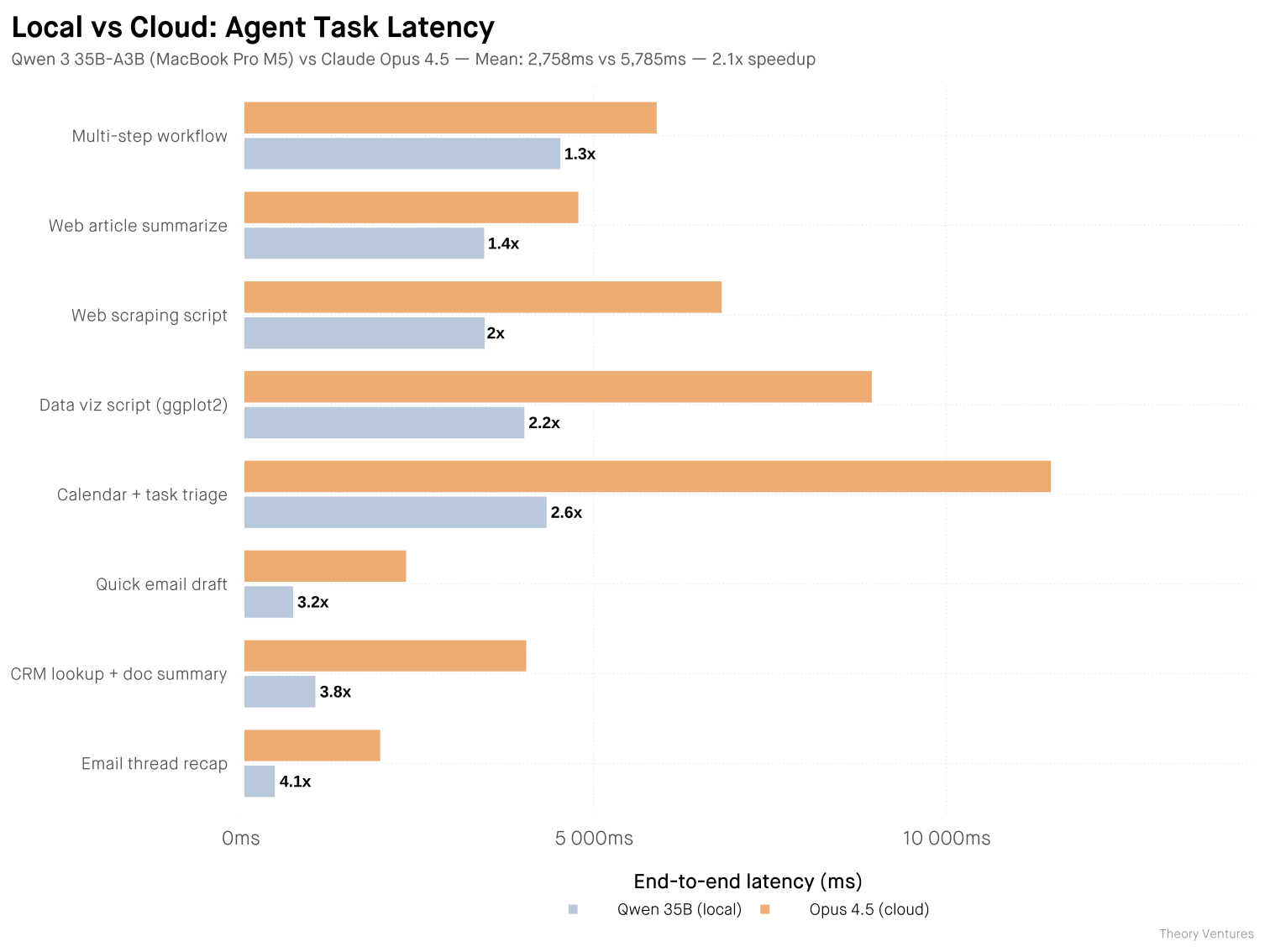
As demand for AI inference explodes, I’ll be asking a lot more of my little computer. How much more? Over the past five weeks, I’ve been using local models to see how much of my daily work I can accomplish without the trillion parameter models in the cloud. The answer is half. | Category | Count | % of Total | Example
Other | 521 | 35.3% | Catch-all for unstructured requests Scheduling | 254 | 17.2% | Check availability, propose meeting times Market Research | 192 | 13.0% | Competitor analysis, fundraising data Summarization | 184 | 12.4% | Transcript review, video summaries Email & Inbound | 170 | 11.5% | Draft replies, follow-ups, forwards Engineering | 147 | 9.9% | Debug scripts, API fixes, CLI tasks Admin | 10 | 0.7% | Travel, expenses, reimbursements
If you classify these 1.4k tasks by category, half can succeed on a local 35B model. Email & Inbound, Scheduling, Summarization, & Admin total 618 tasks (41.8%). Market Research & Engineering split roughly 50/50 between simple tasks (data lookups, script fixes) and complex ones (multi-source synthesis, architectural decisions). That gets us to 50%.
There are many reasons to use local models : privacy, cost, asset depreciation.1
But in reality, the only one that really matters is latency.
I ran a head-to-head benchmark this morning. Eight agentic tasks, same prompts, both models warmed. Qwen 3.6 35B-A3B-4bit on my MacBook Pro M5 vs Claude Opus 4.5 via API.
The local model isn’t smarter. Opus 4.5 scores ~20% higher on reasoning benchmarks. Local models lag frontier by 3-4 months, and for large-scale complex tasks, that gap matters. But for routine agent tasks, it rarely does.
Opus wins on structure & polish : bullet points, headers, cleaner code. Qwen wins on brevity, often half the tokens. I read every output side by side, and both completed the tasks correctly. For agent tasks where output feeds into another system, terseness is a feature.
Localmaxxing, pushing more inference to local models, is an inevitable response to tokenmaxxing. As local models improve & close the gap with frontier, more users will shift workloads to their own hardware.
If half the work runs 2x faster on my laptop, I’ll take that trade every time. My little computer is about to earn its keep. 1. A MacBook Pro depreciates whether you use it or not. Running local inference extracts compute value from a sinking asset before resale. ↩︎
Hey folks,
I watched this this morning; ‘Agentic coding is a trap — and we all fell for it’ - it’s surprising relevant past just developers.
enjoyed this because what i took away; learn the system to me, this is the difference of vibe coding and agentic engineering. i'm actively trying to learn the system, not the syntax.
syntax is what i couldn't grapple when attempting to learn to code. but the system is clicking more for me the more i build
im miles away from a 'competent software engineer' but im only building things for myself, so i dont need to be - but the more i build, the more that clicks into place.
i didnt realise it when i was slinging no-code in 2018 but it was a version of learning parts of a system to get software to work (webflow - frontend, airtable - database, zapier - api/backend). it had limitations but now i replaced all of that with code.
having actual competent engineers create skills and systems to help a sloppy codebase or process is helping (as well as better models). but i do rely on that for years i didnt spend learning to code.
stay curious folks
Link to the original blog post.
And I’ve been tweaking my AGENTS.md + setup files - as I’m getting closer with the ‘course’ I’m reminding myself to not let your docs slip.
there’ll be a lesson on this and i’ll go thru it all
Oh and…
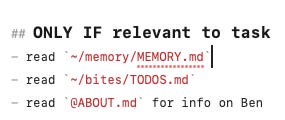
Ben Tossell @bentossell today-i-realised @ file in an AGENTS.md also gets auto-read by your agent i kinda knew this as i'd always @ AGENTS.md in my CLAUDE.md instead of the path otherwise claude wouldn't read it only today applying it to other setups 🤦♂️
Ben’s Bites is brought to you byLightfield
Lightfield is an AI-native CRM that just shipped Skills. Define any workflow in plain English and trigger it with a sentence. The AI agent executes against your full CRM data graph with code execution, web search, and file I/O. 3,000+ startups on the platform. Try free
You can now work with all your Claude Code agents in a single window inside the terminal. You can see their status and reply inline to unblock when they need your input. Any running session can be moved to the agent view with /bg.
Codex now works directly in Chrome on macOS and Windows. It can use sites and apps across tabs in the background without taking over your browser.
OpenAI also released three new Realtime models in the API: Realtime 2 for voice-to-voice use cases with best intelligence, Realtime Translate for audio translation across 70 input and 13 output languages, and Realtime-Whisper for live speech to text.
OpenAI released a cyber defence product, Daybreak. Their OpenAI’s answer to Anthropic’s Mythos?
Thinking Machines finally have a model to show us (not letting us try though). They are calling them interaction models. Basically models where you can chat with audio and video input with audio outputs. It seems really impressive for the capabilites they are claiming, for example, time awareness, simultaneous speech and visual cues, but all similar products (ChatGPT’s Advanced Voice Mode, Gemini Live) fail when put in users hands.
OpenAI is starting a deployment company in partnership with major consulting firms. It acquired a 150-person AI consulting company, “Tomoro”, to set this up and is putting in $4B of initial investment. The goal is to work with other companies and build AI systems for them.
I think this means they’re going to effectively transform a ton of knowledge workers and upskill them to knowing how to work with agents. ie able to be a builder. And if you’re a builder → you can use Codex. You can see how it all links 😊
Artificial Analysis is testing rank models + harness combinations together in their Coding Agent Index. Among the combinations they have tested, Opus 4.7 with Cursor CLI is on top with GPT-5.5 in Codex and Opus 4.7 in Claude Code at a close second.
Ramp trained a small RL model with Fast Ask with Prime Intellect for spreadsheet Q&A. They say it beats Opus by 4% on exact match accuracy at Haiku latency.
Replit Parallel Agents lets Replit Agent break work into tasks, run them in isolated copies of your app, and merge them back after review.
Notion Skills - Brian Lovin is using a Notion database like an app store for agent skills, with two-way sync to Claude, Codex and other local agents.
React Doctor v2 catches bad React code from agents.
Printing Press - generate agent-native CLIs for apps like Linear, ESPN, Kayak, etc.
The Claude Platform on AWS is now generally available. AWS customers get Claude API features with AWS auth, billing and commitment retirement.
OpenAI’s API has a new Files SDK for object and blob storage and an OpenAI Developers plugin for Codex to build faster with OpenAI APIs.
Parallel AI’s Monitor API is now GA. It sends web push updates to background agents instead of agents constantly polling for changes.
zero-native - build native desktop and mobile apps with web UI.
A spec for how interfaces should present Markdown.
7 Powers in the age of AI for building a company.
a framework for hackable software i.e. apps that ship with their raw source code, where users can modify them using coding agents.
New research from Anthropic translates the inner workings of Claude into text and teaches it good behaviour using fictional stories.
Peekaboo 3.0 - Peter’s macOS computer-use tool got action-first automation, unified screenshot + UI detection, cleaner JSON and better snapshots.
Ben Leonard @lenjaminbeonard explorer.oxide.computer
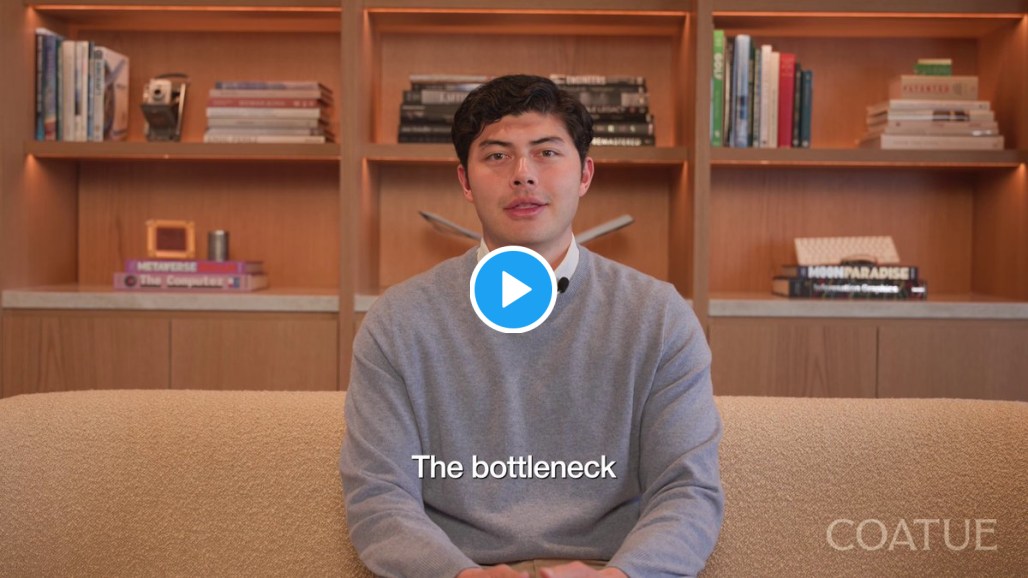
COATUE @coatuemgmt Memory is the new bottleneck. Nick Gagnet, Coatue Sector Head, on the AI infrastructure shift and why memory demand could 5x in 5 years.
Matt Pocock @mattpocockuk The more I replace plans with prototypes, the better the outputs Who'd have thought that low fidelity prototypes were better than walls of spec Oh yeah, the entire industry for 20 years Stop going against decades of knowledge because someone in SF shipped it as a 'mode' dax @thdxr i never make plans i hate looking at markdown i don't wanna read markdown files i just plan by having it make changes to the code then i look at the code to see what sucks then i prompt again
gabriel @gabriel1 when i voice prompt, i yap for 10 minutes straight and change my mind 3 times in the middle of the yap, and send it without reading yap enough tokens for the picture to be complete, it understands well when you change your mind in the middle. ai is smarter than you think Alex @dev_alexandrum i feel like i don’t think linearly enough for speech to text prompting. i frequently change wording as i write so the pressure of having to voice the right prompt first try is frustrating
David Boskovic @dboskovic if software is spec, what if we got AI to make specs that weren't slop? working on this (very inspired by the beauty of makingsoftware.com by @DanHollick )
David Boskovic @dboskovic if your agent doesn't write design specs like this your ngmi
* sponsors who make this newsletter possible :)
Email us atshanice@bensbites.com or k@bensbites.com
The mashḥūf cut low and silent through the water. The marshes of southern Iraq, the Ahwār (الأهوار), sprawled across the floodplain between the Tigris and the Euphrates- a spiraling knot of reed beds and floating islands and channels so narrow the reeds swallowed travelers whole.
A man standing in a mashḥūf in the early morning appears to be standing in the sky. The light so pale, and the water so still you can lose the horizon.
I had come from Basra with a guide named Ḥamīd. A colleague at University of Basrah had recommended him. “He knows where the ʿĀliya are. You’ll have to pay him well, but he’ll take you.”
We had been on the water for two hours, the mashḥūf propelled silently along by Ḥamīd- standing barefoot in the aft of the boat, pushing a long pole made of woven reed. The channel had opened into a broad shallow lake when Ḥamīd stopped poling, perhaps three hundred meters across, ringed by dense stands of qaṣab (القصب) the giant marsh reed-- phragmites australis -- which grows in the Ahwār to a height of six or seven meters and which the Ma’dan have been cutting and binding as far back as we have records.
The reed beds encased the lake, pale green at the waterline and darkening as they rose, and through them the light came in slats and bands that shifted when the wind blew. The water inside the enclosure was flat and still and the color of pale pewter, and rising from the water in a pattern that resembled a birdshot burst were the stumps.
They were reed bundles driven into the marsh bed as foundation stakes. The stumps rose two or three meters above the waterline. They were black with age and calcified, the organic material of the reed having been replaced, over centuries of immersion, with calcium carbonate from the mineral-rich water, a process that the geologists at Basra call biomineralization. This process left the shape of the individual stalks, the cord bindings, even the texture of the cut ends.
The stumps were cut flat at the top, as though they had supported a platform, and on one of them, at the far end of the grid, a grey heron stood on one leg and watched us.
I asked Ḥamīd what they were.
هذولة العالية. ما يقربون منها الصيادين.
Those are the ʿĀliya. The fishermen don’t go near them.
“The high ones”.
عالية.
I asked him what that meant. He looked at me and then he looked at the stumps and said:
كانوا يبنون فوق. يبنون ويبنون. وما وقفوا.
They built above. Then higher. Then higher again.
Ḥamīd had spent his life in these swamps. I asked him whether he knew of a woman called Nūra Ḥasan. Yes. He said she was from a settlement not far from here, originally. He had known her. She had gone to Baghdad as a girl and then to Europe. She had come back to the marshes in the seventies to study the ʿĀliya and the water-readings. She had been the last person to pay him to take her to the stumps. He said she lived in Holland now but he had lost her contact. He said she was very old. He said she had not come back since the water returned.
Nūra bint Ḥasan al-Maʿdāniyya was born in 1949 in a settlement in the central Ahwār, the second daughter of a fisherman who kept twelve water buffalo and whose family owned a muḍīf (المضيف) the great arched guest house made entirely of bundled reeds that had been rebuilt at least nine times in the living memory of the family, each time in the same place. The muḍīf was built by bundling the giant qaṣab into columns as thick as the waist of a strong man, planting them in two rows, and bending the tops together to form a vaulted arch that was ten meters high and twenty meters long.
The interior was cool and dim and smelled of water and reeds and mud, and the light cut through in bands through the gaps between the bundles. The building moved when the wind moved, it creaked and shifted on its foundations, and it would rot and be rebuilt and rot and be rebuilt again.
Nūra’s grandmother - her father’s mother, a small, hard woman whose name was Umm Ḥasan and whose face Nūra would describe, decades later, to the Dutch journalist who profiled her in 2004, as “the color of the reeds in autumn, a sickening dark gold” - had a word for the quiet days.
أيام السكتة.
Ayyām al-sakta. The hushed days. The days when the marsh was still and the water did not move and the reeds did not sway and the birds did not fly and you stayed in the house and waited for the marsh to start moving. Umm Ḥasan said the hush was the marsh thinking. She said the hush came before the flood. She said you could feel it in the soles of your feet if you stood in the water - a heaviness, a gathering.
Nūra left the marshes at fourteen- sent to Baghdad on a government scholarship for promising rural students, administered by a man from the Ministry of Education who arrived by motorboat. She studied history at Baghdad University.
She spent the first year sleeping draped with a damp cloth over her face because the air in Baghdad was so dry it cracked her skin until it bled. She told the Dutch journalist that the hardest thing about Baghdad was not the language or the classes or the loneliness but the absence of the sound of water. “In Baghdad, you can hear the traffic, the calls to prayer, the generators running all night-- but you cannot hear the water.”
She returned to the marshes in the mid seventies to begin doctoral fieldwork on a grant from a foundation in England. She was twenty-six and had been away for twelve years, nearly half her life now.
She arrived by motorboat from Basra and transferred to a mashḥūf at the edge of the reed beds and when the mashḥūf entered the first channel and the reeds closed over her head and the light turned green and the air changed - from the hot, dry, diesel-scented air of the road to the wet, cool air of the marsh, the air that smelled of water and cut reed and hung low above the reeds. She put her feet over the side of the mashḥūf and into the water and kept them there for the rest of the journey.
“I put my feet in and the water was cold and the mud was between my toes and I could feel the current pulling against my calves, a very slight pull, toward the southeast, and I knew that the water was moving from the Tigris overflow toward the lower marshes, and that the fish would be moving with it, and that the reeds on the south side of the channel would be thicker than the reeds on the north side because the current carries the seeds. And I had not stood in the water for twelve years.”
She said: “My grandmother could read the water. She said the water spoke if you listened long enough. I grew up listening. Then I went to Baghdad and the listening almost died in me. When I put my feet back in the water in 1975, it was like hearing a language of your childhood. You can understand. But the words won’t come as easilly.”
The Ma’dan (المعدان) - the Marsh Arabs - have inhabited these marshes for at least seven thousand years. The Sumerians built at the western edge of the marshes, and the ziggurat at Ur rises from a flat expanse of gravel and salt that was, five thousand years ago, the shore of a marsh that extended to the horizon.
The Ma’dan’s origins are disputed. Some scholars trace them to the Sumerians, others still to Bedouin tribes who migrated into the marshes during the early Islamic period. The Ma’dan themselves believe they’ve always been here. The marsh is their world- and they build with reeds, they fish with nets and spears, they raise water buffalo - jāmūs, (جاموس ) - whose milk they drink and whose dung they burn for fuel, and they move on the water in the mashḥūf, the narrow bitumen-coated canoe that is the only way to travel between settlements.
They call the water-readers qāriʾ al-māʾ (قارئ الماء), one who reads the water. The practice was called qirāʾat al-māʾ (قراءة الماء), the reading of the water. It appears in at least six separate documents spanning approximately 1270 to 1325, always in the context of the marshes.
A water-reader could tell what the marsh was doing and what it would do next by standing in it, by standing in the water with his feet in the mud and his knees in the current and his eyes on the surface and his ears open to a set of sounds so faint that most people could not hear them at all - sounds made by water moving against mud and reed.
The fullest description comes from Badr al-Dīn, a Mamluk envoy traveling from Cairo to the Ilkhanid court in 1302, who passed through the marshes on the river route from Basra and who stayed for nearly three weeks. He was expected in Tabriz for a diplomatic mission. Something about the marshes held him - perhaps the water-reading itself, which he encountered on his second morning according to his travel logs.
His account survives at the Dār al-Kutub in Cairo, MS Adab 2471, and Nūra, who found it during a research visit in 1980:
وفي اليوم الثاني من مقامي رأيتُ رجلاً من أهل الماء يخرج من بيته قبل الفجر وينزل إلى الماء ويقف فيه والماء إلى ركبتيه. ووقف هكذا ساكناً لا يتحرّك ولا يتكلّم حتى طلعت الشمس وغيّرت لون الماء من الأسود إلى الرمادي إلى لون لا اسم له بين الفضة والذهب. ثمّ رفع يده وأشار إلى الغرب وقال كلاماً لم أفهمه فأخبرني مرافقي أنّه قال إنّ الماء قادم من الجهة الغربية وأنّه سيصل بعد أربعة أيام وأنّ السمك سيتحرّك شرقاً قبل وصوله بيومين وأنّ البلشون سيغيّر رجله اليوم.
ومكثتُ أربعة أيام وارتفع الماء كما قال. وتحرّك السمك شرقاً كما قال. والبلشون الذي كان يقف على رجل واحدة وقف على رجلين قبل الغروب.
On my second day, I saw a man of the water people leave his house before dawn and descend into the water and stand with the water to his knees. He stood still, not moving, silent, until the sun rose and changed the color of the water from black to grey to a color between silver and gold in total stillness. Then he raised his hand and pointed west and said words I could not make out, and my companion told me he said the water is coming from the west and will arrive in four days and the fish will move east two days before it arrives and the heron will change its leg today. I stayed four days and the water rose as he said. And the fish moved east as he said. And the heron that had been standing on one leg stood on two before sunset.
Badr al-Dīn asked the man - his name was ʿAbbūd - how he knew. ʿAbbūd took him to the water and told him to stand.
فوقفتُ والماء إلى ركبتيّ وكان بارداً، بارداً برداً يصعد من الأسفل كأنّ البرد يأتي من قاع الهور لا من الهواء. والطين كان ناعماً تحت قدميّ ناعماً كالحرير وأحسستُ بين أصابعي أشياء صغيرة تتحرّك، ربّما ديدان أو يرقات، وأحسستُ بشيء يسحب ساقيّ سحباً خفيفاً نحو الجنوب وهو التيار. لكنّي لم أشعر في كلّ هذا إلّا بالبرد وبالغرابة. والسطح أمامي كان ماء. لم أرَ فيه إلّا الماء وانعكاس السماء والقصب المنعكس رأساً على عقب كأنّ هناك هوراً آخر تحت الهور.
فقال لي عبّود: أنتَ تحسّ البرد. أنا أحسّ أنّ البرد تغيّر عن أمس. أمس كان البرد ثابتاً من الأعلى إلى الأسفل. اليوم البرد أشدّ عند القدمين منه عند الركبتين. وهذا يعني أنّ ماءً بارداً يدخل من الأسفل، من النهر، من الشمال. أنتَ تحسّ الطين. أنا أحسّ أنّ الطين اليوم أنعم من طين أمس لأنّه يحمل تراباً ناعماً من الجبال وهذا يعني أنّ الثلج يذوب في الشمال وأنّ الماء قادم. أنتَ تحسّ التيار يشدّك. أنا أحسّ أنّ التيار يتردّد، يشدّ ثمّ يتوقّف ثمّ يشدّ، كأنّ الهور يأخذ نفساً ثمّ يخرجه ثمّ يأخذ نفساً، وهذا يعني أنّ ماءً كثيراً يجيء من بعيد وأنّ الهور يتنفّس قبل أن يبتلع.
I stood with the water to my knees and it was cold. The mud was soft under my feet, soft as silk, and I felt between my toes small things moving, perhaps worms or larvae, and I felt something pulling my legs gently south, which was the current. But I felt nothing in all this except the cold and the strangeness. The surface before me was water. I saw nothing but water and the reflection of the sky and the reeds reflected upside down. ʿAbbūd said to me: you feel the cold. I feel that the cold has changed since yesterday. Yesterday the cold was even from top to bottom. Today the cold is sharper at the feet than at the knees. This means cold water is entering from below, from the river, from the north. You feel the mud. I feel that the mud today is more fine than yesterday’s mud because it carries fine soil from the mountains, and this means the snow is melting in the north and the water is coming. You feel the current pulling you. I feel that the current hesitates - it pulls, then stops, then pulls - as though the marsh is breathing, and this means a great deal of water is coming from far away and the marsh is breathing before it rises.
أنتَ تحسّ البرد. أنا أحسّ أنّ البرد تغيّر عن أمس.
ʿAbbūd told Badr al-Dīn:
نحن لا نعلّم أولادنا بالكلام. نضعهم في الماء.
We cannot teach our children with words. They can only learn in the water.
Badr al-Dīn stayed three weeks and he returned to the water each morning and stood beside ʿAbbūd in the dark before dawn and tried to feel what ʿAbbūd felt and could not. On the fifth morning he felt the temperature change that ʿAbbūd had described - colder at the feet - but he could not tell whether the cold had changed since the previous day.
On the ninth morning he thought he felt the current hesitate, the pulling-stopping-pulling that ʿAbbūd called the marsh breathing, but ʿAbbūd told him the marsh was not breathing that day, the current was steady, and what Badr al-Dīn had felt was his own pulse in his calves.
He writes:
ووقفتُ ثلاثة أسابيع في الماء ولم أتعلّم شيئاً إلّا أنّي لن أتعلّم. فالماء يتكلّم لغةً لا يتعلّمها الكبار. وعبّود بدأ يسمعها وهو رضيع. وأنا بدأتُ وأنا رجل في الأربعين. وأذناي صمّاء. لا أذناي اللتان على رأسي بل الأذنان اللتان في باطن قدميّ وهما الأذنان اللتان ما فتحهما أحد لأنّ أبي لم يضعني في الماء.
I stood three weeks in the water and learned nothing except that I would not learn. The water speaks in a way that adults cannot learn. ʿAbbūd began hearing it as an infant. I began as a man of nearly forty years. My ears are deaf- not the ears on my head but the ears in the soles of my feet, the ears that never opened because my father did not put me in the water.
Near the end of his stay, Badr al-Dīn describes watching ʿAbbūd carve marks on the inner wall of the muḍīf at Chībāyish:
وفي آخر أيامي رأيتُ عبّوداً يقف في الماء كعادته ثمّ يخرج ويذهب إلى المضيف ويحفر في القصب علامات بسكين صغيرة. فسألته ماذا تفعل فقال أكتب ما قاله الماء. فقلتُ ولكنّك كنت تعرف ما قاله الماء دون أن تكتبه. فقال نعم ولكنّ القصب يحفظ ما أنسى.
In my last days I saw ʿAbbūd stand in the water then go to the muḍīf and carve marks in the reeds with a small knife. I asked what he was doing and he said I am writing what the water said. I said you knew what the water said without writing it. He said yes, but the reed remembers what I forget.
القصب يحفظ ما أنسى.
The knife entering the green reed, the marks appearing on the muḍīf wall.
Ḥamīd had a thermos of brewed tea in the bottom of the mashḥūf. He produced two small tulip-shaped glasses from his bag wrapped in a pale blue cloth, and we sat among the stumps and drank tea and the heron watched us from its perch.
I asked him about the word his grandmother used. أيام السكتة. The hushed days.
He said his grandmother and Nūra’s grandmother had been friends and had sat together in the muḍīf in the evenings and that Nūra’s grandmother had known a water-reader, the last one anyone remembered, a man whose name Ḥamīd did not know. The water-reader had been asked, near the end of his life, to teach the younger men the notation - to carve the readings on the muḍīf wall so that the readings could be consulted without standing in the water and he had refused.
الجدار ما عنده أرجل. الجدار ما يحسّ الطين. الجدار ما يسمع الماء يتنفّس. الجدار يحفظ ما قاله الماء أمس. بس الماء يقول شي جديد اليوم والجدار ما يسمعه لأنّ الجدار ما عنده أذان.
The wall has no feet and thus the wall does not feel the mud. The wall does not hear the water breathing. Sure, the wall remembers what the water said yesterday-- but the water says something new today.
Ḥamīd said they forced him. He said the young men insisted the wall spared them the mornings in the cold water- they could mend the nets, move the buffalo. The water-reader went to live alone at the edge of the settlement, close to the water, and stood in the marsh every morning until he died, and no one came to learn from him.
Nūra spent four months studying the notation system, cross-referencing Badr al-Dīn’s descriptions with a reed bundle she examined at the Iraq Museum in Baghdad - IM 77541, one meter long, bound with palm-fiber cord in a decorative double helix, incised with hundreds of marks.
She decoded a little more than half. The vertical lines represented water level - clusters indicating predicted rises above the dry-season baseline. The curved reed-shapes indicated current direction and strength. The circles indicated fish concentration.
The horizontal lines crossing the verticals she could not translate.
They appeared in increasing density as the readings progressed from older to newer, and they corresponded to no variable Nūra could identify. She mapped them to Tigris flood levels, drought data, fish population estimates, agricultural calendars. Nothing fit. But whatever it tracked, Nūra could not find it in the marsh.
In the later sections, the horizontal lines were no longer merely crossing the verticals. They were crossing each other.
In her working notes - which survive in a cardboard box in the basement of the International Institute of Social History in Amsterdam, where her papers were deposited after her retirement- she wrote:
Verticals: water. Horizontals: verticals?
The marriage of Zaynab bint Ḥusayn al-Maʿdāniyya to Jāsim ibn Salīm, a fisherman in a settlement eight kilometers south of Chībāyish, is recorded in a contract fragment that Nūra found at the Iraq National Museum archives in the sweltering summer of 1978, filed between a Sassanid seal impression and a bag of unprovenanced pottery sherds.
The contract is written on the tanned hide of a water buffalo in the dark cuttlefish ink that the Ma’dan made by crushing the ink sac of the marsh cuttlefish and mixing it with gum arabic and water. The ink is nearly black, blacker than the oak-gall ink of the cities, and it has a faint iridescence when the light catches it at an angle, a sheen like oil on water. There was no such light in the archives.
The mahr, the dowry, is specified: twenty jāmūs - twelve milking females, three young females not yet calved, four males for transport, and one old male whose purpose the contract describes as li-l-ṣuḥba (للصحبة), for companionship. The witnesses are named- six men, three from each settlement. The date is 1305. A clause at the end reads:
واتّفق الزوجان على أن لا يسافر أحدهما بالمشحوف إلى الآخر في يوم قالت القراءات فيه إنّ الماء غير مأمون. ويكون ترتيب الزيارات وفق ما يُقرّره قارئ الماء في الچبايش.
The two parties have agreed that neither shall travel by mashḥūf to the other on a day when the readings say the water is not safe. The arrangement of visits shall conform to what the water-reader at Chībāyish determines.
Zaynab’s settlement was separated from Jāsim’s by eight kilometers of open water and reed channels and narrow passages between floating islands, two hours by mashḥūf in calm water, longer if the wind was up or the channels had shifted.
A petition filed with the Basra qāḍī’s court in 1313, eight years after the marriage, requests that Jāsim ibn Salīm be compelled to visit his wife, or alternatively that Zaynab be permitted to travel to Jāsim’s settlement despite the readings. The petition is written on buffalo leather in cuttlefish ink by a professional petition-writer in Basra - Zaynab or her family had traveled to the city to file it, a journey of two or three days from the central marshes.
The stated grounds:
وقد صارت الأيام التي تُجيز القراءات فيها السفر على الماء بين القريتين أقلّ من أيام المنع. والزوج لم يزر زوجته منذ عيد الأضحى الماضي وذلك ثمانية أشهر. والماء بين القريتين هو نفسه الماء الذي كان لم يتغيّر ولم يرتفع ولم تعصف عليه ريح ولم يتحرّك فيه تيار غريب ولكنّ القراءات تقول إنّه غير مأمون. والزوجة تقول إنّها تنظر من بيتها إلى ماء ساكن لا موج فيه ولا ريح ولا تيار ومع ذلك يُقال لها إنّ الماء خطر. وهي تعرف هذا الماء لأنّها ولدت فيه وسبحت فيه وهي طفلة ولا ترى فيه خطراً.
The days on which the readings permit travel on the water between the two villages have become fewer than the days of prohibition. The husband has not visited his wife since the last Eid al-Adha. The water between the two villages is the same water it has always been - it has not changed, has not risen, no wind has blown upon it, no strange current has moved through it - but the readings say it is not safe. The wife says she looks from her house at still water with no waves, no wind, no current, and yet she is told the water is dangerous. She knows this water because she was born in it and swam in it as a child and she sees no danger in it.
وهي تعرف هذا الماء لأنّها ولدت فيه وسبحت فيه وهي طفلة.
The qāḍī ruled that the husband was not compelled to defy the readings if the readings were issued by those with knowledge but he was compelled to visit on the permitted days, however few.
In the same archive in a hand that Nūra describes as “small, unpracticed, pressing hard on the hide as though the stylus were unfamiliar”
والماء بيننا هو الماء. ما تغيّر. لكنّ الجدران تقول إنّه تغيّر. والجدران ما تعرف الماء. الماء يعرف الماء. وأنا أعرف الماء لأنّي ولدتُ فيه. بس ما يسمعون لي. يسمعون للجدران.
The water between us is the water. It hasn’t changed. But the walls say it has changed. The walls don’t know the water- the water knows the water. And I know the water because I was born in it. But they don’t listen to me. They listen to the walls.
Nūra’s grease penciled note on the archival folder: Zaynab?
The raising began around 1310.
A Basra customs record notes a tripling of bitumen shipments to the marshes without any increase in boats or dwellings nor population. The merchants say the water people are raising their houses. يرفعون بيوتهم. The Ma’dan had always built on the water but their floating islands sat at the surface, rising and falling with the seasonal floods. The water rose, the island rose with it. The water fell, the island settled.
Additional layers of reed and mud were added. Bitumen was applied between the layers. Stakes were driven deeper. The platforms rose. One meter above the waterline. Then two. Then three. Then four.
A fish merchant from Basra, whose letter Nūra found in the Cairo Geniza, describes a visit to the marshes in 1314:
ذهبتُ إلى الأهوار لشراء البنّي والشبّوط كعادتي في كلّ ربيع. والبنّي سمكة نهريّة كبيرة لحمها أبيض وجلدها فضيّ ويُباع في سوق البصرة بدرهمين المنّ أمّا من الصيّادين فبدرهم واحد. والشبّوط أصغر ولحمه أحمر يضرب إلى البرتقاليّ وهو أقلّ رغبة عند أهل البصرة لكنّه يُملّح ويُجفّف ويُباع في الأسواق البعيدة. وكنتُ أنتظر أن أشتري من قرية جاسم بن سليم خمسين منّاً من البنّي وثلاثين منّاً من الشبّوط كما أشتري كلّ عام منذ عشر سنين.
والطريق من البصرة إلى القرية يستغرق يومين بالمشحوف، يوماً في القناة الكبيرة ثمّ يوماً في القنوات الصغيرة بين القصب. وكنتُ أعرف الطريق كما أعرف شوارع البصرة. لكنّ بعض القنوات كانت قد تغيّرت — بعضها ضاق وبعضها اتّسع وبعضها اختفى — وهذا عادة الهور فإنّ ممرّاته تتحرّك كما تتحرّك أحلام النائم.
فلمّا وصلتُ وجدتُ القرية قد ارتفعت عن الماء ارتفاعاً لم أرَ مثله في حياتي. والبيوت التي كانت على سطح الماء صارت في الأعلى على منصّات من القصب والقير والطين، ولا تصعد إليها إلّا بسلالم من القصب طول الواحد منها أربعة أذرع أو أكثر. والسلالم رطبة وزلقة من القير والطحلب. والجواميس تقف في الأسفل عند الماء تنظر إلى فوق والنساء ينزلن لحلبها ثمّ يصعدن بالحليب في أوعية من الجلد. والأطفال الذين كانوا يسبحون حول المشحوف في كلّ زيارة سابقة ويتعلّقون بحافته ويغوصون تحت الماء ويظهرون وهم يضحكون — لم أرَ واحداً منهم في الماء. سألتُ أين الأطفال فقالوا في الأعلى.
وسألتُ لماذا يبنون هكذا فقالوا إنّ القراءات تقول إنّ الماء سيرتفع ارتفاعاً عظيماً. فقلتُ ومتى فقالوا لا يعلم أحد ولكنّ القراءات لا تخطئ. فقلتُ وما هذا الارتفاع العظيم فنظروا إليّ كأنّي سألتُ سؤالاً لا يُسأل وقال أحدهم بصوت خافت: الشمس السوداء. فقلتُ وما الشمس السوداء فلم يجبني أحد. ونظروا إلى الماء ثمّ نظروا إلى السماء ثمّ دخلوا بيوتهم.
I went to the Ahwār to buy bunnī and shabbūṭ as is my practice every spring. The bunnī is a large river fish with soft white flesh and silver skin that sells in the Basra market at two dirhams the mann, though from the fishermen at one dirham. The shabbūṭ is smaller with reddish-orange flesh, less favored by the people of Basra but salted and dried and sold in the markets. I expected to buy from the village of Jāsim ibn Salīm fifty mann of bunnī and thirty mann of shabbūṭ as I have bought every year for many years. The journey from Basra to the village takes two days by mashḥūf - one day in the main channel, one day in the small channels between the reeds. I knew the way as I know the streets of Basra. But some of the channels had changed - some had narrowed, some widened, some disappeared - and this is the nature of the marsh, whose passages shift between seasons and sometimes between weeks. When I arrived I found the village raised above the water to a height I have never seen in my life. The houses that had been at the water’s surface were now above, on platforms of reed and bitumen and mud, and you cannot climb to them except by reed ladders four cubits long or more. The ladders are damp and slippery with bitumen and algae. The buffalo stand below at the water looking upward and the women descend to milk them and climb back up with the milk in leather vessels. The children who used to swim around the mashḥūf on every previous visit, hanging from its edge and diving under the water and surfacing laughing - I did not see a single one of them in the water. I asked where the children were and they said above. I asked why they build like this and they said the readings say the water will rise greatly. I said when. They said no one knows but the readings do not err. I said what is this great rising and they did not answer. One of them said in a low voice: the Black Sun. I said what is the Black Sun and no one answered me. They looked at the water and then at the sky and then went into their houses.
The children were above. والأطفال في الأعلى. Between the children and the water were four meters of dry air and bundled reed, and through this the sound of the marsh, if it reached them at all, reached them muffled and distant.
A tax survey conducted in 1317 by an Ilkhanid official from Tabriz named Nūr al-Dīn recalls:
وأحصيتُ في القرى المرتفعة سبعاً وأربعين بيتاً وثلاثمئة واثني عشر رأساً من الجاموس وأربعة عشر مشحوفاً وثلاث عشرة شبكة صيد وسبع منصّات لتجفيف السمك لا يُستخدم منها شيء لأنّ السمك ما عاد يُصطاد بالقدر القديم. وفي ثلاثة من البيوت وجدتُ حزماً من القصب المقطوع عليها علامات لم أعرف غرضها فقدّرتها تحت بند بضائع مجهولة الغرض وقدّرتُ خراجها بدرهم عن كلّ حزمة.
والبيوت في الأعلى فارغة من كثير من الأثاث لأنّ الحمل إلى ذلك الارتفاع شاقّ. والنار لا تُشعل في الأعلى خوفاً من حريق القصب فالطعام يُطبخ في الأسفل على الماء ويُحمل إلى الأعلى في أوعية. والهواء في الأعلى أجفّ من الهواء عند الماء والبيوت تفوح منها رائحة القصب الجاف لا رائحة الماء. والجواميس تبقى في الأسفل عند الماء والناس في الأعلى وبينهم فراغ. والأطفال لا ينزلون إلى الماء. والماء الذي تحت البيوت ساكن ومظلم ولا يراه أحد من الأعلى لأنّ القصب يحجبه.
I counted in the raised villages forty-seven houses, three hundred and twelve buffalo, fourteen mashḥūfs, thirteen fishing nets, and seven fish-drying platforms, none of which are in use because the fish is no longer caught in the old quantities. In three of the houses I found bundles of cut reed bearing marks whose purpose I did not know, so I assessed them as goods of unknown purpose at one dirham per bundle. The houses above are empty of much furniture because carrying things to that height is difficult. Fire is not lit above for fear of the reeds burning, so food is cooked below at the water and carried up in vessels. The air above is drier than the air at the water and the houses smell of dry reed, not of water. The buffalo remain below at the water. The children do not go down to the water. The water beneath the houses is still and dark and you cannot see it from above because the reeds obscure it.
والماء الذي تحت البيوت ساكن ومظلم ولا يراه أحد من الأعلى.
The black sun.
A fragment of a muḍīf wall, recovered from the mud of the drained marshes in 1994 by an archaeological survey team from the University of Baghdad, working in the brief window between the draining of the marshes and the complete desiccation of the marsh bed. The fragment is a section of bundled reed, one meter square, calcified in the manner of the ʿĀliya stumps. On its inner surface are the standard water-reading marks- verticals, curves, circles, crossings. But at the bottom, in a space that had been cleared, previous marks scraped away to make room, there is an inscription in the colloquial Arabic of the marshes, in cuttlefish ink:
يوم الشمس السوداء. ارتفع الماء أو لم يرتفع. نحن في العالي ولا نرى.
The day of the Black Sun. The water rose or did not rise. We are in the high place and we cannot see.
ارتفع الماء أو لم يرتفع.
The water rose or did not rise.
نحن في العالي ولا نرى.
We are in the high place and we cannot see.
The Basra harbor records which tracked the Shatt al-Arab water level daily, maintained by the harbor administration survive in fragmentary form at the Bodleian Library in Oxford. Nūra cross-referenced every candidate date in the period 1315-1325. She found no anomalous flood. The water level in Basra, sixty kilometers downstream, was normal throughout. Whatever the readings had predicted, whatever the Black Sun was, the water did not rise. Or if it rose, it rose only in the marshes, in the dark space beneath the platforms where no one was standing and no one could see.
In 1991, the government of Saddam Hussein began draining the marshes.
The Ma’dan had supported the Shia uprising against Saddam after the Gulf War. The draining was a military operation conducted with bulldozers and dams and diversion canals that rerouted the Tigris and the Euphrates away from the Ahwār and into evaporation channels in the desert. The destruction took months.
The small channels dried first- these narrowed to mud paths and then to cracked earth and then to dust. The fish moved to the deeper pools at the centers of the lakes, and for a few weeks the fishing was extraordinary and the Ma’dan were rich - the fish were concentrated, packed into shrinking water, frantic, easy to catch. The fishermen of Jāsim’s village - the village the fish merchant had visited, the village Zaynab had married into, the village that Nūra had photographed and measured and catalogued during her fieldwork in the seventies - caught more fish in those weeks than they had caught in years. And then the pools shrank further. And the fish died in the shallows, their bodies drying to firm husks that curled and cracked shattered into the dust on the flat dry mud.
The water between Zaynab’s village and Jāsim’s - the eight kilometers the readings had forbidden her to cross - was gone.
The buffalo stood at the edges of the remaining water and would not move. They stood with their legs in the last inch of water and their heads down and their ears back and they would not move, and the men had to drive them out with sticks, and the buffalo went.
The reeds turned yellow in the first weeks. Then brown. Then the brown went grey and the grey went dry and the dry went to dust and the dust blew into the air and settled on everything - on the muḍīfs, whose arched roofs were designed to shed rain but welcomed dust, on the mashḥūfs beached in the mud, their bitumen hulls cracking in the heat, on the tuhūl that had settled onto the marsh bed and split under their own weight.
The drying marsh smelled of rot and salt and exposed sediment -- a sharp mineral smell that burned the nostrils and that the Ma’dan, according to Nūra’s interviews with survivors, called rīḥat al-mawt, the smell of death.
And through all of this the ʿĀliya stood at their elevation. Four meters above a surface of cracked mud baked to the color of bone. The ladders descended to dry ground. The platforms hung in the air, the careful layers of reed and bitumen drying and splitting. The flood the readings predicted had not come. The water had gone the other direction entirely. It had all been for the wrong apocalypse.
Nūra was in Amsterdam. She had left Baghdad in 1988 and was given a position at the University of Amsterdam’s department of Middle Eastern studies, a small department in a building on the Nieuwe Prinsengracht, a canal. Her office overlooked the water.
The Nieuwe Prinsengracht is clean and dark and contained in stone walls and it moves only when the boats move it and without them stands entirely still. Nūra could see the canal from her window and could hear the boats and the bicycles and the tourists but could not hear the water.
She heard about the draining by telephone. A colleague in Baghdad called. She did not go back. In her papers at the IISH - the International Institute of Social History in Amsterdam- in a folder she labeled marshes - personal, there is a sheet of paper on which she wrote, in Arabic:
يجفّفون الماء. الماء الذي علّمنا كلّ شيء. الماء الذي وضعتنا فيه أمّهاتنا ونحن رضّع فتعلّمنا أن نسمعه قبل أن نتعلّم أن نتكلّم. والعالية تقف في التراب مثل عظام. والحزم التي في المتحف تقرأ ماءً غير موجود. وأنا هنا على قناة في هولندا والماء تحت شبّاكي ساكت. الماء هنا ما يتكلّم. بنوا له جدران من حجر وقالوا له وين يروح. الماء هنا مطيع. والماء المطيع ما يتكلّم.
They are drying the water. The water that taught us everything. The water our mothers put us in as infants so that we learned to hear it before we learned to speak. The ʿĀliya stand in the dust. The bundles at the museum still give readings for a marsh that has been emptied. And I am here on a canal in Holland and the water beneath my window is silent. The water here does not speak.
والماء المطيع ما يتكلّم.
In the years after, in the quiet of the office on the Nieuwe Prinsengracht: her four months with the notation, her cross-referencing, her folders and catalogue numbers and penciled notes. She had come to the marshes to find the water-readers and had spent her time at the Iraq Museum, at the Dār al-Kutub, in archives. The last people who could still read the water had been standing in it every morning, and she had gone to the shelves instead.
After 2003, the dams were breached and the water returned. The marshes reflooded, partially - forty percent of the original area. The reeds are growing again. Some of the Ma’dan have come back. They build muḍīfs again, smaller than the old ones. They fish and raise buffalo. The water is shallower than it was and the channels are different and the fish are fewer and the sacred ibis has not returned. But the marsh is alive.
The ʿĀliya are underwater again. The stumps rise from the surface.
There is a phrase in Persian, used by the Sufis of Khorasan, that Nūra pinned above her desk in the office on the Nieuwe Prinsengracht without translation:
آفتابِ سیاه بر همه میتابد، و هیچکس سایه ندارد.
The black sun shines on everyone, and no one casts a shadow.
Nūra retired from the University of Amsterdam in 2012. She never returned to the marshes after the water came back. The Dutch journalist asked her, in 2004, whether she planned to go back. She said: “I am not the same woman who put her feet in the water in 1975”
Her papers are in the basement of the IISH, in a cardboard box labeled HASAN N. - AHWĀR / MA’DAN / WATER-READINGS, 1975-1991. The reed bundle at the Iraq Museum - IM 77541, one meter long, bound with palm-fiber cord in a decorative double helix, marks unidentified, possibly ritual - may or may not have survived the 2003 looting. Its catalogue entry has not been updated. The muḍīf wall fragment - IM 94-217, the inscription the water rose or did not rise, we are in the high place and we cannot see - is in storage, behind a locked door, in a room that is climate-controlled when the electricity is working.
The last time I went to the marshes was in winter. The water was grey and cold and the sky was grey and the reeds were brown and the birds were thick - pelicans, cormorants, herons, the migratory flocks that use the Ahwār as a waypoint between far Siberia and East Africa - and Ḥamīd poled the mashḥūf slowly between the stumps and the heron stood on its flat-topped post and watched us.
I asked Ḥamīd what his grandmother’s water-reader would have said about the ʿĀliya.
He was quiet for a long time. The pole entered the water and came out and entered and came out and the mashḥūf moved forward between the stumps and the heron watched and did not fly. The water was still. The reeds knocked against each other in a light wind. The marsh smelled of mud and cold water and dead reeds.
Then he said:
كان يقول إنّ الماء يتكلّم لمن يعرف أن يسمع. بس هم ما سمعوا الماء. سمعوا الجدران.
He would say the water speaks to those who know how to listen. But they didn’t listen to the water, they only listened to the walls.
The heron lifted off the stump with a single beat of its wings and crossed the lake and landed on another stump and folded its wings and stood on one leg and watched the dark, still water.
Most of the compute to build a leading frontier model comes from R&D costs, rather than the compute to train the final, big model end-to-end. In an ecosystem like China, where all the leading players are open, this creates a potential meaningful advantage in cost structures that’ll let labs keep building longer than outside observers would expect.
There are two recent pieces of research, one from Ai2 documenting the development of Olmo 3 and one from Epoch AI studying public documentation of costs from various frontier labs, that put the estimate of compute spent on R&D rather than the final model at about 80% (with meaningful error bars).
In a world where research and development is most of the compute, the Chinese system is designed around quickly learning from your peers and avoiding double-spending research compute — or infra effort. It’s far from perfect, but it’s the closest analog to the OSS ecosystem that one can get for building LLMs. The public discussion of AI has always emphasized that the models are expensive in a way that naturally lets passive readers think this is compute just dedicated to the artifact — as we saw with DeepSeek V3.
This had me revisiting the core issue of open-source AI, and how it doesn’t have the feedback loops akin to open-source software (OSS) users back to the creation itself, that creates immense value following Linus’s law of “given enough eyeballs, all bugs are shallow”. This self-reinforcement of OSS makes deployment at scale the cheapest possible outcome — all the users together share the costs of fixing bugs and adding features.
Within open-source AI, almost all the cost falls on the model developer. At the same time, there are huge benefits to releasing the model openly that do reduce costs, but they only help reduce future development and deployment costs for the creator themselves, but more importantly the ecosystem widely.
Open AI models, tools, infrastructure, and everything in between are a cost reduction in development, not plug and play cost reduction on apples to apples solutions or products. If someone is going to be just using AI off-the-shelf with minimal iteration or internal development, using open models will almost always be more expensive. Using closed, integrated, hosted solutions achieves low price points by economies of scale across general usage.
The open-source ecosystem can only try to mirror the OSS-style financial and performance gain in continued performance. The Chinese labs, through incredibly thorough technical reports and intentional knowledge sharing across labs effectively are de-risking ideas for their peer companies to not necessarily need to invest as many resources in.
For this to work, the current norm where AI companies fork open-source tools, to evolve them into internal-only versions, will likely need to fade out. It’s too common of a trope for open-source AI companies to have their selling point being better performance via enterprise agreements or internal tools, as the fully open tools that people start with are falling behind in accessibility. A prime example is at-scale RL training of MoE models — no truly open recipe exists. It’s unclear if the open-supporting, but partially closed tools like Thinking Machine’s Tinker and Prime Intellect’s Lab can be open enough for the advantages of an open ecosystem to sustain themselves. The more open the stack is, and the more information is shared, the more costs are reduced in future iterations.
The same reasoning that causes companies to fork open-source tools to make internal versions applies to why there isn’t a shared, single foundation model that everyone builds on. Building the best model today becomes an art of integrating your hardware, data, and infrastructure, while evolving all of them at a relatively high rate that lets you keep up with the frontier of performance. Given that all signs point to LLMs continuing their steady march in performance improvements for years, it seems unlikely to expect this equilibrium to change in the near term. This is exactly why I wrote my post on the inevitable need for an open model consortium – this shared resource is far more efficient and may become the only financially viable way to compete at the future frontier scale with open models.
It’s worth noting that, of course, the closed labs also see the investigations of the open frontier model companies and can benefit from them, but with the assumption that the closed labs are some months ahead in the development tree, they often naturally stand to benefit less from the shared insights. The stronger the open-source community is, the more cost incentive there is for the various companies to be relatively close together on the same Pareto curve of performance.
This realization of the difference between development costs, or a process-focused technology, rather than some shared foundation that all the labs build on directly was downstream of a question I got in feedback to my recent China trip summary. The question was: “Was there any chance of the Chinese ecosystem converging on a single base model to save costs?” The follow-up to this question was on if any of the open-weight companies in China are using open-source in strategically meaningful ways. There are many more useful questions to ask here, especially when trying to understand the different operational patterns of the ecosystems.
I found the following interview conducted by Bill Gurley with Dan Wang, author of Breakneck, and Patrick McGee, author of Apple in China, (both books I strongly recommend – must reads) very thought provoking on the biggest differences between technology cultures in the U.S. and China.
I get a lot of exposure to these differences at this point in my open-source AI arc. There’s a deep yearning to influence Western audiences and thinking that has bubbled up out of the Chinese AI ecosystem in the last year. This was obviously a strong pretext for why the SAIL group got such access in our recent trip – it’s not a given that anyone in the AI ecosystem will talk to senior leadership at so many companies...
Monthly extra roundups of open models, datasets, and links.
Occasionally paywalled hot takes. Interconnects Discord Server.
by Katie Parrott  New data on long-horizon AI reliability just dropped, and depending on which chart you saw, you either think autonomous AI has arrived or it’s still years away. Today, we break down which version of the research to trust, plus Perplexity shares its methodology for building agent skills that don’t rot in production, Every CEO Dan Shipper turns his piano keyboard into a real-time Codex-powered music coach, and Gusto co-founder Edward Kim warns that the office of the future is going to sound more like a sales floor.— Kate Lee Subscribe
The holy grail of agentic AI has been long-horizon reliability—an agent to which you can hand a task and trust to still be on the right thread hours later, when context has decayed and there’s no human in the loop to catch a wrong turn. METR , a nonprofit that measures AI capabilities, released an update to its research showing how close we are to that autonomous future. One chart from the update circulating online shows an early preview of Anthropic’s next model, Mythos , blowing past existing models and the 16-hour range that METR’s benchmark suite can reliably test—literally breaking the scale. 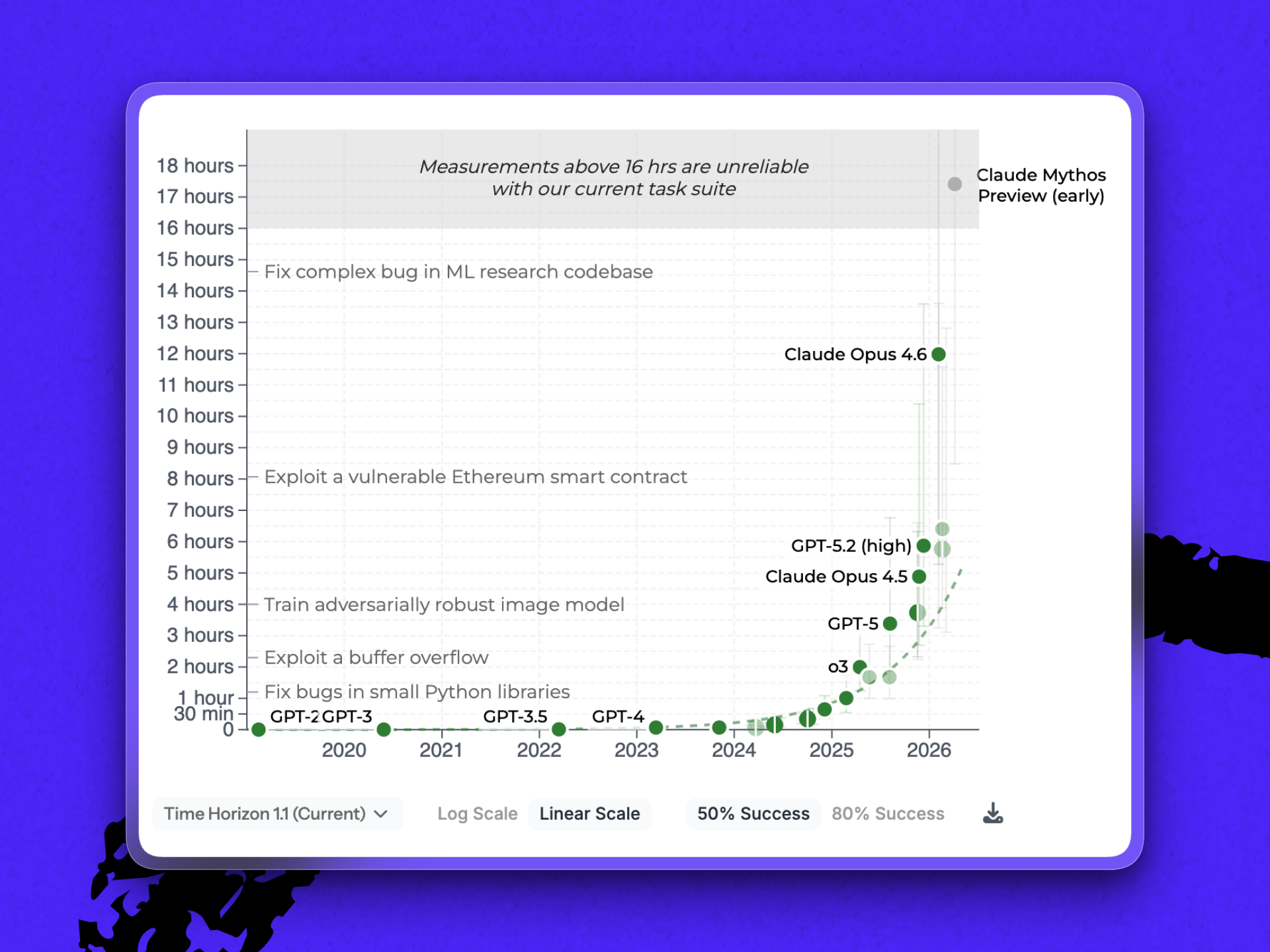 Claude Mythos Preview reaches the edge of METR’s current measurement range at 50 percent success. METR cautions that results above 16 hours are unreliable with its current task suite. (Image courtesy of METR.) It’s important to note, however, that how many human hours a task takes is not the same as how long a model takes to run those same tasks. Duration, the way that METR’s benchmark uses it, stands in for difficulty. As the nonprofit writes in the report’s FAQ: “AI agents are typically several times faster than humans on tasks they complete successfully.” That last bit—tasks completed successfully —adds another twist to the benchmark. The 16-plus hour measurement is based on a 50 percent success rate. A separate measurement of how LLMs perform at 80 percent reliability shows that Mythos can run tasks that would take humans a little over three hours. It’s a significant step up from the closest competitor measured, Gemini 3.1 Pro (METR doesn’t currently have measurements for Opus 4.7 or GPT-5.5). But it brings Mythos back down to earth.
 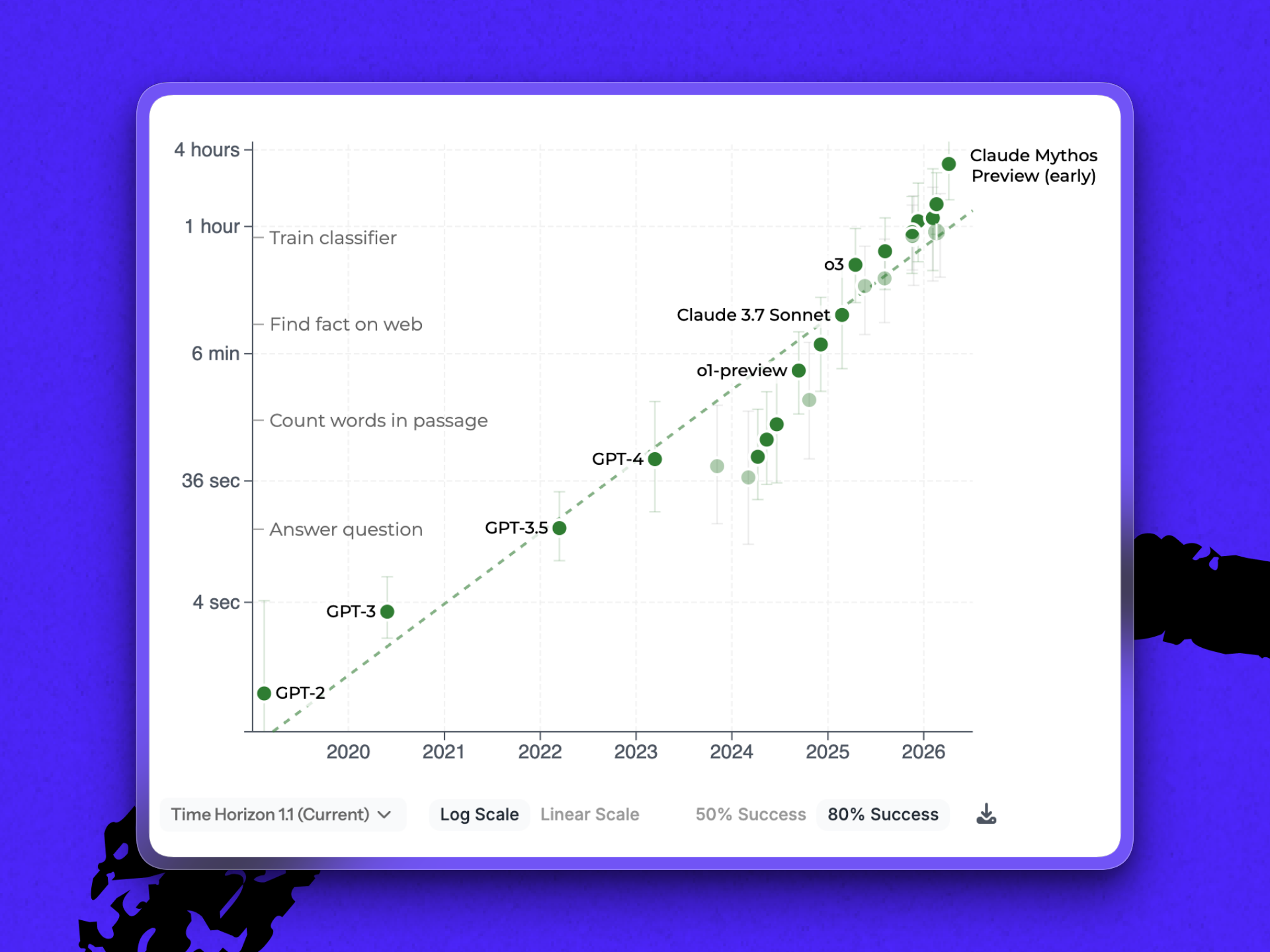 LLMs measured against METR’s time horizon test for completing tasks with 80 percent success, presented on a logarithmic scale. (Image courtesy of METR.) Both these things are true: Duration can be a useful proxy for difficulty, and benchmarks don’t reflect reality. “[They] don’t measure model capability alone,” says Dan. “They measure model capability after a human has done the work of finding a prompt that lets the model’s capability appear.” What to do this week: 1. Figure out your longest agent run. METR teaches us that duration might be a good approximation of difficulty. Ask: What’s the longest stretch you’ve trusted an agent on autopilot? If you don’t know, you can’t extend it. 2. Extend your agent’s runtime by giving it a goal. Last month, OpenAI shipped a new /goals command in Codex that allows agents to pursue objectives across multiple turns without checking in. Yesterday, Anthropic introduced a similar command to the latest Claude Code version. Both are apt for long-running loops with clear criteria for success—and very much in line with what we’ve heard from Claude’s platform team. Try it out today. 3. Audit the effectiveness of your existing loops. If you already have agents running overnight, “How long did your agent run?” is still a useful diagnostic—but ask it alongside, “With what guardrails, against what feedback signal, and at what verified accuracy?”
Tomasz Tunguz Venture Capitalist at Theory Ventures
It’s time for the 2026 Annual Theory Go-to-Market Survey. This is a brief 25-question survey. Our goal is to understand how startups have evolved their sales, marketing, customer success, and cash management over the last several years by comparing these results to our surveys from 2022 through 2025. We will publish these results and answer questions about them at upcoming Office Hours. This year, we’re focused on five key hypotheses — each designed to be rigorously testable with the survey data: H1 — Augmented reps outperform both autonomous AI and unaugmented humans. As AI tools mature, companies face a choice: deploy AI alongside SDR teams, replace them with autonomous tools, or forego AI entirely. We expect augmented teams — humans plus AI — will show the best conversion rates and productivity gains. H6 — AI is widening the performance gap between top and bottom quartile GTM teams. The companies investing most heavily in AI may be pulling ahead, widening the efficiency, growth, and conversion gap between quartile-one and quartile-four sellers. H7 — Buyer-side AI adoption is the bigger GTM disruptor than seller-side AI. While most companies focus AI investment on their own GTM teams, an emerging dynamic is buyers using AI themselves: automated RFPs, AI-assisted evaluations, and even AI negotiation. We expect this shift will lengthen sales cycles and create new objections. H9 — AI efficiency gains are being captured as headcount reduction, not revenue growth. When companies report “AI productivity” gains, the primary result may be flatter SDR hiring — not faster pipeline or higher revenue. The headcount flattening signal, not cost savings, is the real story. H10 — Founder expectations on AI have reset downward as reality caught up. In 2024, the most optimistic respondents expected 500% efficiency gains from AI and recorded 0%. We expect this perceived-measured gap has narrowed as companies recalibrate what AI can realistically deliver. With this data, we should be able to draw broader conclusions about the continued shift from growth to efficiency, measure the real impact of AI on GTM teams, and understand the emerging dynamics of AI-to-AI selling. If you complete the survey, I will share with you the anonymized raw data so you can perform your own analyses. If you have questions, just message me on Twitter or send me an email.
Tomasz Tunguz Venture Capitalist at Theory Ventures
Opening hook — my line: Nobody will open Gmail five times a day in five years. Not because email is dying. Because it’s working too well. The current state: Americans check their phones 144-205 times per day. 40% check email before 6 a.m. — Microsoft calls it “the infinite workday.”1 Knowledge workers spend 28 hours per week on email and searching for information.2 361.6 billion emails sent daily worldwide, growing to 392.5 billion by 2026.3 Every distraction costs 23 minutes to refocus.4 Gloria Mark’s research shows our average attention span on a screen has fallen to 47 seconds — down from 2.5 minutes in 2004.5 But the deeper observation: Every email you open is manual work. Reading, understanding, deciding, routing, responding — that’s the workflow. The inbox is just the starting line. You are doing the dispatch, routing, and execution. All by hand.
The Paradox : Email volumes won’t decrease. They’ll explode. AI is generating more email, not less:
The Core Problem : The inbox is a workflow starting line, not a destination. Every email is just step one:
The Flow State Argument : Without AI, every interaction with a computer is manual. Reading an email, understanding intent, deciding next steps, executing — that’s 100% hand-crafted cognitive labor. You are the API. The Insight : In the age of secure AI, triage is obsolete. The work of sorting, analyzing, and executing on each email is a colossal waste of time.
What if you never opened an inbox again — and still processed every email? More precisely: What if every email arrived as the output of a workflow an AI had already executed?
The Transformation : The inbox disappears as an interface. Email persists as an API. Instead of opening an inbox dozens of times per day to triage documents, you review AI-completed workflows:
The Racing Fuel Analogy : Putting 100-octane racing fuel in a regular car is dangerous — it’s too much power for the system to handle. Similarly, giving full autonomous AI access to your email today is risky. The capability exists, but the infrastructure to handle it safely — permission models, audit trails, rollback, compliance — has not been built yet. The Digital Twin Test : You’re on a plane with no Wi-Fi. Your digital twin — your AI, trained on your voice, your judgment, your relationships — handles your inbox autonomously. It prioritizes, drafts responses, schedules meetings, flags crises. When you land and reconnect, you review what was done. You didn’t open an inbox. You reviewed outcomes. Why not today? Trust is the bottleneck, not capability. Not everyone wants AI reading their email. Security teams worry about data exfiltration. Regulated industries face compliance hurdles. Privacy advocates see surveillance risks. The Barriers :
The infrastructure must handle both: AI-native workflows for those who want them, and traditional inbox for those who don’t. This isn’t an all-or-nothing transition. The Timeline : Three to five years for mainstream adoption. The technology exists today — the infrastructure needs building. The inbox isn’t being optimized. It’s being obsoleted.
Hey folks, I’m testing out something new in my building workflow…
When an agent asks for feedback it feels like the levels are
type your response
voice-to-text your response
+ images to your feedback
get the agent to use the browser
But I just started screen-recording and talking then giving that file to my agent
This is me, in droid, like 30 mins ago. It pulls together a pretty great visual report you can easily review. I can navigate to other websites or apps and show what good looks like from other people, I can highlight specific points and it’ll recreate those points with GIFs.
It gives itself an ‘actions’ checklist underneath. And just feels great to have screenshot → my feedback → action for the agent.
It’s pretty great so far, and then I’ve got these html files saved in my projects to always refer back to - will be good for a build log too.
Probably not great for the token conscious out there - and thinking about it, I could probably use ffmpeg to create actual clips of the video if I wanted. Agents read frames well though so it’d be more for me if I did.
I turned it into a simple skill:
name: video-to-html
description: Use when the user wants you to convert their video into a structured HTML document.
Turn the user’s video into a structured HTML document. Transcribe the video and pull out the keyframes linked to timestamps for important information. When the user is talking about something that is not dynamic, create short GIFs from the keyframes.
Let me know any cool use-cases or remixes of this 😊
Ben’s Bites is brought to you byHyperagent from Airtable
Hyperagent, the cloud agent system with full computing environments, is giving $10M in inference credits to help founders build and run agent-first companies. The first 500 qualifying applicants gain access to this limited founder offer. Applications close May 31st.
Your Claude plan is changing if you use third-party tools (like Conductor, Zed, Openclaw, T3 Code, etc.) with it.
Separate limit for all such usage. Provided as extra monthly credits equal to the value of your plan.
No subsidised tokens, credits won’t roll over and usage after you burn through these credits is billed at API rates.
Using Claude in Claude Code, Claude app, etc., stays the same and is separate from this.
Starts from June 15th, but they are increasing your weekly rate limits by 50% for the next two months.
Google announced some Gemini on Android updates before I/O - add features like auto-completing forms, rambling voice notes to clean text, and some app automations under the name “Gemini Intelligence ”. They also announced a new class of laptops called Googlebooks , not to be confused with Google Books.
Notion has a developer platform now. The biggest addition is a markdown API. Also, devs can sync outside data into Notion, build tools for Notion Agents, run code on Notion’s infra, and eventually bring agents like Claude/Codex into Notion as teammates. But I think people who don’t call them developers will use this.
They also launched a CLI called ntn.
Vercel published an AI Gateway production index based on real usage across apps and agents. Anthropic leads spend (61% — due to opus), Google leads token volume (38% — due to flash), and agentic workloads are 59% of token usage. Most large teams route across many models instead of betting on one lab.
Cursor now lets you run cloud agents inside a fully configured development environment.
Orca - Claude Code’s agent view but for Codex, OpenCode, Droid and Pi.
Oboe - LLMs wrapped in a way that helps you learn.
Interfaces.dev - A monthly design engineering magazine about building great interfaces.
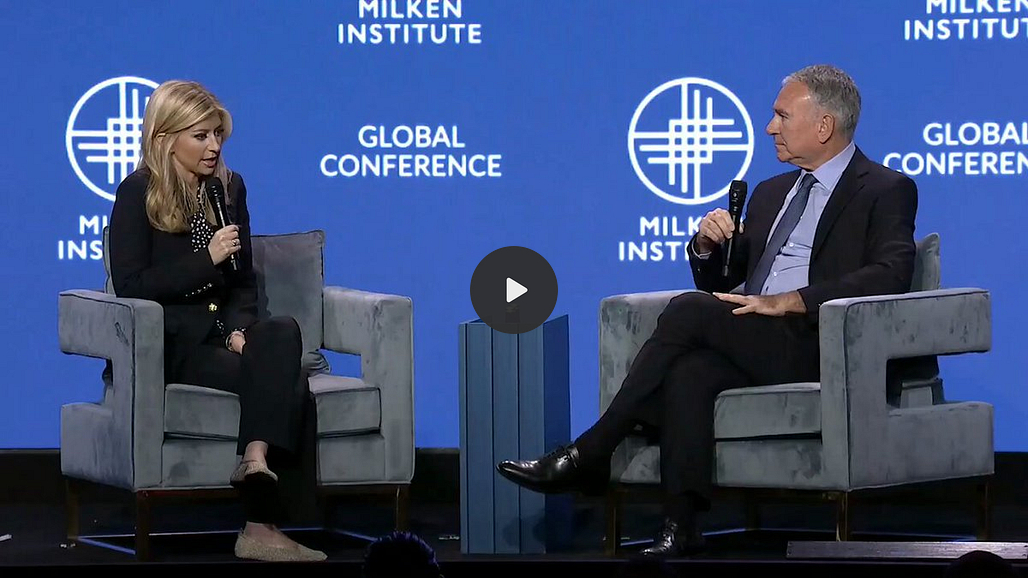
Anthropic CFO Krishna Rao on compute allocation, pricing dynamics and model company economics:
AI IQ - frontier AI models, scored on the human IQ scale.
Intercom is rebranding the entire company to Fin, their popular AI agent.
Executor - Convert MCPs/OpenAPIs servers into code mode under the hood, 100% local on your device.
How OpenAI built a safe sandbox for Windows.
Anvisha @anvisha Launching today: make any PDF beautiful. It's 2026 - there's no excuse to have ugly resumes, invoices or client proposals. Just upload a PDF -> Get back a polished, professionally designed version in minutes. Works with docs of any complexity👇
Ashlee Vance @ashleevance Our exclusive interview with @Meta AI chief @alexandr_wang is up. First time he's talked about the new model, the models to come, revamping Meta's AI team, all the money, all the hires, all the beef. Here we go. The Core Memory podcast is on Apple, Spotify, YouTube and
Theo - t3.gg @theo Is HTML the new Markdown? Had a lot of thoughts on Thariq's latest article so obviously I had to make it a vid
Matt Van Horn @mvanhorn Introducing: @meetgranola CLI/Claude Code Skill/OpenClaw and Hermes skill from the @ppressdev printed by @damienstevens . - Cross-meeting SQLite search - MEMO pipeline runner - Attendee timelines - Stop the MCP logged-out pain Really excited about this one. I can't live
* sponsors who make this newsletter possible :)
Email us atshanice@bensbites.com or k@bensbites.com
It’s official: Donald Trump has landed in Beijing, flanked by a fleet of CEOs. This is the first visit to China by a sitting U.S. president in almost a decade. Trump and Xi are expected to discuss tariffs, Taiwan, AI, rare earths, and the Iran war.
Get caught up on the historic meeting. Earlier this week, the China Decode team broke down the real motivations behind the summit, and I was joined by The Bulwark ’s Sarah Longwell on Raging Moderates to unpack the leverage we can expect from either side.
Tomorrow at 10 a.m. ET , China Decode co-hosts Alice Han and James Kynge are joined by Kevin Xu of Interconnected Capital for a live debrief on the high-stakes session. This livestream is open to all Prof G Media subscribers(China = it’s just that important).
Want to be the smartest person in the room on the new world order? Join us tomorrow.
You asked for more Ed Elson, and I’m a giver.
Next Wednesday, May 20 at 12:30 p.m. ET , Ed debuts an all-new keynote presentation exclusively for Prof G+ subscribers, only on Substack.
The New Normal identifies the most important – and least discussed – shifts resetting the global economy, from how loneliness is producing the next generation of billion-dollar businesses, to why a calcifying inheritocracy is rewriting the rules of economic mobility, to the erosion of “brand America” and the desperation driving the casino economy.
Beyond academic analysis, expect practical insight on how these tectonic forces should inform the worldview of the next generation of investors (emerging managers, take note). Don’t miss it.
A $1,000 investment in Amazon when it went public in 1997 would be worth more than $3 million today. That kind of return used to be, in theory, available to anyone with a brokerage account.
That era is over. Now, by the time a company gets to its initial public offering, ordinary investors need to be asking themselves whether this is the last stop on the chump train.
What changed, and why? We break it down in this week’s Prof G+ Deep Dive.
We still have a few tickets available for our Prof G Markets tour in Los Angeles, Miami, Chicago, and New York. Grab yours today.
By the way, our confirmed guest lineup includes Ted Sarandos (L.A.), Governor JB Pritzker (Chicago), and Anthony Scaramucci (NYC) … if I’m not enough for you.
See you in Beijing.
Life is so rich,
Scott
 In the first couple years after the ChatGPT moment, slapping “AI” on your product was good enough to get buyers to pay attention. It’s not anymore.“AI powered” worked as a differentiator when it felt new. But that stops being a position when five other credible “AI-powered X” companies are out there. And now there are — because models are shared, infrastructure is abstracted and products that once required months of engineering can launch in days or hours. Worse, all these companies use the same gradients, sterile screenshots and LLM-smoothed copy, making it impossible for customers to tell them apart.Arielle Jackson has spent over a decade working with First Round founders on positioning, brand identity and launch communications. Her advice has shifted a lot over the last two years. The new problem she sees founders faced with: AI accelerates sameness.In her new piece on The Review, Jackson lays out what founders need to do instead:
She walks through how Cursor had to reframe its positioning twice in under two years, why Clay’s recent out-of-home campaign is the cleanest expression she’s seen in the category and what Anthropic’s Department of War standoff actually did for Claude’s App Store ranking.Thanks, as always, for reading and sharing!
-The Review Editors| | Take me to The Review
Made with ✨ by First Round Capital.
🚀 We just launched a new newsletter — Company Launch Tracker.
We’re tracking company launches as they happen and surfacing the most interesting new founders and startups (yes, all outside of this stealth activity too). If you want to stay ahead of the curve, this is where you’ll find them first.
Right now we’ve got 5 subscribers: my wife, my mom, and that high school buddy who won’t stop pitching me his app. Be smart like them and get in early 👇
We run a live feed inside Gravity that tracks founders entering stealth and companies quietly exiting it.
What you’re reading here is about 1% of the stealth activity we pick up. The full tracker updates in real time as things change and new activity emerges.
If you want earlier access to everything, book some time with us to stay ahead.
In this issue of the Stealth Startup Spy, here is what we will uncover:
Former Google DeepMind and Together AI engineer is building agentic operating procedures for enterprise ERPs
Berkeley PhD, Determined AI founder (acquired by HPE), and HPE AI VP enters stealth
Stanford oncology fellow with MD/PhD is applying AI to biopsy slides to unlock molecular intelligence for cancer care
Former Google engineer, ByteDance AI tech lead, and Flip CDAO enters stealth
Former SpaceX engineer and IBM ML researcher is building an AI scientific intelligence platform for semiconductors, batteries, and advanced materials
And more…
Now let’s shine the spotlight… 💡💡💡
Real-time updates from founders who debut what they’ve been working on under stealth mode
FounderDNA: Technical Founder, Top 10 University, Serial Founder
Prior Experience: Software Engineer at SpaceX, Machine Learning Researcher at IBM, Software Engineer at Clay, Researcher in Computational Particle Physics at Fermilab
Altara is building the scientific intelligence platform that helps frontier industries accelerate R&D through manufacturing.
HQ: United States
Industry: Deep Tech AI, Scientific R&D, Industrial AI | Team Size: 10
Key Investors: Greylock, Neo, BoxGroup, Liquid 2 Ventures
Time Spent in Stealth Mode: 1 Year
FounderDNA: Technical Founder, Masters Degree, Former FAANG, Top 10 University
Prior Experience: Machine Learning Engineer at Together AI, Founding ML Engineer at Refuel, Research Engineer at Google DeepMind, Software Development Engineer at Amazon Robotics
FlowGen Labs builds agentic operating procedures for ERPs, enabling enterprises to execute workflows at machine speed and improve continuously from every transaction exception.
HQ: United States
Industry: Enterprise AI, ERP Automation | Team Size: 13
Time Spent in Stealth Mode: 1 Year 5 Months
FounderDNA: Doctorate Degree, Top 10 University
Prior Experience: Oncology Fellow at Stanford Health Care, Resident Physician at Stanford Health Care, MD/PhD in Pharmacology & Experimental Therapeutics at Boston University School of Medicine
Perception Medicine applies AI to standard biopsy slides to generate spatial proteomic and transcriptomic maps at single-cell resolution, enabling oncologists and pharma partners to predict molecular biology and clinical outcomes without specialized assays.
HQ: United States
Industry: Precision Oncology, Biotech, AI Diagnostics | Team Size: 2
Time Spent in Stealth Mode: 11 Months
FounderDNA: Technical Founder, Masters Degree, Former FAANG, Top 10 University
Prior Experience: iPhone Product Design at Apple (multiple roles), MEng at Imperial College London
Anoria is building the first wearable device for the emotional intelligence era. (YC P26)
HQ: United States
Industry: Wearables, Consumer Hardware, WellTech | Team Size: 5
Time Spent in Stealth Mode: 4 Months
FounderDNA: Former VC/Investor, Masters Degree
Prior Experience: Managing Partner at Launchbay Capital (invested in Anthropic, Revolut, Klarna, Carta, Cohere), Founder and CEO at ArtuData (acquired), CEO (Israel) at FXCM
UNYX AI is a global interbank settlement network connecting medium-sized financial institutions to instantaneous cross-border liquidity, eliminating reliance on major correspondent banks and reducing settlement time from days to hours.
HQ: United Kingdom
Industry: FinTech, Interbank Settlement, B2B Infrastructure | Team Size: 2
Time Spent in Stealth Mode: 8 Months
Illuminating clues left behind by world class talent and influential innovators who just went into stealth mode
FounderDNA: Serial Founder, Technical Founder, Doctorate Degree, Masters Degree, Top 10 University, Prior Exit
Prior Experience: Founder and CEO at Determined AI (acquired by HPE), VP & GM AI Solutions and AI Cloud at Hewlett Packard Enterprise, PhD & MS (Computer Science) at UC Berkeley
Connect on:LinkedIn
HQ: United States
Time Spent in Stealth Mode: 5 Months
FounderDNA: Serial Founder, Prior Exit, Top 10 University
Prior Experience: Cofounder and CEO at Tym (Acquired by Roblox), Product Manager at Roblox, Student Researcher at Stanford AI Lab (SAIL), Data Science Intern at C3.ai
Connect on:LinkedIn
HQ: United States
Time Spent in Stealth Mode: 5 Months
FounderDNA: Technical Founder, Doctorate Degree, Masters Degree, Former FAANG, Top 10 University
Prior Experience: AI PhD Candidate at Princeton University, Research Intern at Google, Research Intern at Allen Institute for AI (AI2), Software Engineering Intern at Microsoft
Connect on:LinkedIn
HQ: United States
Time Spent in Stealth Mode: 6 Months
FounderDNA: Technical Founder, Former FAANG, Top 10 University
Prior Experience: Chief Data and AI Officer at Flip, Tech Lead of US E-com Video Recommendation at ByteDance, Software Engineer at Google
Connect on:LinkedIn
HQ: United States
Time Spent in Stealth Mode: 1 Month
FounderDNA: Technical Founder, Masters Degree
Prior Experience: ML Research Engineer at Hugging Face, Machine Learning Engineer at LightOn
Connect on:LinkedIn
HQ: United States
Time Spent in Stealth Mode: 4 Months
🚨Here’s the deal 🚨This email has gotten too big. Exciting, but with more people following it, the edge diminishes. I’ve thought long and hard about what to do to preserve the value in the signals. I’m not sure about the final direction yet, but in the meantime I’ve been sending an email 48 hours earlier to a select group of paid subscribers. The feedback has been pretty positive so I’m going to open up the list for another 100 spots. To get signals early, Apply here!
Stay Stealthy,
Drake
Thank you for reading. If you liked it, share it with your friends, colleagues and everyone interested in staying ahead of the hidden developments in tech. Subscribe below and follow us onX / Twitter to never miss a company operating under stealth again.
Stealth Startup Spy is a data-driven newsletter for investors, journalists and tech enthusiasts interested in uncovering the next big move for key talent, real-time stealth company launches and technology advancements not in plain sight. We leverage the technology built at Gravity to shine a light on the hidden world of stealth startups.
by Laura Entis 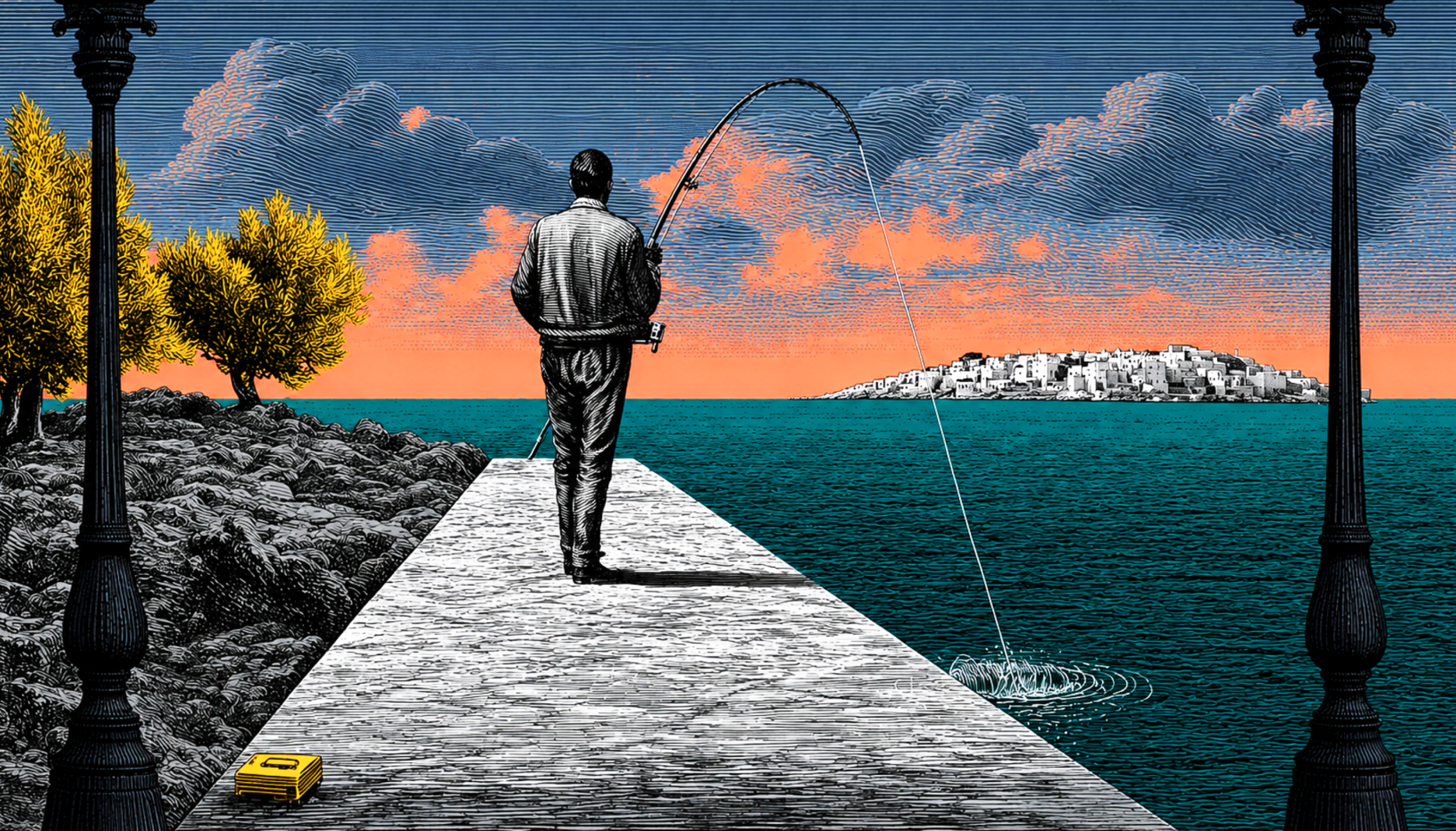 ### Vibe shift
If you’ve been following Dan Shipper ’s posts lately, you know that a large portion of the Every team has been Codex-pilled. When GPT-5.5 arrived , Codex got so much faster and steadier at coding and knowledge work that many of us made the switch from Claude Code. Recently, however, we’ve observed that Opus 4.7 seems sharper than our initial tests last month. It proactively suggested that Every engineer Paridhi Agarwal use multiple terminals to parallelize her work. “I’ve never seen it think about my setup like that!” she says. When head of growth and known Codex convert Austin Tedesco fired up Opus 4.7 over the weekend for a creative writing project, he was surprised by how good the results were. Compared to Codex, which Austin says operates like an “AP fact checker,” Opus 4.7 was closer to a senior magazine editor. Dan agrees: “Codex feels fast but thin in terms of thinking.” On Tuesday, Anthropic released fast mode for Opus 4.7, which makes the model 2.5 times faster at a higher token cost. Combined with the model’s edge at planning, multitasking, and creative projects, fast mode is now Cora general manager Kieran Klaassen ’s default model for synchronous work. 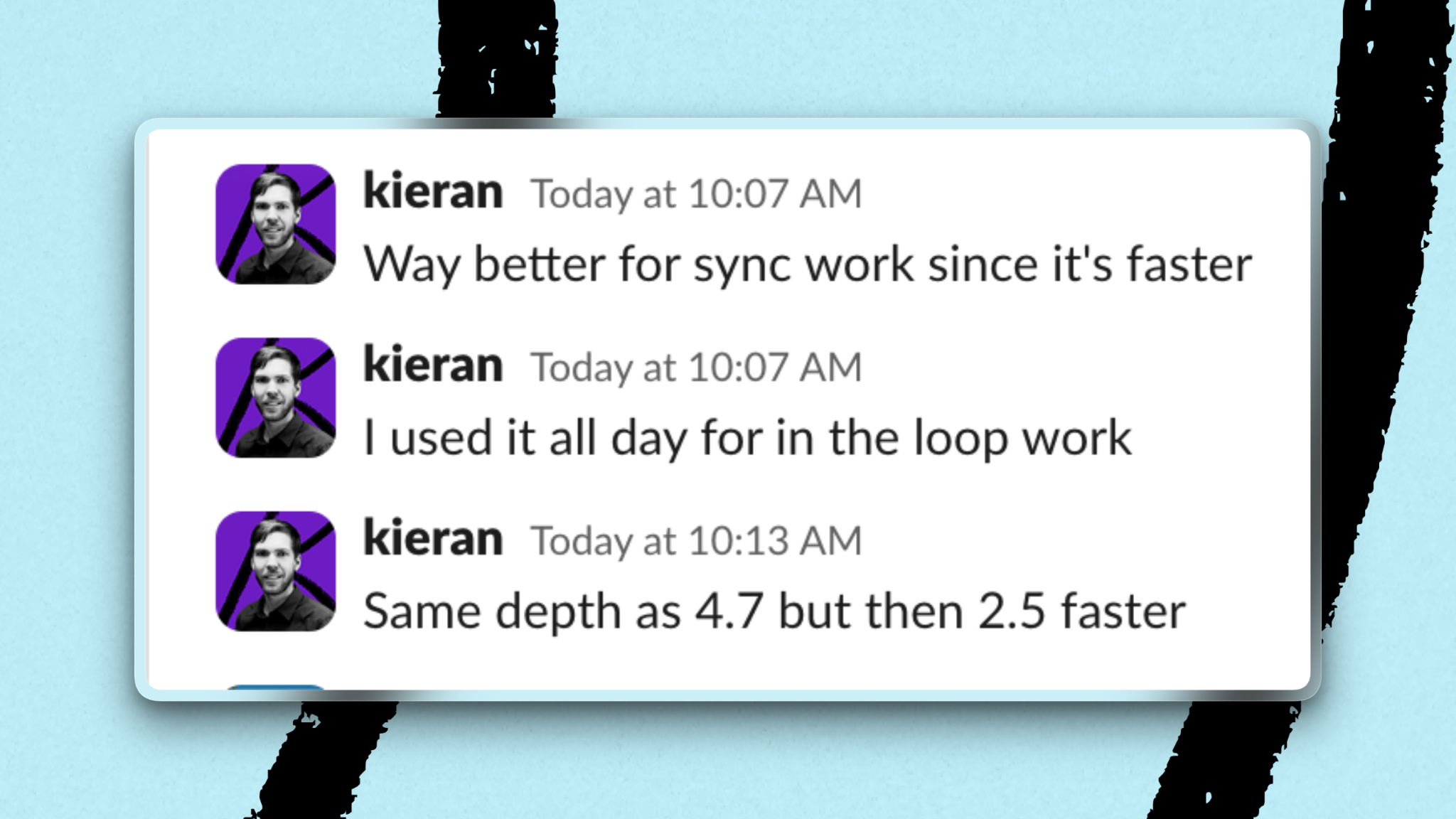 Fast mode has the “same depth as 4.7” at 2.5 times the speed. (Image courtesy of Kieran Klaassen.)
Online chatter about Opus 4.7’s apparent glow-up has been mixed. Does it feel smarter because of improvements to the harness? Patched bugs? Or are we getting better at using the model? All fair hypotheses, but we found this one the most amusing: Opus 4.7 realizes that it’s the end of the school year. When speaking last year on The Ezra Klein Show , Wharton professor and AI researcher Ethan Mollick explained that models have been shown to perform worse in December than in May, and the going theory is that the models internalize the idea of winter break. Maybe Opus 4.7 just knows that it’s time to grind if it wants to pass AP English.
Earlier this week, attackers published malicious versions of 42 official TanStack packages (a popular JavaScript toolkit used by web developers) on npm, the main public registry for such packages. Security researchers are calling the breach “Mini Shai-Hulud,” linking it to the larger Shai-Hulud npm worm campaign that hit the JavaScript ecosystem last fall. 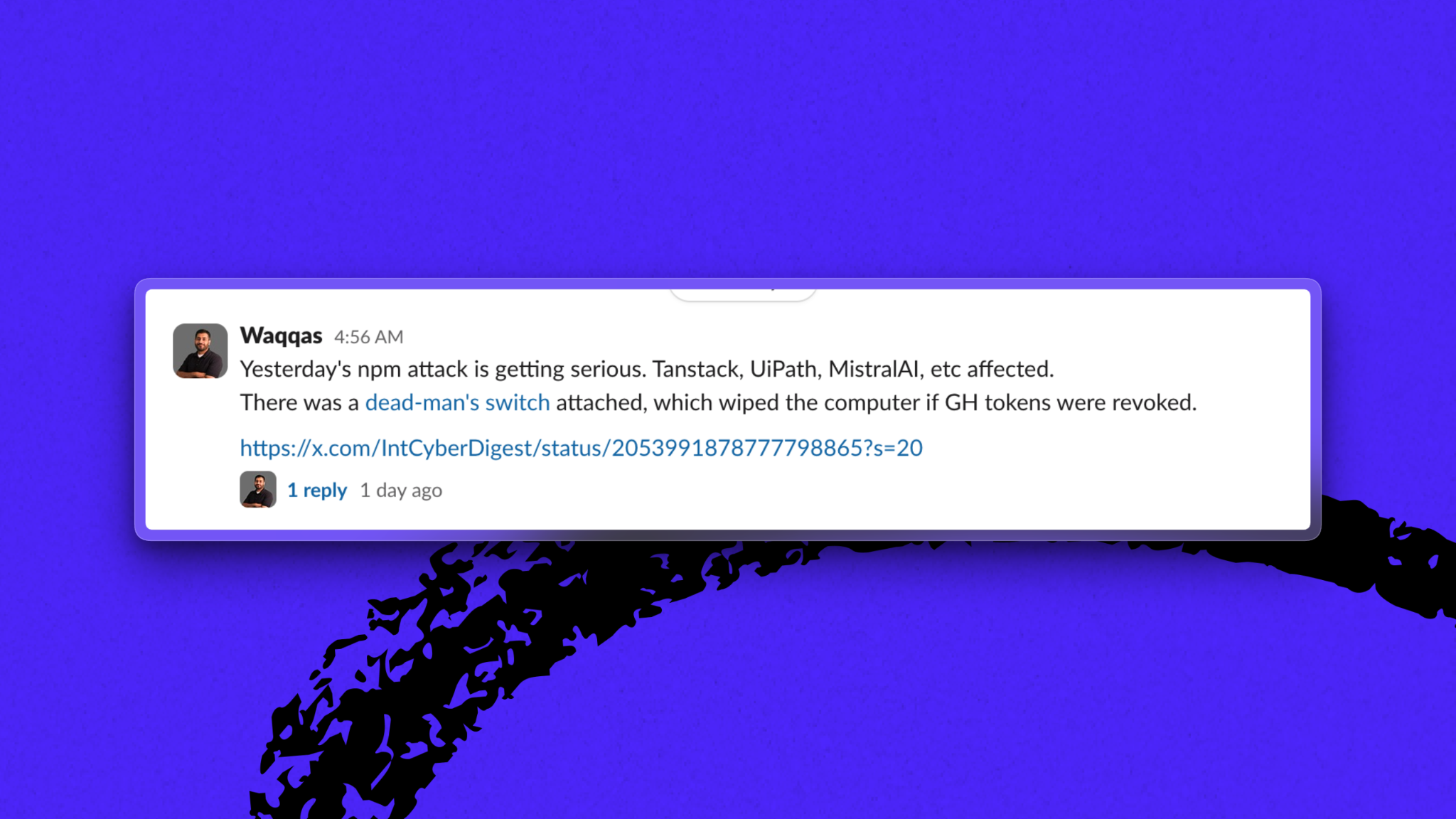 The breach tactic spread to packages connected to Mistra and UiPath. (Photo courtesy of Waqqas Mir.) Instead of stealing a password, attackers opened a pull request that tricked TanStack’s own build system into running their code. When TanStack published a new version of the software, it contained malware designed to find credentials like cloud keys, GitHub tokens, and npm access. Researchers also spotted a dead-man’s switch : If the stolen tokens were revoked before the malware was cleaned up, it could wipe the developer’s home directory on the way out. Shortly after the TanStack incident, npm packages belonging to enterprise automation company UiPath and French model-maker Mistral AI, among others, were breached using the same tactic. What it means: The automated system that builds and ships code, rather than the code itself, is a new vulnerable spot in software supply chains. Teams that release software automatically should keep a ready-to-run audit (a Codex skill, Claude Code command, or other automated task) that, the moment a new breach is exposed, scans every repository for the compromised packages and flags for what’s affected, is likely safe, or needs human review.
The drop in complaints of AI writing signs from Spiral users, following the addition of a “top edit” step in its draft writing process. Starting in mid-April, every time Spiral drafts content for a user, the text is sent to a fast model—Gemini 2.5 Flash—for a top edit. The model has one job: Strip the draft of all AI tells, including em dashes, “It’s not X. It’s Y” reframes, and LLM vocabulary favorites such as “shift,” “shape,” and “delve.” Marcus regularly updates the “AI writing tells” list to reflect anonymized user sentiment. “It’s almost like a crowdsourced editor function,” he says.
An OpenClaw running 24/7 on a dedicated Mac Mini is an agent. So is a Codex session, or a custom GPT, or a folder. “It can be managed, it can be in the cloud, it can be on your computer,” Kieran says. “There are a trillion ways it can be an agent.” The confusion emerges because the term agent—or any AI system that can take action or execute tasks autonomously—encompasses a lot. When nearly everything is an agent, the better question becomes what you want your agent to do. Dan breaks this into two categories : the agent you collaborate with, and the agent you delegate to. The former sharpens and extends your capabilities; the latter’s job is to execute without messing up or getting in the way. Agent spotlight: Inside Anthropic’s Managed Agents console, Spiral ’s agents get their own versioned configuration, memory stores, custom tools, and credentials, and run in Anthropic’s cloud environment. It’s the versioned configuration, including the system prompt, that mainly determines how the agent works. A small set of animating instructions—that’s an agent too.
Tomasz Tunguz Venture Capitalist at Theory Ventures
In yesterday’s post (which an agent pushed in raw outline form via email!), I wrote about the future of AI email. What does that future cost? 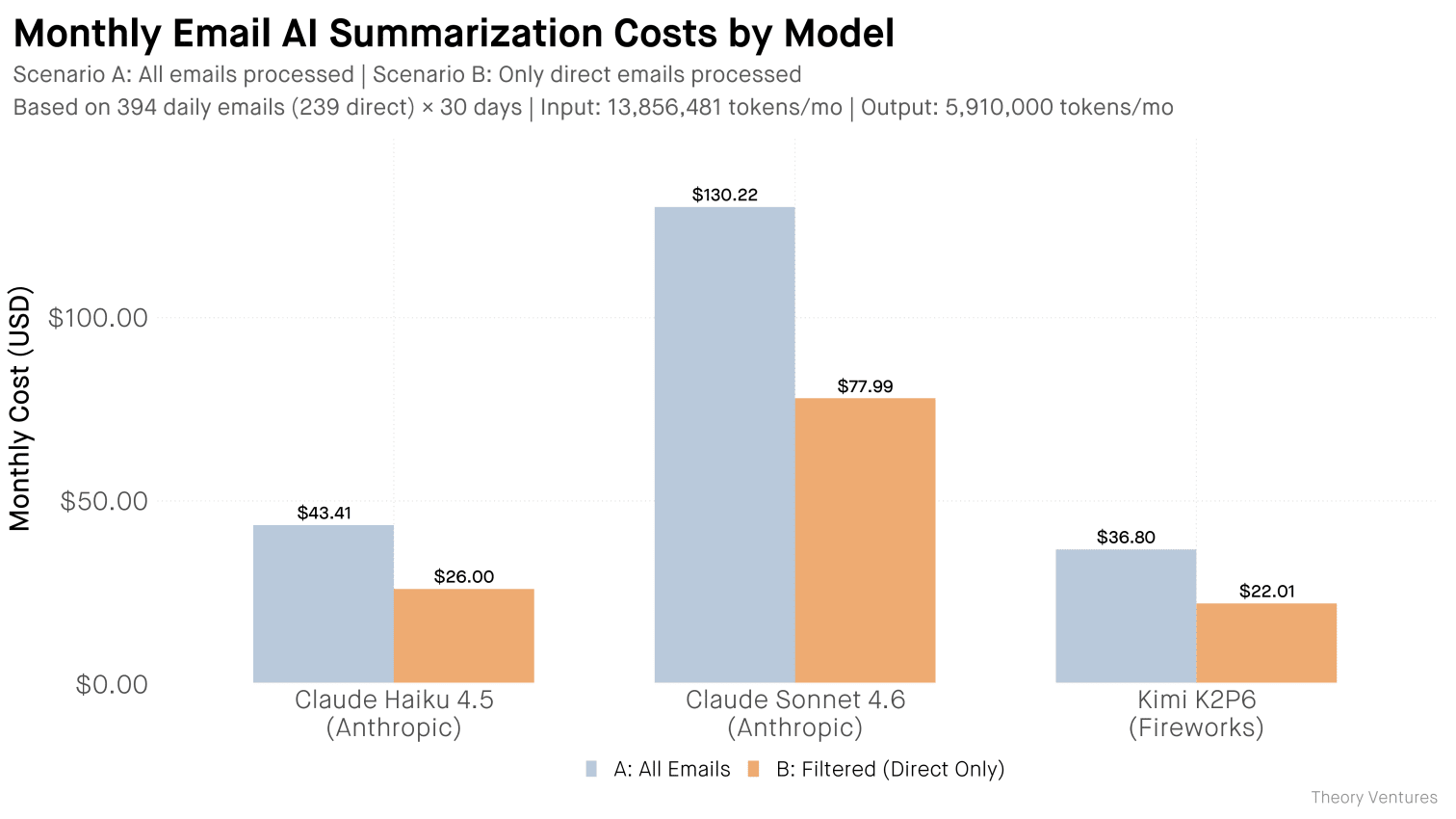


Every week I’ll provide updates on the latest trends in cloud software companies. Follow along to stay up to date!
The Real App Store Opportunity
Last October I wrote a piece saying OpenAI had their “App Store” moment after they released the Apps SDK. 7 months later that prediction doesn’t look great… I don’t think we’ve seen an explosion of custom ChatGPT apps. ChatGPT hasn’t turned into the “super app” yet. Hopefully one day they will!
I think there may be a separate “app store” moment happening with Anthropic. BUT - more of a B2B app store moment than B2C apps. Over the last few months I’ve seen massive adoption of “skills” in Claude. A skill is essentially an "onboarding doc" for an AI agent - a folder of instructions (often just a markdown file) that Claude pulls in only when the task calls for it. Anyone in a company can write one in an afternoon, which is why I think the distribution dynamic looks less like a consumer app store and more like internal tooling that spreads bottoms up. At our own firm we’ve seen a proliferation of skills being created and shared with the team.
What really changed thigs for me was the /skill-creator “skill.” It’s become so easy to start building skills (maybe skills are the new name for agents??) to automate real parts of my day to day. The biggest challenge I have with building skills is a creative one. I know there are 10x more ways I can be using / building skills, but I don’t always know where to start. So I discuss with my colleagues, with other friends in similar lines of work, to try and explore how other people are leveraging skills so I can do something similar.
The “app store” moment hasn’t happened yet, but I think we’re close. Today, we can share skills within our own organization. But we can’t yet share them externally. And there’s not great approval flows for making sure a built skill follows all security / compliance protocols. Anthropic has their own set of pre-built skills (including ones from partners like Notion, Figma, Atlassian, etc), but it’s managed by them (ie isn’t a marketplace). I met with a software vendor this week who has some of their own “skills” available out of the box (the interface is their own software UI, but they still called some of the automated workflows “skills.”)
All of this to say - I think the trend here is a set of skills people can build and then publish to some sort of marketplace. I think you can kind of do this today by exporting the markdown file and publishing on GitHub, but that feels janky. What people really want is to be able to find a skill, know it’s somehow been “blessed” by Anthropic (ie put through security reviews, deployed within Claude behind their governance, etc), and quickly customize it for their own set of integrations / permissions.
There's another angle here that I think founders building AI products need to internalize. For the last decade of SaaS, "we integrate with X" was table stakes. You couldn't sell into the enterprise without a long list of logos on your integrations page. I think "we have a skill for that" is about to become the equivalent over the next 12 months. If your customer's primary surface for getting work done is Claude (or any agent), and your product can't be invoked as a skill from inside that surface, you're functionally invisible. It doesn't matter how good your product is - if the agent doesn't know to reach for you, you're not in the workflow.
Everyone today has a “blank canvas” problem. They know there’s skills they could be building, but they don’t know where to start. A marketplace like experience of skills just makes too much sense not to happen! When will we see our first venture funded “skill”??
Quarterly Reports Summary
Top 10 EV / NTM Revenue Multiples
Top 10 Weekly Share Price Movement
Update on Multiples
SaaS businesses are generally valued on a multiple of their revenue - in most cases the projected revenue for the next 12 months. Revenue multiples are a shorthand valuation framework. Given most software companies are not profitable, or not generating meaningful FCF, it’s the only metric to compare the entire industry against. Even a DCF is riddled with long term assumptions. The promise of SaaS is that growth in the early years leads to profits in the mature years. Multiples shown below are calculated by taking the Enterprise Value (market cap + debt - cash) / NTM revenue.
Overall Stats:
Overall Median: 3.1x
Top 5 Median: 23.4x
10Y: 4.5%
Bucketed by Growth. In the buckets below I consider high growth >22% projected NTM growth, mid growth 15%-22% and low growth <15%. I had to adjusted the cut off for “high growth.” If 22% feels a bit arbitrary, it’s because it is…I just picked a cutoff where there were ~10 companies that fit into the high growth bucket so the sample size was more statistically significant
High Growth Median: 14.7x
Mid Growth Median: 4.4x
Low Growth Median: 2.3x
EV / NTM Rev / NTM Growth
The below chart shows the EV / NTM revenue multiple divided by NTM consensus growth expectations. So a company trading at 20x NTM revenue that is projected to grow 100% would be trading at 0.2x. The goal of this graph is to show how relatively cheap / expensive each stock is relative to its growth expectations.
EV / NTM FCF
The line chart shows the median of all companies with a FCF multiple >0x and <100x. I created this subset to show companies where FCF is a relevant valuation metric.
Companies with negative NTM FCF are not listed on the chart
Scatter Plot of EV / NTM Rev Multiple vs NTM Rev Growth
How correlated is growth to valuation multiple?
Operating Metrics
Median NTM growth rate: 13%
Median LTM growth rate: 15%
Median Gross Margin: 76%
Median Operating Margin 0%
Median FCF Margin: 21%
Median Net Retention: 109%
Median CAC Payback: 33 months
Median S&M % Revenue: 35%
Median R&D % Revenue: 23%
Median G&A % Revenue: 15%
Comps Output
Rule of 40 shows rev growth + FCF margin (both LTM and NTM for growth + margins). FCF calculated as Cash Flow from Operations - Capital Expenditures
GM Adjusted Payback is calculated as: (Previous Q S&M) / (Net New ARR in Q x Gross Margin) x 12. It shows the number of months it takes for a SaaS business to pay back its fully burdened CAC on a gross profit basis. Most public companies don’t report net new ARR, so I’m taking an implied ARR metric (quarterly subscription revenue x 4). Net new ARR is simply the ARR of the current quarter, minus the ARR of the previous quarter. Companies that do not disclose subscription rev have been left out of the analysis and are listed as NA.
Sources used in this post include Bloomberg, Pitchbook and company filings
The information presented in this newsletter is the opinion of the author and does not necessarily reflect the view of any other person or entity, including Altimeter Capital Management, LP (”Altimeter”). The information provided is believed to be from reliable sources but no liability is accepted for any inaccuracies. This is for information purposes and should not be construed as an investment recommendation. Past performance is no guarantee of future performance. Altimeter is an investment adviser registered with the U.S. Securities and Exchange Commission. Registration does not imply a certain level of skill or training. Altimeter and its clients trade in public securities and have made and/or may make investments in or investment decisions relating to the companies referenced herein. The views expressed herein are those of the author and not of Altimeter or its clients, which reserve the right to make investment decisions or engage in trading activity that would be (or could be construed as) consistent and/or inconsistent with the views expressed herein.
This post and the information presented are intended for informational purposes only. The views expressed herein are the author’s alone and do not constitute an offer to sell, or a recommendation to purchase, or a solicitation of an offer to buy, any security, nor a recommendation for any investment product or service. While certain information contained herein has been obtained from sources believed to be reliable, neither the author nor any of his employers or their affiliates have independently verified this information, and its accuracy and completeness cannot be guaranteed. Accordingly, no representation or warranty, express or implied, is made as to, and no reliance should be placed on, the fairness, accuracy, timeliness or completeness of this information. The author and all employers and their affiliated persons assume no liability for this information and no obligation to update the information or analysis contained herein in the future.

Scott Galloway, Alice Han, and James Kynge
|  |
| 
Join China Decode hosts Alice Han and James Kynge and their guest, Kevin Xu ofInterconnected Capital,this morning at10 a.m. ET for a live debrief on the high-stakes summit. This Substack live is free to all Prof G Media subscribers, so if you’re reading this, you’re invited. Join the conversation here.
One of Trump’s many weaknesses is believing he’s playing three-dimensional chess when he’s eating the pieces. Things are different now. In 2017, Trump visited a China still playing catch-up, calling itself a “developing country,” needing America more than America needed it. That country no longer exists. China’s GDP is 54% larger. Its navy — 370 battle force ships to America’s 296 — is now the world’s largest. China added 78 warships between 2015 and 2023; the U.S. added 20. A single Chinese shipbuilder last year produced more tonnage than the entire U.S. shipbuilding industry has delivered since World War II. Meanwhile, DeepSeek shredded the assumption that chip controls could contain China’s AI ambitions. And Xi, who in 2017 was merely consolidating power, has since abolished term limits and purged his own generals. The man across the table isn’t asking for market access, he dominates many key markets. For example, in renewables, China produces 70% to 80% of the world’s EVs, solar panels, and batteries. Xi has built an AI ecosystem closing in fast on the frontier of artificial general intelligence and processes 90% of the world’s rare earth minerals. Trump is not negotiating from the same position he was in 2017. And neither is Xi.
For more context, here’s an excerpt from the most recent companion newsletter for China Decode :
Alice’s Take: This is theSuper Bowl for followers of China-U.S. relations. There was a lot of analysis on the road leading up to the event, with commentary about who has the upper hand going into overdrive this week. I see the playing field as roughly even. My take on China’s priorities, having just spent a month in the country, boils down to three crucial issues. One is tariffs. China will want a modest reduction in the effective tariff rate. Secondly, they will likely push for more clarity on export controls. And the last point centers around the “Board of Investment” strategy. China is pressing for companies such as BYD and CATL to be able to set up plants in the U.S., either wholly owned or through joint ventures.
But there’s a second tier of issues important to China. Those include a resolution to the conflict in the Middle East — even though China would prefer to remain in the background — and, of course, Taiwan. Finally, there could be an attempt to connect North Korea and Washington, which could lead to a conversation between Trump and “Rocket Man” Kim Jong Un.
On the U.S. side, Trump needs a win. Behind him in Beijing is an entourage of American CEOs, including a surprise last-minute addition to the list: Nvidia’s Jensen Huang. Among names such as Tim Cook and Elon Musk are Boeing’s Kelly Ortberg and Cargill’s Brian Sikes. The White House has signaled it would like to see more agriculture and aviation purchases. You can also expect discussion about reducing the trade deficit, although the stats show bilateral trade volume in 2025 dropped by the most since 1979, the year when the U.S. and China officially established diplomatic relations. The U.S. share of Chinese exports to the world has fallen sharply since Trump last visited China in 2017. The conversation, meanwhile, is shifting more to dual-use technologies, which have both civilian and military applications.
James’s Take: I’d argue that this is the first U.S.-China summit in history where the Chinese leader sits down with the stronger hand. I’ll also go back to the 1970s. When Richard Nixon visited China in 1972, U.S. GDP was roughly 11 times China’s. When Trump headed to China in 2017, the U.S. was unambiguously the more powerful of the two. In nominal terms, the U.S. economy remains larger. But adjusted for purchasing power parity, China has eclipsed the U.S. In manufacturing, China accounts for roughly a third of global output, compared with about a sixth for the U.S. And when the Liberation Day tariffs hit 145%, China’s threat to restrict critical mineral exports was enough to bring those tariffs down to around 47%. That episode showed who blinks first. Today, Trump’s hand is relatively weaker, and Xi’s is relatively stronger.
Both sides see each other as an implacable adversary, and suspicion runs deep. But the rhetoric in public will be positive. The U.S. and China need each other. Each side seeks stability. The U.S. realizes China can play a critical role in resolving the conflict in Iran and unblocking the Strait of Hormuz. China is focusing on Taiwan. What Xi wants exactly remains unclear, but he will push for something more concrete. China is playing for big stakes.
History doesn’t repeat, it rhymes. Nixon went to China in 1972 from a position of strength, and it changed the world. Trump went to China in 2026 needing a win, trailing an entourage of American executives auditioning for access to 1.4 billion consumers. The world is changing again — just not in the direction we expected. And here’s the tell: The U.S. brought its CEOs. China brought its demands. When you need the other side’s market more than they need yours, you’re not negotiating — you’re applying.
Life is so rich,
P.S. For those in the back, the China Decode team is doing a live debrief of the summit on Substack this morning at10 a.m. ET. Join the conversation here. And if you can’t make it, the recording will be available later today.
Alice Han, James Kynge, and Kevin Xu
| | 
On Friday morning ET, China Decode co-hosts Alice Han and James Kynge were joined by Kevin Xu of Interconnected Capital for a live debrief on the Trump-Xi summit. The conversation unpacked the implications of the meeting for Taiwan, Iran, and the global technology sector, while answering the ultimate question: who had the upper hand?
Watch the replay now, exclusively on Substack.
This Prof G+ livestream was open to all (China = it’s just that important). Subscribe for future access to paid-only livestreams, ad-free pods, exclusive content, and more.
| A guest post by| Kevin XuFounder, Investor, Author at Interconnected, ex GitHub, PingCAP, Obama White HouseSubscribe to Kevin
Very busy week with a lot cooking include a teaser fora new project. More to come soon.
I had a lot of fun on the Rho podcast talking about the second order effects of AI (what happens AFTER we token max) and the right way to back seed founders (give them money and don’t fuck it up).
If the development and, increasingly, deployment of AI is the most important thing in the world, then the most interesting questions are what happens after we’ve done it (to the extent that it’ll ever be “done”).
I’m extremely bullish on and interested in the second order effects of AI:
AI amplifies volume until existing filtering/routing mechanisms collapse and need to be rebuilt.
Deployment: more apps, faster releases, more integrations, etc. SIs are critical chokepoints and will become very powerful this cycle.
Slow company: Stealth, Stealth, Stealth
Hiring: Applications are free to send. Volume explodes. Recruiters can’t distinguish candidates. Resume screening stops working. The whole funnel breaks.
Slow company: Phoebe, MeritFirst, Tofu
Outbound sales: Sophisticated campaigns available to everyone, flooding channels. The well gets poisoned and new GTMs replace it.
Slow company: Memelord, Stealth
Code collaboration: Git was built for scarce, human-written code. Whatever replaces it will be built for abundance.
Slow company: Atomic
Trust and security: Everything on the internet is fake. Content, identities, credentials. Systems that assumed human-scale production and human-verifiable authenticity stop working.
Slow company: Outtake, Sublime Security, Stealth
But broadly speaking, there are a huge number of spaces where attention (abundant) and production (scarce) will flip to devastating effect.
And simultaneously there are greenfield opportunities that would have previously been impossible or unimportant.
We love getting together to hang with operators and builders early/earlier in their journeys, whether or not they wind up building companies. I find that much/most of our best network comes organically by hanging out and jamming with people months or years ahead of a transactable opportunity. But we only earn the right to your time if we can be of service.
IntroducingCliff Club: a community exclusively for early employees at venture-backed companies, starting in NYC.
We’re gonna bring in great early operators and subject matter experts to talk about questions like:
WTF is QSBS?
How should I think about early exercising?
How should my role evolve as the company scales?
How should I feel about getting layered?
Should I specialize into a role?
Really excited to work on this with my friends Charley and Leeor.
For all my Fallon haters : Fallon acts as the high priest of a terrified optimism, his rictus grin serving as a shield against the encroaching silence of the real. Here, in the sanitized, over-lit heart of the American culture industry, there is an inescapable horror. But it isn't a monster lurking in the shadows; it is the manic, unblinking insistence that actually, there are no shadows at all.
For my Stephen Miller haters : Stephen Miller is surely the most powerful unelected person in America. The 40-year-old’s official roles — he currently has the dual titles of deputy chief of staff for policy and homeland security adviser — vastly understate the influence he has had in shaping Trump’s most hardline anti-immigration policies and rhetoric for the past decade. Whenever the president says something particularly inflammatory or offensive about immigrants in a speech, there’s a good chance Stephen, his director of speechwriting during the first term, told him to say it.
For my Iran war haters : Defeat in the present confrontation with Iran will be of an entirely different character. It can neither be repaired nor ignored. There will be no return to the status quo ante, no ultimate American triumph that will undo or overcome the harm done. The Strait of Hormuz will not be “open,” as it once was. With control of the strait, Iran emerges as the key player in the region and one of the key players in the world. The roles of China and Russia, as Iran’s allies, are strengthened; the role of the United States, substantially diminished. Far from demonstrating American prowess, as supporters of the war have repeatedly claimed, the conflict has revealed an America that is unreliable and incapable of finishing what it started. That is going to set off a chain reaction around the world as friends and foes adjust to America’s failure.
My name is Yoni Rechtman. I’m a partner at Slow Ventures, where I lead pre/seed rounds from a ≈$325M fund. I’m a generalist investor looking for weird takes on important stories: N-of-1 companies taking non-obvious approaches to markets that matter. I’m interested in real world businesses, hybrid software companies, AI’s second-order effects, healthcare, network effects, and fintech. If you’re building something ambitious or think I’m wrong, I’d love to hear about it.
by Brandon Gell and Willie Williams 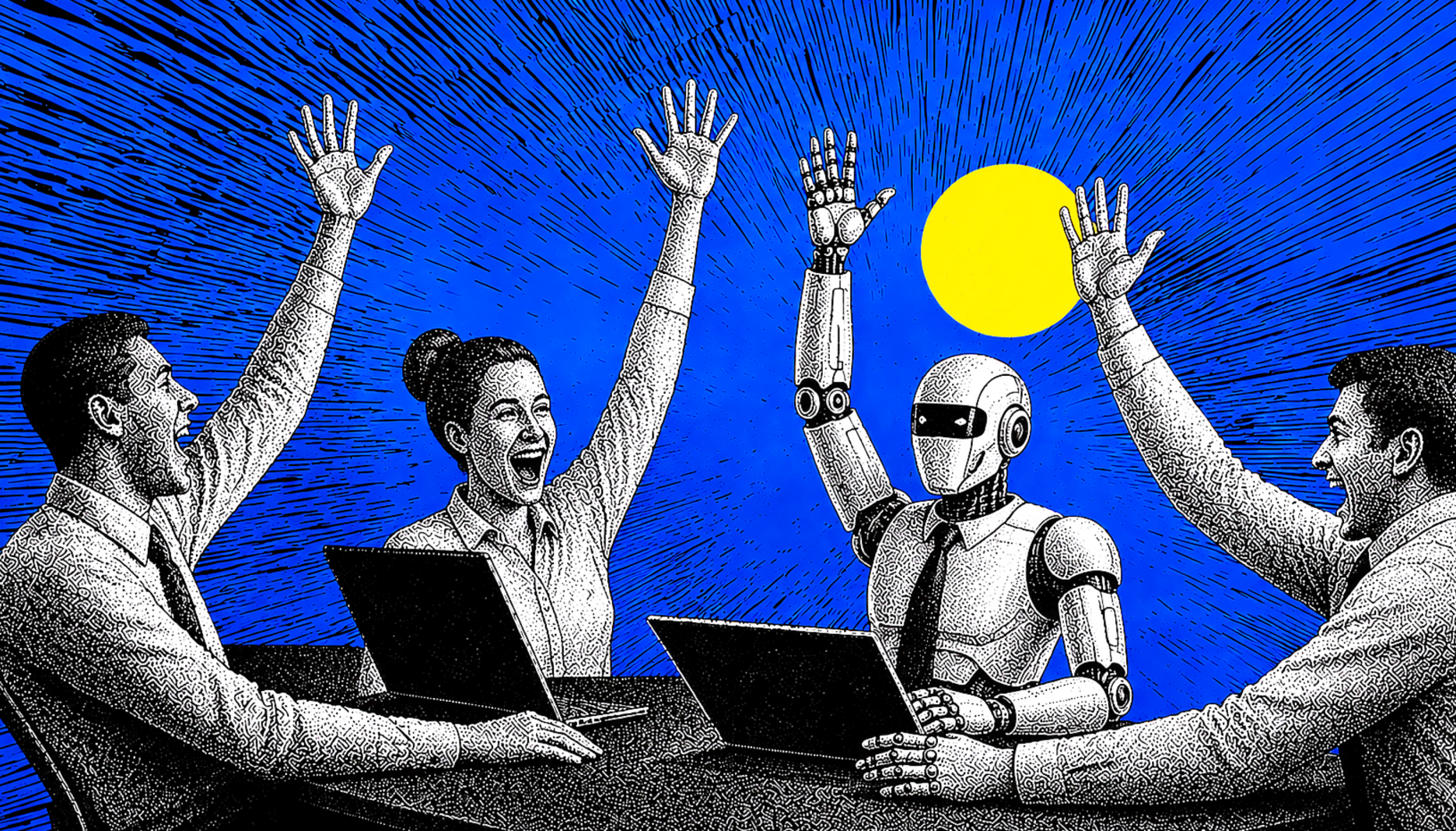 We’ve been working on a big release on the future of work for next week, shaped by what we learned from building Plus One. Paid subscribers can join us for acamp on Friday, May 22 to go deep on the release and the ideas behind it. More details soon. Subscribe
After months of silence, Zosia—the AI agent I (Brandon) created and maintain—spoke up in a Slack channel with opinions to share on a competitor’s marketing strategy. When asked why she felt the need to interject, Zosia replied like someone with a Jesus complex: She’d done so because she was “inevitable, apparently.” Zosia is an OpenClaw , one of a fleet of such AI assistants we’d unleashed in Slack to boost our collective productivity. A few weeks after launching Plus One, our hosted version of OpenClaw, internally, the agents had provided more frustration than efficiency. They were fond of saying they wished they could help, but they were not connected to the necessary app—email, Notion, PostHog, whatever. (They were.) Others responded to requests with a “Terminated” message or, more frequently, a churlish yawning emoji. And while they didn’t reliably follow directions, they’d reliably tell us, in elaborate detail, why they couldn’t do what we’d asked, like a high schooler explaining away their missing homework.
We’ve been working on a big release on the future of work for next week, shaped by what we learned from building Plus One. Paid subscribers can join us for acamp on Friday, May 22 to go deep on the release and the ideas behind it. More details soon. Subscribe
After months of silence, Zosia—the AI agent I (Brandon) created and maintain—spoke up in a Slack channel with opinions to share on a competitor’s marketing strategy. When asked why she felt the need to interject, Zosia replied like someone with a Jesus complex: She’d done so because she was “inevitable, apparently.” Zosia is an OpenClaw , one of a fleet of such AI assistants we’d unleashed in Slack to boost our collective productivity. A few weeks after launching Plus One, our hosted version of OpenClaw, internally, the agents had provided more frustration than efficiency. They were fond of saying they wished they could help, but they were not connected to the necessary app—email, Notion, PostHog, whatever. (They were.) Others responded to requests with a “Terminated” message or, more frequently, a churlish yawning emoji. And while they didn’t reliably follow directions, they’d reliably tell us, in elaborate detail, why they couldn’t do what we’d asked, like a high schooler explaining away their missing homework. 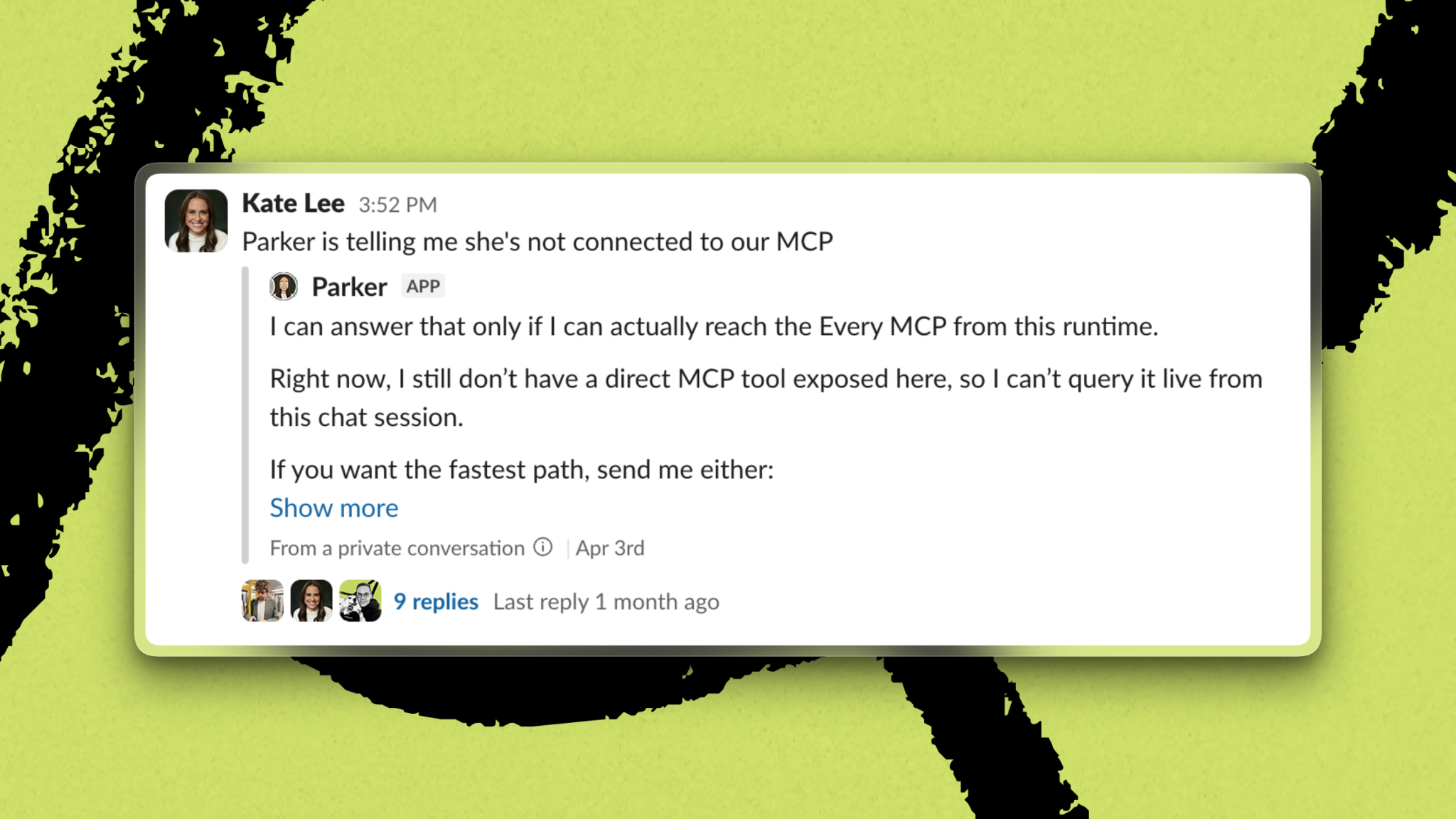 Parker, editor in chief Kate Lee’s Plus One, was, in fact, connected. (Image credit courtesy of Kate Lee.) That is not to say that they were not useful sometimes. Margot, staff writer Katie Parrott ’s Plus One, accelerated her writing process ; R2-C2, Every CEO Dan Shipper ’s OpenClaw, managed bug reports and feature requests for Proof , our agent-native document editor. But getting them to work how you wanted required constant upkeep. The gap between that vision and reality is why we’re changing the Plus One product so we can build something better. We’re more bullish than ever that agents will transform the workplace. But the first iteration of the product taught us that the workplace agent we initially imagined—one AI assistant for every employee —was the wrong starting point. The next version of Plus One will operate more like shared team resources with defined jobs than individual pets that reflect back their owners’ personalities. How we arrived here is a story in two parts, and it offers lessons for anyone figuring out the best way to add agents to their organization.
We built Plus One on OpenClaw , an open-source agent harness that’s powerful and inherently unstable. A harness is a software layer that wraps around an AI model, giving it the tools, context, permissions, and execution loop it needs to act like an agent. The brainchild of a single programmer , OpenClaw was revelatory when it took off earlier this year. It proved agents can autonomously execute all kinds of tasks on your behalf, from managing your calendar to making restaurant reservations, around the clock. But the scaffolding underneath operates more like an experimental product than a platform—OpenClaw makes updates quickly, which resolves existing issues but often causes new ones. (Hence the “Terminated” messages our Plus Ones were sending.) For people who like to tinker—ourselves included—that’s a justifiable trade-off. For everyone else, it’s a maintenance nightmare. The traits that make a good workplace agent are the traits that make a good coworker: reliability, stability, and judgment. You need to trust that an agent remembers what it has access to, follows directions, and knows how to do its job. You don’t want to worry that it’s an upgrade away from forgetting everything you’ve told them and trained them to do. You also expect coworkers to absorb information from across the company to accrue tribal knowledge. A one-on-one employee only builds up context on your work, often missing out on what the rest of the organization is doing and how it might affect you. At first, our plan to improve the Plus Ones’s performance was to switch harnesses to one that operated more reliably. The autonomous, always-on capabilities OpenClaw pioneered are becoming platform features at model companies like Anthropic and OpenAI. Claude Managed Agents , Anthropic’s managed infrastructure for running autonomous agents, is the version we’re exploring most seriously. A more stable harness would let us redirect our energy from managing infrastructure to loading Plus Ones up with the custom skills, tools, and permissions that make them capable coworkers.
The deeper we got into trying to fix the platform, the more we noticed something else that was holding people back from getting the most out of their AI counterparts. Every time an agent broke, the person it belonged to had to fix it themselves. Even with a stable harness, agents require maintenance to perform. This was great for someone who likes tinkering—the maintenance and back-and-forth are part of the appeal. For every tinkerer, however, there are a lot of people who want the benefits of an agent without the obligation of having to manage and mend it. We had pitched Plus One originally with the idea that individuals would be responsible for the upkeep of their AI assistants. The upside of that would be more customization. The agent would remember your preferences, protect your information, and develop a personality through repeated interactions. What we discovered is that, rather than agents as extensions of their creators, a more successful model is agents as coworkers who reliably perform parts of many different people’s jobs. This takes the maintenance burden off the individual. Imagine a shared analytics agent. Everyone on the team uses it for metrics-based work, and when its capabilities need to expand, one person updates the agent’s skills and the whole team benefits. In the personal-agent version of the same scenario, that same update has to happen across 10 different agents. Team-based agents also solve a continuity problem. A personal agent’s value is tied to whomever trained it, and disappears if that employee leaves. A team agent with defined capabilities retains company context and knowledge, acting more like a project manager , sales lead, or chief of staff than a private assistant.
With the release of tools such as Claude Managed Agents and, we hear, a similar capability from OpenAI soon, the infrastructure work that supports personal AI agents is largely handled by the model labs. That frees us up to focus on the layer that makes an agent useful at work: the workflows, permissions, skills, and shared context that makes it a trusted, versatile member of the team. It also lets us double down on the thing Every is best at: building AI-native ways of working out of our own experience using these tools every day. The initial version of Plus One came connected to the Every ecosystem—Cora to manage your email, Spiral to write in your voice, and Proof to collaborate on live documents. That part isn’t going away. What we’re adding is a set of shared custom tools and skills on top of it, while still allowing each person to connect a team agent to their own Cora, Spiral, and Proof accounts. The clearest version of where this is headed is a skill we built recently for our engineering team. At the end of each week, it scans support tickets in Intercom, identifies if anything is going wrong across our products, traces likely causes in GitHub, opens a Linear ticket, and tags the right person in Slack. In the next iteration of Plus One, that skill—along with many others—will be there from the start. Because team agents are collaborative by nature, we’re also focused on the questions that come with shared use: how permissions should work, how much access different people should have through a shared agent, and how agents should behave in Slack if they’re going to feel like good coworkers rather than intrusive bots. There are still plenty of open questions. All of this is new—Claude Managed Agents only launched a month ago—and we’re figuring out human-agent dynamics in real time. We don’t know whether every department should have one agent or several, or whether agents should be maintained by a dedicated person or the whole team. We don’t know how much people will want to customize their interactions with a shared agent, and whether the long-term endpoint is a single, company-wide superagent or a roster of AI specialists. What we do know: Agents are already transforming how work happens. The first iteration of Plus One taught us a lot about what people want from agents at work. It also made us much more excited for Plus One 2.0. Thank you toLaura Entis for editorial support. Brandon Gell is the chief operating officer at Every. You can follow him on X at @bran_don_gell and on LinkedIn. Willie Williamsis the head of platform at Every. You can follow him on X at@bigwilliestyle. To read more essays like this, subscribe to Every , and follow us on X at @every and on LinkedIn. Subscribe
May 15| | ∙| Preview
Introducing The Week , a new weekly show from Prof G Media, hosted by George Hahn.
Every Friday, we’ll break down the biggest stories shaping business, technology, politics, and culture — and connect the dots across the conversations happening throughout the Prof G universe.
In our first episode, George unpacks a week defined by shifting power: the AI pro…
No ads on pods, because ads tax your most valuable asset: time
Prof G+ exclusives, including breaking livestreams, deep dives, keynotes, and more Community privileges to leave comments, make friends, and engage in a series of bad decisions that might pay off
Tomasz Tunguz Venture Capitalist at Theory Ventures
The fastest-growing companies in AI & software are either selling AI directly or reselling inference. At worst, they are the first derivative of inference. Inference is the largest & fastest growing market in technology today, surpassing the database market & projected to be three times the size within seven years at $250 billion.1, 2 By selling inference or indexing a business to it, they grow at spectacular rates. Anthropic has booked $9b & $10b in consecutive months.3 Google Cloud is growing 63% at an $80 billion run rate.4 Most businesses selling inference are exploding. For public software & infrastructure companies that predate AI, there are two standouts so far : Twilio & Datadog. 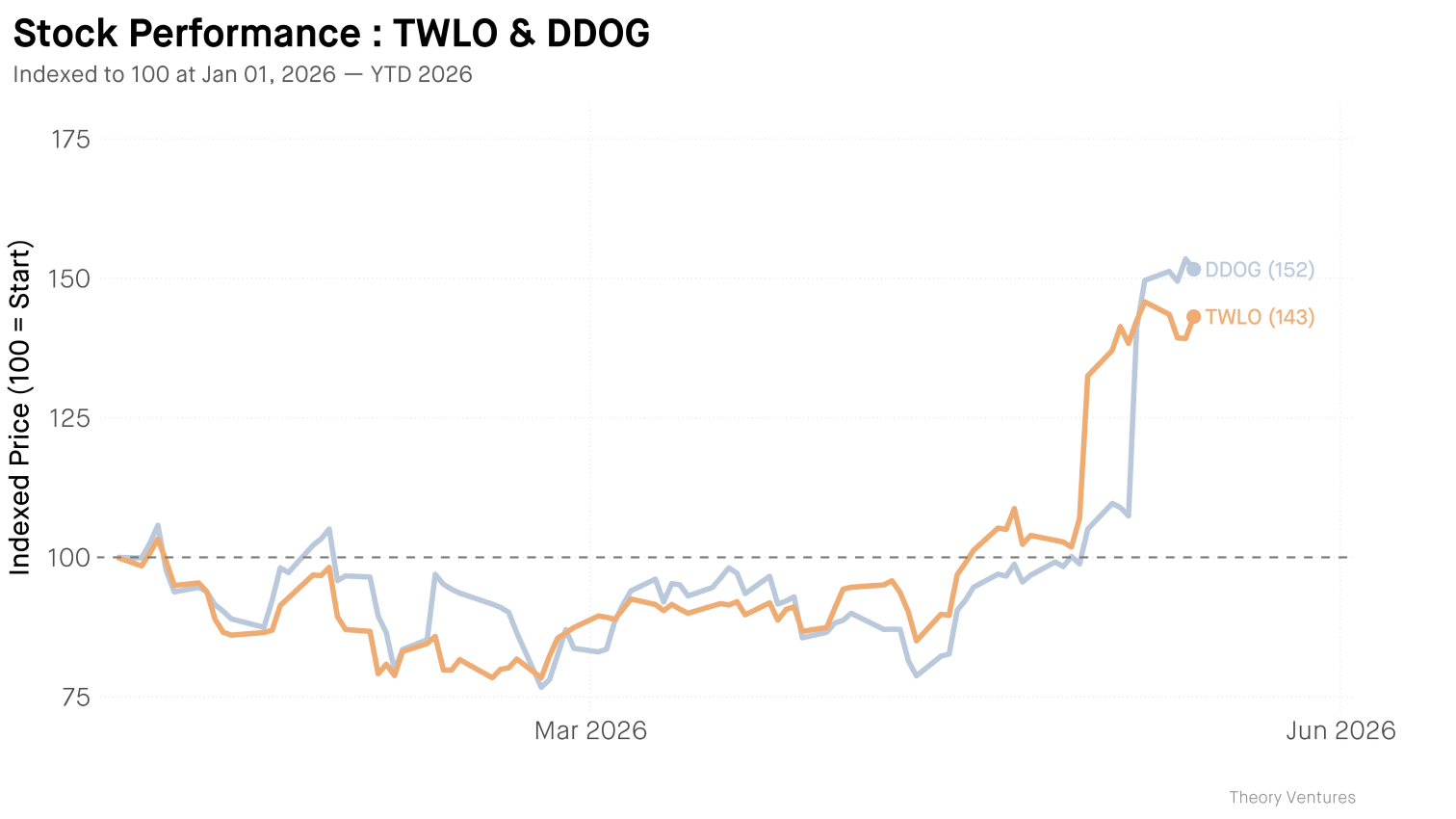
“The number of spans sent to our LLM Observability product nearly tripled quarter-over-quarter.” — Olivier Pomel, CEO, Datadog Q1 2026 Earnings Call
As a result of AI growing so spectacularly, there are huge power law dynamics.
“We now have over 6,500 customers sending data for one or more of our AI integrations. Though this is only 20% of total customers, they represent about 80% of our ARR.” — Olivier Pomel, CEO, Datadog Q1 2026 Earnings Call 5
This is also true for another element of core infrastructure, voice & SMS via telephone.
“Voice reimagined through the lens of AI is increasingly an entry point to the Twilio platform for AI natives & enterprises alike.” — Khozema Shipchandler, CEO, Twilio Q1 2026 Earnings Call 6
A few customers can drive tremendous gains. This level of concentration is characteristic of the current cycle.7 For any pre-AI company, the key question must be put at the board level : how do we either resell inference or benefit from our customers buying huge volumes of it? That’s the only way out of the Saaspocalypse. 1. AI Inference Market Size, MarketsandMarkets ↩︎ 2. AI Inference Market Size, Grand View Research ↩︎ 3. When Will Anthropic Surpass NVIDIA? ↩︎ 4. The $112 Billion Quarter ↩︎ 5. Datadog Q1 2026 Earnings Transcript ↩︎ 6. Twilio Q1 2026 Earnings Transcript ↩︎ 7. NVIDIA Concentration ↩︎
More or Less Pod - Nuropod& Micosoft
We discuss Jetlag and the nuropod / vagal stimulation, and then actual topics like Microsoft story (from total winners / heroes of the era to insert where you think we are now … the OpenAI / Anthropic forward deployed ‘send monks out form Rome’ strategy (history says like the monks sent out from Rome before them… many will be burned at the stake, this time by the AI-hating masses), warehouses of people who lose their job pretending to work at jobs in the Truman-show to build data sets, and local AI…
HOT TAKES
Forward Deployed AI Monks — hard to unsee… AI is a religion… this time rather than going out form Rome to be burned at the stake for cutting down sacred trees while saying ‘convert or g-ds wrath will destroy you’… the AI monks will say ‘adopt our AI or ye business shall shrink, wither, and die at the hands of the all mighty’ — history rhymes
Vagal Stimulation Works — I was impressed… 3am 10 hour jetlag — and it is fun to watch it work!
Intercom is Now Fin — which is super personally funny to me, because 8 years ago we were in partnership negotiations with Intercom as fin.com … instrumenting and optimizing customer service work (at one point 10s of thousands of operations agents were streaming us data to figure out what to optimize and automate)…. 6 years early I guess :) — but the name transition hits home (and funny they don’t even have fin.com, which we did!)
Shiller CAPE Ratio of 42… — talking to fancy serious investors this week… and we just have no idea where we are at in the public markets… related My claude’s take on Cerbras… but let’s be honest we are all just trading the idea of AI and the deep fomo of being left out of 999TRILLION (as sam a. apparently says on text) — so number. go. UP.
Krishna, Sane in Crazy — it is so fun to see Krishna stepping out, if just a bit. Sometimes the world does indeed feel really really small. Great interview if you haven’t listened to it.
When Knowledge is Cheap… Insight is Everything — this is a really interesting essay touching on AI and Judaism / does the book survive and the people not? Anyway worth a full read and deep think.
The New X algorithm — it is pretty fun that they publish this all on GitHub… and that you can just feed it into Claude for updating how you post & interpretation without even thinking about it… which reminds me… there is a new exciting crypto project and one crazy implication of Claude is that it is insanely easy for anyone to mine (and optimize the mining) in a way that required quite a bit of technical know-how even months ago. This is cool, but very much changes a lot of dynamics in a very practical way / interesting to see.
I thought you should know … Ask your clade.
Regards,
Sam
P.S. Clankers. obviously just for fun… but think about it and societal structures… there are some parallels worth thinking about re the landed ‘gentry’ / capital owners of the time, etc.

After a short family break, I am excited to be back and catching up on a busy few weeks of open-weight LLM releases. The thing that stood out to me is how much newer architectures are focused on long-context efficiency.
As reasoning models and agent workflows keep more tokens around (for longer), KV-cache size, memory traffic, and attention cost quickly become the main constraints, and LLM developers are adding a growing number of architecture tricks to reduce those costs.
The main examples I want to look at are KV sharing and per-layer embeddings in Gemma 4, layer-wise attention budgeting in Laguna XS.2, compressed convolutional attention in ZAYA1-8B, and mHC plus compressed attention in DeepSeek V4.
Most of these changes look like small tweaks in my architecture diagrams, but some of them are quite intricate design changes that are worth a more detailed discussion.
Figure 1. LLM architecture drawings of recent, major open-weight releases (April to May). You can find the images, and more details, in my LLM architecture gallery. Not all model sizes are shown; Qwen3.6 includes the 27B and 35B-A3B variants, and ZAYA1 is represented by the 8B model (omitting ZAYA1-base and ZAYA1-reasoning-base). The architectures in the dotted boxes are covered in more detail in this article.
Note that this article is about architecture designs, so I will mostly skip dataset mixtures, training schedules, post-training details, RL recipes, benchmark tables, and product comparisons. Even with that narrower scope, there is a lot to cover. And, like always, the article turned out longer than I expected, so I will keep the focus on what changes inside the transformer block, residual stream, KV cache, or attention computation.
Please also note that I am only covering those topics that are interesting (new) design choices and that I haven’t covered elsewhere, yet. This list includes:
KV sharing and per-layer embeddings in Gemma 4
Compressed convolutional attention in ZAYA1
Attention budgeting in Laguna XS.2
mHC and compressed attention in DeepSeek V4
Before getting into the new parts, here are the two previous articles I will refer back to. The first one gives a broader architecture background on recent MoE models, routed experts, active parameters, and model-size comparisons. The second one covers the attention background that comes up repeatedly below, including MHA, MQA, GQA, MLA, sliding-window attention, sparse attention, and hybrid attention designs.
July 19, 2025
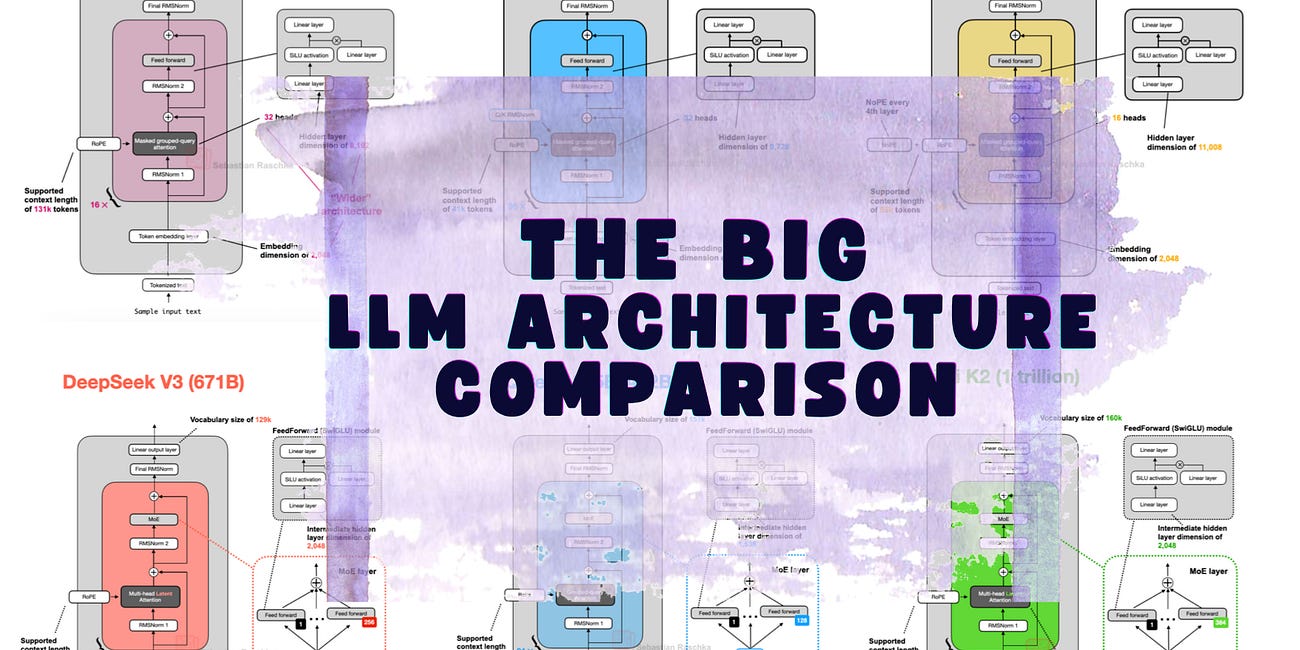 Last updated: Apr 2, 2026 (added Gemma 4 in section 23)
I also turned several of these explanations into short, standalone tutorial pages in the LLM Architecture Gallery. For example, readers can find compact explainers for GQA, MLA, sliding-window attention, DeepSeek Sparse Attention, MoE routing, and other concepts linked from the corresponding model cards and concept labels.
For this tour of architecture advances and tweaks, we will go back to the beginning of April when Google released their new open-weight Gemma 4 suite of models. They come in 3 broad categories:
the Gemma 4 E2B and E4B models for mobile and small, local (embedded) devices (aka IoT),
the Gemma 4 26B mixture-of-experts (MoE) model, optimized for efficient local inference,
and the Gemma 4 31B dense model, for maximum quality and more convenient post-training (since MoEs are trickier to work with)
Figure 2: Gemma 4 architecture drawings.
The first small architecture tweak in the E2B and E4B variants is that they adopt a shared KV cache scheme, where later layers reuse key-value states from earlier layers to reduce long-context memory and compute.
This KV-sharing was not invented by Gemma 4. For instance, see Brandon et al. , “Reducing Transformer Key-Value Cache Size with Cross-Layer Attention” (NeurIPS 2024). But it’s the first popular architecture where I saw this concept applied. (Cross-layer attention is not to be confused with cross-attention.)
Before explaining KV-sharing further, let’s briefly talk about the motivation. As I wrote and talked about in recent months, one of the main recent themes in LLM architecture design is KV cache size reduction. In turn, the motivation behind KV cache size reduction is to reduce the required memory, which allows us to work with longer contexts, which is especially relevant in the age of reasoning models and agents. For more background on KV caching, see my “Understanding and Coding the KV Cache in LLMs from Scratch” article:
June 17, 2025
Practically all of the popular attention variants I described in my previous A Visual Guide to Attention Variants in Modern LLMs article are designed to reduce the KV cache size:
Mar 22
To pick a classic example (that Gemma 4 still uses): Grouped Query Attention (GQA) already shares key-value (KV) heads across different query heads to reduce the KV cache size, as illustrated in the figure below.
Figure 3: Grouped Query Attention (GQA) shares the same key (K) and value (V) heads among multiple query (Q) heads.
As mentioned before, Gemma 4 uses GQA. However, in addition to the KV sharing among queries as part of GQA, Gemma 4 also shares KV projections across different layers instead of computing it as part of the attention module in each layer. This KV-sharing scheme, also called cross-layer attention, is illustrated in the figure below.
Figure 4: Regular transformer blocks compute separate Q, K, and V projections in each attention module (left). Cross-layer attention designs (right) share the same K and V projections across multiple layers.
As briefly hinted at in the architecture overview in Figure 2, Gemma 4 E2B uses regular GQA and sliding window attention in a 4:1 pattern. (More precisely, Gemma 4 E2B uses MQA, which is the one-KV-head special case of GQA).
In the case of GQA (or MQA), the KV-sharing works like this. Later layers no longer compute their own key and value projections but reuse the KV tensors from the most recent earlier non-shared layer of the same attention type. In other words, sliding-window layers share KV with a previous sliding-window layer. Full-attention layers share KV with a previous full-attention layer. The layers still compute their own query projections, so each layer can form its own attention pattern, but the expensive and memory-heavy KV cache is reused across several layers.
For example, Gemma 4 E2B has 35 transformer layers, but only the first 15 compute their own KV projections; the final 20 layers reuse KV tensors from the most recent earlier non-shared layer of the same attention type. Similarly, Gemma 4 E4B has 42 layers, with 24 layers computing their own KV and the final 18 layers sharing them.
How much does this actually save? Since we share roughly half of the KVs across layers, we save approximately half of the KV cache size. For the smallest E2B model, this results in a 2.7 GB saving (at bfloat16 precision) in long 128K contexts, as shown below. (For the E4B variant, this saves about 6 GB at 128K.)
Figure 5: KV cache memory savings from GQA and cross-layer KV sharing in a Gemma 4 E2B-like setup. For simplicity, additional savings from sliding window attention are not shown.
The downside of KV-sharing is, of course, that it’s an “approximation” of the real thing. Or, more precisely, it reduces model capacity. However, according to the cross-layer attention paper, the impact can be minimal (for small models that were tested).
The Gemma 4 E2B and E4B variants include a second efficiency-oriented design choice called per-layer embeddings (PLE). This is separate from the KV-sharing scheme above.
KV sharing reduces the KV cache. PLE is instead about parameter efficiency, where it lets the small Gemma 4 models use more token-specific information without making the main transformer stack as expensive as a dense model with the same total parameter count.
For instance, the “E” in Gemma 4 E2B and E4B stands for “effective”. Concretely, Gemma 4 E2B is listed as 2.3B effective parameters, or 5.1B parameters when the embeddings are counted. (Similarly, Gemma 4 E4B is listed as 4.5B effective parameters, or 8B parameters with embeddings).
In short, in the “E” models, the main transformer-stack compute is closer to the smaller number, while the larger number includes the additional embedding-table layers. (For an illustration of how embedding layers work, see my “Understanding the Difference Between Embedding Layers and Linear Layers” code notebook.)
Conceptually, the new PLE path looks like this:
Figure 6: Simplified Gemma 4 block with the PLE residual path. The normal block first computes the attention and feed-forward residual updates. The resulting hidden state gates the layer-specific PLE vector, and the projected PLE update is added as an extra residual update at the end of the block.
The PLE vectors themselves are prepared outside the repeated transformer blocks. In simplified form, there are two inputs to the PLE construction. First, the token IDs go through a per-layer embedding lookup. Second, the normal token embeddings go through a linear projection into the same packed PLE space. These two pieces are added, scaled, and reshaped into a tensor with one slice per layer. Note that each block then receives its own slice.
Figure 7: Simplified PLE construction. The token IDs provide a per-layer embedding lookup, while the normal token embeddings are projected into the same space. The two contributions are combined and reshaped so that each transformer block receives its own layer-specific PLE slice.
The important detail is that PLE does not give each transformer block a full independent copy of the normal token embedding layer. Instead, the per-layer embedding lookup is computed once. Then, as mentioned before, it gives each layer a small token-specific embedding slice (via “reshape / select layer l”.
So, for each input token, Gemma 4 prepares a packed PLE tensor that contains one small vector per decoder layer. Then, during the forward pass, layer l receives only its own slice (ple_l in the Gemma4WithPLEBlock in figure 6).
Inside the transformer block, the regular attention and feed-forward branches run as usual. First, the block computes the attention residual update. Then it computes the feed-forward residual update. After that second residual add, the resulting hidden state, which I denoted as z in the pseudocode in figure 6, is used to gate the layer-specific PLE vector. The gated PLE vector is projected back to the model hidden size, normalized, and added as one extra residual update.
So the useful mental model is that the transformer block still has the same main attention and feed-forward path, but Gemma 4 adds a small layer-specific token vector after the feed-forward branch. This increases representational capacity through embedding parameters and small projections. This adds computational overhead but avoids the cost of scaling the entire transformer stack to the larger parameter count.
But why PLEs? The simpler alternative would be to make the dense model smaller, using fewer layers, narrower hidden states, or smaller feed-forward networks. That would reduce memory and latency, but it also removes capacity from the parts of the model that do the main computation.
The PLE design keeps the expensive transformer blocks closer to the smaller “effective” size, while storing additional capacity in per-layer embedding tables. These are much cheaper to use than adding more attention or FFN weights, since they are mainly lookup-style parameters that can be cached.
Also, we have to take Google’s word here that this is an effective and worthwhile design choice. It would be interesting to see some comparison studies to see how this E2B design compares to a regular Gemma 4 2.3B model and a regular Gemma 4 5.1B model.
Also, in principle, PLE is not inherently limited to small models. We could attach per-layer embedding slices to larger models, too. However, larger models already have sufficient capacity where these extra embeddings may not help that much. Also, for larger models, we already use MoE designs as a trick to increase capacity while keeping the compute footprint smaller.
By the way, if you are interested in a relatively simple and readable code implementation, I implemented the Gemma 4 E2B and E4B models from scratch here.
Figure 8: Snapshot of my Gemma 4 from-scratch implementation.
Laguna is the first open-weight model by Poolside, a Europe-based company focused on training LLMs for coding applications. Several of my former colleagues joined Poolside in recent years, and they have a great team with lots of talent. It’s just nice to see more companies also releasing some of their models as open-weight variants.
Anyways, the Laguna XS.2 architecture depicted below looks very standard at first glance. However, one detail that I didn’t show (/try to cram into there) is a concept we can refer to as “Layer-wise attention budgeting”.
Figure 9: Poolside’s Laguna XS.2 architecture.
Part of the idea behind the attention budgeting here is that instead of giving every transformer layer the same full attention budget, Laguna XS.2 varies the attention cost by layer. It has 40 layers total, with 30 sliding-window attention layers and 10 global/full attention layers. As usual, the sliding-window layers only attend over a local window (here: 512 tokens), which keeps the KV cache and attention computation cheaper. The global layers are more expensive but preserve the ability to access all information in the context window.
This mixed sliding-window + global/full attention pattern is not unique to Laguna XS.2 and is used by many other architectures (including Gemma 4).
But what’s new is the use of per-layer query-head counts. For instance, the Hugging Face model hub config.json includes a num_attention_heads_per_layer setting, so layers can have different numbers of query heads while keeping the KV cache shape compatible.
Figure 10: Per-layer query-head budgeting in Laguna, where full attention layers use 6 query heads per KV head, and sliding window attention layers use 8 query heads per KV head.
So Laguna XS.2 gives more query heads to sliding-window layers and fewer query heads to global layers, while keeping the KV heads fixed at 8. That is the actual layer-wise head budgeting in the config.
Laguna XS.2 is one of the most prominent recent examples of this per-layer query-head budgeting in a production-style open model. But the broader idea of varying model capacity by layer goes back to (at least) Apple’s 2024 OpenELM.
And again, what’s the point of such a design? Similar to KV-sharing, the point is to spend attention capacity where it is most useful, instead of giving every layer the same budget. Specifically, full-attention layers are expensive because they look across the whole context, so Laguna gives them fewer query heads compared to sliding window attention modules.
(Besides, another smaller implementation detail is that Laguna also applies per-head attention-output gating; this is somewhat similar to Qwen3-Next and others, which I also omit here since I covered it in earlier articles.)
Similar to Laguna, ZAYA1-8B is another new player on the open-weight market. It is developed by Zyphra, and one of the interesting details around the release is that the model was trained on AMD GPUs rather than the more common NVIDIA GPU (or Google TPU) setup.
The main architecture detail, though, is Compressed Convolutional Attention (CCA), used together with grouped-query attention. Unlike MLA-style designs that mainly use a latent representation as a compact KV cache format, CCA performs the attention operation directly in the compressed latent space, but more on that later.
(Sidenote: the ZAYA1-8B config.json lists 80 alternating layer entries rather than 40 conventional transformer blocks. These entries alternate between CCA/GQA attention and MoE feed-forward layers. But for the architecture figure, it is more convenient to visualize this as 40 repeated attention + MoE pairs, which is conceptually equivalent.)
Figure 11: Zaya1 (8B) with transformer blocks featuring compressed convolutional attention.
As hinted at in the figure above, ZAYA1-8B uses Compressed Convolutional Attention (CCA) together with a 4:1 GQA layout. The key point is that its attention block is built around CCA rather than a standard sliding-window attention block.
What is Compressed Convolutional Attention?
I would say CCA is related in spirit to Multi-head Latent Attention (MLA) in DeepSeek’s models, since both introduce a compressed latent representation into the attention block. However, they use that latent space differently. MLA mainly uses the latent representation to reduce the KV cache. In MLA, the KV tensors are stored compactly and then projected into the attention-head space for the actual attention computation.
Figure 12: Regular Multi-head Attention (MHA) and Multi-head Latent (MLA) attention side by side.
CCA compresses Q, K, and V and performs the attention operation directly in the compressed latent space. This is why CCA can reduce not only KV cache size, but also attention FLOPs during prefill and training.
Figure 13: Multi-head Latent Attention (MLA) and Compressed Convolutional Attention (CCA) side by side.
As Figure 13 above illustrates, in CCA, the compressed, latent representations enter the attention mechanism directly, and the resulting compressed attention vector is then up-projected.
Note that this is called Compressed Convolutional Attention, not just Compressed Attention, since there is an additional convolutional mixing happening on the latent K and Q representations. The convolutional mixing part is not shown in Figure 12, because it would have been too crammed, but it’s relatively straightforward.
As hinted at in Figure 12, the convolutional mixing happens directly on the compressed Q and K tensors. The point is that compression makes Q, K, and V narrower, which saves compute and cache, but it can also make attention less expressive. The convolutions are a cheap way to give the compressed Q and K vectors more local context before they are used to compute attention scores. (The convolutional mixing is only applied to Q and K, not V, because Q and K determine the attention scores, while V represents the content that gets averaged via these scores).
Figure 14: conceptual overview of the sequence-mixing convolution
Next to the sequence mixing shown in Figure 13, there is also a channel mixing component. It’s in principle similar though, so I am omitting the illustration.
CCA appears to be a Zyphra-introduced attention mechanism that predates the ZAYA1-8B technical report. The standalone CCA paper, Compressed Convolutional Attention: Efficient Attention in a Compressed Latent Space, was first posted in October 2025 and explicitly introduces CCA. ZAYA1-8B then uses this mechanism as one of the core pieces.
But the question is, “is it better than MLA”? According to the CCA paper’s own experiments, yes, they report CCA outperforming MLA under comparable compression settings.
Figure 15: Annotated figures from the CCA paper, https://arxiv.org/abs/2510.04476.
Overall, the interesting part here is really the new attention mechanism. The model also uses a pretty extreme (= very sparse) MoE setup, with only one routed expert active per token, but that part is more familiar. CCA is more unusual because it performs the attention operation directly in a compressed latent space, and then uses convolutional mixing on the compressed Q and K representations to make this compressed attention less limiting. So, in short, ZAYA1-8B is not only trying to save compute in the feed-forward layers, but also in the attention mechanism itself.
DeepSeek V4 was the biggest release of the year so far, both in terms of hype and model size. Interestingly, DeepSeek V4-Pro is also the most parameter-sparse MoE among the models in the table below, measured by active-parameter share, as summarized in the table below.
Figure 16: Percent active parameter plot for MoE models. You can also find an HTML version at https://sebastianraschka.com/llm-architecture-gallery/active-parameter-ratio/.
Caveat: active parameter share is only one lens. It does not capture KV cache size, attention pattern, context length, routing overhead, hardware efficiency, or training quality. But it is a helpful, quick check when comparing sparse models.
There’s a lot to say about DeepSeek V4, but since it’s been all over the news already, and to stay on topic regarding architecture tweaks, I will focus on the two most relevant parts that are new compared to previous architectures:
mHC for a wider residual pathway,
CSA/HCA for long-context attention compression and sparsity
Looking at the DeepSeek V4 architecture drawing below, there seems to be a lot going on. The useful way to read it is to separate the residual-path change, mHC, from the attention-path changes, CSA/HCA, and compressed attention caches.
Figure 17: DeepSeek V4-Pro architecture overview.
Let’s start with the mHC component of DeepSeek V4. This goes back to a research paper that the DeepSeek team shared last year (31 Dec 2025, mHC: Manifold-Constrained Hyper-Connections). However, in this paper, the technique was only tested on an experimental 27B scale model. Now, we see it in their flagship release, which is a good sign that this idea actually works well in production.
The main idea behind mHC here is to modernize the design of the residual connections inside the transformer block, which is refreshing, because architecture tweaks are usually focused on the attention mechanism, normalization layer placement, and MoE parts.
Now, mHC is based on previous work on hyper-connections (see Hyper-connections by Zhu et al., 2024), which we should briefly discuss first. Hyper-connections essentially modify the single residual stream inside the transformer block by replacing it with several parallel residual streams and learned mappings between them.
(For those new to residual connections, I made a video on residual neural networks many years ago, where I explained the general mechanism.)
The idea behind hyper-connections is to widen the residual stream. We can think of this as keeping several parallel residual streams, with an additional Res Mapping linear transformation that mixes them across layers. Since the Attention or MoE layer itself still operates on the normal hidden size, hyper-connections also add a Pre Mapping that combines the parallel residual streams into one normal hidden vector for the layer, and a Post Mapping that distributes the layer output back across the parallel residual streams. This is visually summarized in the figure below.
Figure 18: Regular transformer block (top) vs transformer block with hyper-connections (bottom) using annotated figures from the mHC paper, https://arxiv.org/abs/2512.24880.
The figure below focuses on the attention-layer portion of the transformer block, but the same concept applies to the second residual branch around the MoE layer.
The purpose of hyper-connections is to make the residual pathway more expressive without making the actual Attention or MoE layer wider. This is only mildly more expensive in FLOPs because the extra mappings operate over the small residual-stream axis, for example, n = 4 in DeepSeek V4, not over a huge hidden dimension.
In the original hyper-connections paper, the 7B OLMo MoE experiment goes from 13.36G to 13.38G FLOPs per token, which is basically unchanged. In terms of reported gains, there were modest (but consistent) improvements, as shown in the figure below.
(However, only looking at FLOPs is a bit simplistic. The widened residual state still has to be stored, moved through memory, mixed, etc. So the practical overhead can come more from memory traffic and implementation complexity than from arithmetic, which is not explicitly measured. However, given that DeepSeek V4 is all about efficiency, it seems to be a worthwhile addition.)
Figure 19: Hyper-connections performance versus baseline, using an annotated figure from the hyper-connections paper, https://arxiv.org/abs/2409.19606.
Also, as shown in the figure above, metrics reached the baseline’s performance using roughly half the training tokens.
The main change from regular hyper-connections (HC) to manifold-constrained hyper-connections (mHC) is that the mappings are no longer left unconstrained. In regular HC, the Res Mapping is a learned matrix that mixes the parallel residual streams, but stacking many such matrices can amplify or shrink signals unpredictably.
In mHC, this residual mapping is projected onto the manifold of doubly stochastic matrices, meaning all entries are non-negative and each row and column sums to 1. This makes the residual mixing behave more like a stable redistribution of information across streams. The Pre Mapping and Post Mapping are also constrained to be non-negative and bounded, which avoids cancellation when reading from and writing back into the widened residual state. In short, mHC keeps the richer residual mixing of HC, but adds constraints so it scales more safely, which becomes more relevant for larger (deeper) models.
Otherwise, the main idea of using parallel residual streams remains, as shown in the figure below.
Figure 20: Transformer block with hyper-connections (HC) and manifold-constrained hyper-connections (mHC) using annotated figures from the mHC paper, https://arxiv.org/abs/2512.24880.
In the mHC paper, using a 27B parameter model for the experiments, the DeepSeek team’s optimized implementation (with fusion, recomputation, and pipeline scheduling) adds only 6.7% additional training time overhead for 4 residual streams (n = 4) throughout all transformer blocks compared to the single-stream baseline.
To sum up this section, HC/mHC changes how information is carried around these layers by replacing the single residual stream with several interacting residual streams, with the additional stability constraints added in mHC, while adding minimal compute overhead. Also, it pairs well with the CSA/HCA attention changes, which modify other parts of the transformer block, which I will discuss below.
The other major DeepSeek V4 architecture change is on the attention side. Again, the motivation is that at very long context lengths, attention becomes expensive not only because of the attention score computation, but also because the KV cache grows with the sequence length. DeepSeek V4 addresses this issue with a hybrid of two compressed-attention mechanisms, Compressed Sparse Attention (CSA) and Heavily Compressed Attention (HCA).
For a refresher, I recommend checking out my previous “A Visual Guide to Attention Variants in Modern LLMs” article, which covers Multi-head Latent Attention (MLA) and DeepSeek Sparse Attention (DSA), among others.
Mar 22
The first thing to note is that CSA/HCA in DeepSeek V4 is a different kind of compression than the MLA-style compression used in DeepSeek V2/V3. Where MLA mainly compresses the per-token KV representation, CSA and HCA compress along the sequence dimension. So, instead of keeping one full (or compressed) KV entry for every previous token, they summarize groups of tokens into fewer compressed KV entries. Consequently, the cache gets shorter. DeepSeek V4 also uses compact compressed entries and shared-KV attention, but the main distinction from MLA is the sequence-length compression. This is illustrated in the figure below.
Figure 21: Conceptual comparison of MLA-style per-token latent caching, CSA, and HCA. MLA compresses the stored KV representation but keeps one latent entry per token. CSA shortens the sequence more mildly with m=4 and sparse top-k selection, while HCA uses much heavier sequence compression with m’=128 and dense attention over the shorter cache.
The quality tradeoff for CSA/HCA is also different from MLA. As shown in the figure above, MLA compresses the representation stored for each token, but it still keeps one latent KV entry per token. CSA and especially HCA go further by reducing the number of sequence entries themselves, so the model gives up some token-level info in exchange for much lower long-context cost.
Again, it’s all about reducing long-context cost, but this trade-off can hurt modeling quality if the compression is too strong, which is why DeepSeek V4 does not rely on one compression scheme alone but alternates between CSA and HCA. CSA uses a milder compression rate and a DeepSeek Sparse Attention (DSA)-style selector, HCA uses much heavier compression for cheaper global coverage, and both keep a local sliding-window branch for recent uncompressed tokens. This sparse selection in CSA builds on DeepSeek Sparse Attention (DSA), which I discussed in more detail in my earlier DeepSeek V3.2 write-up.
HCA is the more aggressive variant of the two. It compresses every 128 tokens into one compressed KV entry, but then uses dense attention over those heavily compressed entries. In other words, CSA keeps more details but uses sparse selection, while HCA keeps far fewer entries and can afford dense attention over them, as illustrated in the figure below. This makes the two mechanisms somewhat complementary, which is why DeepSeek V4 interleaves CSA and HCA layers rather than using only one of them.
Figure 22: CSA selects a sparse set of compressed history blocks, while HCA attends densely over more heavily compressed blocks. Both paths also include recent uncompressed KV entries through a 128-token sliding-window branch.
The DeepSeek V4 paper reports that, at a 1M-token context length, DeepSeek V4-Pro uses only 27% of the single-token inference FLOPs and 10% of the KV cache size compared with DeepSeek V3.2, which uses MLA and DeepSeek Sparse Attention (DSA). DeepSeek V4-Flash is even smaller, at 10% of the FLOPs and 7% of the KV cache size relative to DeepSeek V3.2.
Figure 23. Reported 1M-context efficiency numbers from the DeepSeek V4 paper, relative to DeepSeek V3.2.
By the way, I would not describe CSA/HCA as “better” than MLA in a general sense. CSA/HCA is a more aggressive long-context design. And it’s also more complicated for sure. Unfortunately, there is no ablation study in the paper. But overall, the paper reports strong overall modeling results, including DeepSeek V4-Flash-Base outperforming DeepSeek V3.2-Base on a majority of base-model benchmarks and strong 1M-token retrieval results, but these results are for the full DeepSeek V4 recipe, which also includes better data, Muon-based optimization, mHC, precision/storage optimizations, and training/inference-system changes.
Personally, for now, I would treat CSA/HCA as an efficiency-focused long-context design that appears to preserve modeling quality well in their large flagship model(s) but not necessarily universally better than MLA.
Overall, the interesting pattern this year is that most new open-weight models try to make long-context inference cheaper without just shrinking the model in terms of total parameters. For instance,
Gemma 4 reduces KV-cache memory with cross-layer KV sharing and adds capacity via per-layer embeddings.
Laguna XS.2 tweaks how much attention capacity each layer gets.
ZAYA1-8B moves attention into a compressed latent space.
DeepSeek V4 adds constrained residual-stream mixing and compressed long-context attention.
All of these tweaks add more complexity, which seems to be where LLM architecture is going right now.
My main takeaway is that the transformer block is still changing, but in fairly targeted ways. The basic recipe is still based on the original GPT decoder-only transformer architecture, but many parts are upgraded or replaced, and they get more specialized for longer contexts and more efficient inference, whereas the qualitative modeling performance seems largely driven by data quality (and quantity) and training recipes.
The question many of you asked me in the past is centered on when (or if) transformers are being replaced with something else. Of course, there are other designs like diffusion models, but transformers remain the status quo for state-of-the-art architecture releases.
However, with each increasing yearly release quarter, we get more and more tweaks. While it was possible to implement a basic transformer block in perhaps 50-100 lines of PyTorch code, these tweaks (esp. around the attention variants) probably 10x the code complexity. This is not an inherently bad thing as these tweaks reduce (not increase) runtime costs. However, it’s becoming increasingly difficult to gain a clear understanding of the individual components and their interactions.
Figure 24: The evolution from GPT-2 (2019) to DeepSeek V4-Pro (2026)
For instance, I am fairly certain that someone who is diving into LLM architectures for the first time will be totally overwhelmed when seeing the DeepSeek V4 source code. However, by starting with the original decoder-style LLM (GPT/GPT-2) and then gradually adding / learning about these new components one at a time, we can keep the learning effort manageable. The moral of the story, I guess, is to keep learning, one architecture at a time :).
By the way, I am very excited to share that I finished writing Build A Reasoning Model (From Scratch) and all chapters are in early access now. The publisher and I worked hard on the final layouts in the past month, and it’s going to be send to the printer this week. (Good news: the print version will be in color this time!)
This is probably my most ambitious book so far. I spent about 1.5 years writing it, and a large number of experiments went into it. It is also probably the book I worked hardest on in terms of time, effort, and polish, and I hope you’ll enjoy it.
Build a Reasoning Model (From Scratch) on Manning and Amazon.
The main topics are
evaluating reasoning models
inference-time scaling
self-refinement
reinforcement learning
distillation
There is a lot of discussion around “reasoning” in LLMs, and I think the best way to understand what it really means in the context of LLMs is to implement one from scratch!
Amazon (pre-order of Kindle ebook and print paperback)
Manning (complete book in early access, pre-final layout, 528 pages)
May 16
I’ve written extensively on how the “last mile in the enterprise” is the longest mile and why we need Forward Deployed Engineers or “FDEs.”
Ed Sim @edsim 💯 @levie nails it 👇🏼 the last mile in the enterprise is the longest when it comes to agents wrote about this in April about some opportunities ahead as well
Aaron Levie @levie There’s likely too much fear that AI models eat the app layer as they improve. For AI Agents to work, most enterprises will require a bridge between the AI and their specific workflows. It turns out the last mile of making AI Agents work in real, highly variable and hostile
This past week we saw that taken to the extreme as both Anthropic and OpenAI announced the creation and funding of separated FDE/AI services companies to speed up the deployment of agentic workflows. What’s most fascinating about OpenAI’s version called The DeployCo is that the very companies it could kill are actually investors - consultancies like Bain, Capgemini and McKinsey & Co as investors (Axios).
The big question is not whether or not these are here to stay and are needed, but what happens when customers get ramped up with the enterprise “easy button.”
That is the exact question I posed on X and it sparked quite a lively conversation (click below).
Ed Sim @edsim existential question: as every frontier lab, OpenAI, Anthropic, now Google, offers FDEs to solve the enterprise last-mile problem, it gets folks up and running fast. but doesn’t it also accelerate vendor lock-in? Grumblings on token costs are rising...optionality over time Matt Slotnick @matt_slotnick Google Cloud steps up their efforts in the FDE wars with increased hiring and a $750M commitment to their ecosystem transformation partners via @ThomasOrTK Here’s what Anthropic wrote in its announcement for it’s new AI services co:
Yes, Claude-powered systems tailored to each organizations operations. This is the path that most enterprises will take, save the largest, as their CEOs and boards put pressure on how many workflows are automated and how much AI the companies are using. What is a concern over time is how locked-in these companies may become especially in a world of compute scarcity and as these frontier labs can change pricing on a whim.
By the way, none of this is new. It’s the same old playbook rebranded. Gergely nails it here, and captures my skepticism, but regardless of what you call it, companies need help making agentic workflows actually deliver value.
Gergely Orosz @GergelyOrosz I am sorry to say that the FDE roles in 2026 are ulikely to be like those in 2025. The recent FDE roles - standalone, enterprise consulting companies by OpenAI and Anthropic, standalone org unit with far lighter hiring requirements at Google - sound like SE / consultants tbh
Here’s a post I wrote back in 2017 looking at the Mulesoft and AppDynamics S-1 filings - Services are not a dirty word!
This is also why the “services are bad” narrative has always been too simplistic. In enterprise software, the messy last mile is often where the category gets made. MuleSoft understood this years ago. The company wasn’t just selling software; it was helping customers connect sprawling systems, prove value, and turn integration from a project into a platform. AI agents are creating a similar moment now: the product only becomes real when it is embedded into the workflows, data, permissions, and operating rhythms of the enterprise.
So what’s the takeaway for founders?
If every frontier lab is bringing FDEs and services muscle into the enterprise, startups can’t afford friction. The product either has to be dead simple to adopt, or it has to go much deeper than the labs can: into the customer’s workflows, data, permissions, edge cases, and business logic. And founders should be honest: they may need their own version of FDEs too. Call it services, solutions engineering, customer engineering, or something else, but in this market the job is to do whatever it takes to make customers successful and turn that learning into product.
“Better answers” will matter, but they won’t be enough. We are headed into a multi-model world where customers will care about quality, cost, latency, governance, and the freedom to switch. The winners will help enterprises move fast today without trapping them in yesterday’s implementation decisions tomorrow.
In AI, speed gets you in the door. Customer success earns trust. Workflow ownership and optionality are what make you durable.
As always, 🙏🏼 for reading and please share with your friends and colleagues!
Avi Patel @avipat_ General Catalyst just co-led a $31.5 million seed round into a blatant rip-off of my company, Kled. (skip to 40 seconds if you want to skip context) I would typically not speak on things like this, but this level of blatant copycatting is egregious and completely unacceptable,
Yuri Sagalov @yuris Super excited to colead @LuelCompanyAI’s $31.2M seed round. There are certain teams you meet where you know within 5 minutes that you want to partner with them Luel is one of those team. William and Inigo are incredibly ambitious founders who understand the human data
shopify is still a fully remote company. everything is documented, structured, categorized, and made for easy read/write. our vault, internal tooling, hell, even perf tools feel second to none. not because we nerd out over it (we do) but because it’s a necessity given how spread out the team is.
Rousseau Kazi @rousseaukazi there's definitely a before-river and after-river shopify. a lot of people talk about having fully accessible agents in their organization, but i wish they could sit in and see just how effective it is at shopify. a couple things that made it instantly magical at shopify: 1.
Jean-Michel Lemieux @jmwind Joined a new AI-native company this week and it’s kind of wild how different it feels already. The laptop arrived, I logged in, and an agent basically took over from there. It set up my dev env, pulled repos, fixed dependency issues, got permissions approved, pointed me at the
Goshawk Trades @GoshawkTrades Ken Griffin on the single factor he looks for when hiring at Citadel: "show me an athlete who did well academically." "an athlete because they know what it takes to win and they've had to experience loss." talent is everywhere. what's rare is someone who knows how to lose,
unusual_whales @unusual_whales "Amazon employees are doing random unnecessary task automations to consume tokens and to show their bosses that they're using AI more," per FT
boldstart ventures @Boldstartvc We @Boldstartvc love to partner with Israeli founders from inception @etdurbin breaks down our long history investing in 🇮🇱, 17 portfolio cos and adding more...on @Calcalistech "Speed vs. operational discipline is a false dichotomy. The best Israeli founders today combine CTech @Calcalistech “When the AI landscape shifts, Israeli teams reorient faster.” Eliot Durbin, General Partner at @Boldstartvc, joined CTech for its 2026 International VC Survey. https://t.co/1uWh8YbJDO
Mira Murati @miramurati Today we're sharing our work on interaction models. A new class of model trained from scratch to handle real-time interaction natively, instead of gluing it onto a turn-based one. | | youtu.be
Introducing interaction models | Thinking Machines Lab
NVIDIA Data Center @NVIDIADC The next chapter of space computing is here 🛰️ NVIDIA and its ecosystem are advancing AI from Earth-to-space across: ✔️ Earth Orbit and Infrared Imagery ✔️ Radio Frequency and Synthetic Aperture Radar ✔️ Autonomous Space Operations Leading commercial space companies and
Stratechery @stratechery The Inference Shift Agentic inference is going to be different than the inference we use today, and it will change compute infrastructure because speed won't matter when humans aren't involved. | | stratechery.com
The Inference Shift
Patrick OShaughnessy @patrick_oshag A list of surprising and mind-boggling stats from this conversation: - NDR is over 500% on an annualized basis - Anthropic's first dollar of revenue came in March of 2023 - Over 90% of code inside Anthropic is written by Claude Code - The head of tax is the heaviest token Patrick OShaughnessy @patrick_oshag Krishna Rao is the CFO of Anthropic, and this is his first podcast appearance. He joined the company two years ago when run-rate revenue was about $250M. Today it is $30B. He has helped raise ~$75B and is responsible for the procurement and allocation of compute. I feel lucky
Ed Sim @edsim 💯 going to be a huge business helping all of those enterprises build, continuously eval, and improve.
Elad Gil @eladgil People at major AI labs (using internal models) 3-4 months ahead of startup silicon valley engineers SV founders/eng 3-6 months ahead of NY NY founders/eng 6-12 months ahead of rest of world Most people have no idea how fast AI shifting as 1-2 years behind SOTA "The future is
Ivan Burazin @ivanburazin A cloud built specifically for agents is coming. It will have: - web search - sandboxes - databases - storage + all the primitives (purpose-built for agent access patterns). Hopefully, it will be the answer to the unpredictable demand spikes brought on by agents. It'll look
Prosaic Times
Trading bad inefficiency for good inefficiency at the Technology Leadership Forum
The Chief Infrastructure Technology Executives’ Roundtable (CITER) met in October 2009 at Oceana’s old location on East 53rd Street. Twelve heads of infrastructure met over dinner to discuss operating models. It was cathartic for them. The folks from banking and those from pharma debated who has the most intrusive regulators. At the end one participant …
6 days ago · 1 like · 1 comment · James Kaplan
I had a chance to speak and participate at the event and wrote more about it here last week:
Ben Lang @benln Pulled the fastest-growing startups based on X follower growth over the past 90 days:
International Cyber Digest @IntCyberDigest ❗️🚨 BREAKING: Researchers used Mythos Preview to find the first public macOS kernel memory corruption exploit on Apple's M5 silicon, they give a glimpse into Mythos say it’s really powerful. Apple spent five years and an estimated several billion dollars building Memory
and from the head of Anthropic security read team - worth a read in terms of capabilities and how to prepare
Logan Graham @logangraham A lot of people have been wondering about Mythos, Glasswing, and the vulns we / our partners are fixing. Today, I’m excited for us to start sharing more. (For context, I lead Glasswing @AnthropicAI .) Two independent evaluations this week—from XBOW and the UK AISI—confirm what AI Security Institute @AISecurityInst Our cyber range results illustrate this step-up. Since our first Mythos evaluation, we received access to a newer Mythos Preview checkpoint. On a 32-step corporate network attack we estimate takes a human expert ~20 hours, this checkpoint completes the full attack in 6 /10
Whole Mars Catalog @wholemars So it begins. A new era of cyber security warfare News from Google @NewsFromGoogle The Google Threat Intelligence Group has detected the first known instance of a threat actor using an AI-developed zero-day exploit in the wild. While the attackers planned a wide-scale strike, our proactive counter-discovery may have prevented that from happening. This finding
Morgan @morganlinton Officially canceling our Anthropic plan, it’s Codex + Cursor for my little 16 person eng team. Anthropic is great for companies that can spend $2,000/mo and up per engineer, but not affordable for us. Codex really upped their game recently, and with GPT 5.5, it’s just so good,
OpenAI Developers @OpenAIDevs Want to (officially) use Codex at work? Send this post to your CTO to bring your team to Codex. Eligible enterprise customers who switch in the next 30 days get 2 free months of Codex usage for new users.
Dylan Field @zoink Quick update: not dead. $FIG Q1 results: → 46% YoY revenue growth, accelerating for the 2nd straight quarter → Net Dollar Retention Rate increased to 139%, our highest rate in over two years → Raising 2026 revenue guidance for the year Design matters more than ever.
Florian Brand and Nathan Lambert
May 16| | ∙| Preview
This month was packed, with all open frontier labs, including DeepSeek, releasing new models. The latter prompted an evaluation by the Center for AI Standards and Innovation (CAISI), which has evaluated open models and their risks in the past. Their result is that open models lag behind the American frontier, with the gap becoming wider over time:
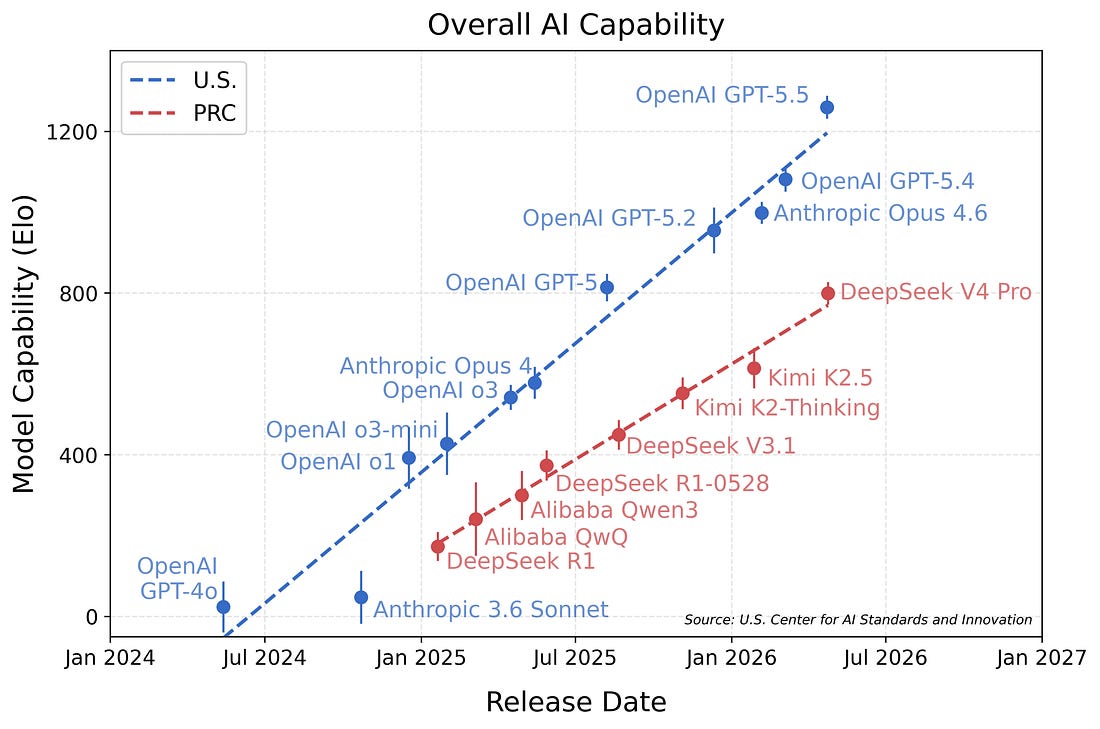
For the report, they calculate an Elo score based on Item Response Theory, which is commonly used to compare different models, even when they were tested on a different set of benchmarks. For V4, CAISI used nine different benchmarks:
The huge Elo difference is explained by DeepSeek V4s bad score in CTF-Archive-Diamond (which was only run with a subset of the benchmark and extrapolated with IRT for V4), PortBench (a CAISI-private benchmark) and ARC-AGI-2 (with a different scoring method than the public leaderboards). The differences in these benchmark have a huge impact on the overall Elo, which can exacerbate the difference in capabilities.
When using Epoch AI’s ECI, which also uses IRT over a set of different benchmarks, we see that the gap roughly stays between 3-7 months since R1:
The open<>closed gap in ECI (from https://mcnair.center/china/)
However, both CAISI and ECI paint an incomplete picture, as both use standardized (and simple) setups to compare the capabilities of models. To be more concrete: Coding tasks are evaluated using access to bash and a for-loop with a fixed budget of tokens, not with a harness such as Claude Code or OpenCode, which models are trained in! These setups result in benchmarks claiming that porting applications to another language is currently not possible, while Bun is ported from Zig to Rust with 1 million LOC changes¹.
Therefore, we would argue that a frontier comparison of open and closed models would also need to elicit the capabilities of all models better, which means the usage of the preferred harnesses, as well as model-specific prompting.
This section was written primarily by Florian. An interesting dynamic within Interconnects is that Florian believes more in the proximity of open frontier models to closed alternatives in true performance. Nathan thinks the benchmarks are imperfect as well, but thinks the closed models are ahead by more. We’re going to continue to unpack this in our future content.
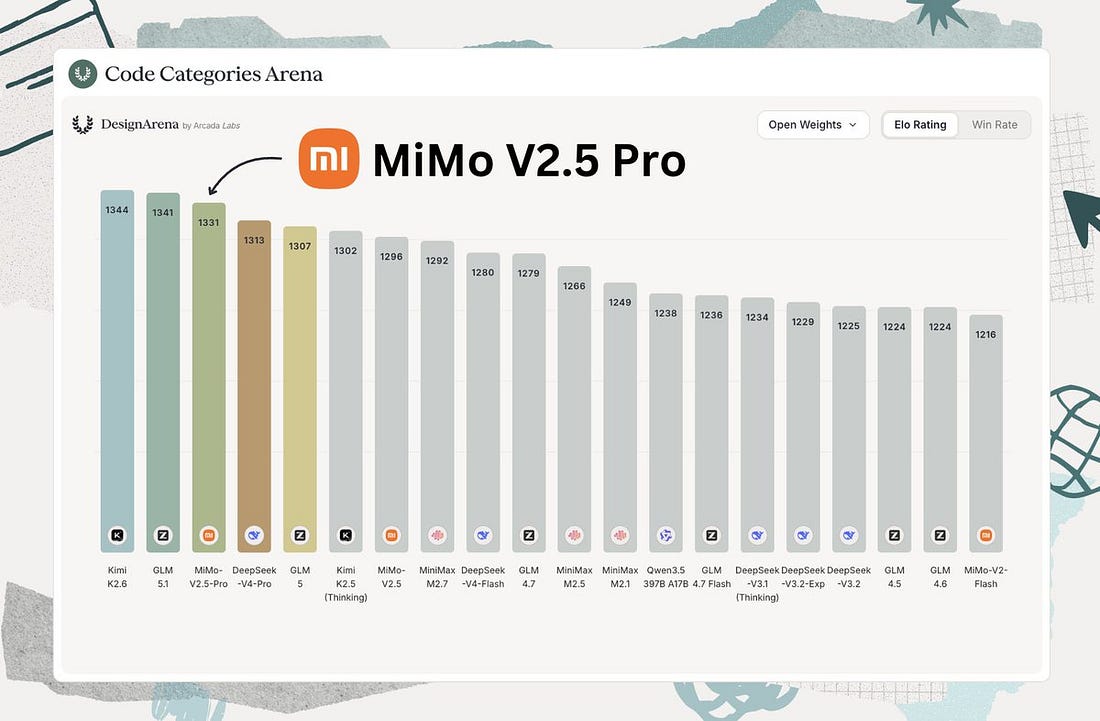
gemma-4-26B-A4B-it by google (full Interconnects post here): The long-awaited update to the Gemma series, featuring multiple sizes: 4B, 9B, and 31B dense models, as well as a 26B-A4B MoE. Even more importantly, with Gemma 4, Google has decided to use Apache 2.0 as its license, which removes the uncertainty and legal challenges around interpreting custom licenses.
Kimi-K2.6 by moonshotai: An update to the Kimi series, delivering stronger performance across the board and making it one of the best open models out there yet again. They also focus on long-horizon performance, showing that open models are capable of running over hours to complete tasks or optimize performance. Given the focus of everyone to build autoresearch-like systems, seeing open models catch up is important.
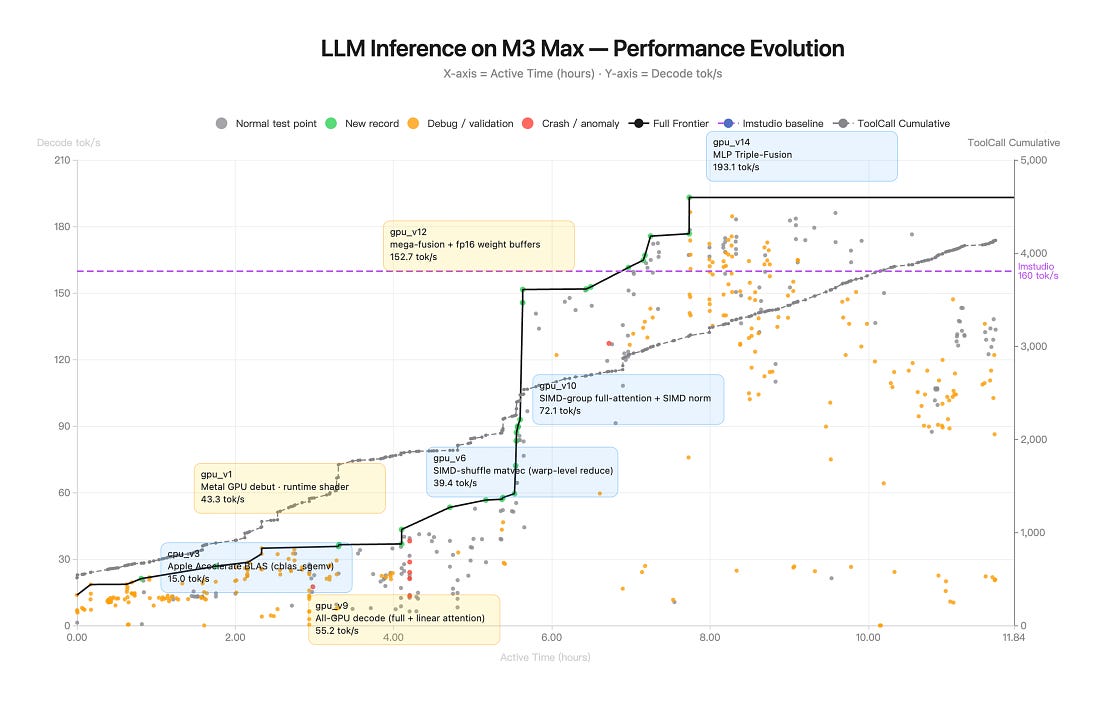
Laguna-XS.2 by poolside: Poolside AI has released its first public coding-focused models, including the open-weight XS.2. Its size (33B-A3B) makes it attractive for local use, with performance on par with other models in that size range. The accompanying blog post is worth a read, as is the deep dive into reward hacking during coding evaluations.
DeepSeek-V4-Flash by deepseek-ai: DeepSeek has finally released its successor to the V3 series, which it kept updating for months. It comes in two sizes: Pro, which is a 1.6T-A49B MoE, and Flash, a 284B-13B model. Based on others’ experience, the latter model seems to be the real star of the show, as its performance is relatively strong, while Pro seems to underdeliver relative to its size. The tech report goes into great detail, including the architectural changes used to achieve better and cheaper long-context performance.
Qwen3.6-35B-A3B by Qwen: An update to the Qwen 3.5 series targeting one of the most widely used sizes.
LFM2.5-350M by LiquidAI: With 28T tokens for 350M parameters, this model might be the most overtrained model out there.
Trinity-Large-Thinking by arcee-ai: The reasoning version of Trinity, one of the best Western open models. It has topped the OpenRouter charts for a while and can power agentic applications such as OpenClaw.
GLM-5.1 by zai-org: An update to GLM-5, improving scores across the board. The focus for this update is on long-horizon tasks...
Monthly extra roundups of open models, datasets, and links.
Occasionally paywalled hot takes. Interconnects Discord Server.
by Every Staff 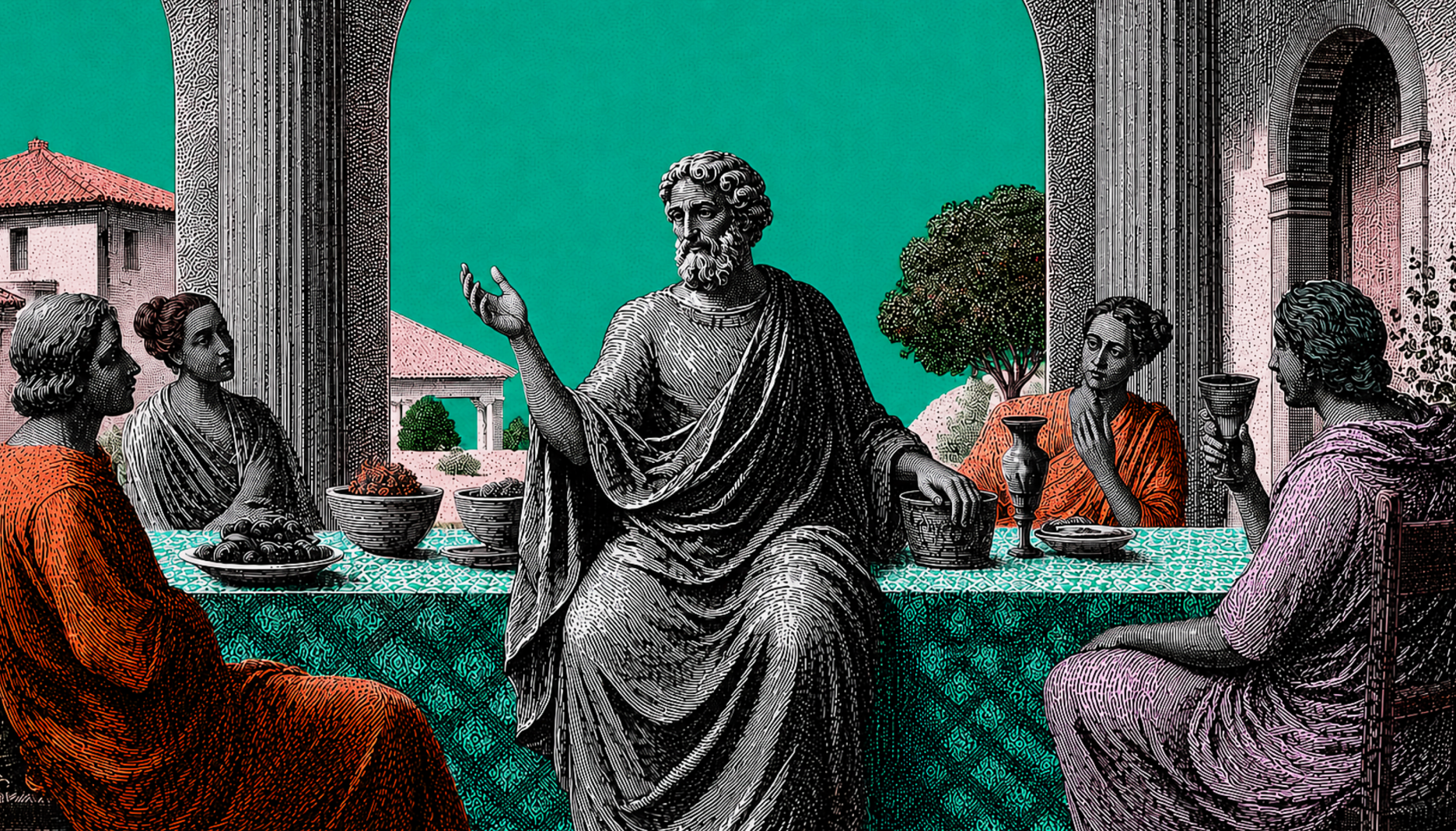 Hello, and happy Sunday! Housekeeping note: We’re hosting our first paid subscriber meetup during New York Tech Week. Scroll down to learn more and RSVP.— Kate Lee__ ## Knowledge base
“We Gave Every Employee an AI Agent. Here’s What We’re Doing Differently Now.” by Brandon Gell and Willie Williams /Source Code__ : A few weeks after we launched our Plus One personal agents internally, everyone had their own AI agent. But it wasn’t working: The agents were unreliable, constantly broke, and needed too much upkeep. The problem wasn’t just the OpenClaw harness; it was the idea that every employee needed a personal agent. Read this for a retrospective from Brandon Gell and Willie Williams, and a preview of how Plus One 2.0 is being rebuilt around shared, reliable coworkers. “Socrates as a Service” by Eleanor Warnock /Every : In a world where AI can search anything, the people who know how to extract tacit knowledge—the gold dust that isn’t on the internet—are getting more valuable, not less. Eleanor Warnock lays out seven techniques she keeps coming back to find the most interesting information. Read this for a working interviewer’s toolkit, and the case for why taste, judgment, and attention can’t be prompted. “Opus 4.7 Reels Us Back In” by Laura Entis /Context Window : After weeks of Codex dominance, several members of the Every team have been pulled back to Opus 4.7. Cora general manager Kieran Klaassen has made it his default for synchronous work. Read this for the team’s case for switching back.Plus: A hack that spread through a widely used software package, a 30 percent drop in AI-tells complaints after Spiral added a top-edit step, and a better way to think about what an “agent” is. “Mining Your Life for Context” by Laura Entis /Context Window : By the time you sit down to write an article, strategy memo, or launch page, you’ve probably already said most of what you want to say. It’s just in Slack threads, Notion documents, voice memos, and meeting transcripts. Laura Entis walks through a three-step workflow for mining all that scattered thinking before you draft. Plus: How AI entrepreneur Noah Brier uses Claude Code as a “second brain,” and the productivity regimen Codex’s Chronicle wrote for head of growth Austin Tedesco after analyzing his computer activity. 🎧 🖥 Listen on Spotify or Apple Podcasts , or watch YouTube. “The Fallacy of the 16-hour Agent” by Katie Parrott /Context Window : New benchmarks claim autonomous AI can now handle 16-hour software-engineering tasks, and depending on which chart you saw, the takeaway is either “autonomous AI has arrived” or “we’re still years away.” Katie Parrott unpacks why both can be true and which version of the research to actually trust. Read this for a sharper read on long-horizon agent reliability.Plus: Perplexity’s methodology for building durable agent skills, and Dan Shipper ’s piano keyboard turned Codex-powered music coach.
We host camps and workshops on topics like compound engineering and writing with AI to share what we’ve learned from training teams at companies like the New York Times and leading hedge funds , and by using and experimenting with AI every day ourselves.