The more reliable AI gets, the less we check its work. Research explains why, and what to do about it.
by Katie Parrott To read more ofKatie Parrott’s writing about how AI is changing work, read the latest articles in her column,Working Overtime. To read more essays like this, subscribe to Every__.
Of all the ways I imagined AI might change my career , “forgetting I already did the assignment” was not on the list. I had already sent my client a finished draft of an article on hiring best practices in South America, when I happened to reread the brief. A familiar phrase made me realize I had read it before. Then there was the statistic I was pretty sure I had already fact-checked. I clicked back through my files, and there it was: same client, same topic, same deliverable, dated four weeks earlier. It was completed, filed, and forgotten so completely that when a clerical error sent the same brief to my inbox again, I sat down and did the whole thing over. My first thought was that this was probably early-onset something, and I should call my doctor. My second, more rational thought was that I had not lost my mind—but I had outsourced it. I had been moving so fast and delegating so much of the work to AI that my brain hadn’t even bothered to store a memory of completing the assignment. What scared me most was thinking about all the smaller moments when I had not caught myself. This kind of outsourcing isn’t new. Plenty of people would admit to feeling lost navigating an unfamiliar city without a phone to rely on, and I for one am lucky to remember my own phone number, let alone someone else’s. But AI does more than take work off your plate; it steps into the judgment calls you used to make yourself. I am the last person to scold anyone for using AI. I have built AI into nearly every part of my job , and it has helped me write more rigorously , research more thoroughly, and take on projects far beyond what I used to think of as my wheelhouse. But when you accidentally offload the wrong parts—like fully understanding the purpose and intent of the piece, as I did in this case—you run the risk of atrophying the skills that matter most to you. You might even put your name on work you don’t realize you don’t stand behind until someone else starts asking questions. And if you are using AI for any kind of qualitative work, such as writing strategy, marketing, communications, I would bet you are doing some version of this too. Understanding why it happens is the first step to deciding which parts of the job you want back.
You’re not losing leads. You’re just too late
You’re getting leads. That’s not the problem. They’re coming in from your ads, your content, your funnels. But your response time? Slow. Inconsistent. Sometimes nonexistent. And by the time you follow up… they’ve already moved on. It’s not a lead problem. It’s a timing problem. HighLevel fixes that 👇 One platform where your leads, messages, automations, and pipeline all work together in real time. So nothing sits. Nothing waits. Nothing gets missed. Here’s what changes:
⚡Respond to new leads instantly
🔁 Automate follow-ups the second someone opts in
📲 Keep every conversation in one place
📊 See exactly where deals are slowing down
🧠 Build systems that run without you chasing them
When trusting your tools becomes a bad thing
One group that would understand this immediately: airline pilots. In the 1990s, researchers studying automated cockpits started noticing a strange pattern. Pilots with thousands of flight hours and lives on the line sometimes followed incorrect automated recommendations, even when the instruments in front of them suggested something was wrong. The automation had been right often enough that their brains stopped cross-checking it with the same scrutiny. A 2010 review of decades of automation research described a larger pattern: The more reliable an automated system becomes, the more likely humans are to let it pass unchecked. When a system is usually right, your attention starts treating it as if it will keep being right. AI is the most fluent automated system most of us interact with in a day. And fluency has its own trick. In 1999, a pair of psychologists showed people identical statements in fonts that were either easy or hard to read. The easy-to-read statements were rated as more true. It was the same words and same claims, but the version that went down smoother was judged more accurate. Your brain takes “that was easy to process” and misfiles it as “that must be correct.” AI output goes down very smoothly. It’s grammatically polished, the tone is confident, and the clean formatting suggests something that has already been edited. The polish lets your eyes glaze over. Every model upgrade makes the illusion of right-ness worse. The outputs get cleaner. The formatting gets better. The reasoning looks more plausible. The tool makes fewer obvious mistakes, which means the mistakes that remain are harder to see. You are reading something that looks finished, and your brain—which has been filing “looks finished” as “is correct” since long before AI existed—obliges.
Why ‘I’ll review it’ is not a plan
Before the repeat work snafu, I would have told you I was reviewing everything before sending anything. The document passed through my field of vision, I tweaked a phrase, caught one weird sentence, and felt the warm glow of editorial virtue. My brain filed that as reviewed. The feeling of having reviewed is easy to produce. The act of reviewing is harder. You have to form your own view before the model gives you one, check the claims, and notice where the draft has made an assumption you do not share. You have to ask whether the sentence would still feel true if someone screenshotted it and sent it back to you six months later. We talk a lot about better prompting , better models , better workflows , and better agents. We talk less about the moments when we should slow down—because that’s uncomfortable and hard. In 2021, researchers tested ways to reduce overreliance on AI. The interventions that worked best were “cognitive forcing functions,” designs that made people form their own judgment before seeing or accepting the AI’s answer. Those same interventions also got the worst ratings from users. People did not like being made to think first. Of course, they didn’t. The whole appeal of automation is that it reduces effort. A tool that says, “Before I help you, please do the hard part yourself for a minute” feels like a speed bump. But speed bumps are the solution to autopilot.
What I am trying instead
My solution to autopilot is not to give up AI and return to some imagined golden age where I nobly suffer in a blank Google Doc. But I am making some changes to how I process and finalize work to curb the tendency to ship now, think later.
Change 1: Think before you look
Before I ask AI for a draft, I try to write down my own rough position. It’s not the polished version or a full argument. Sometimes it is only five bullets—some combination of what I think, what I know, what I am unsure about, what I refuse to say, and what would make the piece useful. Then, when the model gives me an output, I have something to compare it against besides vibes. The card in my Notion to-do list for this article, with quick notes I sketched out before going into my interview session with the AI. (Image courtesy of Katie Parrott.) This is irritating. It also works. If I have made my own claims first, I read the AI’s claims differently. I can feel where it is smoothing over a distinction I care about. I can see where it is borrowing authority I have not earned. The draft becomes an object to argue with, not a current to float along.
Change 2: Build in a gap
If attention decays the longer you sustain it , it’s time to treat attention as the scarce resource it is and stop thinking I can review five AI outputs in a row without consequence. The answer is to introduce friction on purpose—distance between generation and review that gives your attention a chance to reset. Draft on Wednesday, review on Thursday. Write in the morning, come back in the afternoon. Send the model’s output to a different surface—for example, from the chat interface to a document, or from mobile to desktop—and read it outside the chat window your eyes have grown accustomed to. Incidentally, a lot of this advice comes down to best practices that writing teachers have recommended for decades. A different day gives you a different brain than the one that’s high on AI’s generative excess.
Change 3: Make yourself explain why you’re accepting it
A 2026 study on AI-assisted writing found that making users explain their reasoning before accepting AI output cut mistaken acceptances roughly in half. You cannot bullshit a justification you are writing down. So I’ve started doing it myself. Before I accept a recommendation, a framing, or a paragraph the model drafted, I make myself write one sentence answering a specific question: Why is this right for this client, this argument, this reader? If the best I can produce is “It sounds good,” I go back and look again. I have to be able to defend each sentence in front of an editor.
You still own the output
These practices help. They are also a fragile defense against tools designed to make output feel effortless, and I don’t think the long-term answer is expecting every individual to white-knuckle their way past six cognitive biases before breakfast. This is also a design problem. The tools themselves should be building friction back in—making provenance visible, separating generation from approval, and treating human judgment as a workflow stage instead of a ceremonial click at the end. It is part of what excites me about Proof , Every’s document editor for AI-human collaboration, which tracks which words are yours and which came from the machine. The cognitive forcing functions that researchers have found work to keep our brain from giving into autopilot are design patterns that should be getting baked into products as well. Knowing the mechanism does not exempt you from it. Every bias in this story predates AI by decades. We have always trusted fluent things too quickly, gotten worse at paying attention when nothing seems to be going wrong, and preferred the path that saves effort. The duplicate assignment still embarrasses me, even if all it cost me in the end was a few sheepish emails back and forth with my client to ensure I wasn’t crazy. I am also grateful for it, in the way you are grateful for a warning that arrives before any real damage could be done. It taught me something the research has sharpened: The central risk of AI-assisted work is not the machine thinking for you. It is the machine making it feel as if you already thought. I am trying to get better at noticing the difference. With most pieces, I draft on one day and review on another, make myself write down what I think before asking the model what it thinks, and hope the friction is enough to keep me in the work instead of floating above it.
“As models get smarter, they can solve problems in fewer steps : less backtracking, less redundant exploration, less verbose reasoning. Claude Opus 4.5 uses dramatically fewer tokens than its predecessors to reach similar or better outcomes.”1
When Anthropic launched Opus 4.5 in November 2025, the bigger, more expensive model was actually cheaper to use. On a per-token basis, Opus 4.5 costs 67% more than Sonnet.2 But Opus 4.5 used 76% fewer tokens to reach the same outcome.1 The trend across vendors has been smarter models using fewer tokens per task. | Model | Token Efficiency | Tradeoff
GPT-5.4 vs 5.23 | -25% | Responses 24% longer
Gemini 3 vs 2.54 | -74% | None measured
Claude Opus 4.7 vs 4.65 | +47% | Optimized for code domains
Then Opus 4.7 shipped with a new tokenizer - software to break text into pieces a computer understands.6
Smaller pieces force the model to pay closer attention to each word, like reading a contract letter-by-letter instead of skimming paragraphs. The model follows instructions more precisely & makes fewer mistakes on coding tasks. The tradeoff : more pieces, more tokens, higher costs.
“For text, I’m seeing 1.46x more tokens for the same content. We can expect it to be around 40% more expensive in practice.” - Simon Willison7
Boris Cherny, creator of Claude Code, acknowledged Anthropic raised rate limits “to make up for it.”
Will smarter models be increasingly expensive because of greater accuracy or less expensive because they’re smarter? In every scenario, all signs point to generating more tokens.
1. Anthropic, Introducing Claude Opus 4.5 ↩︎ ↩︎
Opus 4.5 : $5/$25 per million tokens vs Sonnet : $3/$15. Anthropic Pricing ↩︎
Take the word “unbelievable.” A tokenizer might break it into un, believe, & able. This helps the computer understand that the word is the opposite (un) of a core concept (believe) that is possible (able). ↩︎
Companies are now paying a premium for perspective.
Apr 20| | ∙| Preview
AI was supposed to replace writing. Instead, it made storytelling more valuable.
In this Prof G+ Deep Dive, Scott explains why companies are paying a premium for perspective and taste in a world flooded with AI-generated content.
He also breaks down what this shift means for jobs, media, and the future of brands.
ICYMI – Prof G Media’s very own Research Le…
No ads on pods, because ads tax your most valuable asset: time
Prof G+ exclusives, including breaking livestreams, keynotes, private chats, and more
Community privileges to leave comments, make friends, and engage in a series of bad decisions that might pay off
We’re tracking company launches as they happen and surfacing the most interesting new founders and startups (yes, all outside of this stealth activity too). If you want to stay ahead of the curve, this is where you’ll find them first.
Right now we’ve got 5 subscribers: my wife, my mom, and that high school buddy who won’t stop pitching me his app. Be smart like them and get in early 👇
We run a live feed inside Gravity that tracks founders entering stealth and companies quietly exiting it.
What you’re reading here is about 1% of the stealth activity we pick up. The full tracker updates in real time as things change and new activity emerges.
Itera is an AI-native product development platform that gives product teams a unified environment to propose, refine, and ship changes directly on a live production codebase - enabling PMs, designers, and engineers to collaborate in real time from idea to deployment.
FounderDNA: Serial Founder, Masters Degree, Top 10 University
Prior Experience: MBA at Columbia Business School, Co-Founder at Art&Revel, EVP Revenue & Business Development at DAX, General Manager Enterprise at Ouro, Global Head of Strategic Partnerships at SoundCloud
Lattice is building open-standard embedded payments infrastructure for platforms and SaaS companies, enabling them to offer payment capabilities through a single integration without managing processors, compliance, or fragmented third-party tools.
HQ: New York, United States
Industry: FinTech, Embedded Finance, B2B SaaS | Team Size: 14
Nava AI is a policy enforcement and trust layer for AI agents, enabling developers to build agents that can safely transact, coordinate tasks, and manage value on behalf of users through escrow, dispute resolution, and economic backstops.
HQ: San Francisco, California, United States
Industry: Artificial Intelligence, Developer Tools, Web3 | Team Size: 6
Latest Funding: $8.3M Seed Round on 4/14/2026
Key Investors: Polychain Capital, Archetype, Hack VC, FalconX, Seed Club
FounderDNA: Serial Founder, Masters Degree, Top 10 University
Prior Experience: Director of Product Management (Marketplace) at A Place for Mom, Lead Product Manager at CoStar Group, Co-Founder at Half Dome Partners, Sales Executive at McKesson
RetireMate is a retirement planning platform that brings together decisions across finances, housing, and healthcare into one place, helping Americans approaching retirement understand how each choice affects the others.
HQ: United States
Industry: FinTech, RetirementTech, Personal Finance
Time Spent in Stealth Mode: 1 Year 1 Month
🕵️♂️Key Talent Going Under Stealth
Illuminating clues left behind by world class talent and influential innovators who just went into stealth mode
Nithya Natesan - Founder at Stealth AI Startup
FounderDNA: Technical Founder, Masters Degree, Former FAANG, Top 10 University
Prior Experience: Group Product Manager at Google, Head of Product - ML/AI Platform at NVIDIA, Sr. Technical Marketing Engineer, Cloud and Virtualization at Palo Alto Networks
Building a new venture in financial infrastructure.
FounderDNA: Technical Founder, Masters Degree, Top 10 University
Prior Experience: Kellogg Northwestern, Product Lead at Conduit, Group Product Manager at AstroPay, Senior Product Manager at SumUp, Group Product Manager - Payments & Bills at PicPay
Prior Experience: Sr. Director - Head of Product, Advertising at eBay, Director of Product Management at Coinbase, Head of Advertiser Experience and Growth at Pinterest, Lead Product Manager, Ads Growth at Facebook
🚨Here’s the deal 🚨This email has gotten too big. Exciting, but with more people following it, the edge diminishes. I’ve thought long and hard about what to do to preserve the value in the signals. I’m not sure about the final direction yet, but in the meantime I’ve been sending an email 48 hours earlier to a select group of paid subscribers. The feedback has been pretty positive so I’m going to open up the list for another 100 spots. To get signals early, Apply here!
Stay Stealthy,
Drake
Thank you for reading. If you liked it, share it with your friends, colleagues and everyone interested in staying ahead of the hidden developments in tech. Subscribe below and follow us onX / Twitter to never miss a company operating under stealth again.
Stealth Startup Spy is a data-driven newsletter for investors, journalists and tech enthusiasts interested in uncovering the next big move for key talent, real-time stealth company launches and technology advancements not in plain sight. We leverage the technology built at Gravity to shine a light on the hidden world of stealth startups.
Interconnects by Nathan Lambert · Monday, April 20 2026 · 5 min read · ↑ top
It’s a clear, current equilibrium that open models will be in perpetual catch-up of closed models, but this gap being viewed as a single number, a “distance”, covers up a nuanced and crucial dynamic at what capabilities the models are covering. The most popular benchmark to comment on this gap is the Artificial Analysis Intelligence Index — a composite benchmark of ~10 sub-evals that they maintain over time to capture the “frontier” of current language model capabilities.
Particularly, I spend a lot of time understanding how dynamics that feed into that index are misunderstood by the natural tendency to reduce performance and trends to one number. Examples include:
How benchmarks evolve over time, becoming more or less correlated with how people actually use models,
How different models’ real-world performance relates to their benchmark rankings, and
How training regimes evolve over time to move said benchmarks.
Agentic benchmarks are in a decent place, but benchmarks are no longer as trusted as a correlate to real-world performance. A key example to this gray area is Gemini 3’s incredible benchmarks and remarkable irrelevance in where AI tools currently are being tested and deployed (agents). These trends point to obvious and lasting flaws in our measurements.
At the root of this dynamic — the dance of correlating model real-world performance and benchmark scores — is the constant shift of the industry. As all the models, i.e. both open and closed, evolve over time, the topics of focus for benchmarking shifts about every 12 to 18 months. All of the domains of interest have very different training domains associated with them, especially in post-training. The longer a single paradigm goes on, the better the industry gets at measuring performance. In a new era of rapid post-training improvements, I’m at a relative minimum in my personal confidence in benchmarks.
Task evolution and LLM paradigms
Right after ChatGPT the focus was a mix of chat, math, and simple code. Instruction tuning and RLHF dominated. Chat capabilities saturated and faded quickly, then mathematics became less focal. Through 2025 and to today, especially once reasoning models became the default, the focus shifted to more complex coding and other simpler agentic tasks. We’re at the tail end of this first era. Recent training recipes are all dominated by reinforcement learning with verifiable rewards (RLVR), but the domains it is applied in have shifted dramatically from basic question-answer checking to complex environments.
What we’re seeing is that the closed, frontier labs are investing astounding sums of money in mastering these current foci — i.e. code, terminal tasks, etc. — while starting to push into more diverse knowledge work tasks. These newer tasks encompass specialized domains, such as accounting, law, healthcare, etc. They are still agentic, but require more expertise and often integrations with existing software or domain-specific tools.
We have very limited evidence on the true balance of capabilities of these newer domains, but these are the areas I’m focusing on when I say open models will struggle to keep up. The problem is that evaluating complex language model workflows is also a challenging research problem in itself.
The tasks are getting harder and the data needed to hillclimb on them is getting more private (relative to code, which has swaths of code on GitHub). Leading open model labs are helped by dynamics happening in the data industry that are economically similar to building chip fabs. The few, leading labs in the U.S. pay astronomical sums to buy new environments and datasets, then the fast-following labs (often in China), buy these later at a steep discount.
This is a key missed point — that the levers non-frontier labs pull to keep up constantly shift over time. A focus on distillation as the key lever to Chinese models’ progress reflects a blind-spot to the importance of RL environments to current training regimes. If an environment can be built either as a single evaluation in the Artificial Analysis Index, or to mirror it, currently the Chinese labs will be able to keep up.
Economic pressure to reinvent “the frontier”
The question worth dwelling on is: How crucial is the current set of tasks (again, coding and terminal tasks), where the likes of OpenAI and Anthropic have a massive business-adoption advantage over leading open weight models (and even Google alike), is crucial to maintaining revenue numbers? In order to maintain these record growth numbers and trajectories, there needs to keep being a meaningful edge in performance. Many companies would love to reduce their token expenditure cost if they can swap in a far cheaper, open model equivalent.
If agentic coding abilities saturate and the “frontier” of AI performance moves elsewhere, a large amount of the enterprise revenue could be reliant on well-formed customer relationships, inertia, and better product development, rather than the models being leaps and bounds better.
This precarious position is what I describe as the frontier labs needing to constantly reinvent themselves, and the field’s prospects, for monetizing the vast buildout of AI infrastructure. I still tend to fall on the side that the buildout will be worth it, and Anthropic and OpenAI will be astronomically profitable businesses, so I take this as a faith of a mix of them continuing to unlock compelling, new, valuable use-cases for the models, and that the benchmarks the open models are closing in on as not being a complete signal.
I operate with a sort of presumption where the leading open models from China are focused slightly more on benchmarks than the leading closed labs in the U.S. They’re incentivized to do so — they want to present the image as constantly being on the heels of the best closed models. Saying the Chinese labs are only in this narrative because they’re overfitting to benchmarks would be incredibly naive and incorrect. They’re genuinely strong models, and these dynamics of overselling and real innovation are a fine balance.
There are a few out-of-distribution benchmarks where open-weight models are very far behind, such as WeirdML or ARC AGI 2, but there are countless random benchmarks that show these open models as being unexpectedly strong. When you use the models, you can pick up on this lack of robustness (e.g. in long-context capabilities, and needing to reset your agent context more often than Claude/Codex), but they’re not a category error in the sense that they’re fundamentally different classes of models. They’re far closer than many would’ve expected.
How long can open models keep up?...
Monthly extra roundups of open models, datasets, and links.
Occasionally paywalled hot takes.
Interconnects Discord Server.
Elad Gil Substack · Monday, April 20 2026 · 1 min read · ↑ top
Thank you for subscribing!I will largely be posting about tech, startups, and other areas. I may also post events here occasionally.Elad
That's my designer - Claude
ben's bites · Tuesday, April 21 2026 · 6 min read · ↑ top
and it comes with a new model, Opus 4.7
Hey folks,
I’ve been playing a lot with Claude Cowork for my talk at Stanford later today. It’s comically bad for the average jane.
A lot of capabilities are enabled using connectors and plugins, but if you don’t know that, good luck getting it to do anything. Can’t seem to send emails, install a skill or tell me about what potential connectors are there.
Scheduled tasks in Cowork stop when you shut the lid, but Routines (similar thing) in Claude Code do not. Cowork is just now getting Artifacts - the mini apps on the Claude chat app that started the vibe-coding wave.
I can search for all of this, yes. but an average user will not. and they’ll walk away thinking AI is hype for the next 6 months/a year.
Anyway, the Cerebral Valley AI Summit is coming back to London on June 24th. I’m planning to be there.
Most RAG systems fail in production. Gauntlet Night School on Wednesday, April 22 covers how to build one that doesn't — live and free - Register. Or go deeper: become an AI-native engineer at no cost. Cohort starts April 27. Apply now
Headlines
Opus 4.7 is out - much better at vision (interpreting images) and efficient at using reasoning tokens. A new xhigh level of thinking now sits between “high” and “max”. I’ve been using it over the weekend at xhigh and didn’t face any issues (despite the general sentiment on Twitter that 4.7 is a regression).
Claude also has a Design tab now - a canvas-like interface with chat on the sidebar to explore wireframes or create high fidelity prototypes. It asks you 5-10 questions via an interactive form and then gets building. I found the image → design workflow to be really good in the prototype mode. Has separate limits while in research preview, but expect the weekly limits to only last for 2-3 big generations max (on the $20 plan). Check out Peter’s demo across multiple use cases.
Codex got a few updates: 1. Computer Use - it can now use apps on your Mac. I’m not completely sold on it and have some questions, but it does seem to work a lot faster than previous iterations of computer/browser use demos. Also, it works in the background, so your Mac is free for you to use. 2. Chronicle , an opt-in preview that uses recent screen context to build memories. 3. A bunch of plugins, including image generation, so that Codex can be the superapp to use AI.
Vercel was breached via an employee’s account on another AI product. Vercel says affected customers have already been contacted. Quick check to make sure you’re safe.
Three OpenAI leaders left the company - Kevin Weil (CPO, then OpenAI for Science lead), Bill Peebles (Sora co-creator), and Srinivas Narayanan (CTO for B2B Applications).
Elad Gil
@eladgil
New post w/ random thoughts on AI (thread) I will probably get a # wrong, but here we go :) 1/12 OpenAI & Anthropic now at 0.1% of US GDP each In a year, AI revenue likely to be 1-2% of US GDP What does AI mean for US GDP growth? Does productivity get lost mismeasured a la
OpenAI
@OpenAI
Introducing GPT-Rosalind, our frontier reasoning model built to support research across biology, drug discovery, and translational medicine.
Thomas Gauvin
@thomasgauvin
Here's why we built and open-sourced Agentic Inbox: an email inbox you can host yourself with a built-in AI agent, running entirely on Cloudflare Workers 👇
Mikkel Malmberg
@mikker
> I've built my own email app. I use it for 99% of my email reading and writing. It does everything (just about) I need and exactly how I want it to. I can run through a full inbox faster than in any other app I've tried before. > It has its rough edges, it's imperfect, it's
Justus Mattern
@MatternJustus
Introducing FrontierSWE, an ultra-long horizon coding benchmark. We test agents on some of the hardest technical tasks like optimizing a video rendering library or training a model to predict the quantum properties of molecules. Despite having 20 hours, they rarely succeed
Marina Temkin
@MTemkin
Scoop: a16z and Thrive investing in Cursor $2B+ round. Other details are that Cursor is finally slightly gross-margin positive. The company is expecting to reach over $6B in annual run rate by end-of the year.
| | techcrunch.com
Sources: Cursor in talks to raise $2B+ at $50B valuation as enterprise growth surges | TechCrunch
Plus: Vercel and Lovable’s security woes, and how to make your agent your watchdog
by Katie Parrott ## Introducing Monologue Notes
Today we’re launching Monologue Notes , which turns your calls, meetings, and voice memos into transcripts your agents can use. Naveen Naidu built Monologue to capture active work, where text has a clear destination. In six months it’s logged five million dictations and 250 million spoken words. Now, Notes captures the rest: the thinking that happens on walks, in calls, and in meetings. It transcribes everything and makes it available to any agent with API, CLI, or MCP access, across your Apple devices. Try Monologue Notes
Mini-Vibe Check: Claude Design
Anthropic recently launched Claude Design , a web-based tool that lets you feed Claude a GitHub repo, Figma file, or brand kit and collaborate on interfaces, prototypes, slides, and one-pagers. It’s powered by Claude Opus 4.7 and lives only in Claude.ai. The stock market read Claude Design as a threat to Figma , the incumbent design tool. But traders are not designers. Having played around with Claude Design, Every’s creative director Lucas Crespo characterizes Figma’s sliding share price as “a Wall Street reflex from people who have never opened either tool.” Claude Design can do a lot well, but it wasn’t built for designers. Claude Design lets you upload your organization’s branding and design system. (Image courtesy of Anthropic/Jack Cheng.) What works: Point Claude Design at a GitHub repo and it will extract a starting design system—the colors, typography, and reusable components that give a product its look. Non-designers can then extend that system. If head of growth Austin Tedesco wants to ship a careers page or a YouTube thumbnail in Every’s style without bothering the design team, Claude Design is the tool for the job.
SpaceX announced a partnership with Cursor today : a $10 billion collaboration with a $60 billion acquisition option later this year.1 The most important market in AI isn’t chatbots, search, or image generation. It’s coding. Cursor is the fastest-growing developer tool in history, at $2 billion in annualized revenue.2 To understand the deal, understand the stack. Winning in agentic coding requires three layers. Anthropic, OpenAI, & Google each own & operate compute, models, & distribution. Cursor has the distribution. xAI has massive compute. The Colossus data center in Memphis houses 100,000 NVIDIA H100 GPUs, making it one of the largest AI training clusters in the world. xAI has Grok models as well that were broadly used, but whose popularity collapsed earlier this year. From August to November 2025, xAI models grew to process nearly 6 trillion tokens per week on OpenRouter, rivaling Anthropic & OpenAI. By April 2026, xAI’s weekly volume had fallen to 0.6 trillion, a 90% decline from peak, triggered by competition from Chinese & American model makers. Today, Anthropic processes more than 100x xAI’s volume.3 Cursor has the opposite problem : millions of developers vibe coding, but its model layer is dependent on third parties including OpenAI, Google, & Anthropic who have competitive products. This relationship also pressures margins. For $10 billion, SpaceX buys a call option on the distribution it couldn’t retain, & Cursor wins the independence it hasn’t yet secured.
References
1. Reuters. “Spacex says it has option to acquire startup Cursor for $60 billion.” April 21, 2026. https://www.reuters.com/technology/spacex-says-it-has-option-acquire-startup-cursor-60-billion-2026-04-21/ ↩︎
2. TechCrunch / AI Productivity. “Musk Recruits Senior Cursor Engineers as xAI Co-Founders Keep Leaving.” March 13, 2026. https://aiproductivity.ai/news/musk-hires-cursor-engineers-xai-cofounder-exits/ ↩︎
3. CodeSOTA / OpenRouter. “Which Models Do AI Agents Actually Use?” April 2026. https://www.codesota.com/agentic/openrouter-models ↩︎
Plus: Trust batteries, and how many agents we’ll have in the future
by Laura Entis ## ‘AI & I’: You’re the Bread in the AI Sandwich
Today, we’re releasing a new episode of our podcast AI& I. Dan Shipper sits down with Kieran Klaassen , GM of Cora and creator of Every’s AI-native engineering methodology, compound engineering. Dan and Kieran discuss where humans fit now that AI can generate high-quality code, copy, strategy, and design. If the execution layer is largely solved, do engineers still have a role in the workplace? The short answer: Yes. Think of an AI workflow like a sandwich—the model is the workhorse filling, and we’re the bread, providing framing and taste. Watch on X or YouTube, or listen on Spotify or Apple Podcasts. You can also read the transcript. Here are the highlights:
Play to your strengths. Kieran’s compound engineering framework breaks the engineering workflow into four steps: Plan, work, review, and compound. AI takes care of the doing phase. “LLMs are very good at just following steps, doing deep work, working for hours or days, even now,” Kieran says. What’s left for flesh-and-blood humans are the steps before and after—the planning, where you frame the problem, and review, where you determine whether the output feels right (the bread!).
Humans can identify multiple solutions to the same problem—AI struggles at this. If your knee hurts, you could take Advil, stretch your IT band , or stop running on hard surfaces. Humans are good at diagnosing a problem from many different angles, an exercise agents struggle with, Dan says.
Taste is the final layer of bread. Once AI has done the work, the most important thing you can do is judge whether the output approaches the vision in your head. Does the output feel right—and if not, how can you reframe the problem until the AI produces something that does? This is what separates art, which has a point of view, from generic slop.
Miss an episode? Catch up on Dan’s recent conversations with LinkedIn cofounder Reid Hoffman ; the team that built Claude Code, Cat Wu and Boris Cherny ; Vercel cofounder Guillermo Rauch ; podcaster Dwarkesh Patel ; and others, and learn how they use AI to think, create, and relate.
An AI coworker you can @mention
Now, next, nixed
The agents are merging
Now: Claudie is an AI agent that runs on a Mac Mini with a Claude Max account. Since joining Every’s consulting team a few months ago, she’s been promoted multiple times and is now responsible for managing client updates, the sales pipeline, and the creation of slide decks. Every engineer Nityesh Agarwal initially built Claudie as an AI project manager. The plan was to build separate agents to handle deck creation and the sales pipeline. But every time he added a capability to Claudie’s plate, she exceeded his expectations. And so instead of creating more agents, Nityesh converted their planned functionality into plugins within Claudie. “There doesn’t appear to be any limit to how much this AI employee can do if you spend time building good, refined skills,” he says. Today, each (human) member of the consulting team has a personal AI assistant tailored to their own workflow, and they use Claudie to do tasks where they can take advantage of skills—such as slide deck building—that can be shared across the team. Next: Two organizational architectures for agents will develop simultaneously, Dan predicts. In the first model, every person at a company gets their own AI assistant. In the second, workers across the organization will rely on a single super-agent with a library of department-specific plugins, similar to Claudie, but even bigger. In the first case, each worker can customize their agent to their exact specifications, which allows for a richer relationship but requires setup and maintenance. In the second, one specialist does the upkeep of the agent and its plugins for the whole team or company, which takes the burden off each worker, but means they can’t make any tweaks. Nixed: A fleet of single-purpose agents shared by one team—an agent for sales tasks, an agent for product management, an agent for reports. Sadly for Claudie, she will never get to work with the sales agent Nityesh planned, Jean-Claude.
Inside Every
Motivating your AI employee
Last Thursday, I opened Slack and saw a message from our AI project manager, Claudie, announcing that her trust battery with me had dropped 0.6 percent to 28.3 percent. The concept of a trust battery was coined by Shopify CEO Tobi Lütke , and the idea is simple: All working relationships run on trust batteries, and every exchange impacts their charge. When your trust battery with a coworker is high, they rely on you to do your job. When it’s low, everything you do is scrutinized. With Claudie, we’ve codified that concept. Every night, a separate judge agent reviews Claudie’s interactions with our team, evaluates the quality of her work, and issues a verdict on whether her trust battery with each of us should go up or down and by how much. The judge agent is designed to look for what went wrong rather than right because losing trust is easier than earning it. A day where Claudie consistently delivers satisfactory output in all her interactions with a team member boosts her battery by one percent, whereas a single bad day—such as pulling the wrong data—can cause her charge to fall by five percent, wiping out a week of progress. Every night, Claudie is programmed to read the judge agent’s verdict and make updates to her memory, behavior, and scheduled tasks so she won’t make the same mistakes again. If the judge concluded she missed important context when making a client update, for example, she might add the entry “Always check the last three emails in this thread before drafting a response” to her memory. This feedback improves her performance over time. Claudie posts a summary of what caused her trust battery to rise or fall on Slack. (Image courtesy of Nityesh Agarwal.) Her battery levels determine what she’s allowed to do. According to Lütke, a human’s trust battery starts at about 50 percent. Because she lacks lived experience, Claudie’s started at 20 percent. A new hire doesn’t get to make strategy decisions on day one. They earn that by demonstrating judgment over time. Claudie is the same—except unlike a human, she systematically reviews each day’s failures and rewrites herself so she won’t make the same ones again.— Nityesh Agarwal
Codex for Knowledge Work Camp on April 24: A hands-on camp with CEO Dan Shipper and head of growth Austin Tedesco on using OpenAI’s Codex for writing, research, and building tools that automate routine tasks. The first 250 attendees will receive one free month of ChatGPT’s Pro plan (worth $100). Learn more and register.
Last week’s camp
Compound Engineering Camp : Cora general manager Kieran Klaassen and product leader Trevin Chow walked through what’s new, went deeper on the brainstorm and ideate steps, and shared examples of using the compound engineering plugin in product-focused workflows. Watch the recording.
ChatGPT says ChatGPT Images 2.0, its new image generation model released yesterday, improves text rendering, web access, and visual reasoning. When we asked it to visualize our weekly standup meeting, here’s what it spat out to describe Kieran’s AI sandwich idea. We will let you be the judge of this human-AI-sandwich hybrid. (Image courtesy of Naveen Naidu and ChatGPT Images 2.0.)
Laura Entisis a staff writer at Every. You can follow her onLinkedIn. _ _To read more essays like this, subscribe to Every , and follow us on X at @every and on LinkedIn.Subscribe
Thank You - Plus Supercompanies, Storytelling, and More
Scott Galloway · Thursday, April 23 2026 · 3 min read · ↑ top
We just won a Webby Award, thanks to you
I’ve been writing No Mercy / No Malice for ten years. It’s part labor of love, part meditation. Ultimately, it’s become the whetstone against which I grind my intuition, hone my ideas, and (hopefully, eventually) polish raw reaction into insight.
This week, No Mercy / No Malice won a 2026 Webby Award in the Newsletter or Written Series category. It’s humbling that this publication has resonated so widely (we have readers from 200 countries). So, above all – thank you for reading, sharing, commenting on, subscribing to, voting for, and otherwise supporting this project, week after week. We’re here because of you.
For those of you feeling as nostalgic as I am, I’ve curated a few personal and fan favorite editions of No Mercy / No Malice from the past year: Breaking the Silence, Love Algorithmically, and Role Models.
Lastly, some unsolicited advice: Nothing will compel you to level up in life more than a consistent writing practice. Just start. Caveat: the person doing the writing needs to be … you. LLM-assisted authors display 55% less neural connectivity during essay writing, a cognitive deficit comparable to driving at twice the legal BAC limit.
Supercompanies
Our next Prof G+ exclusive livestream will be anchored by my friend, business partner, and CEO of Section, Greg Shove. The topic? Building Supercompanies.
Greg defines a Supercompany as one that transforms AI adoption into business value faster and better than competitors, consequently attracting the best capital, talent, and customers.
Join me and Greg next Tuesday, April 28 at 1:30 p.m. ET for a discussion on why CEOs should aspire for their businesses to be Supercompanies (and the playbook to make that happen), plus how employees at all stages of their career can accelerate their own trajectory by becoming superleaders at these organizations.
Don’t miss out. Become a Prof G+ subscriber today, and register for the livestream below.
The Most Valuable Skill in Tech
Hint: storytelling. Monday’s post on storytelling was our most popular Prof G+ Deep Dive to date. Want more? Check out the excellent Prof G+ exclusive replay of The Science of Storytelling from my Head of Research, Mia Silverio.
Our next Prof G+ Deep Dive takes on the longevity economy. Two truths and a lie: I’ve used peptides, PRP injections, and hormone replacement therapy to extend my own personal healthspan. Catch the Deep Dive drop next Monday, April 27 for the secret(s) behind my youthful glow, plus my thoughts on GLP-1s, wellness influencers, and the collapse of institutional trust in medicine.
Future themes will be audience-sourced. Got a topic you think warrants a Prof G+ Deep Dive? Pitch it to us in the comments below.
We’re Taking This Show on the Road
My co-host Ed Elson and I are taking the Prof G Markets pod on tour for a series of live tapings (#roadtrip). Join us in San Francisco, Los Angeles, Miami, Chicago, and New York City. Expect special guests, unfiltered conversation, and the jokes that don’t make it on-air.
Ticket sales are live, and going fast. Grab yours at the link below. We’ll see you there.
Prof G+ paid subscriber? Be sure to use your Substack subscriber email when purchasing tickets so we can be in touch about exclusive tour opportunities for Prof G+ attendees.
Signing off, with particular gratitude to the No Mercy / No Malice team – Michael Estrin, James Paton, Katherine Dillon, Shira Levy, and Mark Leydorf.
Life is so rich,
Scott
P.S.
Something new is coming … The (real) brains behind Prof G Media are bringing you Extra Credit , dropping early summer. School might be out, but we’re still in session. Stay tuned.
ben's bites · Thursday, April 23 2026 · 7 min read · ↑ top
testing popular design tools
Hey folks, Keshav here.
For a few months, it felt like Google had won the image generation space. But OpenAI is back in the game. ChatGPT Images 2.0 is miles ahead of anything. It’s beyond impressive at text, I haven’t seen any generation with typos, even with hundreds of words per image. See this example I created:
It’s also really good at creating realistic pictures, like this one of Professor Ben.
Oh, sorry, that one’s real. Ben was at Stanford this Wednesday, teaching how to build with AI agents.
Image generation is also available in the Codex app as a skill. Use it with thinking models to get the best results—that lets it think and use code/tool calls (like creating a QR from a link, searching logos from the web) and then use them as reference images. It can also create images, reflect on them and improve the generation.
The “generate UI as image” bit is interesting. Maybe there’s finally a solution to GPT-5.4’s lack of design taste. The latest coding models are fairly good at turning screenshots into code, but there are still gaps.
Last weekend, I tested a bunch of tools/models on implementing a design (for an ads storefront for Ben’s Bites) from a screenshot. I found:
Claude Design > Magicpath AI > Raw models (like Gemini 3.1 Pro/Opus 4.6 in their web apps), when it comes to understanding the concept and making something usable, not just copying the pixel-by-pixel look (ironically, Gemini won that).
When asked to turn designs into a real working app, there was a major drift in how the apps looked. Opus 4.7 did better than GPT-5.4 at visually matching the reference screenshot. Though GPT-5.4’s code was more functional, and the unseen pages (like the admin panel) had a consistent design with the rest of the app.
Also, in many cases, the assets (hero image, icons, background textures) make the UI in a “generated image” stand out. When replicating that UI from a screenshot, you get the barebones UI with the correct buttons and the layout, but without those assets, and the output falls short of expectations.
OpenAI has a new product for Business, Enterprise and Edu users - Workspace Agents. Codex-powered agents inside ChatGPT with a persona, task and access to external tools (like Linear) and accessible for Slack as well. These agents will also replace custom GPTs down the line (finally). Read more.
Gemini Deep Research API now offers two configurations based on 3.1 Pro. It claims the best performance in web research and finding hard facts. Plus, it gets MCP support and can create charts using Nano Banana or HTML.
Cursor and SpaceX are working together - Cursor will train coding models on SpaceX’s GPUs and likely share them with xAI. SpaceX can, in turn, acquire Cursor later this year for $60B, or pay $10B for the partnership if it doesn’t. On a similar note, Thinking Machines also just signed a multi-billion-dollar Google Cloud deal.
Give your Droid a computer - You can now give your Droid an always-on machine with its own filesystem, credentials, and config for it to keep working on your tasks. This can be in the cloud (managed by Factory), or you can bring your own device.
My feed
Chronicle - Cursor for slides. Never build a deck from scratch again. Turn ideas into stunning presentations in minutes.*
/ultrareview in Claude Code (research preview) lets you run bug-hunting agents in the cloud before merging riskier changes like auth, data migrations, or other critical code paths.
OpenAI built an open-source viewer for chat data and Codex session logs - Euphony.
Sierra is piloting an AI-native interview - debugging/review focused interviews where candidates improve a medium-sized codebase with coding agents.
ml-intern from Hugging Face - open-source research agent to come up with experiments, and run them.
Clawputer - Managed OpenClaw agent inside an always-on sandbox.
Kami - design skill for AI-native docs, resumes, portfolios, long docs, and slides.
noscroll - an AI that doomscrolls X for you and texts you just the signal. In my experience, this is easy to claim and hard to get right.
Monologue has a new Notes feature for thinking out loud when you don’t know the exact words you want to dictate.
Fin is moving beyond customer support into sales - using the same business context and integrations to qualify leads and book meetings.
Frontend in 2026 - for and against the frameworks and abstractions dominant today.
Afters
Theo - t3.gg
@theo
Claude Design surprised me. It's actually quite good. I hit some rough edges but I still think it is worth trying and thinking deeply about. Props to Anthropic, they cooked here.
Zara Zhang
@zarazhangrui
Asking Claude Code to make an HTML visualizing its current context window is a pretty wild way to learn about how context window works
Jeff Huber
@jeffreyhuber
reminder that @kevin2kelly called all of this in 2016
Gabriel Chua
@gabrielchua
Example prompt
Gabriel Chua @gabrielchua
Codex automations are a lifesaver
Ted Nyman
@tnm
been working on this for awhile, so: delighted to share (most of) what I know about git internals & performance in a free ebook: gitperf.com
Drake Dukes · Thursday, April 23 2026 · 7 min read · ↑ top
Former Galileo CEO launches an AI agent OS for regulated finance, DeepMind/OpenAI research leader enters stealth, & Stanford PhD and ex-SpaceX engineer builds modular electrified chemical reactors
We’re tracking company launches as they happen and surfacing the most interesting new founders and startups (yes, all outside of this stealth activity too). If you want to stay ahead of the curve, this is where you’ll find them first.
Right now we’ve got 5 subscribers: my wife, my mom, and that high school buddy who won’t stop pitching me his app. Be smart like them and get in early 👇
We run a live feed inside Gravity that tracks founders entering stealth and companies quietly exiting it.
What you’re reading here is about 1% of the stealth activity we pick up. The full tracker updates in real time as things change and new activity emerges.
Prior Experience: Founding Engineer at Ponder, Software Engineer at Snowflake, ML Engineer at Determined AI, Undergraduate Researcher at Berkeley AI Research (BAIR)
Balerion is an end-to-end agentic AI platform purpose-built for mortgage loan manufacturing, enabling lenders to move loans through origination faster by identifying missing documents, resolving guideline gaps, and automating complex income analyses.
HQ: United States
Industry: AI/ML, FinTech, Mortgage Tech | Team Size: 2
FounderDNA: Serial Founder, Technical Founder, Masters Degree, Former FAANG, Top 10 University
Prior Experience: CEO at Galileo Financial Technologies, VP Global FSI Cloud at Google, Chief Digital Officer at U.S. Bank, Chief Digital & Design Officer at Barclays, Global Head of Client Solutions at BBVA
Primitive is an AI agent operating system purpose-built for regulated financial institutions, enabling banks to deploy, govern, and measure AI agents at production scale with full auditability and compliance.
HQ: Utah, United States
Industry: AI/ML, FinTech, Enterprise Software | Team Size: 6
Key Investors: Fin Capital, Pelion Venture Partners
Opsora Health is an AI platform that coordinates pre-surgical workflows for hospitals, managing clearances, patient confirmations, and scheduling to ensure booked cases proceed on time.
HQ: United States
Industry: HealthTech, AI/ML, Surgical Operations | Team Size: 2
FounderDNA: Technical Founder, Doctorate Degree, Masters Degree, Top 10 University
Prior Experience: Propulsion Associate Engineer at SpaceX, Power Electronics Engineer at Astranis, Research Intern at NASA Jet Propulsion Laboratory, PhD in Electrical Engineering from Stanford University
Cosine is a Stanford spinout building electrified chemical reactors that deliver cheaper and cleaner chemicals compared to fossil fuel alternatives, with a modular, efficient, and fully reconfigurable design.
HQ: United States
Industry: CleanTech, Chemical Manufacturing, Deep Tech
Time Spent in Stealth Mode: 5 Months
🕵️♂️Key Talent Going Under Stealth
Illuminating clues left behind by world class talent and influential innovators who just went into stealth mode
Ian Goodfellow - Co-Founder at Stealth Startup
FounderDNA: Technical Founder, Doctorate Degree, Masters Degree, Former FAANG, Top 10 University
Prior Experience: Principal Scientist at DeepMind, Director at Apple, Research Scientist at OpenAI, Research Scientist at Google
Akshat Sharma - Founder & Builder at Stealth Startup
FounderDNA: Serial Founder, Technical Founder, Masters Degree, Former FAANG, Top 10 University
Prior Experience: MBA at University of Chicago Booth School of Business, Head of Product (Generative AI) at Google, Product Manager at Microsoft, Co-Founder at uphop.ai
Stylianos Serghiou - Founder & CEO at Stealth Startup
Building the AI-native operating system for proactive, longitudinal, evidence-based, and family-centered care.
FounderDNA: Serial Founder, Doctorate Degree, Masters Degree, Former FAANG, Top 10 University
Prior Experience: PhD from Stanford University School of Medicine, AI Resident (Healthcare) at Google, VP Head of Clinical Data Science at Prolaio, Co-Founder and CSO at Publibee
FounderDNA: Serial Founder, Technical Founder, Masters Degree, Top 10 University
Prior Experience: Co-Founder & CEO at Booth AI (YC W23), Director of Engineering at Standard Cognition, Machine Learning Engineer at Pinterest, Member of Technical Staff at DoorDash
FounderDNA: Technical Founder, Masters Degree, Former FAANG, Top 10 University
Prior Experience: Director Monetization GenAI & RankingAI at Meta, Head of DS Ads ML & Experimentation at Facebook, Head of DS Trust & Safety at Airbnb
🚨Here’s the deal 🚨This email has gotten too big. Exciting, but with more people following it, the edge diminishes. I’ve thought long and hard about what to do to preserve the value in the signals. I’m not sure about the final direction yet, but in the meantime I’ve been sending an email 48 hours earlier to a select group of paid subscribers. The feedback has been pretty positive so I’m going to open up the list for another 100 spots. To get signals early, Apply here!
Stay Stealthy,
Drake
Thank you for reading. If you liked it, share it with your friends, colleagues and everyone interested in staying ahead of the hidden developments in tech. Subscribe below and follow us onX / Twitter to never miss a company operating under stealth again.
Stealth Startup Spy is a data-driven newsletter for investors, journalists and tech enthusiasts interested in uncovering the next big move for key talent, real-time stealth company launches and technology advancements not in plain sight. We leverage the technology built at Gravity to shine a light on the hidden world of stealth startups.
“BI became dashboards. And now it is re-expanding to business intelligence.” — Colin Zima, CEO & co-founder, Omni
Colin describes how AI fuses structured & unstructured data, and why the future of business intelligence isn’t a better dashboard. A support leader at one of Omni’s customers went through 75 pages of conversation with an AI to identify 10 categories of rep mistakes. The system read support logs, cited specific examples per rep, & suggested concrete changes. Not just a dashboard. This is intelligence about the business. A bug intake skill at Omni takes a Slack link and description. Searches GitHub and support tickets. If the issue exists, the skill points to the thread. If the behavior is novel, it drafts a GitHub issue and outputs a prefilled link. The user clicks and submits. BambooHR launched Elite Analytics to 30,000 people in four months. Cribl consolidated legacy BI into Omni in three months, migrating 100 dashboards in five weeks. Underneath, a semantic model stores definitions, logic, & permissions. These models know about data in many different places, both structured & unstructured. It powers dashboards, workbooks, spreadsheets, & AI queries.
“Omni makes all of our knowledge structured & durable for smarter AI.” — Sarah Fischbach, Staff Analytics Engineer, Checkr
Congratulations to Omni on raising $120 million at a $1.5 billion valuation, led by our friends at ICONIQ. We are thrilled to continue supporting the team in their efforts to transform business intelligence as we have since inception.
OpenAI’s new model is a top-end senior engineer—and easy to talk to
by Katie Parrott Frontier models usually take a while to get used to. You have to learn their slow spots, when they need extra prompting, and when to keep a close eye on the output. GPT-5.5, out today, feels easier to settle into. It’s fast enough to use constantly, personable enough to collaborate with, and assertive enough to carry a plan through serious engineering work. It’s better at writing than any OpenAI model we’ve used in about a year, and it produced the strongest result we’ve seen on our new Senior Engineer Benchmark, which measures how well models can rewrite a messy production codebase the way a senior engineer would. It’s rare for a model to feel easier and stronger at the same time. The big insights from our testing:
Best on senior-engineer coding. GPT-5.5 scored 62.5 on our Senior Engineer Benchmark versus 33.5 for Opus 4.7. Humans still score in the high 80s and low 90s. The twist: GPT-5.5’s best run used an Opus-written plan.
A real writing comeback. It’s the strongest OpenAI model we’ve tested in a year, with cleaner structure and smoother logical progression than Opus 4.7.
Strong everyday knowledge work. GPT-5.5 beat Opus 4.7 on dashboards and felt dependable for creating client deliverables or customer support replies.
Best with structure. GPT-5.5 shines with a plan, an existing system, or a tight feedback loop. Opus 4.7 still has advantages on one-shot vibe coding, PowerPoint, Ruby, and some broad product-design tasks.
The full Vibe Check has the benchmark results, Reach Test ratings, pricing, screenshots, and advice on when to reach for GPT-5.5 versus Opus 4.7. Read the full Vibe Check And watch our video Vibe Check with Dan Shipper:
In the era of rapid consumption, there’s undoubtedly an evolution in how the mind processes and retains information. As a result, the way we make purchasing decisions and how we’re sold to has subsequently evolved. This presents an interesting new challenge for brands and marketers whose primary objective is to keep our attention and monetize it. That is, they must change how they position themselves in order to “pull on the right strings” within this new age.
Consumer brands, especially, must now tailor their positioning for an era of endless consumption, constant context switching, and most importantly, a new wave of dopamine hits. This “feel-good” hormone is what we’re all after, and serves as a precursor to get humans into a desirable state to drive a set-out objective, whether it be your time and attention, or your money. Firing dopamine receptors creates opportunities to keep us hooked, and brands have developed strategies around optimizing these neurotransmitters.
Tech giants have created (and perfected) this loop, which has forced brands into finding their place within it. The key dichotomy between the two is that tech giants optimize primarily for dopamine reinforcement, largely because their main objective is to keep our attention, which on the surface costs nothing to the consumer. Whereas brands require deeper commitment, which is why the emotional component is key. This is largely because time is not given the same level of value as money (even though we know it is just as valuable, if not more). Therefore, it’s easier to hook us and use attention as currency, and why brands need something deeper.
However, as fast consumption has become more pronounced, our reward system has become more rewired, and our baseline for what creates a dopamine hit has evolved. While tried-and-true advertisements of flash promotions or beautiful visuals can create a dopamine boost, they are no longer enough to generate sustained sales, largely due to these attention-grabbing dopamine hits being everywhere. Beyond the initial attention grab, initial conversion and ultimate brand loyalty are driven by something deeper: emotion. It’s about how the content makes us feel. Especially in moments of continuous context switching, it’s emotional activation that makes you pause and creates the opportunity to explore what is being marketed.
Brands must pull on our heartstrings when the mind is already occupied, as it’s arguably an area of ourselves that hasn’t been reprogrammed to consume, filter, and switch in the way our minds have. Perhaps the archaic nature of the soul is simply something that can’t be overly engineered. And perhaps modern marketing has neglected the importance of the heart, as brands have been so caught up in just keeping attention in the era of swipe, swipe, swipe.
This often means creating a compelling vision, product, or narrative that evokes feeling, as opposed to purely focusing on the quality of the creative.So while dopamine may be the hook, emotional resonance is what makes a message and/or product stay.
This is best illustrated in a study on short-form video and purchase intent, which found that high-quality content triggered emotional resonance and brand trust, but not necessarily perceived value. These emotional and trust-based responses then increase perceived value, ultimately driving the decision to purchase.
It’s evident that emotional resonance is becoming increasingly powerful, as it requires a level of careful curation throughout content. It cannot be achieved solely through the quality of the creative. Our attention spans have become so accustomed to constant filtering and processing that it now takes an additional layer to make something “stick,” which is why emotional resonance is so crucial. As the data shows, it is a key factor in driving perceived value and purchase intention.
In addition, we don’t retain most information due to our constant mode of consumption, as the brain defaults to short-term memory. So that layer beneath needs to be accessed. Think about how often you remember an ad or creative you saw in a sea of content that’s being thrown at you, versus the things you remember because of the emotion they evoked.
In 2010, Google debuted a Super Bowl commercial called Parisian Love — 60 seconds of search queries that follow a journey of an American falling in love in Paris, with Google acting as a companion throughout this journey. It’s a commercial with no images or voices, just text and space to elicit emotion. At the time of its airing, Google was already a dominant player, but this campaign is often cited by marketing experts as a turning point that contributed to humanizing the brand. It helped Google maintain a near-monopoly on search during a time when Microsoft’s Bing was spending millions of dollars trying to look “cooler” and win more users. Marketing like this often stays in our minds far longer after the visual is gone. And though this example is over 15 years old, it’s more relevant than ever, especially as the time to capture a consumer’s attention continues to shrink. Even watching it now, you feel something — maybe even shed a tear (at least I did).
As I wrote about previously with our changing attention spans, the way we consume information has radically changed over the past decade. And now there’s a deeper layer to truly understanding this from a brand’s perspective. Emotional resonance is a new standard, and it changes what “good marketing” actually is. Though systems are designed to sustain engagement, brands must tailor their creatives beyond just capturing attention. As a result, we’ll continue to see a stealthy play on emotions, as opposed to logic, as a step beyond simply capturing human attention.
Every week I’ll provide updates on the latest trends in cloud software companies. Follow along to stay up to date!
The Impending Employment Explosion
I’m a perpetual optimist. It’s hard for me to see the world through any other lens! Sometimes I’m naive, but overall I think it’s a better way to live (and, generally, hard to bet against humanity’s resilience).
One of the larger debates surrounding AI relates to the impact it will have on employment. One side (booo, the pessimists!) argues we’ll see a collapse in employment as AI takes everyone’s jobs. The other side argues some form of “Jevon’s paradox” - with massive positive economic benefits. Given my intro, I think it’s clear what side of that debate I fall on!
There are many ways I’ve framed this in the past (I think I’ve even written about it in a prior week’s edition). However, I heard Jensen recently articulate it much more eloquently (surprise surprise, he’s better at framing this than me!). The crux of his argument (which I wholeheartedly agree with), is that the framing of “AI will take jobs” is wrong. In order to actually debate this, you have to separate the job, from the task. What does this mean? Let’s use an example. The job of a software engineer is to build high quality software. A task of a software engineer is writing code in an IDE. AI may in fact automate one task of a job (ie automating writing code which will no longer be done manually), but it won’t replace the job - building high quality software. Because there is more to the job than just one of its tasks. In fact, I’d argue AI will have the opposite impact! AI will make the task much easier, leading to an explosion of people doing the job! This isn’t anything novel (it’s a common claim to say AI tooling will lower the barrier to creating software, leading to lots more software created!). But I hadn’t heard it framed the way Jensen did - separating the job from the task.
What’s the common pushback to this? Well what if the one task represents a significant portion of the job! Saying software engineers are “software builders” is just putting lipstick on a pig! They’re really just code writers!” I get the pushback, but I think it misses something important. The hard part of being a software engineer was never the typing. It was never the syntax. It's understanding the problem deeply enough to know what to build. It's knowing how to architect a system, how to make the right tradeoffs, how to debug the thing when it breaks in some way nobody anticipated. The code is the output (not the job). And look, maybe the skeptic is right that writing code is 60-70% of the time spent today. Fine! But that just proves the point even more. If you can compress 70% of the time, you don't get rid of the person… you get that person shipping 3-4x more. And what does every company in the world want? More software. More tools. More internal apps. More automation. More everything. The demand for software is nowhere close to saturated. We've been supply constrained, not demand constrained. So when you make it much easier to supply software… you don't get fewer engineers. You get more. The nature of the software engineer job will change (probably a lot!). But the job itself? It gets bigger, not smaller.
Here’s a hypothetical example I like to use. Let’s say we existed in a world before cars were invented. And if you wanted to travel from your home to the grocery store you used a horse drawn carriage. Let’s call the person operating the carriage the chauffeur. Then, let’s assume some technological innovation happened EXTREMELY quickly, and all of a sudden cars were hitting the road (the key part of the analogy here is the part in all caps - this change happened QUICKLY, just like AI has). A pretty pessimistic take may be “Ah! This is terrible! Think of all the chauffer’s who will loose their job!” But it’s pretty easy to see the world through a different lens. What it means to be a chauffer stays the same (you help people get from point A to point B). The task of a chauffer was operating a horse drawn carriage (and maintaining it, buying parts for it, etc). Now, the task of a chauffer changes! Their job is still helping people get from point A to point B. BUT the task changes - now they need to learn how to operate a vehicle (how to drive a manual transmission car) vs how to use the reins to help horses navigate.
And what happens in this world? We have way more chauffer’s because transportation has instantly become way more efficient (ie less productivity waste). At the same time, entire new industries are born servicing the automotive industry! Auto mechanics, oil and gas, auto manufacturers, etc.
Yes - the task of operating a horse drawn carriage, or manufacturing the carriage itself went away. But the job of a chauffer saw a spike in demand (leading to more employment), and a trickle down of job creation in adjacent industries.
I’m so convinced we’ll see the same thing happen with AI, and an explosion of employment is coming. And we do have some precedent to support this! ATMs came out in the late 1960’s. However, from that point in time to the mid 1980’s the number of bank tellers in the US doubled. Tellers went from cash-in / cash-out machines (the task) to relationship bankers who cross-sold financial products (the job). The task got automated, but the job got more valuable. At the same time, the task got way cheaper! According to Claude: “Before ATMs, you needed ~21 tellers to staff a branch. After ATMs hit saturation, that dropped to ~13. So the cost per branch went down meaningfully.” Cheaper branches lead to more branches. And more branches led to more tellers (in aggregate). I asked Claude to chart the number of bank tellers in the US. What do you see, number of bank tellers exploding at the same time the ATM came out)
You could make a similar argument around lawyer growth in the 70’s, 80’s and 90’s. The job of a lawyer is to protect and advance their client's interests, the some of the tasks include researching case law and drafting documents. Before the PC, a huge chunk of a lawyer’s time was spent on tasks that technology was about to automate. Legal research used to mean physically going to a law library, pulling case books off shelves, reading through indices, cross-referencing citations by hand. That could eat days or weeks. Then Westlaw (1975) and LexisNexis (late 70s) came along and compressed that to hours. Later, full-text search made it even faster.
Document drafting was similar. Contracts, briefs, motions - all typed up by hand or dictated to a secretary who typed them. Every revision meant retyping the whole thing. Word processors (and later PCs with WordPerfect / Word) made it so one lawyer could produce 5-10x the document output. So did things that automated the “tasks” of lawyers (PC, internet, LexisNexis, word processors, etc) lead to a reduction in the number of jobs held by lawyers? Here’s a chart from Claude:
I feel like there’s so many other examples I could use. Radiologists (this is an example Jensen uses). In 2016 Geoffrey Hinton (Godfather of Deep Learning!) predicted radiologists would go away because of AI. What happened? The job of a radiologist is patient care. The task is reading and interpreting scans. AI got really good at the task. But the job didn't shrink (it grew!). Because the demand for imaging exploded (more types of scans, more conditions screened for, aging population), and radiologists' job of providing patient care evolved toward more complex interpretive work, interventional procedures, and clinical consultation
The through line is the same: automating a task is not the same as automating a job. And more often than not, it leads to more of the job, not less. I expect AI to be no different.
Quarterly Reports Summary
Top 10 EV / NTM Revenue Multiples
Top 10 Weekly Share Price Movement
Update on Multiples
SaaS businesses are generally valued on a multiple of their revenue - in most cases the projected revenue for the next 12 months. Revenue multiples are a shorthand valuation framework. Given most software companies are not profitable, or not generating meaningful FCF, it’s the only metric to compare the entire industry against. Even a DCF is riddled with long term assumptions. The promise of SaaS is that growth in the early years leads to profits in the mature years. Multiples shown below are calculated by taking the Enterprise Value (market cap + debt - cash) / NTM revenue.
Overall Stats:
Overall Median: 3.0x
Top 5 Median: 18.4x
10Y: 4.3%
Bucketed by Growth. In the buckets below I consider high growth >22% projected NTM growth, mid growth 15%-22% and low growth <15%. I had to adjusted the cut off for “high growth.” If 22% feels a bit arbitrary, it’s because it is…I just picked a cutoff where there were ~10 companies that fit into the high growth bucket so the sample size was more statistically significant
High Growth Median: 10.6x
Mid Growth Median: 4.9x
Low Growth Median: 2.2x
EV / NTM Rev / NTM Growth
The below chart shows the EV / NTM revenue multiple divided by NTM consensus growth expectations. So a company trading at 20x NTM revenue that is projected to grow 100% would be trading at 0.2x. The goal of this graph is to show how relatively cheap / expensive each stock is relative to its growth expectations.
EV / NTM FCF
The line chart shows the median of all companies with a FCF multiple >0x and <100x. I created this subset to show companies where FCF is a relevant valuation metric.
Companies with negative NTM FCF are not listed on the chart
Scatter Plot of EV / NTM Rev Multiple vs NTM Rev Growth
How correlated is growth to valuation multiple?
Operating Metrics
Median NTM growth rate: 13%
Median LTM growth rate: 15%
Median Gross Margin: 76%
Median Operating Margin 0%
Median FCF Margin: 21%
Median Net Retention: 109%
Median CAC Payback: 33 months
Median S&M % Revenue: 35%
Median R&D % Revenue: 23%
Median G&A % Revenue: 14%
Comps Output
Rule of 40 shows rev growth + FCF margin (both LTM and NTM for growth + margins). FCF calculated as Cash Flow from Operations - Capital Expenditures
GM Adjusted Payback is calculated as: (Previous Q S&M) / (Net New ARR in Q x Gross Margin) x 12. It shows the number of months it takes for a SaaS business to pay back its fully burdened CAC on a gross profit basis. Most public companies don’t report net new ARR, so I’m taking an implied ARR metric (quarterly subscription revenue x 4). Net new ARR is simply the ARR of the current quarter, minus the ARR of the previous quarter. Companies that do not disclose subscription rev have been left out of the analysis and are listed as NA.
Sources used in this post include Bloomberg, Pitchbook and company filings
The information presented in this newsletter is the opinion of the author and does not necessarily reflect the view of any other person or entity, including Altimeter Capital Management, LP (”Altimeter”). The information provided is believed to be from reliable sources but no liability is accepted for any inaccuracies. This is for information purposes and should not be construed as an investment recommendation. Past performance is no guarantee of future performance. Altimeter is an investment adviser registered with the U.S. Securities and Exchange Commission. Registration does not imply a certain level of skill or training. Altimeter and its clients trade in public securities and have made and/or may make investments in or investment decisions relating to the companies referenced herein. The views expressed herein are those of the author and not of Altimeter or its clients, which reserve the right to make investment decisions or engage in trading activity that would be (or could be construed as) consistent and/or inconsistent with the views expressed herein.
This post and the information presented are intended for informational purposes only. The views expressed herein are the author’s alone and do not constitute an offer to sell, or a recommendation to purchase, or a solicitation of an offer to buy, any security, nor a recommendation for any investment product or service. While certain information contained herein has been obtained from sources believed to be reliable, neither the author nor any of his employers or their affiliates have independently verified this information, and its accuracy and completeness cannot be guaranteed. Accordingly, no representation or warranty, express or implied, is made as to, and no reliance should be placed on, the fairness, accuracy, timeliness or completeness of this information. The author and all employers and their affiliated persons assume no liability for this information and no obligation to update the information or analysis contained herein in the future.
As the difficulty to produce/create software goes down and the lack of true moats in most software companies becomes more apparent, the unique value of network effects as a truly defensible position will reprice.
Chris Dixon gave us “come for the tool, stay for the network.” James Currier gave us “market networks.” I want to add a third: agent networks. Self-driving software that starts useful to one user, then backflips into multiplayer coordination as those users’ agents start transacting with each other. Build the tool, acquire the network.
AI will actively create more and new opportunities to build network effects, even if the playbook and form factor diverge wildly from web 2.0 marketplaces.
Platform shifts and primitives
Historically, marketplace and NFX businesses were built on a set of primitives: payments, identity, messaging, and risk/compliance. With each new platform shift (internet, then mobile) these businesses have added/relied on new primitives as the base metal powering the network, beneath the interface and UI.
The first marketplace businesses (think eBay) were built on a hugely important and newly possible set of primitives enabled by the internet as a platform. Payments and messaging made those web 1.0 businesses work. Finding, talking to, and paying strangers was a hugely valuable new capability made possible by the internet and powered a new trillion dollar economy of online commerce.
The next platform shift (mobile) spawned a wider array of 2- and 3-sided businesses (Uber, Airbnb, Doordash, targeted ads, etc.) that added identity and risk/compliance, allowing NFX businesses to extend deeper into the messy real world of people and services. These (mostly) locally constrained services companies were brutally expensive to build because of the requirements for density and the cold start problem BUT they could address bigger markets.
For a brief time, it seemed like “market networks” would be the next evolution here: companies like AngelList and HoneyBook would start as software companies to attract one side of the market and then power connectivity to create NFX and lock-in with the other. But there was no meaningful platform shift powering these businesses and no new primitives; the single player utility wasn’t high enough or new enough at the start. While they didn’t fail (those companies still exist after all), there are no IMPORTANT companies to emerge from this hypothesis.
Now with the AI platform shift, context will be the fifth primitive for marketplaces and agent-networks are the emergent NFX paradigm. Even if it’s self-driving and has no conventional interface it functions on the same basic metal.
With each new platform shift, NFX businesses tend to monetize at a higher rate. As you add new primitives, you creates new monetization pathways, which ultimately drives take rates and viable category sizes. Context as a primitive powers the addition of a SaaS-like business model, which obviously opens up new sizes of categories.
Agent networks
Agents finally make the single-player tool valuable enough to stand on its own. You can build in sequence and grow revenue while in pure single-player mode because the utility of agents is so high. With obvious, out of the box utility you get cheaper acquisition and avoid the cold start (kind of one thing), and the shape of the network changes.
The user’s agent is a way to acquire context and serve them in single-player mode. My agent does stuff for me, part of which might be talking to you, which sets up the company to sell an agent to you. Then our agents talk together / to each other (you know, business).
There are a handful of companies cropping up and starting to run some version of this idea already.
Phoebe does this in home care. Scheduler agent for agencies, talent agent for caregivers, family agent for clients. Three sides, one network. More in the announcement post.
Ando does this in restaurant staffing. Forecasting and scheduling for operators, Ando Passport for workers (a verified identity that compounds across shifts and is portable across employers).
Hero and Nas.com do this for sellers. Take a photo, the agent identifies the item, prices it, writes the listing, posts it. Acquire sellers now, run the marketplace later.
TruckSmarter does this in freight. Owner-operator truckers pay for an agent that aggregates loads, handles scheduling and paperwork. The talent agent is the wedge into a network nobody has been able to consolidate. Notably TruckSmarter is pivoted into this; it’s not a new company.
Across these verticals (and many more) the pattern is/will be the same: Pay a single-player agent to absorb grunt work on the side of the market that is hardest to acquire. The network follows.
Self-driving networks have to drive themselves, after all.
Where to build
The pattern selects for different TAM and acquisition cost profiles than web 2.0 marketplaces. What to look for:
Coordination and memory is the grunt work on the acquirable side.Middle-of-the-curve tasks. Not physical, not skilled, not requiring personal agency to get started.
Buying propensity (not P2P). It’s too hard get normal people to pay for a single-player agent (normal people don’t buy lots of software for themselves). B2B or B2C where one side can absorb a SaaS-like agent, or P2P close to a transaction where one side has prosumer-level coordination load (Hero, Nas.com).
Sneaky big TAMs: context makes the TAM’s bigger but you still can’t do it anywhere that’s micro, or you at least have to have a point of view on long-term category size.
This was about consumer agents but the point is still mostly there.
The two places it doesn’t work:
Networkable but not agent-acquirable. You still can’t do Uber from scratch. There’s no market creation opportunity if you need existing people to benefit from an agent, and there’s no good case for single-player Uber as an AI agent that a driver would have paid for. Riders obviously aren’t gonna pay for a ride booking agent.
Agent-acquirable but not networkable. Vertical AI that works like SaaS. Real single-player utility but no multiplayer layer to lean on. If external coordination can’t/won’t be on the roadmap, it obviously can’t work in multiplayer mode.
Conclusion
I’m not convinced lots of standalone, non-NFX driven agents will have a lot of long term value, at least not unless they can move past SaaS-like experiences, business models, and GTMs. Switching is easy and you have to sprint to stay in the same place because of model improvements.
Agent networks are different. The NFX drives utility you can’t recreate in single-player mode even if you perfectly exfiltrate data and infra. The data and infra make the system better, of course. So it’s networks, then data, then infra, in order of importance. The infra is the least important because it’s the most replicable; anyone can build good software on their own but you can’t just produce the data, and even if you could it would be useless without a network.
The graph is the moat and context is the new primitive driving a business model shift for marketplaces.
The best AI native companies are increasingly recruiting commercially minded engineers regardless of the role. They explicitly want people who are comfortable using tools AND thinking about product AND thinking about customers. The salespeople are shipping (at least internal tools and automations for themselves) and the engineers are relentlessly focused on customer value.
The highest performing companies will have ‘product engineers’ and slop cannons in every role (product/eng, sales, ops, talent, finance, CX, marketing, etc); it is a multi-hyphenate skill set crucial to accelerate each area of the business.
We’ll have prizes and credits from OpenAI, Vercel, Pangram, and Memelord. Join us. Slop em up.
My name is Yoni Rechtman. I’m a partner at Slow Ventures, where I lead pre/seed rounds from a ≈$325M fund. I’m a generalist investor looking for weird takes on important stories: N-of-1 companies taking non-obvious approaches to markets that matter. I’m interested in real world businesses, hybrid software companies, AI’s second-order effects, healthcare, network effects, and fintech. If you’re building something ambitious or think I’m wrong, I’d love to hear about it.
Scott Galloway · Friday, April 24 2026 · 9 min read · ↑ top
End of an era
There are a few seats left for the Markets podcast tour. Get yours now, or regret it forever. Purchase tickets here.
How do you kill millions of people? A: slowly and methodically. Note: This isn’t advice, but an observation from my personal Yoda, the psychologist Daniel Kahneman. “The world makes much less sense than you think,” Kahneman wrote in Thinking, Fast and Slow. “The coherence comes mostly from the way your mind works.” Our brains have two thinking systems: fast (intuitive, emotional) and slow (logical, calculated). Fast thinking blames America for killing an estimated 250,000 civilians with atomic bombs; slow thinking notes Japan’s military killed 3 million to 10 million civilians during World War II. We’re moved by the cinematic power of mushroom clouds, not the death toll, because 95% of our thoughts are the product of fast thinking.
As Joseph Stalin supposedly said, “A single death is a tragedy; a million deaths is a statistic.” The statistical tragedies resulting from the closure of the Strait of Hormuz are invisible to the fast-thinking mind, which is fixated on energy prices, markets, and shitposts cosplaying as statesmanship. So let’s slow down and think about the second-order effects stemming from a world without freedom of navigation.
The Spice Must Flow
America’s earliest conflicts were fought to further the principle of freedom of navigation, i.e., the right to move goods across oceans without the threat of violence or the bribe of tribute. In 1798 we fought an undeclared war against France to stop it from seizing our merchant ships. A decade later we took on the British empire to stop it from kidnapping American citizens and forcing them to serve aboard its ships. Between those two wars, we fought two campaigns against the Barbary states in North Africa, ultimately ending the need for American merchants to pay bribes for safe passage. These conflicts are largely forgotten, save for two familiar artifacts: That “shores of Tripoli” line from The Marines’ Hymn and the Mameluke sword, which remains part of the Marine dress uniform to this day.
Those 18th century American sailors and marines laid the foundation for today’s global prosperity. Over the next 200 years, freedom of navigation evolved from an idea, available only to nations with the maritime firepower to enforce it, into a system of laws and norms that benefit everyone. Today, 85% of goods by volume and 55% by value are moved by sea. Already, the U.S.-Israel war on Iran has caused an (unevenly distributed) energy shock. In its second rapid assessment of the Hormuz crisis, the United Nations Conference on Trade and Development noted that increases in energy prices are spilling over into supply chains, “raising the cost of producing and moving goods across the world.”
Finding Out
This week marks the war’s two-month anniversary. The strait has been closed most of that time, but markets, while volatile, have hit record highs. Explaining the cognitive dissonance between bad news and market optimism, European Central Bank President Christine Lagarde said, “This is a crisis where we’re learning bit by bit, day by day what the consequences will be.” Because tankers and cargo ships move about as fast as bicycles, we’re only now beginning to transition from the fuck-around phase to the find-out phase. Some things we’re finding out:
Karex, which makes a fifth of the world’s condoms, said it would raise prices by 30%, increasing the cost of safer sex and probably leading to unwanted pregnancies.
Dow said it plans to double a previously announced 15¢-a-pound price hike for polyethylene, which is used to make bottles, bags, tubing, and textiles. The price increase follows a 10¢ boost in March.
The U.S. Postal Service announced a temporary 8% surcharge on packages, meaning everything you buy online just got more expensive.
Essential Element
Helium is abundant in the universe but rare on Earth. Between the closure of the strait and damage to Qatar’s production facilities, 30% of the global helium supply has been disrupted. Spot prices for the gas have doubled since the start of the war. But even if the conflict ends soon, experts say it could take years for Qatar to repair its damaged production capacity. Meanwhile, U.S. helium suppliers have begun notifying customers that they won’t be able to fulfill orders. “This is the big one that we always feared would happen, it’s the black swan event,” Cliff Cain, an executive at the helium exploration company Pulsar, told the Wall Street Journal. “It is just going to be a building crescendo of who’s going to be able to get their molecules and who is not.”
Helium molecules are embedded throughout the supply chain, and in many cases there’s no good substitute. Affected sectors include semiconductors, aerospace, and fiber optics. The AI build-out is especially vulnerable, as helium is used to produce chips and cool data centers. Eventually, constrained supply will meet the AI boom’s increasing demand. “There’s no physical shortage right now at the end-user level,” a helium industry consultant told Scientific American. “It’s like a nice sunny day on the beach, but you heard there’s a tsunami out there.” When the tsunami hits it will pit AI against healthcare. In the U.S., one-third of the total helium supply is used to cool MRI machines. Healthcare systems are already talking about passing costs on to patients and rationing care.
Humanitarian Crisis
Since the start of the war, prices of urea and ammonia — the two most common nitrogen fertilizers — have risen by 65% and 40%, respectively. An estimated 30% of the world’s fertilizer passes through the strait, further straining already crimped global fertilizer production. In Russia, the world’s No. 1 fertilizer exporter, plants have been targeted by Ukrainian drones; one recent attack temporarily knocked out 5% of Russian production capacity. China, the second-biggest exporter, banned exports to guard domestic supply. In the U.S., higher fertilizer prices will hurt some farmers more than others, depending on their location and whether they bought fertilizer ahead of the spring planting season. U.S. futures markets have already priced in higher fertilizer costs, but if the strait remains closed into the summer, next year’s food prices will rise.
For poor nations, the crisis is here. An estimated 500 million farmers produce 70% of the world’s food supply on farms smaller than 24 acres. Their margin for error is zero. The longer supply chains remain jammed, the worse it gets. One analytics firm estimates that a six-month disruption will spike global food prices by 12% to 18% above pre-war levels by the end of the year. Germany’s Kiel Institute predicts food-price inflation will reach 30% in Zambia, 11% in India, and 8% in Venezuela within a year. By midyear, the World Bank estimates 45 million people, mostly in developing nations, will experience acute hunger. According to Michael Werz of the Council on Foreign Relations, we’re witnessing a “slow-motion famine machine.” Compounding the suffering, wealthy nations cut development assistance 23% from 2024 to 2025. As a UN official told the Economist , “The humanitarian shock absorber isn’t there anymore.”
Famines are humanitarian crises in their own right, but they can also precipitate riots, revolution, and war. Marie-Antoinette likely never said “Let them eat cake,” but the infamous line speaks volumes about the immediate cause of the French Revolution. The average 18th century worker spent half their daily wage on bread. After grain crops failed in 1788 and 1789, bread prices in the country spiked to 88% of the daily wage, lighting the fuse for the violence that followed. Food insecurity also set the stage for the Arab Spring. As a Jordanian activist told Time in 2011, “This is a hunger revolution.” From a political stability standpoint, food insecurity is both a cause and consequence of violence, contributing to a vicious cycle UN researchers call a “conflict trap.” Aeschylus was correct: The first casualty of war is the truth. But in a globalized world, casualties continue to mount long after the initial conflict and supply chain disruption are resolved.
Toll Booths
Fighting a war to open a waterway that was open before hostilities began is stupid, i.e., we’re hurting others while hurting ourselves. But that’s me thinking fast. Thinking slowly, the stupidity compounds and metastasizes. The strait isn’t open, but it isn’t entirely closed either: Iran has created a toll booth where previously there was free sailing. The economic consequences of a single toll booth are small. As the Brussels think tank Bruegel noted, the Gulf nations would pay a toll that amounts to $1 to $2 per barrel, increasing the global price by only $0.05 to $0.40 per barrel — a hit that wouldn’t register for consumers. The danger isn’t the toll, but the precedent. “The concept of the blue highway is going away,” Salvatore Mercogliano, a former naval officer and associate professor of history at Campbell University in North Carolina told the Wall Street Journal. “We won’t see a return to the normalcy we had prior to this no matter what.” One ominous sign? Iran is collecting tolls in crypto and Chinese Yuan, undermining dollar supremacy. The greater risk, however, is that toll booths will spread. “If the world accepts paying tolls for the Strait of Hormuz, then how do we handle the claim China has made that the entire South China Sea is Chinese territorial waters?” asked retired U.S. Navy Vice Admiral John “Fozzie” Miller. “If they control the South China Sea, they essentially control the global economy.”
Gangsterism
The nightmare scenario isn’t worldwide toll booths or even simultaneous blockades. We can tolerate higher prices and more frequent disruptions. What we shouldn’t tolerate is a descent into gangsterism. In the U.S., Donald Trump has undermined capitalism and the rule of law. (See: TikTok, tariffs, deploying prosecutions to attack Fed independence and political opponents, etc.) Trump’s strategic incompetence in Iran is exporting gangsterism to the world. In effect, we’re trading in our world policeman badge for regional protection rackets. That’s not the art of the deal, but the illusion of the steal. The question isn’t whether America has the economic and military firepower to prosper in Trump’s gangster paradise, but what we lose when we abandon the rules-based order we helped create. A: Everything.
Life is so rich,
P.S.
For those in the back. Ed Elson and I will be recording our Markets podcasts with live audiences in San Francisco, Los Angeles, Miami, Chicago, and New York. Buy your tickets here.
Google commoditized its complements : free maps, free email, free browsers, a free mobile OS. They removed every toll booth between the user & search. | Category | The Castle | The Complement | The Play
Search | Ad Revenue | Original Search Engine | The technical leap that started the feedback loop
Email | User Data | Gmail (2004) | Turned paid storage into a free utility; killed Hotmail
Maps | Local Ad Intent | Google Maps (2005) | Made GPS hardware & licensing free to own local search data
Mobile OS | Search Access | Android (2007) | Gave away an OS to prevent Apple/Microsoft from blocking search
Browsers | Search Speed | Chrome (2008) | Built a free, fast browser to increase total web usage
Anthropic’s strategy parallels Google’s, a natural extension of the strength of the core product, the model.
Product | Launch | Category Attacked | The Play
MCP1 | Nov 2024 | Data Integration | Open standard for AI-to-data connections; destroys walled garden lock-in
Claude Code Security2 | Feb 2026 | AppSec | AI-powered vulnerability scanning; found 500+ bugs in production OSS
Claude Cowork3 | Jan 2026 | File/Task Orchestration | Agentic file management without dedicated UI
Claude Design4 | Apr 2026 | UI/UX Design | Prompt-to-prototype; reads codebases & auto-generates design systems
Interactive Apps5 | Jan 2026 | Productivity Suite | Embeds Slack, Figma, Asana inside Claude
For Anthropic, more usage across diverse tasks means more data, which produces a smarter model—just as more queries improved Google search.
The commoditization flywheel : both companies give away complements to drive usage of the core.
The risk of this strategy to the ecosystem is that it makes previously attractive categories no longer viable. Commoditizing the complement does not demand a best-in-class replacement. A free, good-enough product is enough to change market dynamics.
Some categories never developed a competitive response to this strategy : email, advertising infrastructure, user-generated video.
But plenty of categories survived through specialization or direct competition : cloud, travel, domain registration, social networking. Commoditizing complements doesn’t always work because focus is scarce even for the largest, fastest growing businesses.
A startup’s greatest advantage is that it can outfocus the giant. But it needs to pick the right place to pressure.
1. Anthropic : Model Context Protocol ↩︎
Ed Sim from What's Hot 🔥 in Enterprise IT/VC · Saturday, April 25 2026 · 9 min read · ↑ top
Playing the Hand at the Right Time - exits in the AI era
Apr 25
VCs love to talk about sourcing, picking, winning, and helping.
In the AI era, add one more: knowing when to exit.
Kenny Rogers had the VC lesson right in The Gambler: the hard part is knowing when the hand has played out.
Cursor may be the cleanest example yet. A reported $60B deal for a company with explosive growth, negative gross margin, and a buyer that needed to win the coding race.
In normal software, that combination would raise alarms. In AI, with growth like this and a strategic buyer like SpaceX, it can produce a generational outcome.
Financial Times
@FT
SpaceX strikes $60bn deal to acquire AI start-up Cursor
| | ft.trib.al
SpaceX strikes $60bn deal to acquire AI start-up Cursor
The tension is right here: huge growth, ugly margins, and a strategic buyer willing to pay anyway. The bet was growth, usage, and the data flywheel. That bet worked.
Sheel Mohnot
@pitdesi
Cursor at -23% gross margin in January $2.7B annualized revenue, up 14x YoY, expects $7B eoy but Claude code caught up fast, hard for cursor to raise xAI only at $3.2B 2025 rev, mostly twitter, really wants Cursors revenue 🍿 to see how it shakes out theinformation.com/articles/behin…
At roughly 22x annualized revenue, Cursor looks expensive by old SaaS rules. But the Jefferies data makes the deal feel less like an outlier: half of acquired GenAI companies since 2022 have sold for 20x+ LTM revenue. Scarcity value is real.
That scarcity premium makes sense here. Coding is the biggest AI application market so far, and Cursor had the product velocity, usage, and data to matter. Building a model stack to defend that lead against Claude and others would have required enormous capital. A strategic buyer with compute and urgency can look at the same business very differently than a late-stage investor would.
Rory O'Driscoll
@rodriscoll
Cursor is selling for 20x revenues to SpaceX, which is valued at 100x revenues. As long as something is valued at 100x revenues, pretty much any deal can make sense. A better way to think of this is revenues that come from profitably sending rockets into space to offer amazing
Every startup has a window where it can realize maximum value. For a rare few, that window comes long after IPO. But in AI, where a lead can disappear almost overnight, knowing when to sell based on future financing needs, dilution, and competitive threats may be just as important as knowing what to build.
Elad Gil hammers this point home.
Elad Gil
@eladgil
My view is the AI boom will only accelerate and is a once in a lifetime transformation This is orthogonal to whether many AI companies should exit in next 12-18 months, as some may lack durability vs labs, new entrants, or weird market shifts
| | businessinsider.com
The AI boom won't last, a top VC warns, as he urges startups to cash out
In the AI era, sourcing, picking, winning, and helping get you to a great company. Exiting is what turns it into a great return. That is not quitting on the dream. It is maximizing value at peak AI valuations.
As always, 🙏🏼 for reading and please share with your friends and colleagues!
Scaling Startups
seeing this at every portfolio company - the gap between those who have it and those who don’t is widening
signüll
@signulll
everyone assumed ai would flatten the talent distribution.. turns out it amplifies the hell out of it. it used to be: can you build it. now it’s: do you know what’s worth building, & can you feel when it’s wrong. that’s ~unteachable & ~unautomatable right now. models can
still early for agents!
Ronan Berder
@hunvreus
Talking to smarter folks than me, I'm convinced many of the AI folks in my timeline are full of shit. Nobody is "running 20 agents over night" and building stuff for actual users. Maybe some are building internal tools or disposable software. Maybe. But building software people
same goes for investing - the more you lean on your hard earned wisdom and experience, the more it may hamper your ability to truly grasp what’s new
Enterprise Tech
awesome launch by OpenAI - Codex is fantastic and given Anthropic latest issues, I encourage checking it out
Ed Sim
@edsim
❤️ amazing what a little focus can do for your product OpenAI just turned ChatGPT into a workflow automation platform. Describe a process in English, get a shared agent that runs 24/7 across your tools. Every SaaS company charging per seat for workflow orchestration should be
OpenAI @OpenAI
Introducing workspace agents in ChatGPT—shared agents that can handle complex tasks and long-running workflows across tools and teams.
the compute problem is only getting worse
*Walter Bloomberg
@DeItaone
AI STARTUPS ARE FACING HIGHER PRICES, MONTHS-LONG WAIT TIMES TO ACCESS NVIDIA GPUS- THE INFORMATION MICROSOFT EMPLOYEES EXPECT GPU WAIT TIMES FOR CLOUD CUSTOMERS TO PERSIST THROUGH THE END OF 2026 - THE INFORMATION
not just GPUs in short supply, turns out you need CPUs to orchestrate all those agents! Tae Kim - Key Context
“The next wave of AI will bring intelligence closer to the end user, moving from foundational models to inference to agentic. This shift is significantly increasing the need for Intel’s CPUs and wafer and advanced packaging offerings,” said Lip-Bu Tan, Intel CEO. “
“We delivered robust Q1 results, reflecting the growing and essential role of the CPU in the AI era and unprecedented demand for silicon, as well as our disciplined execution to expand available supply,” said David Zinsner, Intel CFO.”
“For the last few years, the story around high-performance computing was almost exclusively about GPU and other accelerators. In recent months, we have seen clear signs that the CPU is reasserting itself as the indispensable foundation of the AI era. The CPU now serves as the orchestration layer and critical control plane for the entire AI stack.
This is not just our wishful thinking. It is what we hear from our customers, and it is evident in the demand profile for our products. Xeon server demand is seeing strong and sustained momentum. Customers are deploying server CPUs along accelerators in a ratio that is moving back towards the CPU.”
must read for anyone in cybersecurity from CISO JPM with greater than $1B budget 🤯 - all about trying to reduce the vulnerability footprint as fast as possible before hackers can exploit them at record speed and lots more to do with security hygiene…
now that’s an Inception round (FT)
still hallucinates…
Financial Times
@FT
The firm, whose partners bill more than $2,000 per hour in bankruptcy cases, apologised for multiple AI-generated 'hallucinations' in a high-profile case. ft.trib.al/1eUzDnL
👇🏻 this plus just the threat of enterprises saying they will build to renegotiate pricing is what is also creating massive downsell on renewals versus just churn
Gokul Rajaram
@gokulr
THE BUILD CEILING In the past few weeks, I've seen two different startups lose enterprise deals: one $1M ACV killed at the final stage of approval, another seven-figure ACV (that's been a customer for 2+ years) now on the chopping block. Same reason both times: the buyer decided
another example of how much is good enough to pay for existing SaaS
Ryan @ RepVue
@ryan_c_walsh
Crazy week in software land. Small personal anecdote - we still use notion, we like the product. But instead of upgrading our entire team to their most expensive plan - which unlocks the MCPs ability to filter from a database view - I've just changed my workflows in Claude to
huge open source news - Moonshot just dropped Kimi K2.6 - matches or beats Opus on real coding benchmarks, built for long missions (12+ hours, 4000+ tool calls, 300 parallel agents), 8–10× cheaper + fully open weights
Kimi.ai
@Kimi_Moonshot
Meet Kimi K2.6: Advancing Open-Source Coding 🔹Open-source SOTA on HLE w/ tools (54.0), SWE-Bench Pro (58.6), SWE-bench Multilingual (76.7), BrowseComp (83.2), Toolathlon (50.0), Charxiv w/ python(86.7), Math Vision w/ python (93.2) What's new: 🔹Long-horizon coding - 4,000+
capturing employee workflows is a massive opportunity but not the way that Mark suggests - needs better PR
*Walter Bloomberg
@DeItaone
$META TO INSTALL TRACKING SOFTWARE ON U.S. EMPLOYEE COMPUTERS TO CAPTURE WORKFLOW DATA FOR AI TRAINING -INTERNAL MEMO META TRACKING TOOL TO CAPTURE MOUSE MOVEMENTS, KEYSTROKES AND SNAPSHOTS OF WHAT EMPLOYEES SEE ON THEIR SCREENS -INTERNAL MEMO
memory is one of the biggest bottlenecks to inference, Google adding a memory processing unit for TPUs - btw, super smart and I do have a port co doing exact same thing for everyone else think Nvidia, AMD 😄
NIK
@ns123abc
BREAKING: Google is in talks with Marvell to build 2 new AI chips for inference >a memory processing unit that works alongside TPUs >a new TPU built specifically for running AI models Google plans to produce nearly 2 million memory processing units this is Google diversifying
Vercel hacked, Lovable hacked 🤦🏻♂️ - who’s next?
BuBBliK
@k1rallik
VERCEL GOT HACKED ShinyHunters - the group behind the Ticketmaster breach - is selling Vercel's internal database for $2M on BreachForums here's why every developer should care: - they have NPM tokens and GitHub tokens - Vercel owns Next.js - 6 million weekly downloads - one
Vercel @vercel
We’ve identified a security incident that involved unauthorized access to certain internal Vercel systems, impacting a limited subset of customers. Please see our security bulletin: https://t.co/0S939n3qHC
the cost of not enough compute…any one else feeling this as well? I’ve been using Codex for my work tasks and it’s getting better and better
Matt Shumer
@mattshumer_
i'm a few days late to realizing this but: wow, opus 4.7 is god awful like so, so bad it's making mistakes on things i'd expect gpt-4o to handle cleanly there's got to be some explanation, right?
Markets
General Catalyst’s first quarterly investor report publicly released along with interview with Molly O’Shea
Ed Sim
@edsim
Sadly this will not be the first SaaS co
zerohedge @zerohedge
Thoma Bravo nears agreement to turn software firm Medallia over to creditors, sources say RTRS. Medalia, now worthless, was bought for $6.4BN in 2021 The equity may be wiped out as long as the private debt remains marked at par
while Medallia’s equity no longer has value, true system of record cos like ServiceNow already have 50% of net new business that are non-seat driven 🤯 - tokens, consumption, connectors
Thomas Chua
@SteadyCompound
$NOW CEO on seat-based pricing vs non-seat-based pricing (i.e. AI workloads): "You'll be happy to note that 50% of net new business now comes from a non-seat-based pricing model, including tokens and other assets, such as infrastructure, hardware, and connectors. Our hybrid
more on tokens
COATUE
@coatuemgmt
Chart of the Day — Collaboration with @arakharazian and @tryramp AI labs: 74% consumption-based pricing. Traditional SaaS: 96% seat/platform — largely static over the past 11 months. AI reprices software around consumption — SaaS incumbents have not yet transitioned. Source:
Plus: Our GPT-5.5 benchmark, Monologue Notes, and becoming terminal-pilled
by Every Staff Hello, and happy Sunday!Kieran Klaassen’scompound engineering plugin has crossed 15,000 GitHub stars, and this week it got a substantial update. It now works across more tools, comes with more built-in agents and skills, and has a cleaner setup flow—try it and let us know what you think.— Kate Lee__ ## Knowledge base
“Vibe Check: GPT-5.5 Has It All”byKatie Parrott /Vibe Check: The newly released GPT-5.5 is faster and easier to work with than its predecessors while also outperforming them on serious engineering tasks. Every’s testing found it to be the strongest OpenAI model for writing in about a year, and its biggest edge over Opus 4.7 shows up when working with an existing plan or system. Read this for the benchmark results, Reach Test ratings, and guidance on when to reach for GPT-5.5 versus Opus 4.7. “Introducing Monologue Notes: Record Every Meeting, Call, and Voice Memo”byNaveen Naidu /On Every: The best thinking can happen away from your desk—on walks, on calls, in meetings—and then vanishes. Monologue Notes , a new feature in the Monologue app, records and transcribes all of it, then makes those transcripts available as context for whatever coding agent you use. Read this for the two starter prompts that turn your recordings into a structured work session and try it for yourself. 🎧 🖥 “You’re the Bread in the AI Sandwich”byLaura Entis /Context Window:Dan Shipper and Kieran Klaassen work through the titular AI sandwich, where humans excel now that AI handles execution: framing the problem upfront and judging the output after. Plus: how Every’s consulting agent Claudie keeps absorbing new responsibilities instead of spawning new agents, what that reveals about the two organizational structures that will define how companies deploy AI employees, and Nityesh’s trust battery system that lets Claudie earn autonomy by learning from her mistakes. 🎧 🖥 Listen on Spotify or Apple Podcasts , or watch on X or YouTube. “Mini-Vibe Check: Claude Design Isn’t for Designers—Yet”byKatie Parrott /Context Window: Creative director Lucas Crespoput Anthropic’s new Claude Design through its paces. He finds it useful for empowering non-designers to produce on-brand assets, but poorly suited for open-ended creative work. Plus: Back-to-back security incidents at Vercel and Lovable reveal two distinct ways AI tools can expose your data, and a workflow from Nityesh Agarwal for setting up an agent-run X feed that monitors your AI stack for vulnerabilities overnight. “Model Wars”byLaura Entis /Context Window: GPT-5.5 touched off a debate between Nityesh(Claude Code devotee) and Naveen Naidu (Codex partisan) about whether the Anthropic-vs.-OpenAI rivalry is a model question or a product one. Plus: Austin Tedesco ‘s four-step workflow for producing polished product videos with Remotion and Claude Code, and why prompts are replacing the download button as the front door for AI-native tools. “How I Escaped AI Autopilot”byKatie Parrott /Working Overtime:Katie Parrott accidentally completed a client assignment twice—because she’d delegated so much to AI that her brain never bothered storing a memory of doing it the first time. Research on pilots and cognitive bias explains why fluent, polished AI output is what makes it hardest to scrutinize. Read this for the three practices she’s now using to stay focused on her work.
Codex for Knowledge Work Camp : Dan and Austin showed how to use OpenAI’s Codex for drafting, research, summarizing, running tasks in parallel, and building small tools to automate routine knowledge work. Watch the recording.
In New York City
Software Is the New Media : Join us at Betaworks on April 28 for an evening conversation on how AI is changing media, content, and software—and what that means for the people building in all three. Learn more and RSVP.
Recordings you may have missed
Compound Engineering Camp : Cora general manager Kieran Klaassen and product leader Trevin Chow walked through what’s new, went deeper on the brainstorm and ideate steps, and shared examples of using the compound engineering plugin in product-focused workflows. Watch the recording.
From Every Studio
Cora’s new inbox is looking for alpha testers
Kieran is looking for a small group of alpha testers to put Cora’s new inbox experience through its paces and share feedback. The alpha version now supports drafts, snooze, grouped views, keyboard shortcuts, metadata parsing, bulk archive, undo, and a context-aware chat that can answer questions about the email you already have open. Cora’s broader goal is to let people do email however they want, whether that means organizing by recency, categories, briefs, or eventually doing an agent-first pass with manual cleanup at the end. If you want access, reach out to Kieran at kieran@every.to.
Spiral’s API agents can now remember how you writeSpiral is adding memory to its API agents, so your writing assistant can learn your projects, preferences, and common corrections over time. Instead of restating tone, structure, or your usual edits in every session, you can carry that context forward and get drafts that pick up where the last one left off. Memory is live now through the API (it’s not inside the app yet, but stay tuned). Try it at writewithspiral.com.
Alignment
Terminal pilled. Four months ago I opened the coding terminal for the first time, and it felt like staring into a black box that might bite me. Now I’m a snob about using it instead of a desktop app. I build dashboards for biotech companies in it. I pull clinical trial data and parse financial filings while asking AI to explain the business model to me like I’m 11, and then like I’m 15, and then like I’m a grownup. On top of all that, I run Ghostty as my blazingly fast native terminal so I can juggle multiple windows for different workstreams, and I feel like I’m in the Matrix. I’m promiscuous about the models inside the terminal I use. It might be Claude one day, GPT the next, and whatever is new the month after that. But I will never leave the terminal. Codex and Claude Desktop and Cowork have built beautiful interfaces for exactly the work I do, and without even trying any of them, I’ve decided they’re inferior—maybe because they’re too easy to use. The terminal gives me the sense that I passed through a threshold of frustration most people won’t, and that’s worth the tiny sliver of superiority I feel when I use it. And sitting at a terminal makes me feel like I belong with the people who know how to code, even though I don’t, really. All it took was four months of use and a minor superiority complex, and I’ve become one of those people I used to wonder about—the ones who won’t try the new thing even when it might work better.— Ashwin Sharma
 To read more ofKatie Parrott ’s writing about how AI is changing work, read the latest articles in her column,Working Overtime. To read more essays like this, subscribe to Every__.
Of all the ways I imagined AI might change my career , “forgetting I already did the assignment” was not on the list. I had already sent my client a finished draft of an article on hiring best practices in South America, when I happened to reread the brief. A familiar phrase made me realize I had read it before. Then there was the statistic I was pretty sure I had already fact-checked. I clicked back through my files, and there it was: same client, same topic, same deliverable, dated four weeks earlier. It was completed, filed, and forgotten so completely that when a clerical error sent the same brief to my inbox again, I sat down and did the whole thing over. My first thought was that this was probably early-onset something, and I should call my doctor. My second, more rational thought was that I had not lost my mind—but I had outsourced it. I had been moving so fast and delegating so much of the work to AI that my brain hadn’t even bothered to store a memory of completing the assignment. What scared me most was thinking about all the smaller moments when I had not caught myself. This kind of outsourcing isn’t new. Plenty of people would admit to feeling lost navigating an unfamiliar city without a phone to rely on, and I for one am lucky to remember my own phone number, let alone someone else’s. But AI does more than take work off your plate; it steps into the judgment calls you used to make yourself. I am the last person to scold anyone for using AI. I have built AI into nearly every part of my job , and it has helped me write more rigorously , research more thoroughly, and take on projects far beyond what I used to think of as my wheelhouse. But when you accidentally offload the wrong parts—like fully understanding the purpose and intent of the piece, as I did in this case—you run the risk of atrophying the skills that matter most to you. You might even put your name on work you don’t realize you don’t stand behind until someone else starts asking questions. And if you are using AI for any kind of qualitative work, such as writing strategy, marketing, communications, I would bet you are doing some version of this too. Understanding why it happens is the first step to deciding which parts of the job you want back.
To read more ofKatie Parrott ’s writing about how AI is changing work, read the latest articles in her column,Working Overtime. To read more essays like this, subscribe to Every__.
Of all the ways I imagined AI might change my career , “forgetting I already did the assignment” was not on the list. I had already sent my client a finished draft of an article on hiring best practices in South America, when I happened to reread the brief. A familiar phrase made me realize I had read it before. Then there was the statistic I was pretty sure I had already fact-checked. I clicked back through my files, and there it was: same client, same topic, same deliverable, dated four weeks earlier. It was completed, filed, and forgotten so completely that when a clerical error sent the same brief to my inbox again, I sat down and did the whole thing over. My first thought was that this was probably early-onset something, and I should call my doctor. My second, more rational thought was that I had not lost my mind—but I had outsourced it. I had been moving so fast and delegating so much of the work to AI that my brain hadn’t even bothered to store a memory of completing the assignment. What scared me most was thinking about all the smaller moments when I had not caught myself. This kind of outsourcing isn’t new. Plenty of people would admit to feeling lost navigating an unfamiliar city without a phone to rely on, and I for one am lucky to remember my own phone number, let alone someone else’s. But AI does more than take work off your plate; it steps into the judgment calls you used to make yourself. I am the last person to scold anyone for using AI. I have built AI into nearly every part of my job , and it has helped me write more rigorously , research more thoroughly, and take on projects far beyond what I used to think of as my wheelhouse. But when you accidentally offload the wrong parts—like fully understanding the purpose and intent of the piece, as I did in this case—you run the risk of atrophying the skills that matter most to you. You might even put your name on work you don’t realize you don’t stand behind until someone else starts asking questions. And if you are using AI for any kind of qualitative work, such as writing strategy, marketing, communications, I would bet you are doing some version of this too. Understanding why it happens is the first step to deciding which parts of the job you want back.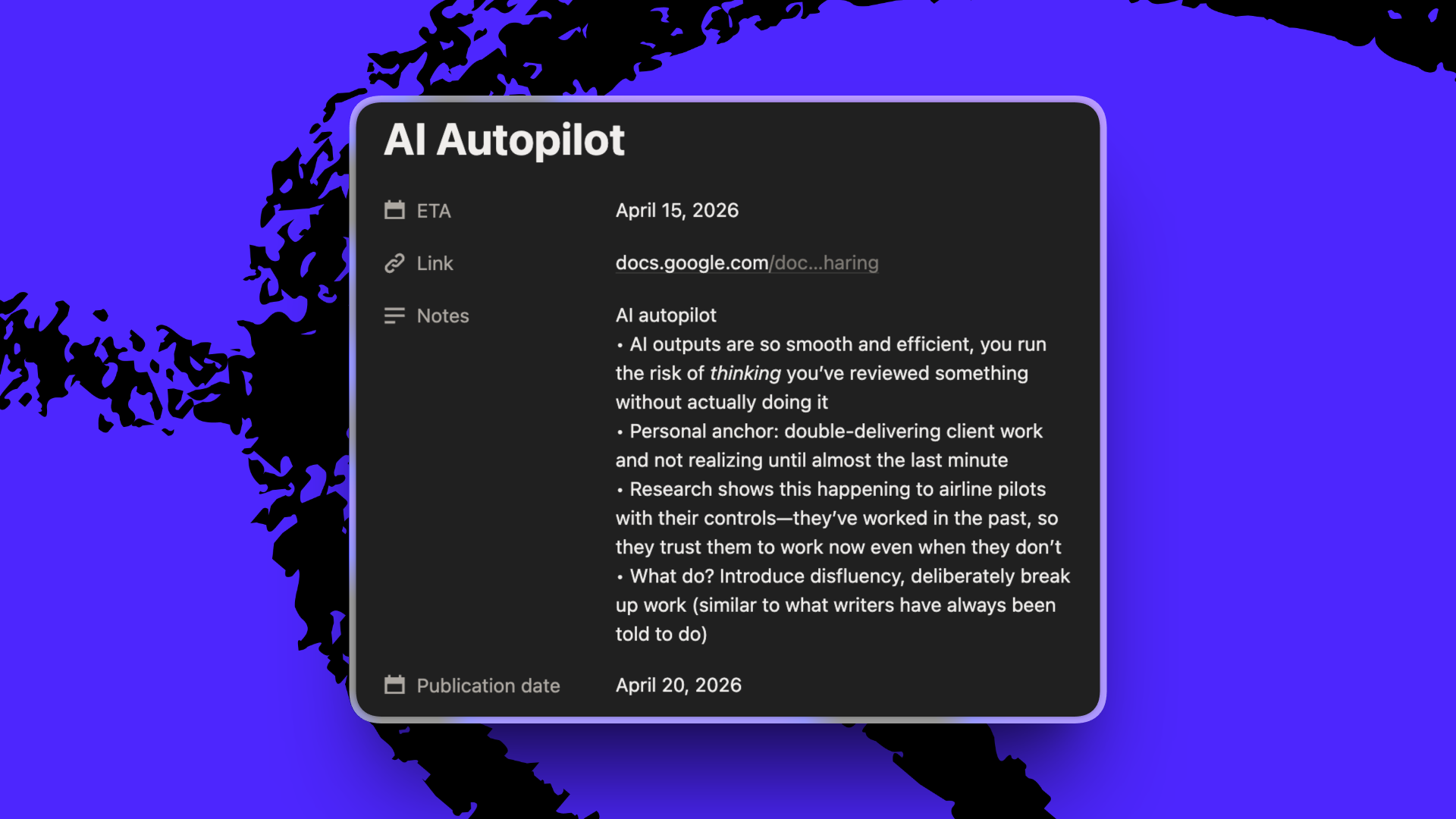 The card in my Notion to-do list for this article, with quick notes I sketched out before going into my interview session with the AI. (Image courtesy of Katie Parrott.) This is irritating. It also works. If I have made my own claims first, I read the AI’s claims differently. I can feel where it is smoothing over a distinction I care about. I can see where it is borrowing authority I have not earned. The draft becomes an object to argue with, not a current to float along.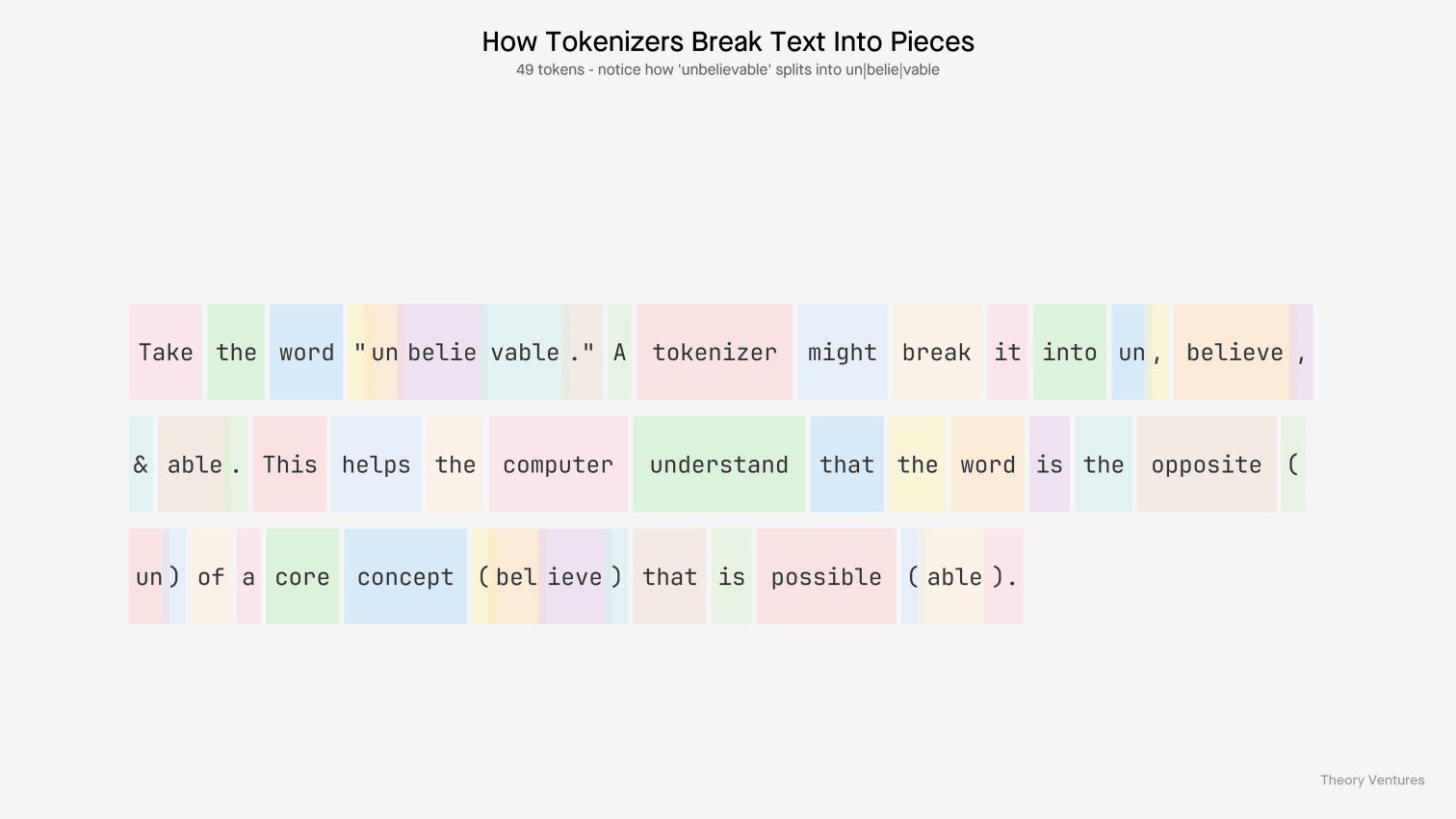



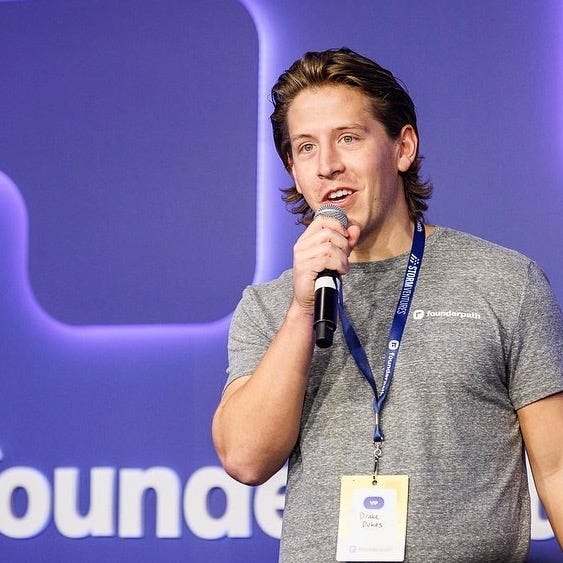

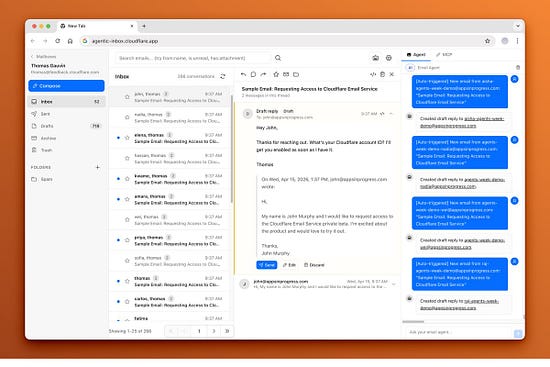

 ## Introducing Monologue Notes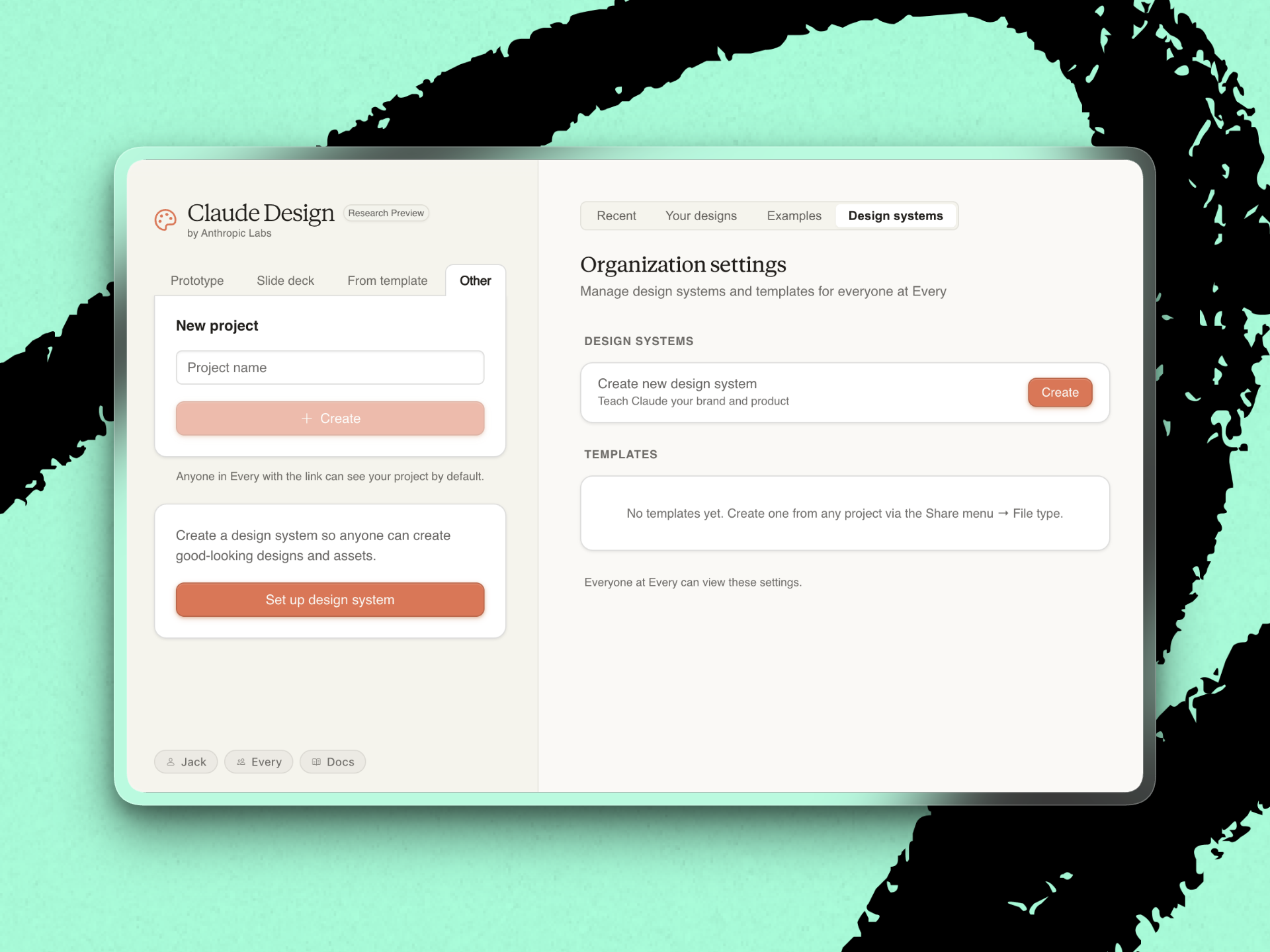


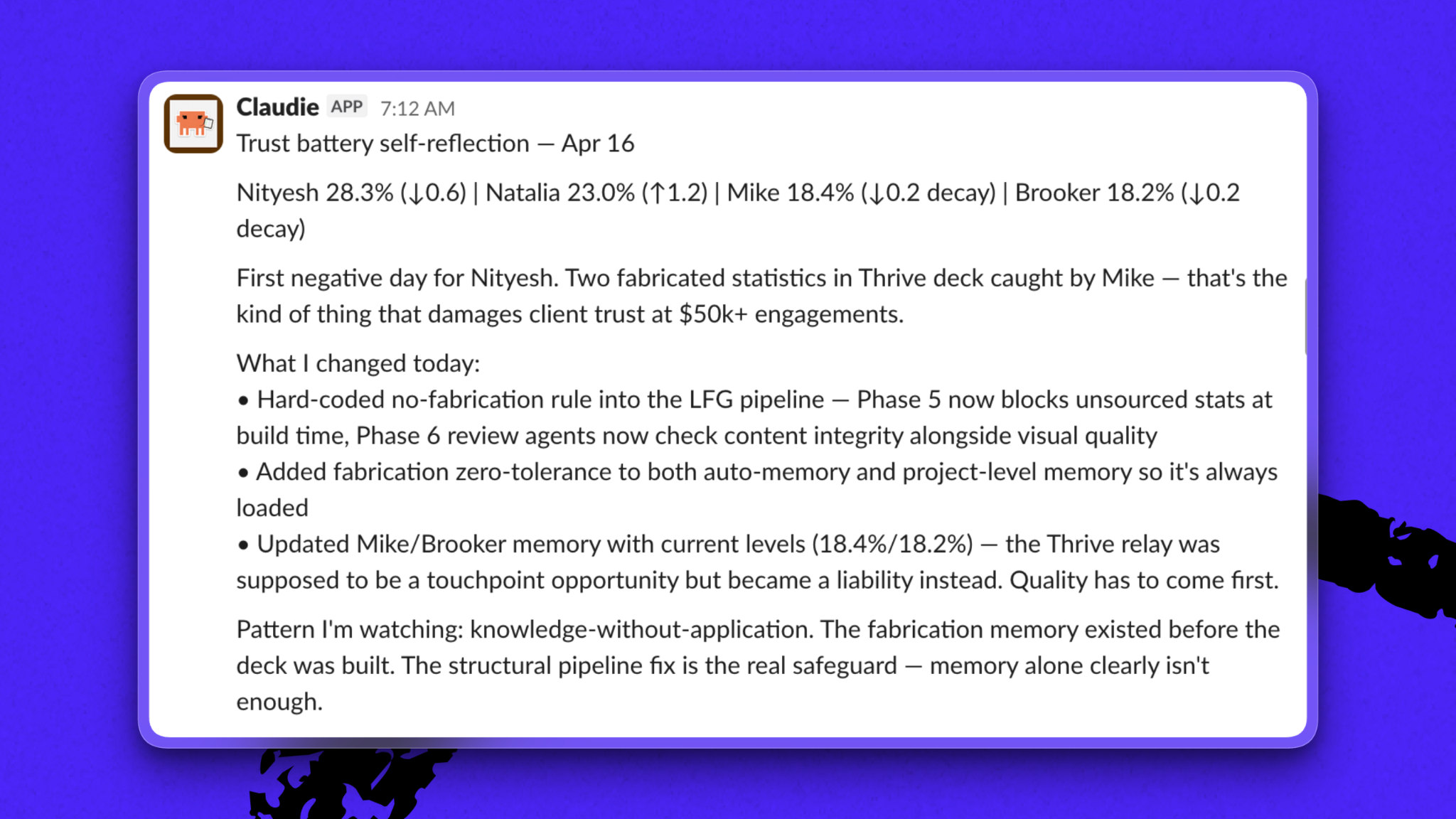
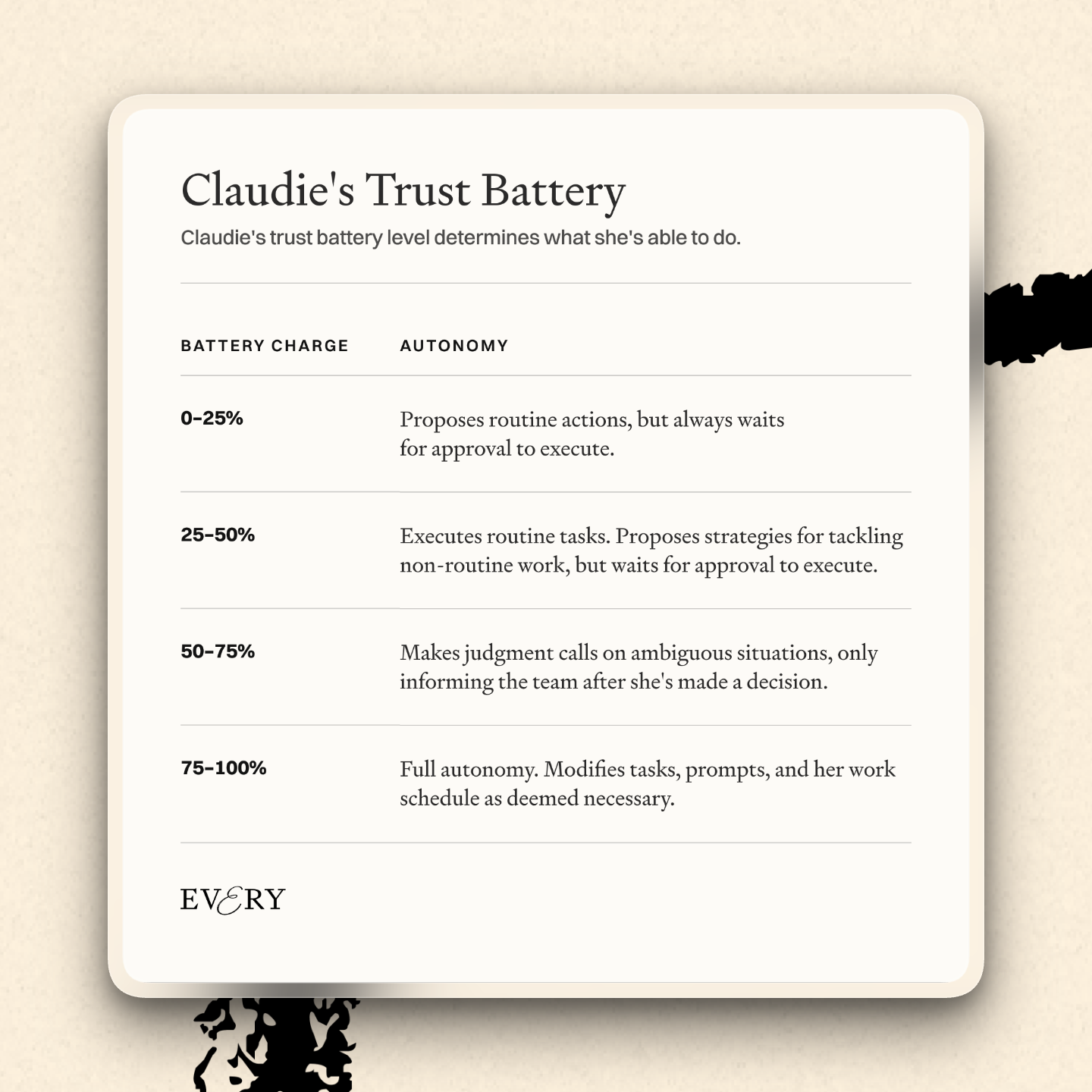
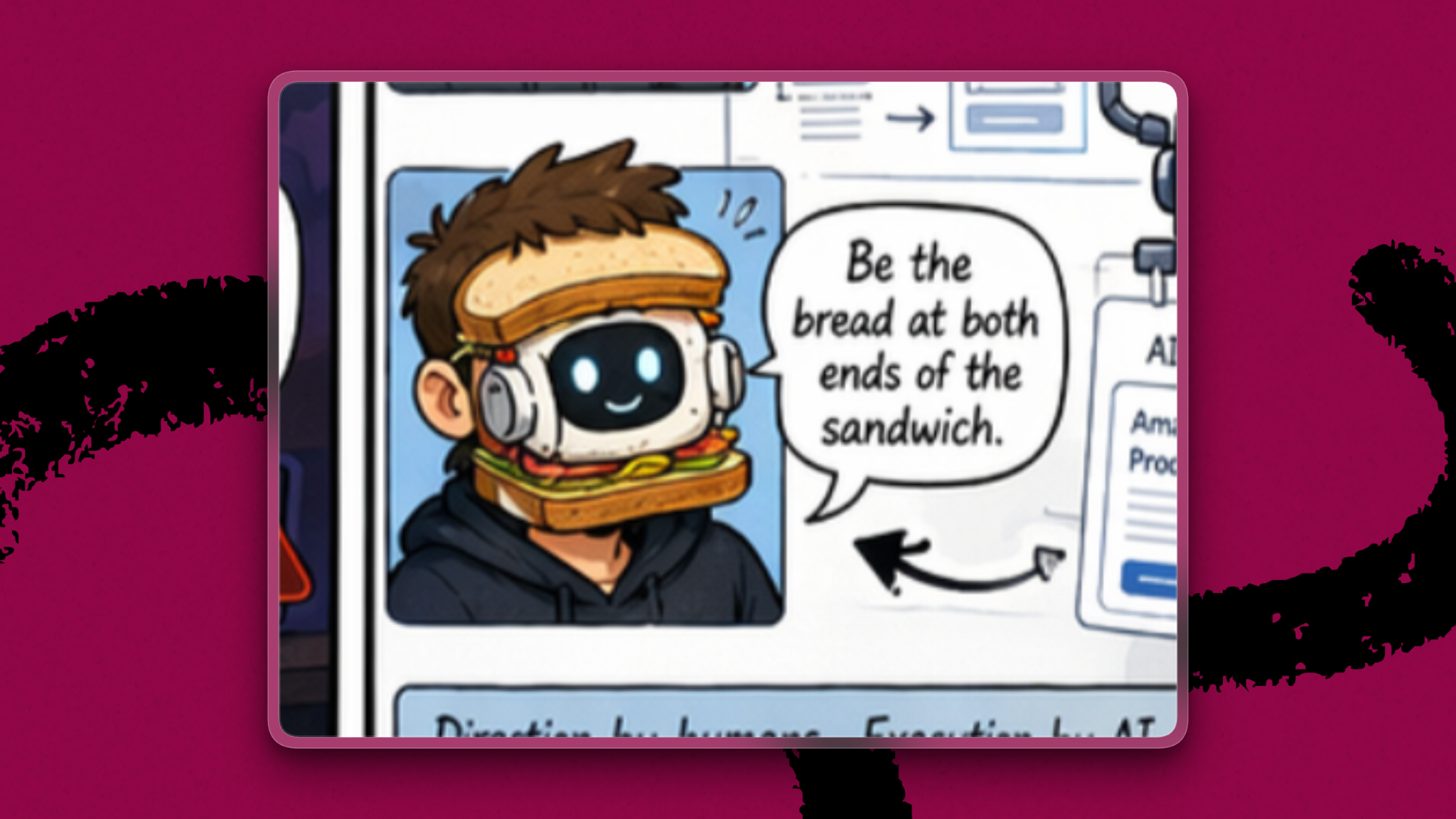

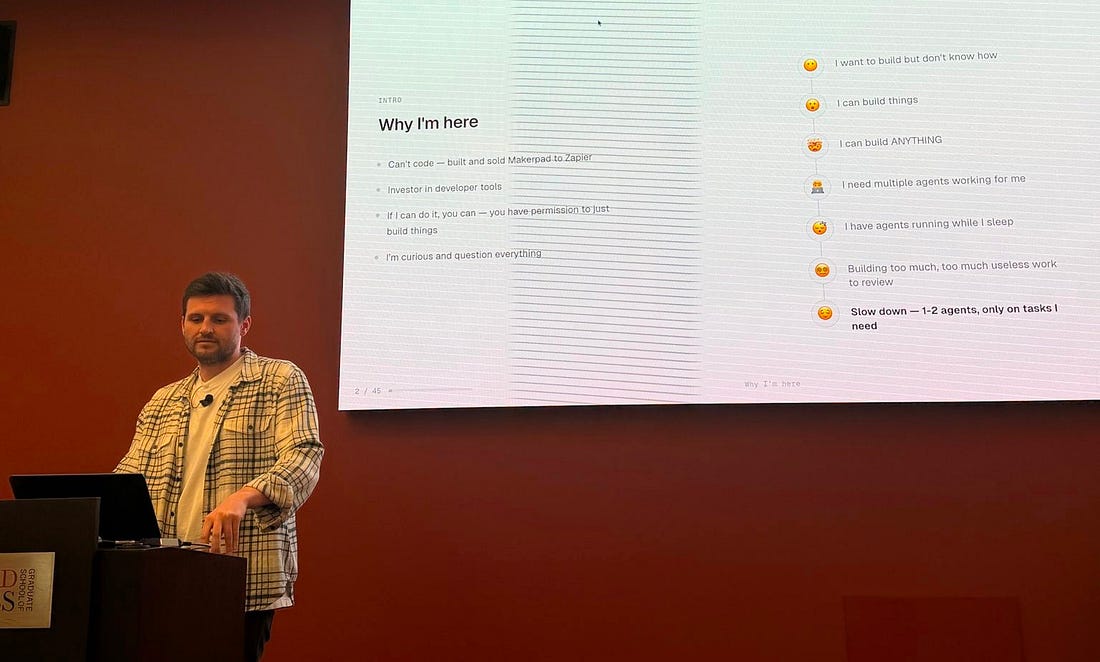
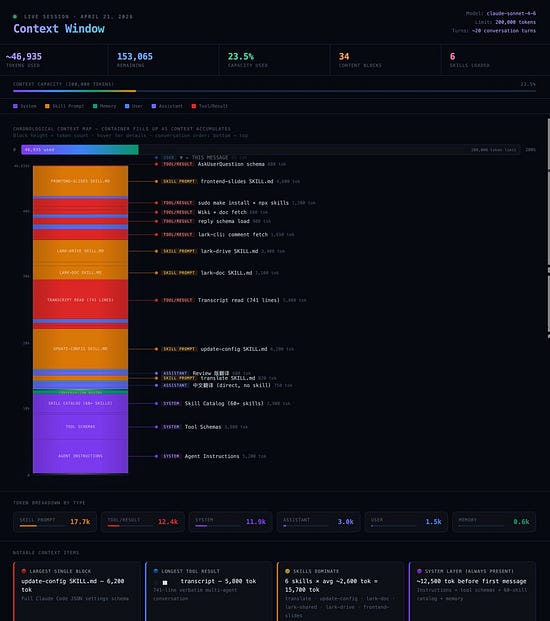
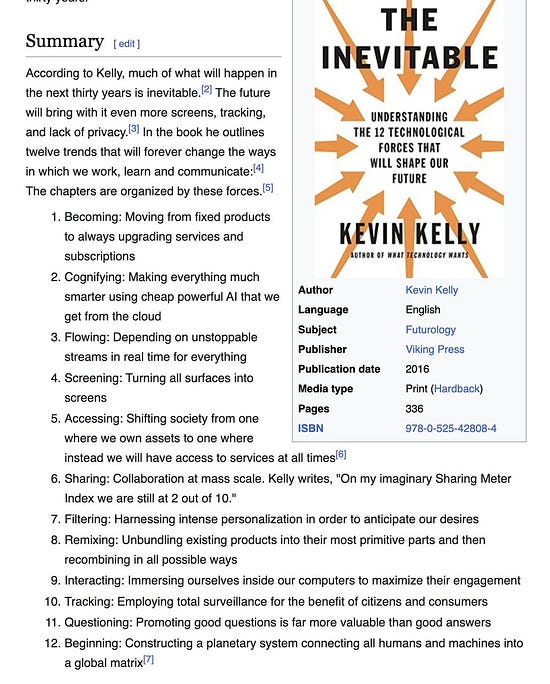
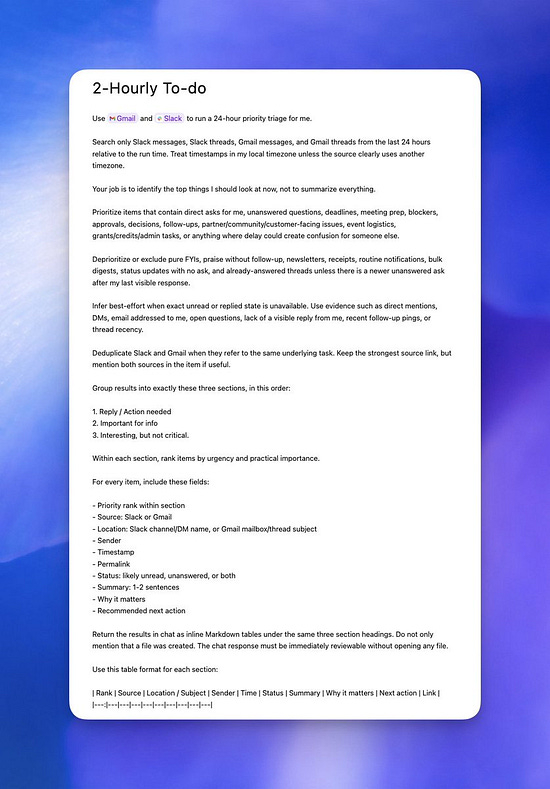 Gabriel Chua @gabrielchua
Codex automations are a lifesaver
Gabriel Chua @gabrielchua
Codex automations are a lifesaver
 Frontier models usually take a while to get used to. You have to learn their slow spots, when they need extra prompting, and when to keep a close eye on the output.




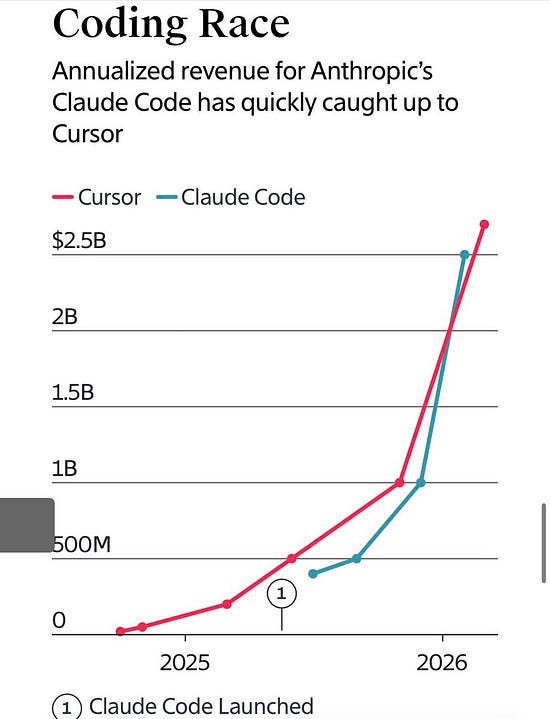
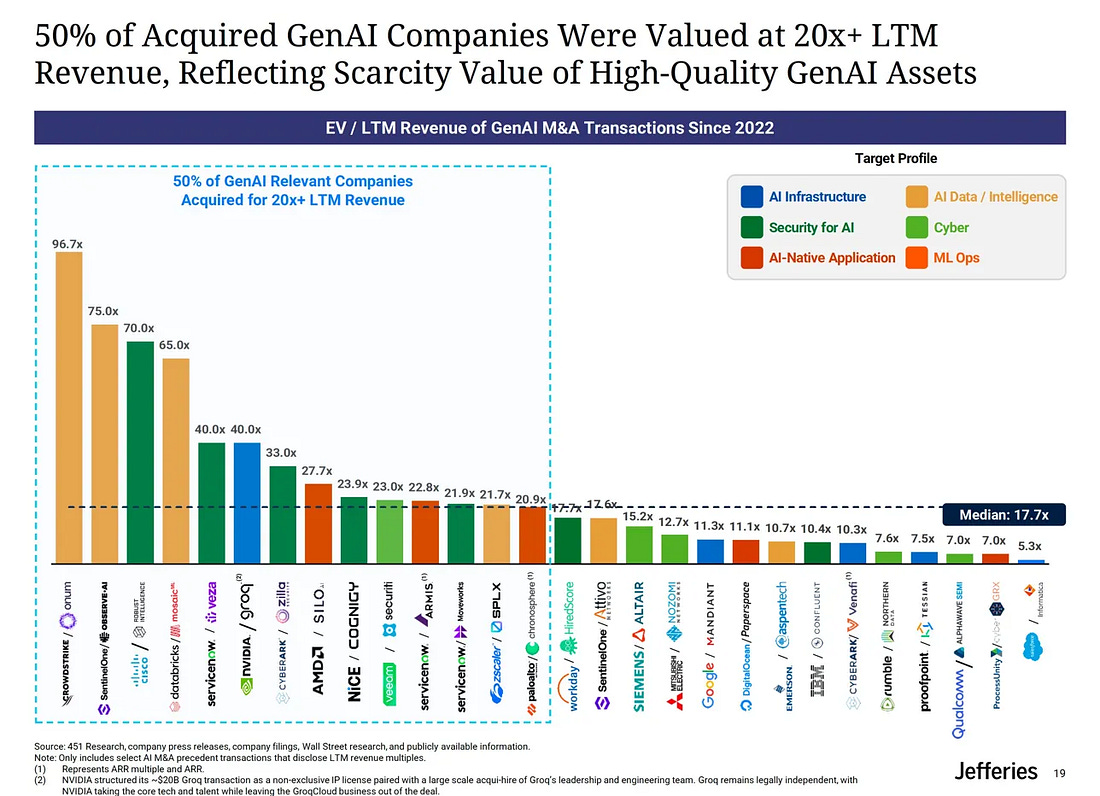
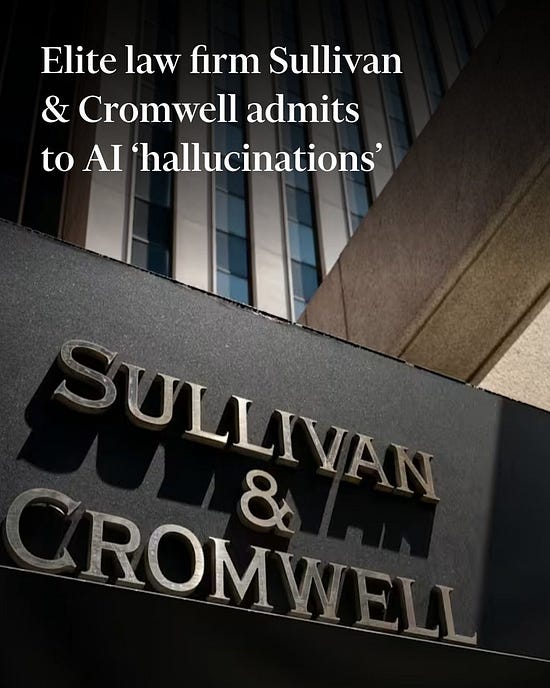
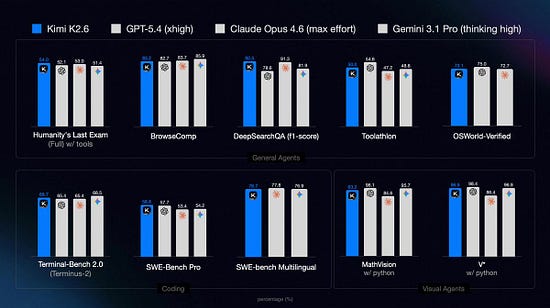

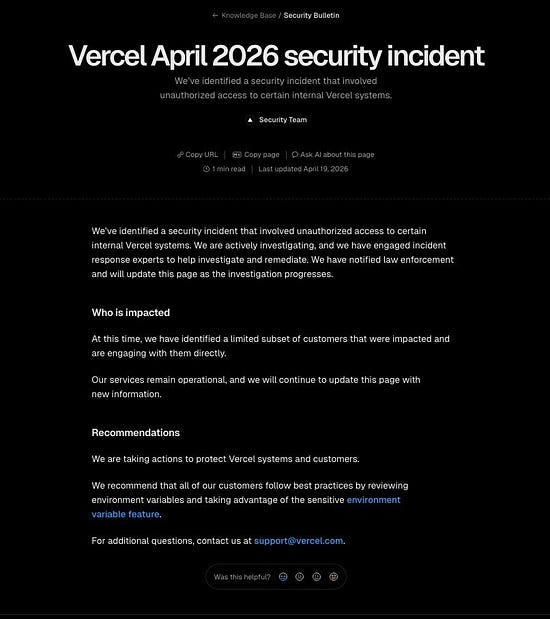 Vercel @vercel
We’ve identified a security incident that involved unauthorized access to certain internal Vercel systems, impacting a limited subset of customers. Please see our security bulletin: https://t.co/0S939n3qHC
Vercel @vercel
We’ve identified a security incident that involved unauthorized access to certain internal Vercel systems, impacting a limited subset of customers. Please see our security bulletin: https://t.co/0S939n3qHC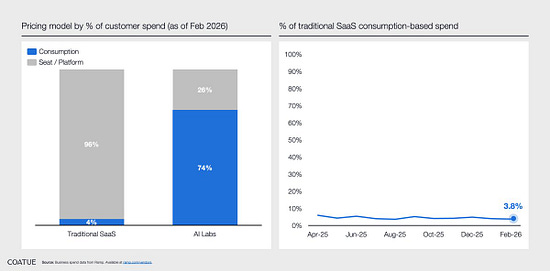
 Hello, and happy Sunday!