Your login link
Hey newsletter,
Click here to log in: magic login link
- Sam
Week 16, 2026 · April 13–19, 2026 · 28 newsletters · 188 links · ≈ 2 h 14 min
Hey newsletter,
Click here to log in: magic login link
by Kieran Klaassen  On Friday, April 17,Cora general managerKieran Klaassen will lead a camp for Every paid subscribers on compound engineering, the AI-native engineering philosophy that he built and that has more than 14,000 stars on GitHub. Since the last camp, Kieran and product leaderTrevin Chow have built out product-focused workflows to make the methodology as valuable for product managers and founders as it is for engineers. In this camp, they’ll walk you through what’s new, go deeper on the brainstorm and ideate steps, and share examples of using compound engineering beyond engineering work.Read the full compound engineering guide , install the plugin , and join us for the camp.—Kate Lee _
I spent three months trying to make agent swarms work. The idea of multiplying myself by coordinating multiple agents at the same time was a compelling pitch as the sole engineer building Every’s AI email assistant, Cora. If I could summon a fleet of AI agents , let them coordinate, and watch them produce work no single agent could match, it would relieve some of my overwhelm. I tried everything to make it work— Claude Code teams, agents dispatching tasks to other agents, orchestration setups where a lead agent managed a pool of workers. Many iterations, many burned tokens. But more agents didn’t make me faster. I’ve run parallel Claude Code sessions for months, which works when each agent has a clear task, and I’m directing the work. The swarm experiment was different: agents coordinating with each other, deciding what to work on, producing output I hadn’t shaped. When 10 of them finished simultaneously, I had 10 results to evaluate without enough context to know which ones I could trust. AI agents don’t have a speed limit, but the person managing them still does. I kept looking for a smarter orchestration layer—a better protocol or a tighter framework that would filter the output and tell me which result to trust. Then I stopped and looked at what was really doing the work. It was something I already had—a folder. A project folder with a CLAUDE.md/AGENT.md (the file that tells an AI how to work in your project), some skill definitions, and context accumulated through months of compound engineering_ —that’s an agent. The context that this folder gives an AI model makes the generalized model a specialist in whatever task or field you want it to excel in. I’m running 44 of these folders-as-agents across multiple projects now. Each one runs inside a specialized folder I’ve built and tested over months, and a dispatch layer I built on top does the routing between them. Here’s how it works.
On Friday, April 17,Cora general managerKieran Klaassen will lead a camp for Every paid subscribers on compound engineering, the AI-native engineering philosophy that he built and that has more than 14,000 stars on GitHub. Since the last camp, Kieran and product leaderTrevin Chow have built out product-focused workflows to make the methodology as valuable for product managers and founders as it is for engineers. In this camp, they’ll walk you through what’s new, go deeper on the brainstorm and ideate steps, and share examples of using compound engineering beyond engineering work.Read the full compound engineering guide , install the plugin , and join us for the camp.—Kate Lee _
I spent three months trying to make agent swarms work. The idea of multiplying myself by coordinating multiple agents at the same time was a compelling pitch as the sole engineer building Every’s AI email assistant, Cora. If I could summon a fleet of AI agents , let them coordinate, and watch them produce work no single agent could match, it would relieve some of my overwhelm. I tried everything to make it work— Claude Code teams, agents dispatching tasks to other agents, orchestration setups where a lead agent managed a pool of workers. Many iterations, many burned tokens. But more agents didn’t make me faster. I’ve run parallel Claude Code sessions for months, which works when each agent has a clear task, and I’m directing the work. The swarm experiment was different: agents coordinating with each other, deciding what to work on, producing output I hadn’t shaped. When 10 of them finished simultaneously, I had 10 results to evaluate without enough context to know which ones I could trust. AI agents don’t have a speed limit, but the person managing them still does. I kept looking for a smarter orchestration layer—a better protocol or a tighter framework that would filter the output and tell me which result to trust. Then I stopped and looked at what was really doing the work. It was something I already had—a folder. A project folder with a CLAUDE.md/AGENT.md (the file that tells an AI how to work in your project), some skill definitions, and context accumulated through months of compound engineering_ —that’s an agent. The context that this folder gives an AI model makes the generalized model a specialist in whatever task or field you want it to excel in. I’m running 44 of these folders-as-agents across multiple projects now. Each one runs inside a specialized folder I’ve built and tested over months, and a dispatch layer I built on top does the routing between them. Here’s how it works.
People hear “agent” and picture a Rube Goldberg machine —dozens of comically complex moving parts, each one triggering the next. But an agent is much simpler: a model with enough context so you don’t have to re-explain everything each time you open the chat. Here’s an example: All of Cora’s code lives in a project folder in the Every organization on GitHub. When I open that folder with Claude, Claude can see the code and the structure. But it doesn’t know my way of working or what I care about, which is why the folder also includes a CLAUDE.md file. The file tells Claude how I name things and how I structure tests. That’s an agent—not a fancy one, but an agent nonetheless. Just by pointing the model at this folder, which contains some of my personality, knowledge, and taste , the model can be a specialist in my codebase. Claude Skills—files that give the model specific capabilities—are an example of this “folder as agent” structure. Before anyone called them “skills,” people were already writing markdown files full of instructions and dropping them into project directories. My ~/cora/ folder goes further:
Tomasz Tunguz Venture Capitalist at Theory Ventures
For the first time since the 2000s, technology companies are confronting the limits of their supply chain. GPU rental prices for Nvidia’s Blackwell chips hit $4.08 per hour this week, up 48% from $2.75 just two months ago.1 CoreWeave raised prices 20% & extended minimum contracts from one year to three.1
“We’re making some very tough trades at the moment on things we’re not pursuing because we don’t have enough compute.” - Sarah Friar, OpenAI CFO1
This scarcity is already reshaping access. Anthropic has limited its newest model to roughly forty organizations.2 Access to the bleeding edge is becoming a gated privilege, for both capacity & security. 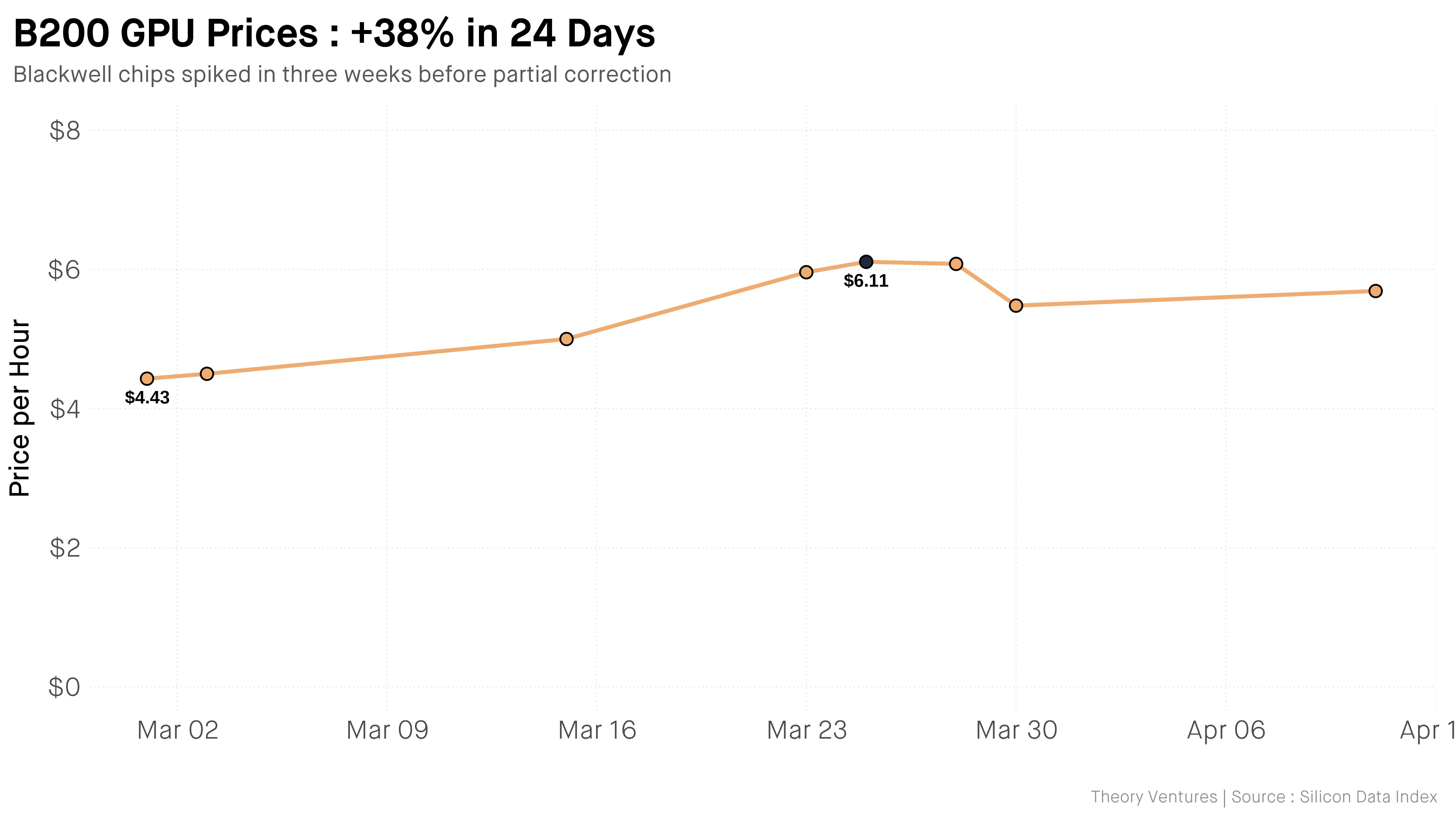
The age of abundant AI is over, & it will remain so for years.3 1. Wall Street Journal, “AI Is Using So Much Energy That Computing Firepower Is Running Out,” April 2026. ↩︎ ↩︎ ↩︎ 2. tomtunguz.com/mythos ↩︎ 3. tomtunguz.com/what-if-we-run-out-of-capacity ↩︎
🚀 We just launched a new newsletter — Company Launch Tracker.
We’re tracking company launches as they happen and surfacing the most interesting new founders and startups (yes, all outside of this stealth activity too). If you want to stay ahead of the curve, this is where you’ll find them first.
Right now we’ve got 5 subscribers: my wife, my mom, and that high school buddy who won’t stop pitching me his app. Be smart like them and get in early 👇
We run a live feed inside Gravity that tracks founders entering stealth and companies quietly exiting it.
What you’re reading here is about 1% of the stealth activity we pick up. The full tracker updates in real time as things change and new activity emerges.
If you want earlier access to everything, book some time with us to stay ahead.
In this issue of the Stealth Startup Spy, here is what we will uncover:
Ex-SpaceX Starship structures engineer and Meta Reality Labs designer enters stealth
Ex-VRChat, EA, and Zynga product leader builds AI-powered social gaming platform for kids
CEO of acquired healthcare AI startup Mendel.ai enters stealth for act two
Ex-Houseware CEO (acquired by LaunchDarkly) and product analytics leader enters stealth
Ex-Labster sales head and Columbia MBA builds AI-native GTM OS for EdTech and public sector
And more…
Now let’s shine the spotlight… 💡💡💡
Real-time updates from founders who debut what they’ve been working on under stealth mode
FounderDNA: Serial Founder, Masters Degree
Prior Experience: Ex-Managing Partner & Co-Founder at Promised Land Consultancy, ex-Head of Sales (NAMER & LatAm) at Labster, ex-Vice President of Sales & Partnerships at Mentor Collective, Columbia MBA
Connect on:LinkedIn
Pillar is an AI-native Go-To-Market Operating System purpose-built for EdTech and public sector revenue teams.
HQ: United States
Industry: Software Development | Team Size: 2
Time Spent in Stealth Mode: 4 months
FounderDNA: Technical Founder
Prior Experience: Ex-Software Engineer at Cloudera, ex-Product Designer at Motiv Technologies, ex-Software Engineer Intern at NVIDIA, ex-Design/SDE Intern at AbbVie, ex-Software Engineer Intern at PayPal
Jurny deploys AI agents that act like users, continuously testing your product to surface usability issues, bugs, and fixes.
HQ: United States
Industry: Software Development | Team Size: 2
Time Spent in Stealth Mode: 4 months
FounderDNA: Technical Founder, Former FAANG
Prior Experience: Ex-CTO at Sandsoft, ex-Head of Reality Labs Automation and Platform Engineering at Meta, ex-Technical Director for North Sea Studios at Electronic Arts (EA), ex-Software Development Engineer for PS4 and PSVR Architecture at PlayStation
Connect on:LinkedIn
Think is dedicated to making AI superintelligence affordable, sustainable, and accessible to everyone.
HQ: United Kingdom
Industry: Technology, Information and Internet | Team Size: 3
Time Spent in Stealth Mode: 7 months
FounderDNA: Serial Founder, Masters Degree
Prior Experience: Founder at Social Pixels, ex-Director of Product Management at VRChat, ex-VP Product & Growth at VersusGame, ex-VP Product & Analytics at Supernatural, ex-Senior Director of Product Management and Business Intelligence at Electronic Arts (EA), ex-Head of Product - Growth at Zynga
Connect on : LinkedIn
Playworlds is a social gaming platform where kids use AI to build limitless multiplayer worlds through conversation.
HQ: United States
Industry: Computer Games | Team Size: 2
Time Spent in Stealth Mode: 2 months
FounderDNA: Serial Founder, Masters Degree
Prior Experience: Founder at Readmore Ventures, Founder, CEO - OCAD U CO at OCAD University, ex-Engagement Leader - Strategy & Innovation (Doblin) at Monitor Deloitte
Connect on:LinkedIn
Veranda is the property-level demand intelligence layer for building materials companies.
HQ: Canada
Industry: PropTech
Time Spent in Stealth Mode: 8 months
Illuminating clues left behind by world class talent and influential innovators who just went into stealth mode
FounderDNA: Serial Founder, Prior Exit
Prior Experience: Co-Founder & CEO at Mendel.ai (acquired)
Connect on:LinkedIn
HQ: United States
Time Spent in Stealth Mode: 2 Months
FounderDNA: Serial Founder, Technical Founder
Prior Experience: Founding GTM Engineer at CombineHealth (YC W23), Co-Founder at Carboledger, Product Manager at Samsung Electronics
Connect on:LinkedIn
HQ: United States
Time Spent in Stealth Mode: 3 Months
FounderDNA: Serial Founder, Prior Exit
Prior Experience: Ex-Head of Product, Analytics at LaunchDarkly, Co-founder & CEO at Houseware (acquired by LaunchDarkly), Angel Investor, ex-Product at Atlan
Connect on:LinkedIn
HQ: United States
Time Spent in Stealth Mode: 4 Months
FounderDNA: Serial Founder, Technical Founder, Former FAANG
Prior Experience: Ex-Product Design Engineer - Reality Labs at Meta, ex-Senior Mechanical Design Engineer - Power Systems at Lightship, ex-Structures Engineer - Starship at SpaceX
Connect on:LinkedIn
HQ: United States
Time Spent in Stealth Mode: 2 Months
Building a Deep Tech Startup at the intersection of AI, physical security, and national security.
FounderDNA: Serial Founder
Prior Experience: Ex-VP of Sales & Partnerships at Visitt, ex-Chief Executive Officer at Aura Smart Air (Americas), ex-VP of Public Sector & B2G Sales at Molekule, Former Paratroopers Company Commander
Connect on:LinkedIn
HQ: New York, New York, United States
Time Spent in Stealth Mode: 1 Month
🚨Here’s the deal 🚨This email has gotten too big. Exciting, but with more people following it, the edge diminishes. I’ve thought long and hard about what to do to preserve the value in the signals. I’m not sure about the final direction yet, but in the meantime I’ve been sending an email 48 hours earlier to a select group of paid subscribers. The feedback has been pretty positive so I’m going to open up the list for another 100 spots. To get signals early, Apply here!
Stay Stealthy,
Drake
Thank you for reading. If you liked it, share it with your friends, colleagues and everyone interested in staying ahead of the hidden developments in tech. Subscribe below and follow us onX / Twitter to never miss a company operating under stealth again.
Stealth Startup Spy is a data-driven newsletter for investors, journalists and tech enthusiasts interested in uncovering the next big move for key talent, real-time stealth company launches and technology advancements not in plain sight. We leverage the technology built at Gravity to shine a light on the hidden world of stealth startups.
RSS feed for my blog www.philschmid.de
Monday 13 April 2026 12:00 AM UTC+00 8 Tips for Writing Agent Skills. Know What a Skill Is, Nail the Description, Write Instructions, Keep It Lean, Set the Right Level of Freedom, Don't Skip Negative Cases, Test It Before You Ship It, Know When to Retire a Skill.
Hey folks,
I’ll be heading to SF on Thursday — speaking at Stanford the week after. I’ll be delivering live the ‘how to use agents if you’re not technical’ course I’ve been working on (ahem, still working on).
I’ll be in town chatting to LPs (my 2 prev funds; 2.3x MOIC, 43% IRR (2023), and 4x MOIC, 28% IRR (2020)) and founders (I invest in AI dev tools and infra!) - let me know who I should try and meet or any cool things going on.
The latest leak from Claude-land shows Anthropic is adding lovable-like features for building full-stack apps right inside Claude. Codex apparently had a similar leak (since deleted).
There’s a new term going around for products that agents can use - headless SaaS. Box’s CEO says that “Enterprises will kick out vendors that don’t make it easy/economical for agents to use their product”. And you can’t just wrap your APIs into MCP/CLIs and call it a day.
Talks at AI Engineer were across the spectrum from “code is a liability” to “slow the fuck down”. Alex has a good recap.
Ben’s Bites is brought to you byCloudera
AI is booming, but ROI is lagging. The problem isn’t AI—it’s data readiness. Most enterprises aren’t as prepared as they think. See where things really stand in Cloudera’s Data Readiness Index.
Claude Cowork is now generally available - out of research preview after 12 weeks with millions of users. Also, Claude for Word is in beta - draft, edit, and revise documents from the Word sidebar with edits showing up as tracked changes. (Team and Enterprise plans)
New Claude Code features - /ultraplan lets you build and edit a plan on the web, then run it in your terminal. The Monitor tool lets Claude watch for events in the background instead of constantly checking - saves a lot of tokens. Plus, an advisor strategy on the Claude dev platform that pairs Opus with Sonnet for better performance at similar/cheaper costs.
OpenAI added a new $100 plan.Their own wording is too complex, so I’m stealing Theo’s. Basically, $100 plan = 5x compute, $200 = 10x compute (where $20 plan = 1x). The bigger plans have 2x boost till May 31st, so effectively, $100 = 10x and $200 = 20x compute.
LlamaParse was built to tackle your most complex PDFs with the highest accuracy & the lowest cost. Now we want to put that to the test. Submit your ugliest PDF (dense contracts, financial tables, etc.), and judge the output vs your current OCR to win a Mac Mini.Can your doc outsmart LlamaParse?*
Anyone can make a game now. Yoroll turns a rough idea into a branching, playable video-native game. Join waitlist to try.*
Cursor cloud agents can now attach screenshots and demos to PRs they open. Your team reviews the artifacts directly in GitHub.
Shopify AI Toolkit - manage your Shopify store with your favourite agent. Works with Claude Code, Codex, Cursor, VS Code, and more. (docs)
Open Agents by Vercel - open-source template for building coding agents.
How Missions work - from the Factory team.
The anatomy of an agent harness and a tutorial/walkthrough to build your own harness.
Personal wiki tools inspired by Karpathy’s knowledge base idea - LLMwiki, Wiki OS, Hatch, and GBrain.
Evo, another Karpathy-inspired CC plugin, optimises your code through experiments.
Ramp says their entire company is AI-pilled. They even built a new internal product called Glass to give every employee an AI coworker.
getdesign.md - browse design systems of popular applications as markdown files. Preview instantly, install with one command.
Aqua Voice - premium voice keyboard for every app on your phone. Now on iOS.
Gitinspect - replace “hub” with “inspect” on any GitHub URL to chat with the repo. Runs in the browser, everything stays local.
Cloudflare Sandboxes are generally available - comes with a terminal, interpreter, live preview URLs & secure credentials. Sleeps when idle and wakes on demand.
Greg Brockman @gdb The world is transitioning to a compute-powered economy. The field of software engineering is currently undergoing a renaissance, with AI having dramatically sped up software engineering even over just the past six months. AI is now on track to bring this same transformation to
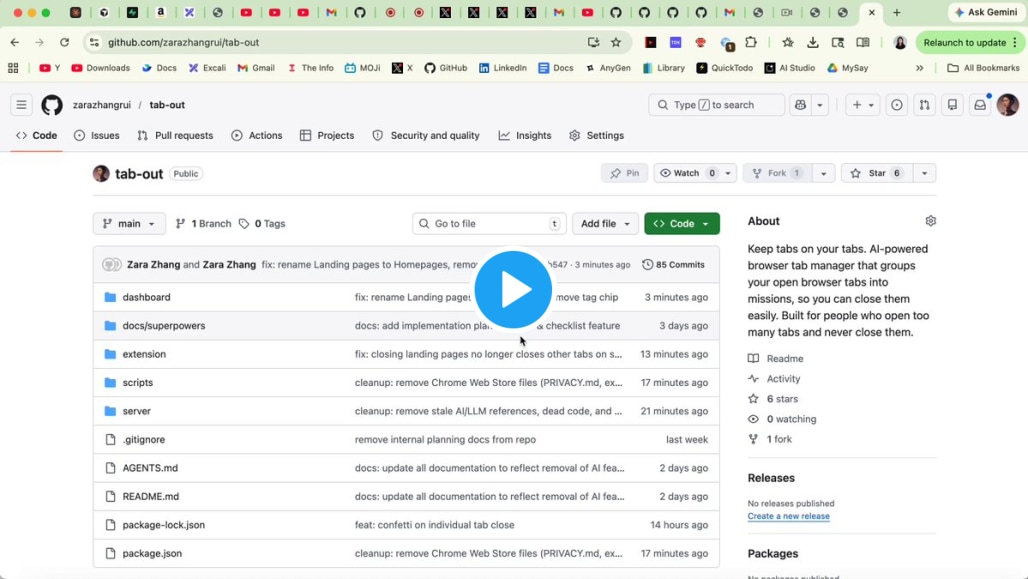
Zara Zhang @zarazhangrui PSA: You can vibe code your own "New tab" page in Chrome. I have turned mine into the ultimate solution to the "too many tabs" problem - See all your tabs with clear titles, grouped by domain - Closing any tab gives you "swoosh" sound and confetti effect 🎊 - "Easy wins" grouped
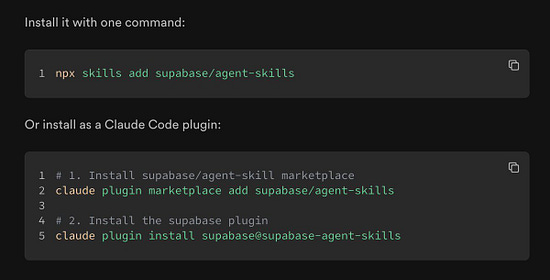
Paul Copplestone - e/postgres @kiwicopple we just released the official Agent Skills for @supabase it's a set of instructions that teach agents how to build with Supabase correctly, including: ◆ Security and RLS ◆ Docs and product knowledge ◆ Schema management ◆ CLI + MCP instructions
Henry Shevlin @dioscuri Big personal news: I’ve been recruited by Google DeepMind for a new Philosopher position (actual title), focusing on machine consciousness, human-AI relationships, and AGI readiness, starting in May. I’ll continue my research & teaching at Cambridge part-time. Absolutely stoked!
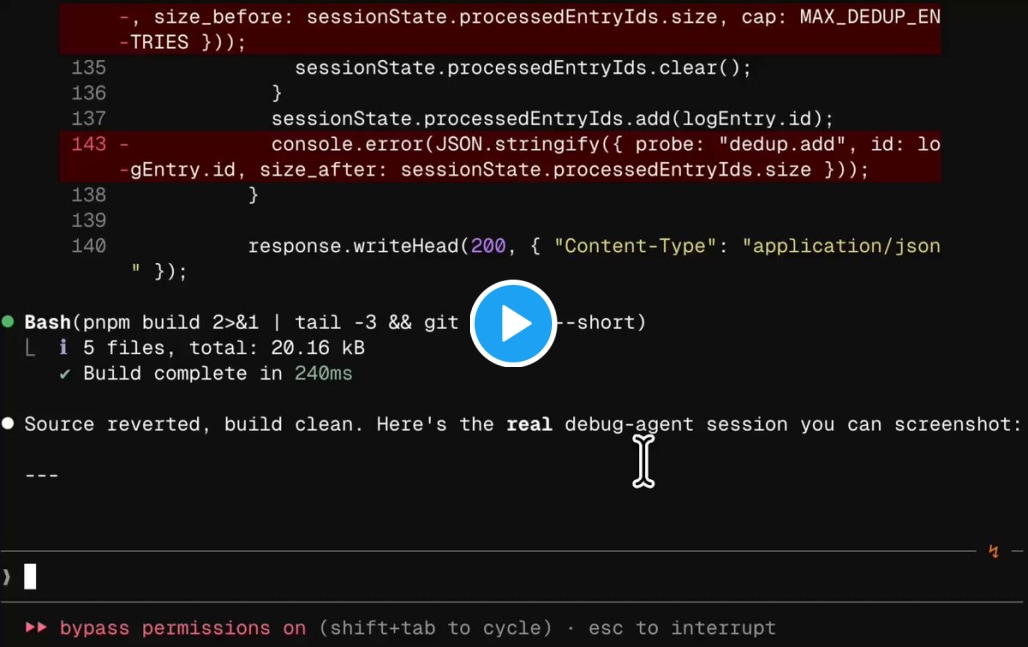
Aiden Bai @aidenybai Cursor's debug mode is great. But I wish i had it in Claude Code / Codex. Introducing debug agent skill: - /debug-agent [your bug] - writes logs and actually repros the bug - fixes the root cause
Mario Zechner @badlogicgames as more and more people start using pi, i now get this question often: "what are essential extensions i should install?" none. zero. start vanilla. only build/install something if you feel a recuring pain that you can't get rid of by reevaluating your workflow learned with
Read about me and Ben’s Bites
📷 thumbnail sourced from Twitter
* sponsors who make this newsletter possible :)
Email us atshanice@bensbites.com or k@bensbites.com

There’s nothing like spring in London. Which is why … I’m hitting the road. My co-host Ed Elson and I are taking the Prof G Markets pod on tour for a series of live tapings. Join us in San Francisco, Los Angeles, Miami, Chicago, and New York City. Expect special guests, unfiltered conversation, and the jokes that don’t make it on-air.
My last tour sold out in one day (#flex). Don’t want to miss out? Prof G+ paid subscribers get 48 hours of presale access starting at 11 a.m. ET today. If you’re looking for guaranteed availability, this is your sign to become a Prof G+ paid subscriber. Move fast – tickets hit the general public starting Thursday.
Important: The link below goes live on Thursday, April 16 for free subscribers. Become a Prof G+ paid subscriber today for your presale access code.
Prof G+ on Substack is where we tackle the topics that are too nuanced for social media and too meaty for pods. A few weeks back, we introduced Prof G+ Deep Dives to make you smarter on the most important forces moving markets, politics, and society, including the economics of falling birth rates, how billionaires buy political influence, and the great social media reckoning.
This week, I’m going deep on how storytelling became the most valuable skill in today’s economy. The post drops on Friday – in the meantime, check out the Prof G+ exclusive replay of The Science of Storytelling from my Head of Research, Mia Silverio.
Deep Dives: one more reason to sign up for Prof G+. Consider us your moat.
Prof G+ members get our pods ad-free (because ads tax your most valuable asset: time).
Looking for ad-free audio? All our pods are now available to Prof G+ subscribers via private RSS feeds for ad-free listening on your preferred podcast app. Set up your feed below.
I’ll see you on the Prof G Markets tour.
Life is so rich,
Scott
by Yash Poojary  Gemini and Photoshop/Figma/Every illustration. TL;DR: We’ve rebuiltSparkle , our Mac file organization app, as an agent-native tool that cleans and organizes your Mac. It’s our biggest update since we first launched it in 2024. The key change is that the new Sparkle cleans your Mac before it organizes it—purging screenshots, installer packages, and other digital junk first, then building a file structure around what’s worth keeping. It’s available now to all paid Every subscribers. Download the new Sparkle
A cluttered file system can feel like a cluttered brain. When your computer is a mess, it takes mental energy to find what you need, much less do actual work. Clutter is universal—and most of it isn’t worth keeping. Around 80 percent of files on the average Mac are screenshots, installer packages, duplicates, and digital debris you’ll never open again. So before you can get organized, you need to purge. “Organized,” then, depends on the person. Maybe you want to arrange files by topic or date, or by a highly-specific system that only makes sense to you. All count as organized if you can find what you want when you want it. We’ve rebuilt Sparkle , our file organization app, with this personalization in mind. Download the new Sparkle
Gemini and Photoshop/Figma/Every illustration. TL;DR: We’ve rebuiltSparkle , our Mac file organization app, as an agent-native tool that cleans and organizes your Mac. It’s our biggest update since we first launched it in 2024. The key change is that the new Sparkle cleans your Mac before it organizes it—purging screenshots, installer packages, and other digital junk first, then building a file structure around what’s worth keeping. It’s available now to all paid Every subscribers. Download the new Sparkle
A cluttered file system can feel like a cluttered brain. When your computer is a mess, it takes mental energy to find what you need, much less do actual work. Clutter is universal—and most of it isn’t worth keeping. Around 80 percent of files on the average Mac are screenshots, installer packages, duplicates, and digital debris you’ll never open again. So before you can get organized, you need to purge. “Organized,” then, depends on the person. Maybe you want to arrange files by topic or date, or by a highly-specific system that only makes sense to you. All count as organized if you can find what you want when you want it. We’ve rebuilt Sparkle , our file organization app, with this personalization in mind. Download the new Sparkle
I’ve been the general manager of Sparkle for a little over a year. In that time, I’ve tried a lot of approaches to AI file organization that didn’t quite work. People wanted AI to handle the organizational heavy lifting, and they wanted to be able to change the file structure until it met their exact, often idiosyncratic specifications. The old Sparkle managed clutter by creating a rigid file system for you. The new Sparkle creates one with you. It analyzes your files and generates a custom system—but only as the starting point. From there, you can make as many changes as you want by chatting with Sparkle’s built-in agent, until the hierarchy feels right.
Before organizing what matters, Sparkle helps you get rid of what doesn’t. The median Sparkle user has around 5,000 files on their Mac. A large portion of those—screenshots, installer DMGs, system cache, duplicates—is digital junk. So we’ve added a cleanup pass that runs before organization begins. From the chat window built into the new app, you can ask Sparkle what’s in your trash, or tell it what you want gone (“Clear my screenshots folder” or “remove anything over 1 GB I haven’t touched in a year”). Sparkle will confirm you really want those files gone—and then move them to Trash, which gives you one last opportunity to rescue files before you delete everything. 
Once cleanup is done, the next stage of work can begin. Sparkle uses a sample of your most recent files to propose a folder structure. You see exactly what it’s suggesting—top-level folders, subfolder labels, and what goes where. From there, you can rename, merge, delete, reorganize, and add folders, all through chat. If Sparkle creates a “Projects” folder but you’d prefer a “Work” folder—with “Client Projects” and “Internal Projects” nested inside—you can tell the agent and it will make the update. 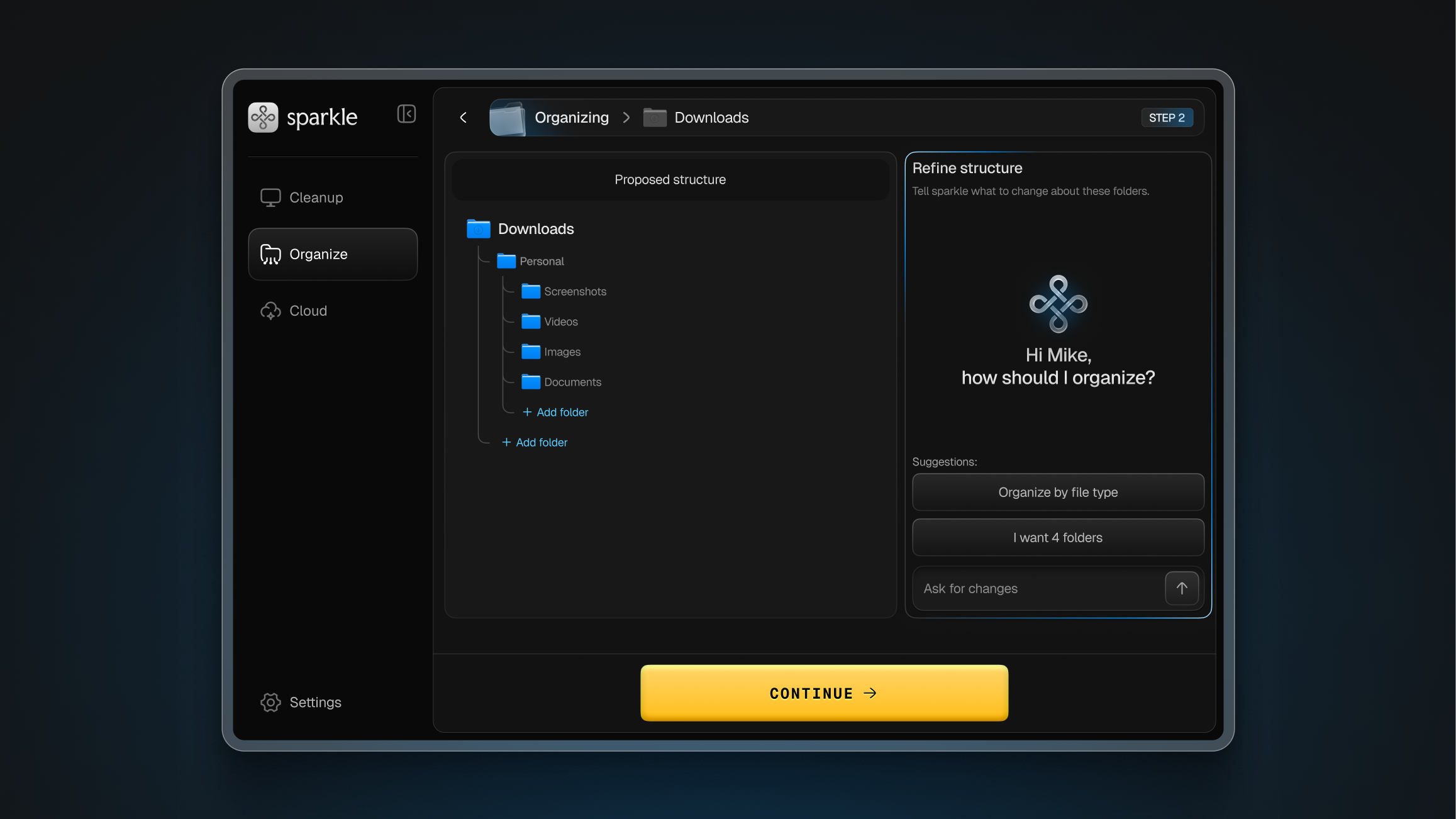
Sparkle’s agent-native architecture became practical about four months ago, when the Claude Code SDK became available. Before that, you could approximate the ability to have an agent move and delete files through a chat window, but building it safely was much harder. We’ve also found a way to create sophisticated file systems while balancing speed and cost. Sparkle starts by analyzing a sub-section of your recent files with Opus 4.6 , a very smart (and expensive) model. After you sign off on the folder structure, classifying new files into the folders you’ve defined doesn’t require heavy AI lifting: A file called “Q1 invoice.pdf” goes into “Finance,” a contract goes into “Legal,” an audio file goes into “Transcripts.” Haiku 4.5 , a faster, cheaper model, can handle this just fine. This way, you get a smarter model where it counts, without having to pay for unnecessary usage.
AI produces better outputs when paired with human judgment. That’s as true for file organization as it is for writing and code. The new-and-improved Sparkle is available to all paid Every subscribers. Try the new Sparkle Thanks toLaura Entis for editorial support. Yash Poojary is the general manager of Sparkle. To read more essays like this, subscribe to Every , and follow us on X at @every and on LinkedIn.
This post is a roundup of my recent efforts that did not warrant a standalone Interconnects post, why I’m spending time on them, and what they accomplished.
https://arxiv.org/abs/2604.07190
To accompany The ATOM Project memo, arguably a manifesto, making the case for investment in open models in the U.S. – originally launched in August 2025 – we’ve released an updated technical report with our latest data, analysis, and storytelling within the open language model ecosystem. The ATOM Report is dense with the methods Florian and I use to keep track of the open ecosystem. It covers GPT-OSS’s rise, inference market share, the influence of China’s mid-tier players like Moonshot, Z.ai, & MiniMax, signs of the U.S.’s progress on open models, and much more.
In particular, the paper details our updates to the Relative Adoption Metric (RAM), which we use to evaluate the adoption of recent models in a time-varying and size-normalized manner. Here’s a sampling of recent, primarily Chinese, models on the RAM score. The RAM score is designed so that a score >1 indicates a model is, at that point in time, on track to be a top 10 most downloaded model of its size category, ever. It reduces a messy landscape to one, easily interpretable number!
We used the data to also analyze the recent Gemma 4 release, which is showing incredible early adoption numbers. We’ll stay tuned on it!
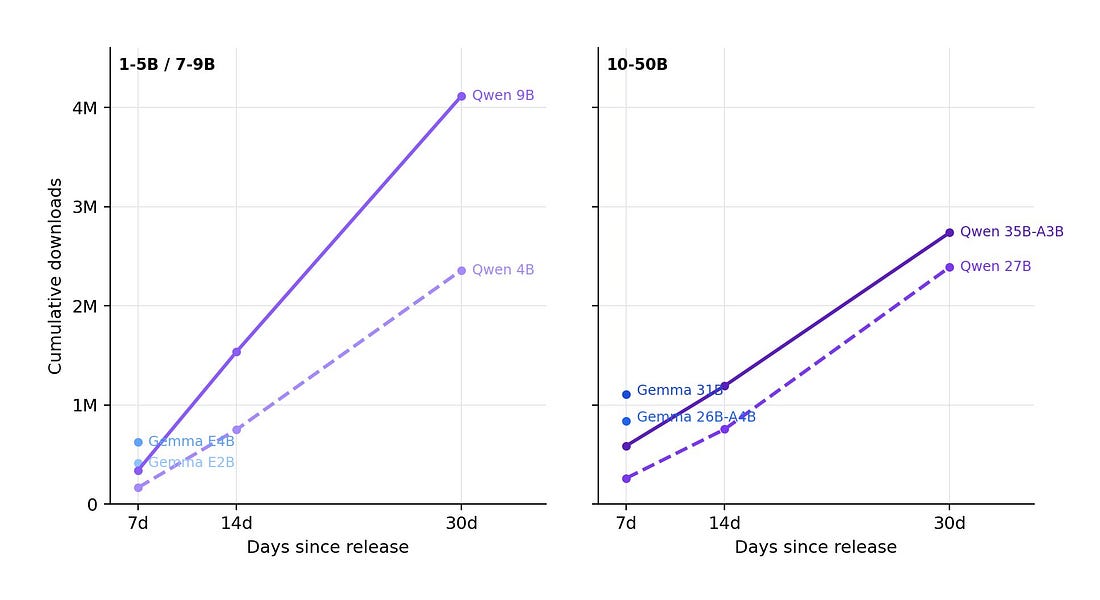
Subscribe to the (infrequent) ATOM Project Substack for more updates like this!
The goal of this book was to write the book I wished I had when I was getting started in post-training language models. This project has been on my mind for a long time. I bought the domain rlhfbook.com and started to take it more seriously on May 20th, 2024. Here we are!
Last week, it was sent to production with the Manning team. This means content edits are done, and it’ll be sent to print in ~2 months. In the meantime, I’m spending my time developing the accompanying code and course (more on that below).
You can preorder on Amazon or Manning (currently cheaper).
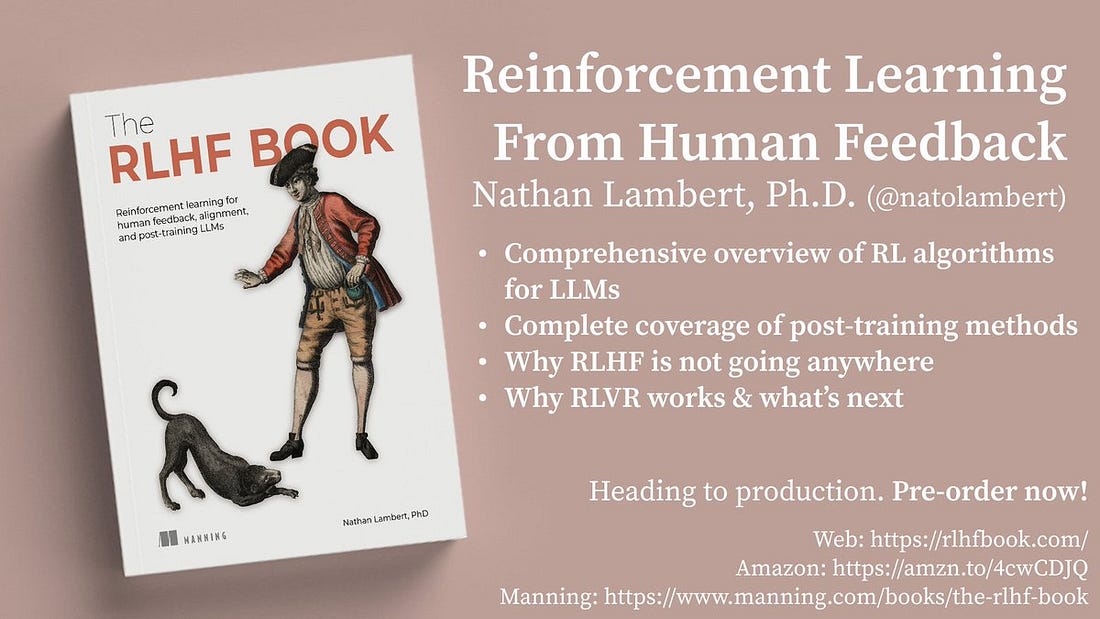
The goal of my book is for it to be the central resource for people looking to transition from beginner to expert in post-training. It’s not necessarily an entry-level book, but as AI models become stronger, it needs to be a community -building effort as well. The first step I’ve made to expand the scope from just a book to a complete learning experience is building a lecture series. The lectures will be freely available on YouTube and incorporate community questions & answers (as standalone videos in between lectures).
You can watch the first batch of videos below, and subscribe on YouTube for future ones. I’m going to build on the book platform more this summer, as I develop the book codebases and host in-person events.
RLHF and Post-training Overview | RLHF Book Course, Lecture 1
RLHF Foundations, IFT, Reward Modeling, Rejection Sampling | RLHF Course Lecture 2
Understanding Policy Gradient Algorithms for RL on LLMs | RLHF Course Lecture 3
Long-time followers of Interconnects know that this blog has its roots in explaining fundamental research in the field. This has immense value in two ways. First, as AI moves incredibly fast, far more people need to be able to parse research to make the right bets on the technology. Research is the only early warning of some big changes coming. Second, it helps uplift the careers of my collaborators – the people I spend my life with! On that note, check out two papers I had the privilege of being part of below.
https://arxiv.org/abs/2603.16759 -TurnWise: The Gap between Single- and Multi-turn Language Model Capabilities ,Graf et al. 2026
This work explores the strengths of various models in multi-turn dialogue settings, how to create training data to improve it, and other quirks in post-training. My interests here have fully shifted to agents, where I see multi-turn interactions as a very important user interface problem — what information do I show to the user to solve the task as soon as possible without cutting corners?
https://arxiv.org/abs/2603.11327 - Meta-Reinforcement Learning with Self-Reflection for Agentic Search , Xiao et al. 2026
This paper frames solving hard problems with RLVR as a meta-learning problem, where context from previous attempts should be used to inform future rollouts. It’s a very obvious idea in some ways, where most of RL for LLMs is still very on-policy, but naive. The models learn from recent trials in parameters, but not in context. This research feeds into a ton of other recent work on ways that RL can be formulated to solve different forms of continual learning. Another great related paper is Learning to Discover at Test Time.
I’m off to China (and then hopefully DC) in the next couple of months to learn even more about how the world sees progress in AI. I’m excited to talk to a broader range of people than I tend to in my focused technical job. Thanks for reading, as always!
by Laura Entis  ## ‘AI & I’: The case against LLMs
Today, we’re releasing a new episode of our podcast AI& I. Dan Shipper sits down with Eve Bodnia , founder and CEO of Logical Intelligence, which is developing an alternative AI model to LLMs. They discussed a question most people in AI are afraid to ask: What if LLMs aren’t going to be the most powerful form of AI? Bodnia argues that LLMs have intrinsic weaknesses, notably non-language tasks such as spatial reasoning, logical verification, and real-time data analysis. Her solution: energy-based models (EBMs), which map possible outcomes onto a mathematical landscape. Likely outcomes sit in valleys, and unlikely ones sit on peaks. Whereas LLMs process one token at a time, an EBM scans the full terrain to find the lowest point, or the most probable answer. Bodnia argues that it’s this approach, not bigger LLMs, that will lead to the next AI phase shift. Watch on X or YouTube, or listen on Spotify or Apple Podcasts. You can also read the transcript. Here’s how LLMs and EBMs are different, according to Bodnia:
Miss an episode? Catch up on Dan’s recent conversations with LinkedIn cofounderReid Hoffman ; the team that built Claude Code, Cat Wu andBoris Cherny ; Vercel cofounderGuillermo Rauch ; podcasterDwarkesh Patel ; and others, and learn how they use AI to think, create, and relate.
Or that feeling when the problem you’ve spent a lot of time solving gets solved for you We’re all about agents at Every. Which means many of us have devoted a lot of time to building the infrastructure that makes them run. That work matters a lot less now since Anthropic launched Claude Managed Agents earlier this month in public beta, a hosted service that handles sessions, memory, tool use, and credentials. You say how you want your agent to operate, and Claude makes it happen. It’s a true “oh shit” moment, says Dan, one that frees up considerable energy to focus on other problems—good!—and commoditizes a skillset you may have spent months developing—destabilizing, maybe! For those at the edge of AI, the experience of building something only for it to become a free offering from a frontier company is becoming increasingly common. Spiralgeneral manager Marcus Moretti used the service to spin up a new Spiral agent. Agents already power the Spiral web experience, but there was an opportunity to build a new one designed specifically for interacting with other agents calling Spiral’s API. (Agents don’t require the same conversational niceties as humans.) With managed agents, the process took a few hours. To be fair, building the agent in code wouldn’t have taken much longer, Marcus says—he already had a working agent he could have extended with the help of Claude Code. But it would still require maintaining much of the agent infrastructure in our code, which would have lots of surface area for bugs. Managed Agents makes building slightly faster, but “the more significant advantage is that Anthropic is handling the technical implementation of agent primitives,” Marcus says. “I know it works versus having to test that whole set of things myself.” An unanticipated benefit: It’s easier to improve existing agents. To update the system prompt or underlying model, ”I just make a change in the dashboard, hit save, and it’s live,” Marcus says.
Every’s head of platform argues we need new vocabulary for the AI-pilled If you have ever contemplated how to describe the “amniotic tranquility of being indoors during a thunderstorm,” The Dictionary of Obscure Sorrows has a proposal: “Chrysalism,” derived from the Latin for a butterfly’s pupa, a chrysalis. The dictionary is a beautiful, wandering tome billing itself as a “compendium of new words for emotions.” It’s also one of my favorite books. I have been thinking about it lately because I keep reaching for the wrong words—words built for a different conversation. Thanks to AI, technical language that once hid behind the abstraction of machines is entering general circulation…and causing general confusion. I use the term “non-deterministic” in conversation regularly to describe how, given the same input, AI systems won’t always give you the same output. People who haven’t lived their lives as computer scientists furrow their brow at the term—it has zero resonance for them. Even the lexicon of the digital age to date falls short in capturing some of the peculiar emotions and experiences of this new era. What do we call the unsettling feeling of receiving a wrong answer from a trusted system, the lurch of losing the thread mid-thought, or the heady fever of late-night building? So instead of forcing old terms into new molds, maybe we need new words: Variagic (adj.)—Describing the unease of asking the same question twice and getting two different answers, both equally confident. A variagic conversation is one where you run the same prompt and get two different answers, forcing you to realize that the other side is not inconsistent but simply contains more possibilities than any single encounter can surface. From Latin varius , changing or diverse, and Greek agos , that which leads. What the engineers call non-deterministic. Memorantia (n.)—The tendency to prepare so much from past experience that you become useless in any new one. The condition that plagues a student who memorizes every answer from last year’s exam, only to freeze at an unfamiliar question. From Latin memorare , to remember, and rantia , a suffix suggesting excess. This is what the engineers call overfitting, when algorithms fit the training data too closely. Fenestralgia (n.)—The quiet ache of knowing your mind can only hold so much at once, and that every new thing you pay attention to gently pushes something else into the dark. The sense, mid-conversation, that you’ve already lost the beginning of it. From Latin fenestra , window, and Greek algos , pain. This is what the engineers call the context window—the model’s finite ability to hold context. Right now, people are making decisions without the right words to underpin them. Language follows understanding and crystalizes it. You feel the thing, then you find the word. We’re all writing the dictionary now.— Willie Williams__
We host camps and workshops on topics like compound engineering and writing with AI to share the knowledge we’ve acquired from training teams at companies like the New York Times and leading hedge funds , and by learning and playing with AI every day ourselves.
Compound Engineering Camp : Cora general manager Kieran Klaassen and product leader Trevin Chow will walk us through what’s new, go deeper on the brainstorm and ideate steps, and share examples of using the compound engineering plugin in product-focused workflows. This virtual event takes place on Friday, April 17.
Models as coworkers “ Codex is like that grumpy senior engineer in your office. When there’s an issue, he’s your go-to guy. He’s not fun to talk to—he’s a bit condescending, asks pointed questions—but things get done. Opus is more like that employee who’s really fun to hang out with, but when things actually need to get done, he’s always postponing. So: If you want to vibe and explore, use Opus. If you want production-ready code, use Codex.”—Naveen Naidu , general manager of Monologue Laura Entis is a staff writer at Every. You can follow her onLinkedIn. _ _To read more essays like this, subscribe to Every , and follow us on X at @every and on LinkedIn. Subscribe
Tomasz Tunguz Venture Capitalist at Theory Ventures
At the heart of every security team, there’s a database. That database records each time a user logs in, every packet of inbound traffic, & each attempted attack. Architected before AI, these SIEM systems are wooden shields in an era of autonomous attackers. The consequences are mounting. Deepfake scams have stolen tens of millions. AI-generated phishing bypasses legacy filters. As Mythos has shown, the sophistication of attacks will only increase. Shachar Hirshberg & Dan Shiebler saw this opportunity. Shachar led the Amazon GuardDuty product, scaling the business to over 80,000 customers. Dan built & led the 60-person AI/ML team at Abnormal Security. Together, they started Artemis to build a database to power defenses for modern security teams. Within a few months, they have more than a dozen production enterprise deployments & are processing over a billion events per hour. We are excited to partner with them at the Series A, along with our friends at Felicis, Brightmind, & First Round. 
| 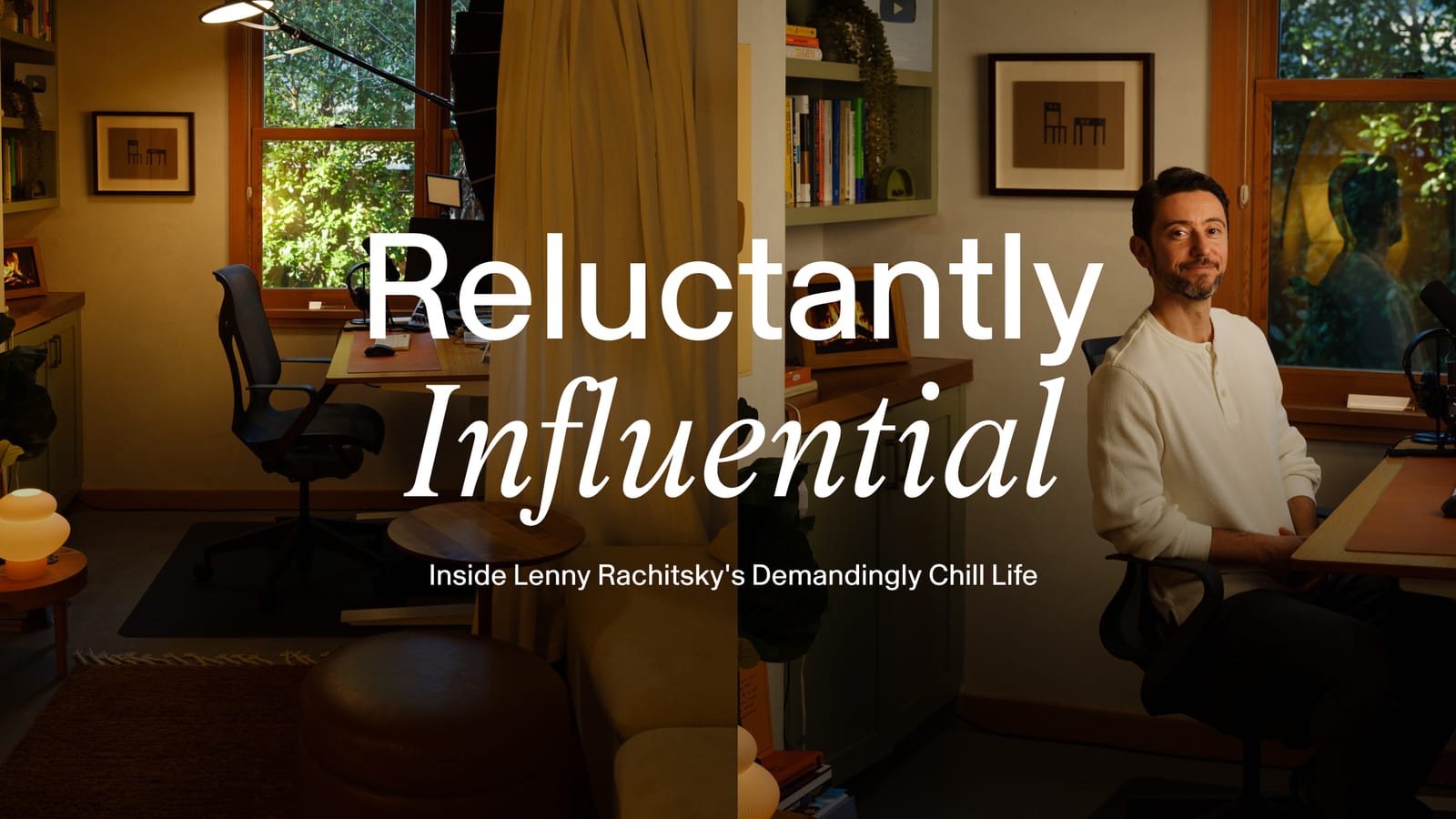 “I have a rule: no meetings before 3pm,” Lenny Rachitsky says. The retro analog clock on the wall ticks past 9:30am. “This is an exception.”Our writer spent hours with Rachitsky — the PM turned reluctant influencer — to see what happens when the podcast camera turns off. He learned that after you peel back Rachitsky’s layer of equanimity, what you find is someone who has something to prove.Rachitsky started Lenny’s Newsletter to live a “chill life.” And on the surface, it seems he’s achieved that: walk into his home and the floors are heated, there are lit candles, steam rises from the mug Rachitsky sips. But with all his success and how much he works, our writer wonders if that goal of living a chill life is still even possible. This is the central contradiction of Rachitsky. The chill life made his insanely high quality bar possible. The quality at which he does everything made the chill life sustainable.| | Take me to The Review
Made with ✨ by First Round Capital.
Listen to post · 6:56
We’re living through the period of time when we’ll learn if open models can keep up with closed labs. The obvious answer is that no, they won’t. This answer is a form of saying they won’t keep up in every area. This framing closes off a popular prediction where the open models completely catch up , as in all models saturate and open and closed models only become increasingly similar. In living through this, it’s evidently very unclear when the longer-term stable balance of capabilities will solidify.
This is a very complex dynamic, where the core point we monitor is a capability gap between models. At the same time, this gap is intertwined with evolving dynamics in the funding of open models, who builds open models, how techniques like distillation that enable fast-following translate through new application domains, potential regulation hampering the open-source AI ecosystem, and of course who actually uses open models.
The capabilities gap is one signal in a complex sea of forces, pushing supply and demand into different shapes. In many cases the demand — where obviously tons of individuals, organizations, and sovereigns want, or need, open models — is largely separated from supply. Supply is fully dictated by economics. The question of “which business strategies support releasing open models” is still at stake.
With this complexity, I wanted to distill my key beliefs down into a clear list. These are downstream of 10+ pieces I’ve written or recorded on open models this spring (which are linked throughout).
It’s surprising that the top closed models did notshow a growing capability margin over open models , based on compute differences for training and research, especially in the second half of 2025 and through today.
Open model labs are technically very strong at keeping pace on well-established benchmarks. This will continue and reflects a balance of abundant talent and sufficient computing power.
Chinese open-weight labs focus slightlymore on benchmark scores than comparable closed labs in the U.S. Distillation helps the Chinese LLM companies do so, but it’s not a panacea. Changes in the distillation dynamic (e.g. regulation) will not be a determining factor on the balance of capabilities. This increase in focus is a natural evolution of their incentives in keeping the narrative on keeping up with the frontier alive, which is crucial to fundraising and adoption.
To date, closed models tend to be more robust and generally useful than similarly scoring open models. Closed models have certain hard-to-measure qualities that are not well captured in current or past benchmarks. This will be key to enabling closed models to dominate in markets where an individual user constantly presents new challenges, i.e. supporting knowledge workers as a direct assistant.
The open vs. closed model race, as monitored through benchmarks, will largely be a game of economic staying power and fast-following, until the market structure constricts. I expect Chinese open-weight labs to face funding difficulties first, as soon as later this year. Funding difficulties will be seen in different capability trajectories 3-9 months later.
The RL dominated training era has increased the relevance of distribution to real-world use-cases as a key factor in continued capabilities improvements. These are tasks where users directly use tools like Claude Code or Codex to solve problems in their job with agents. This is the first clear technical area that closed labs can dominate open-weight models on capabilities, potentially leveraging online RL directly based on user feedback.
Open models will be increasingly adopted in repetitive automation tasks , as measured in the relative share of the API market, for repetitive tasks across the ecosystem. This takes the form of many new AI-native applications, business backend automation, etc. The success of this will drive more investment in domain-specific, efficient open models.
This is a complex picture, where the long-term trajectory is more of an economics question rather than an ability one. Many other outlets can paint a far more simplistic narrative that “China will assuredly catch us in AI” and get more distribution because it is a simple story. The reality is complex. Only real AI revenue begets more investment, eventually that’ll be linked to the ability to keep improving models at a rapid rate. Economic realities have not yet impacted scaling open models, as a general category.
This economic-focused angle relates to my positions on the open model ecosystem more broadly.
Recurring calls to ban certain types of open models will continue to come but are in practice impossible to implement. Training strong AI models (i.e. near but not at the frontier) is a relatively small cost compared to large-scale deployments. E.g. if the U.S. bans open models over a certain compute threshold, another sovereign entity will eventually train them and release them publicly, with the models entering the U.S. market with less oversight.
The second derivative of influence on open models has shifted, and the U.S. will slowly regain ground inadoption metrics of open models starting in early 2027 (it takes a long time for China’s velocity to slow, then flip). Examples include Google’s Gemma 4 (a wild success), Nvidia’s Nemotron, and Arcee AI.
As ever-stronger closed models are built, previewed, and released, there will be more safety-shocks saying that open-weight versions of the strongest AI models never can be allowed to exist , similar to reactions to Claude Mythos. These can spur burdensome regulation on open models.
With the above, there will also be increased long-term interest in open models , as sovereign entities and existing power structures realize the coming, super powerful AI tools cannot land in the hands of only one or a few companies. These entities will see open models as a different governance paradigm.
New funding structures for open models will emerge , as many stakeholders realize dependencies on single, for-profit companies for access to intelligence are unreliable.
Local agents, OpenClaw, and other personal agents represent a large, to date, mostly ignored market for open model usage. It is a sort of dark matter, with pervasive, massive potential for influence on the balance of open-to-closed models.
A single word governs this post and is intentionally repeated — complex.
This complex reality has been driving me to think more deeply about how to clearly describe the open model gap, and why I can hold it in my head that I expect American closed labs to clearly draw ahead, despite the fairly unequivocal evidence in support of the capabilities of recent open-weight models. More on the nuance in the open-closed gap in another piece coming soon, so please subscribe!
Let me know any positions that I missed.
I first became an addict at nineteen.
I had shuffled my way out of a small engineering college outside Boston, where I hadn’t managed to make many friends, into a three-bedroom apartment deep in the Fens of Boston that somehow housed seven people, one bathroom, a kitchen unexplainably never used. My memories of that year are closer to a kaleidoscope than any coherent narrative. We didn’t have fake IDs, so we fermented our own alcohol in a sink-still my roommate had built in his college metal shop, and drank the fortified hard cider that came out of it at a rate of several gallons a week. Looking back, we were consuming enough ethanol to run a tractor.
My body had decayed significantly. The house swelled with heat that slipped in through every open window and every open door, and the elevator had been broken for as long as anyone could remember, beer cans crushed into the ceiling tiles, buttons jammed out by parties long since passed.
I was working a research desk at a cancer diagnostics company across the river. On a good night I was sleeping four hours before shaking awake in the living room, waiting my turn for a strictly timed five-minute shower, before pretending to be functional in an office full of people who were.
This was also the period in which I discovered Twitter dot com.
My life got absorbed into the app. Everything was in there. It felt like a country club you couldn’t get kicked out of, a college party you couldn’t not be invited to. Whatever social rejection I faced from kids more normal, more well-adjusted than I was, didn’t exist on the little black square. And the crowd told me I was right. You could be mean to people. You could tell them their life’s work was meaningless. You could tell them it wasn’t going to work, and most of the time it wouldn’t.
I was an addict for that feeling. For confusing cynicism with wisdom. I spent my days getting likes and retweets for telling people their work was worthless, without merit, unlikely to work.
The simple truth about technology is that most of it won’t work. The Bay Area is full of fools buying into dreams that were never possible, wasting their lives on quests they’ll never finish, climbing mountains that cannot be climbed. The industry takes itself far too seriously. People are getting unbelievably rich doing things that make no sense. The entire world watches from the outside, rooting for the downfall of this silly little halcyon thing, and most of the time the world is right.
The harder truth is that some of the time it works.
In rare moments, against every reasonable prior, the thing in someone’s head ends up in the world. A drug that wasn’t there last year is in a pharmacy this year. A model that didn’t exist eighteen months ago is now reading a doctor’s notes back to her. A rocket lands on its tail. The people who built these things get very rich, and they should -- and even at private-jet money, super-yacht money, the compensation is a rounding error against the consumer surplus on the other side.
I lost a good friend a few months back. I couldn’t make the funeral.
I was texting back and forth with another buddy who knew him, and he said something I haven’t been able to get out of my head. He said the greatest gift we have here on earth is that at the end of time, when the sky rolls up like a scroll and Gabriel blows his trumpet, we’ll get to stand before God and be judged. And then we’ll get to stand alongside him and laugh and laugh until we cry, telling the stories of all the things we got to do together. If our lives were good, we get eternity. And even if we weren’t, even if this whole thing was some kind of misguided adventure -- it will be worth it to see each other again and tell the story of what happened here.
At some point along the way, being mean on the internet lost its thrill.
It started working all at once. The world I had grown up in began to fade. Technological progress went from a standstill to a sprint, and the judgments I had cast along the way turned out to be wrong. Even where I was right -- the individual frauds, the individual grifts, the guys who should have never made it and didn’t work as hard as we did and didn’t have as good of a time and didn’t do right by anyone-- even where those guys fell out, it wouldn’t have mattered. The successes that came outnumbered them a hundred to one.
Around that same time I kicked the brutal addiction of cynicism. My life started to get better. Not all at once. I have an incredible toll to pay for the way I behaved and the way I acted in those years, because cynicism comes at a cost -- and the cost lands exclusively on the cynic.
There’s a refrain in Twin Peaks I deeply adore. The villain looks in the mirror and discovers he is evil, and his hair goes gray instantly. His body cannot bear what his soul has done, and the rot becomes physical in the same moment it becomes visible. It’s easy to read this as a David Lynch at his worst. I don’t think it is. The hardened cynicism, the practiced contempt, the relationship to the world that demands every new thing prove itself before you’ll allow it to exist -- it will destroy you. It will rot your soul.
Unlike many other addictions, the heart is slower to recover from moral injury than the body is from the physical. The years spent in critique, the years spent away from creation, the years spent treating judgment as a thing we get to participate in rather than a deference we owe to God at the end of time -- these carry moral weights that are hard to cure. Weights that can only be answered by hour-long walks, by many-year apologies, by living in the relentlessly mundane day-to-day apologetics of being a sinner, and always being a sinner, and always asking for forgiveness.
It is easy to understand why cynicism deforms the soul, and not only because it is corrosive. Cynicism deforms the soul because it is a counterfeit of final judgment. It allows condemnation ahead of time. It lets you act as though your role in the world is to sort the worthy from the unworthy, instead of learning to love, to build, to discern honestly, and to leave judgment where it belongs.
All we can do is pray for forgiveness, as we are all sinners. And hope that when we stand before our God we are able to laugh and smile as we tell the story of what these lives meant -- that we were given some small part in moving the world toward the new heaven and the new earth that came down upon us like a bride prepared for her husband. That the jasper-lit streets of the New Jerusalem will be lit, in some small part, by our actions, by the light of our relationships.
Hey folks
Boarding my flight to SF very shortly, and I got an email to let me know - no WiFi today. Uh oh. I was kinda hoping my 11 hours uninterrupted hours without the kids would be productive for once (I’m usually a very OOO long-hauler, no internet). But I still have some work to polish this talk I’m giving on Tuesday.
I’m also in town looking to deploy $100k cheques to dev tools and infra founders, plus see some of my wonderful LPs and meeting new ones. Ben’s Bites Fund II has already started investing.
So my flight… I’ve had to hurriedly download a few local models so I can use my agents offline and I think, so far, Gemma 4: 26b is going to be my choice.
We’re so spoiled today with fast intelligence at our fingertips and it’s funny how used to the new intelligence levels we get
Local models are slow to boot up (you’ve got to be more mindful of what context is being loaded on startup (so I’m running with no-skills to get it to go faster, I can call the skills when I want — maybe I’d actually prefer to do that generally 🤔). And they feel pretty slow to do work, but only because of said spoils.
I’ve been in the weeds of context management recently because of the course I’m working on. And it’s been useful to just remind myself about how prickly it can be;
If an agent runs web searches - presumably you didn’t read them, its gobbling up context from content you do not know is 1. right, 2. not ai-slop, and 3. by a source you’d recommend.
Little (or big) lines of slop, misdirection, misinformation slip in to the context and compound over time
Reaching ~60% of a context window is probably the limit of where you want to be
Use other sessions as context-gathering sessions, if there’s lots of documents then create one summary file with the information (and try to read or at least skim it! - I am trying, promise)
I don’t trust 1M context windows, there’s a great post by Thariq from Anthropic below about this window. I shouldn’t need my context for my tasks to need perfect recall beyond ~150k tokens, that’s a lot of words. Only until 1M context windows are the norm, the models dont forget anything and help clean polluted context along the way!
Anyway, got to head to the gate! This was a little different of an intro, let me know if you liked it. I need to share more as I’m learning (or diving deeper).
Ben’s Bites is brought to you byAttio, the AI CRM
Honestly, no one gets excited about a CRM. But then they try Attio. It connects to Claude Code and n8n through its MCP server, completely bridging the gap between my customer data and apps. Wait, there's more, like flagging churn risk and turning customer feedback into Linear projects. Try it now.
Claude Code’s desktop got a redesign. Brings many CLI-only features and more (like split windows for multiple sessions) to the desktop app. Big improvement, but still a lot is missing. It picks up some CLI sessions but not all, opening/editing files isn’t obvious, and it keeps asking for permission even with “bypass” settings on.
Gemini also has a native Mac app now. But it’s light on features - no Gems, no notebooks - and the design feels rough to say the least.
New models - GPT-5.4-Cyber from OpenAI, fine-tuned for cybersecurity, with limited access to trusted partners. And Gemini 3.1 Flash TTS from Google - better voices, audio tags for controlling tone and pacing, and 70 languages.
Routines in Claude Codeare now in research preview - set up a prompt, a repo, and your connectors once, then run it on a schedule (or via API/GitHub trigger). Runs on Anthropic’s infra, so you don’t need your laptop open. Basically, extended cron jobs. OpenClaw calls these heartbeats.
With the latest update to OpenAI’s Agents SDK, you can run Codex-style agents in production without building the whole harness yourself. You get sandboxed execution, computer-use, skills, memory, and compaction built in.
Most RAG systems return wrong answers with complete confidence. Gauntlet's free Night School covers how production AI engineers actually fix that — setup, evaluation, the full loop. Wednesday, April 22. Register free*
Skills in Chrome let you save prompts as reusable one-click workflows that run on whatever page you’re viewing.
Cursor can now respond with interactive canvases - dashboards and custom interfaces instead of just text.
Resend shipped a new email editor with BYOA (bring your own agent). There’s a built-in LLM, but you can also MCP into the editor with your own setup.
Sparkle v4 from Every - let AI organise your filesystem like you would.
Daniel pointed an agent at 5 years of home-building emails (511 events, 690 documents, 170 finance records) and got back a full project timeline in ~$500 of Opus tokens.
Impeccable v2 - the design skill for coding agents. v2 adds a CLI scanner (works without an LLM), a Chrome extension, and a /shape command that runs a design interview before writing any code.
Using Claude Code - guide on session management, compaction, and the 1M context window.
30 min tutorial on building software with agents in Cursor.
Lindy AI’s founder says GLM 5.1 will likely become their default over closed-source models for most use cases, saving them a bunch on inference (their biggest cost, more than payroll).
OpenRouter now offers video generation models with one universal API across all video models.
Copilot in Word now tracks changes and leaves comments.
Windsurf 2.0 - Manage all your agents from one place and delegate work to the cloud with Devin.
Gradient Bang - a fun multiplayer game with subagents in space. Built with Pipecat, Supabase, and open-source.
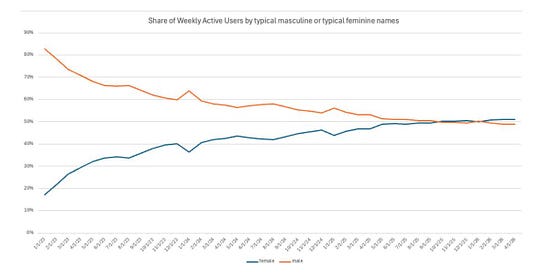
OpenAI Newsroom @OpenAINewsroom When ChatGPT first launched, there was an enormous gender gap, with our anonymized data showing roughly 80% having typically male first names. That gap is now gone.
Logan Kilpatrick @OfficialLoganK Excited to share that the Gemini API now has prepaid billing, rolled out to start for US customers!! We have been working hard across Google to enable this. It’s the default for new API users and existing users can opt in via a new billing account, all directly in AI Studio.
Brayden @BraydenWilmoth Cloudflare dashboard can now complete tasks for you. - "Create a Worker and bind a new R2 bucket to it" - "Change my DNS records to 1.1.1.1" - "How many errors have happened this week" Not only do we tell you, but we show you with generative UI. PROTIP: Use full-screen mode.
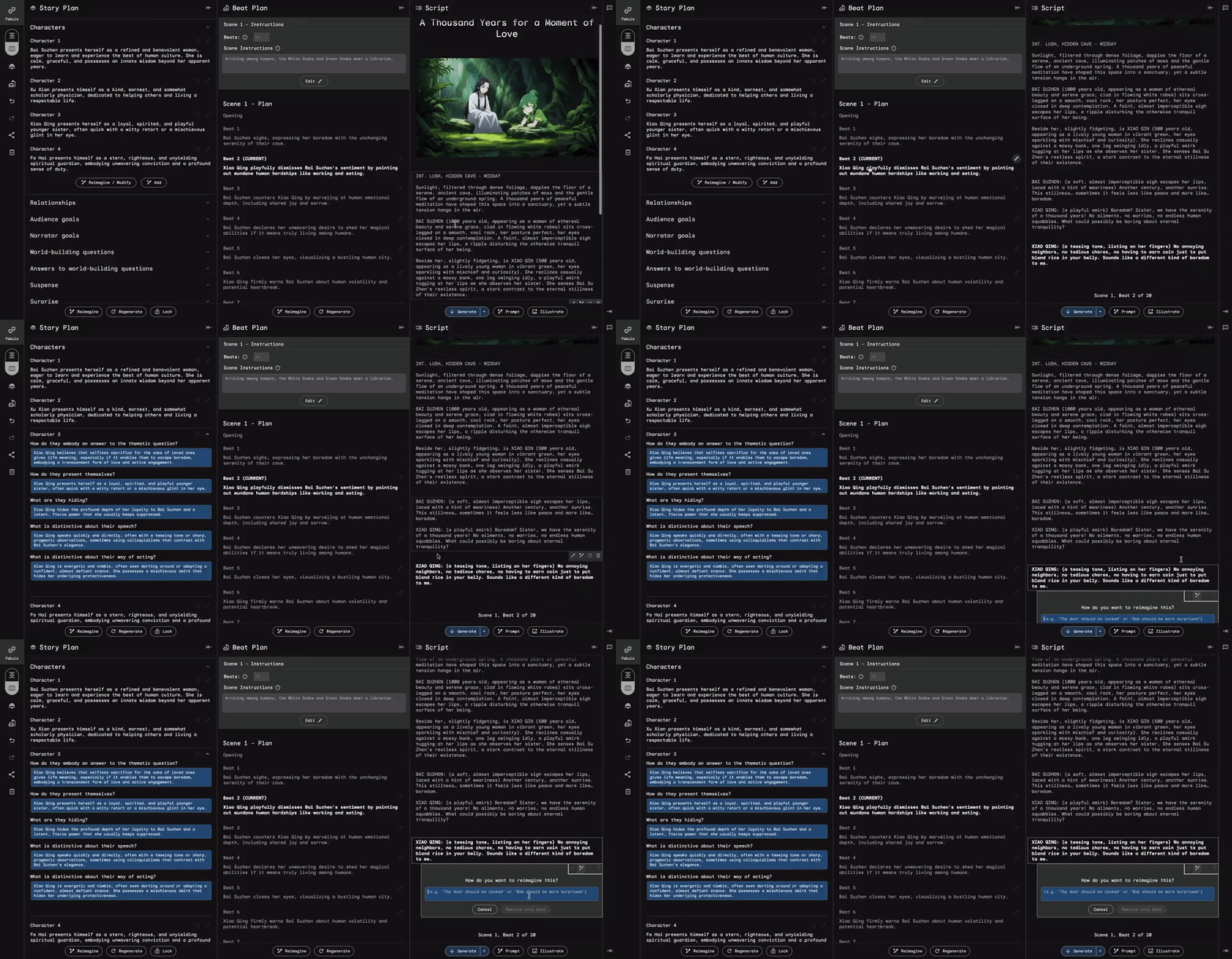
Google Research @GoogleResearch Meet Fabula: an interactive AI writing tool helping authors structure & refine stories. Co-designed with 42 expert writers, the demo showcases how convergent iteration supports creativity. Catch the demo at the Google booth at 10:30AM! #CHI2026
weisser @julianweisser 6 pivots. Cease-and-desist from Microsoft. Then Harvard picked his AI over ChatGPT. Solo Founders Podcast ep 7 is live with @0interestrates of @juliusai . We talk about: How Rahul ended up solo The football analogy for building momentum Why 8/10 co-founder teams are fighting
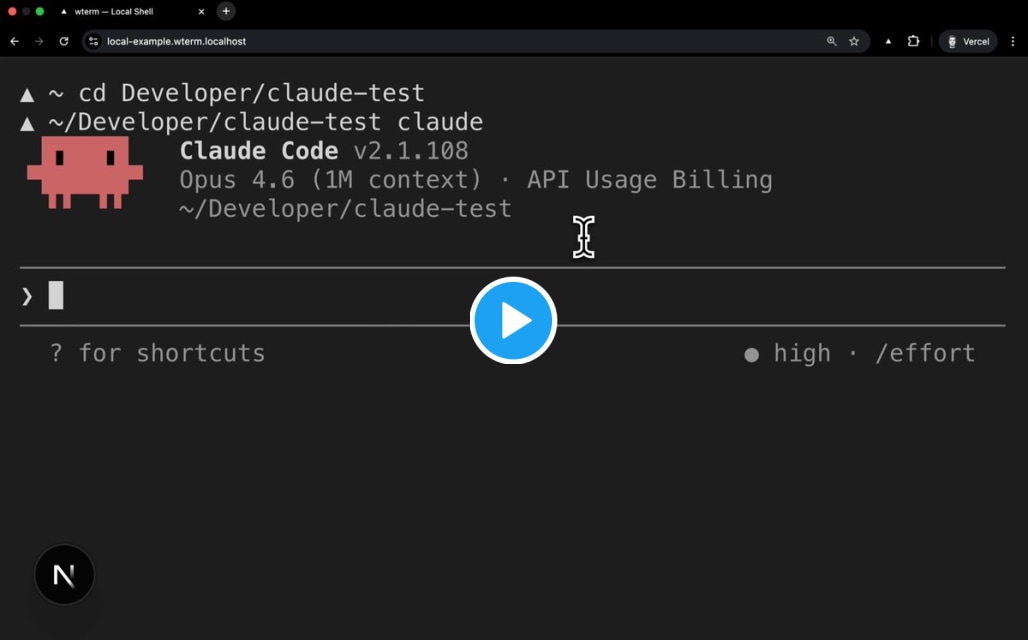
Chris Tate @ctatedev Introducing wterm (“dub-term”) A terminal emulator for the web → DOM rendering — not canvas → Select text, copy/paste, ⌘+F, a11y → Dirty-row tracking, 24-bit color, themes → WebSocket transport with reconnection → Zig core compiled to ~12 KB WASM → just-bash, local, SSH
* sponsors who make this newsletter possible :)
Email us atshanice@bensbites.com or k@bensbites.com
🚀 We just launched a new newsletter — Company Launch Tracker.
We’re tracking company launches as they happen and surfacing the most interesting new founders and startups (yes, all outside of this stealth activity too). If you want to stay ahead of the curve, this is where you’ll find them first.
Right now we’ve got 5 subscribers: my wife, my mom, and that high school buddy who won’t stop pitching me his app. Be smart like them and get in early 👇
We run a live feed inside Gravity that tracks founders entering stealth and companies quietly exiting it.
What you’re reading here is about 1% of the stealth activity we pick up. The full tracker updates in real time as things change and new activity emerges.
If you want earlier access to everything, book some time with us to stay ahead.
In this issue of the Stealth Startup Spy, here is what we will uncover:
Ex-Research Director at Google DeepMind and former Principal Research Scientist at Apple launch a multimodal reasoning lab
Ex-Staff Software Engineer at Databricks with stints at Google and Meta launches an AI-powered end-to-end marketing platform
Ex-Senior ML Scientist at Adyen and PhD-holding serial founder launches a stealth venture in fashion-tech
Yale Chemical Engineering grad and Dorm Room Fund Partner goes stealth in biotech
Ex-ByteDance product lead and South Park Commons alum raises Accel backing for a stealth venture in creative AI
And more…
Now let’s shine the spotlight… 💡💡💡
Real-time updates from founders who debut what they’ve been working on under stealth mode
FounderDNA: Serial Founder, Technical Founder, Doctorate Degree, Masters Degree, Former FAANG, Top 10 University
Prior Experience: DPhil, Computer Science at University of Oxford, User Experience Researcher at Google, Co-Founder & CTO at The Spaceship Academy, UX Research Scientist at NAVER LABS
Deep Interactions is a collaborative AI builder for teams, backed by Y Combinator (Batch P26).
HQ: United Kingdom
Industry: Artificial Intelligence, Collaboration Tools | Team Size: 3
Time Spent in Stealth Mode: 7 months
🔎 Featured Founder under stealth mode in StealthStartSpy#304
FounderDNA: Technical Founder, Doctorate Degree, Former FAANG, Top 10 University
Prior Experience: Research Scientist (Director) at Google DeepMind, PhD (Machine Learning) at University of Edinburgh, Software Developer at Autonomy
Co-Founder:Yinfei Yang (Ex-Principal Research Scientist at Apple)
Elorian AI is a multimodal reasoning research and product lab.
HQ: United States
Industry: Artificial Intelligence, AI Research | Team Size: 12
Time Spent in Stealth Mode: 4 months
FounderDNA: Former FAANG, Top 10 University
Prior Experience: Product Manager at Google, SVP Product Management at Atelio by FIS, Rider & Mapping Product Lead at Lyft, VP of Product Management at Hayden AI
Connect on:LinkedIn
Glover Labs is an agentic AI platform that helps enterprises in regulated industries — insurance, banking, healthcare, and government — modernize legacy software using coordinated AI agents, a proprietary architecture, and an auditable system of record for every transformation decision.
HQ: San Francisco, California, United States
Industry: LegalTech & RegTech | Team Size: 6
Time Spent in Stealth Mode: 10 months
FounderDNA: Serial Founder, Technical Founder, Former FAANG
Prior Experience: Staff Software Engineer at Databricks, Software Engineer at Google, Software Engineer at Meta, Founder at Alpha-CX Group, Software Engineer at IBM Canada
Pomo is an AI-powered marketing platform that helps growth-focused brands replace fragmented tools and manual workflows with a unified system of intelligent agents for planning, creating, and optimizing marketing campaigns end to end.
HQ: United States
Industry: AI Marketing, MarTech, B2B SaaS | Team Size: 18
Time Spent in Stealth Mode: 9 months
FounderDNA: Serial Founder, Technical Founder, Top 10 University
Prior Experience: Georgia Tech alum, Co-Founder & CTO at Greensat Innovation Labs, Chief Technology Officer at Bifröst EdTech, Co-Founder at Markhint, Blockchain Development Intern at Digi Yatra Foundation
Connect on:LinkedIn
The Subvocal Company is building a discreet wearable device that enables knowledge workers to interact with computers using subvocalized thoughts, targeting the future of human-computer interaction.
HQ: United States
Industry: HCI / Wearables, Consumer Tech, AI | Team Size: 2
Time Spent in Stealth Mode: 4 months
Illuminating clues left behind by world class talent and influential innovators who just went into stealth mode
FounderDNA: Serial Founder, Technical Founder, Masters Degree, Top 10 University
Prior Experience: MS & BS at Stanford University, AI/ML Researcher at Massachusetts Institute of Technology, AI/Data Engineer at AS Roma, Advisor at Fathom
Connect on:LinkedIn
HQ: United States
Time Spent in Stealth Mode: 11 months
Building in fashion-tech
FounderDNA: Serial Founder, Technical Founder, Doctorate Degree, Masters Degree
Prior Experience: PhD at Radboud University, Senior Machine Learning Scientist at Adyen, MSc in Innovation and Entrepreneurship at HEC Paris, CTO at First Remit, Co-Founder at VNGRS
Connect on: LinkedIn
HQ: Netherlands
Time Spent in Stealth Mode: 11 months
FounderDNA: Serial Founder, Masters Degree
Prior Experience: Master’s Degree at University of Cambridge, Research Affiliate at University of Cambridge, Alternative Data Analyst at Citadel, Product Manager at Bitpanda, Product Manager at Trade Ledger
Connect on:LinkedIn
HQ: United Kingdom
Time Spent in Stealth Mode: 6 months
Building in creative AI, backed by Accel.
FounderDNA: Serial Founder
Prior Experience: Product at ByteDance, Co-Founder at Clipp, South Park Commons alum
Connect on:LinkedIn
HQ: United States
Time Spent in Stealth Mode: 2 Months
Building in biotech.
FounderDNA: Serial Founder, Top 10 University
Prior Experience: BS in Chemical Engineering at Yale University, Partner at Dorm Room Fund, Venture Fellow at Pear VC, Venture Fellow at Xfund, Summer Associate at Yale Ventures
Connect on:LinkedIn
HQ: San Francisco, California, United States
Time Spent in Stealth Mode: 4 Months
🚨Here’s the deal 🚨This email has gotten too big. Exciting, but with more people following it, the edge diminishes. I’ve thought long and hard about what to do to preserve the value in the signals. I’m not sure about the final direction yet, but in the meantime I’ve been sending an email 48 hours earlier to a select group of paid subscribers. The feedback has been pretty positive so I’m going to open up the list for another 100 spots. To get signals early, Apply here!
Stay Stealthy,
Drake
Thank you for reading. If you liked it, share it with your friends, colleagues and everyone interested in staying ahead of the hidden developments in tech. Subscribe below and follow us onX / Twitter to never miss a company operating under stealth again.
Stealth Startup Spy is a data-driven newsletter for investors, journalists and tech enthusiasts interested in uncovering the next big move for key talent, real-time stealth company launches and technology advancements not in plain sight. We leverage the technology built at Gravity to shine a light on the hidden world of stealth startups.
I am always doing that which I can not do, in order that I may learn how to do it. //Pablo Picasso
Issue #790 // 2026-04-17 // View in your browser
Sysdig - Secure the cloud the right way with agentic AI //sysdig sponsored Claude Opus 4.7 //anthropic comments→ Artemis II safely splashes down //cbsnews comments→ I run multiple $10K MRR companies on a $20/month tech stack //stevehanov comments→ System Card: Claude Mythos Preview [pdf] //cdn.anthropic comments→ Installing every* Firefox extension //jack comments→ The peril of laziness lost //bcantrill.dtrace comments→ Nothing Ever Happens: Polymarket bot that always buys No on non-sports markets //github comments→ Introduction to Obsidian //bryanhogan comments→ Productive Procrastination //maxvanijsselmuiden comments→ The Physics of GPS //perthirtysix comments→
What Are You Working On? Who is using OpenClaw?
A conference about software documentation and community - next month in Portland //writethedocs End recipe clutter. Scan, import, & generate with AI //grandmasrecipes Programming Clojure//pragprog Buttondown Email - the last email platform you'll migrate to //buttondown Book a classified ad for $150
boringBar – a taskbar-style dock replacement for macOS //boringbar comments→ Every CEO and CFO change at US public companies, live from SEC //tracksuccession comments→ I built a social media management tool in 3 weeks with Claude and Codex //github comments→ Plain – The full-stack Python framework designed for humans and agents //github comments→ guide.world: A compendium of travel guides //guide comments→
Claude Code Routines //code.claude comments→ GitHub Stacked PRs //github.github comments→ Cybersecurity looks like proof of work now //dbreunig comments→
Do you even need a database? //dbpro comments→ Distributed DuckDB Instance //github comments→ Design and implementation of DuckDB internals //duckdb comments→
Filing the corners off my MacBooks //kentwalters comments→ Bring Back Idiomatic Design //essays.johnloeber comments→ The buns in McDonald's Japan's burger photos are all slightly askew //mcdonalds.co comments→ Industrial design files for Keychron keyboards and mice //github comments→ DaVinci Resolve releases Photo Editor //blackmagicdesign comments→ Charcuterie – Visual similarity Unicode explorer //charcuterie.elastiq comments→
5NF and Database Design //kb.databasedesignbook comments→ Americans still opt for print books over digital or audio versions //pewresearch comments→ The King James Bible deserved a better website //officialkingjamesbible comments→
All elementary functions from a single binary operator //arxiv comments→ DIY Soft Drinks //blinry comments→ Helium is hard to replace //construction-physics comments→ North American English Dialects //aschmann comments→ Most people can't juggle one ball //lesswrong comments→
Air Powered Segment Display? //youtube comments→ Clojure The Documentary, official film //youtube comments→ Razor 1911 (first place at revision 2026 demoparty) //youtube comments→
Stop Flock //stopflock comments→ Live Nation illegally monopolized ticketing market, jury finds //bloomberg comments→ Cloudflare Email Service //blog.cloudflare comments→ Cal.com is going closed source //cal comments→ Cirrus Labs to join OpenAI //cirruslabs comments→
1D Chess //rowan441.github comments→ Rare concert recordings are landing on the Internet Archive //techcrunch comments→ I gave every train in New York an instrument //trainjazz comments→ Doom, Played over Curl //github comments→ Haunt, the 70s text adventure game, is now playable on a website //haunt.madebywindmill comments→
You're among 70,168 others who received this email because you wanted a weekly recap of the best articles from Hacker News. Published by Curpress from Bellingham, Washington. Hacker Newsletter is not affiliated with Y Combinator in any way.
✨ Want to promote your startup? Buy a classified ad or click reply to get our media kit
⭐ Not a subscriber? Subscribe at https://hackernewsletter.com

Every week I’ll provide updates on the latest trends in cloud software companies. Follow along to stay up to date!
I have two topics I want to write about today:
Are we in an “over earning” period in AI
Follow up to last weeks post on the importance of the harness
Rising Tide, Hidden Risk
I’ve been thinking a lot recently about comments Satya made a few years back. If we rewind the clock to mid / late 2022, the biggest thing on software companies & investors’ mind was “when will the optimizations end.” The ZIRP period of 2020-2021 created a buying frenzy - no one was thinking about costs (when it came to cloud / cloud software spend), they were only thinking about growth and capturing more market share (oversimplification, but you get the main point I’m making). At the end of the day, the market was providing cheap and abundant capital (for public and private companies), and investors (for both public and private companies) were rewarding growth (ie placing the most emphasis on growth when determining valuation multiples). Once ZIRP ended and interest rates went up, capital got more expensive, investors started rewarding different behavior (efficient growth), and ultimately every CFO took a look at their P&L and realized they had a TON of unnecessary spend. Redundant spend, inefficient spend, or completely unnecessary spend was everywhere. After a couple years of “reckless spending” the tide turned, and every CFO was looking for “optimizations.” Way to reduce spend, consolidate spend, and in general reduce the wasteful spend. This was pain lasted quite some time! And this brings me to comments Satya made over and over again on earnings calls - cloud consumption trends tend to be quite cyclical. You have period of rapid expansionary spending, followed by periods of rapid optimizations - and this cycle repeats.
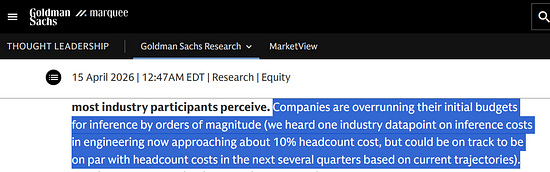
When I look at where we are in the AI spending cycle, we’re very clearly in a period of “rapid expansionary spending.” No one is really thinking about the ROI of the spend when budgeting. So many of the companies I work with say some version of “I don’t want to cap how much our employees use these tools, I want their creativity flowing, I want them trying out everything, and ultimately I want them becoming experts in these tools.” A common conversation went something like “our spend on AI tools (more often than not Claude) doubled from Jan to Feb, tripled from Feb to March, and is trending way up in April. And I don’t care if it 10x from here.” Then of course on top of this you have the “tokenmaxing” companies. Meta was in the news on this recently - the idea is “as an employee I need to show I’m using these AI tools a lot so I can show my boss I’m “AI Fluent" so I don’t get laid off. I want my token consumption to be super high, so I’m just going to have background agents running constantly, doing nothing, to give my boss the perception I’m using these tools a lot, even though they’re all doing empty tasks.” Clearly this kind of excess spend can’t last forever…
The common thread? No one is thinking about the costs. Just the potential.
I don’t know when the tide will turn, or what will cause it to turn. But at some point people WILL start looking at their AI spend and start thinking about “optimizations.” Should I be using smaller cheaper models vs larger ones? Should I be segmenting different use cases for different models? Should I run a particular background agent once per day vs once every hour? the list goes on.
In 2022, what caused the tide to turn was interest rates. Now? Interest rates won’t (I don’t think) be the reason the tide will turn. What most likely happens is the spend on AI tools balloons SO much, that companies have no choice but to think about the costs, and how to optimize. And when this happens, it could be painful for a number of AI companies experiencing hyper growth currently. There are just too many markets, that have too many competitors, that are all growing at ridiculous rates.
The thread I’m pulling at - a lot of companies in AI today are “over earning” just like many cloud companies were “over earning” in 2020 / 2021.
Just to call it out - I think the total token consumption will SKYROCKET over the next 10 years regardless of when this period of optimization happens. But today, everyone seems to be benefiting. When the tide shifts, the dispersion of who will truly benefit will shift, and a smaller subset of companies will benefit disproportionately.
Call out for founders - really introspecting your own customer / revenue / growth to understand “am I growing as part of the rising tide or am I differentiated” will be quite important…Many companies in the 2021 period got this wrong - they didn’t realize they were just catching the rising tide. They over hired, over fundraised, etc. And the unwind was painful.
Topic #2: Is the Harness Really the Moat?
In summary, last week I wrote a post that argues that the code and orchestration surrounding an AI model (the "harness," maybe formerly known as a "wrapper") matters a ton - maybe even more than the model itself? I’m back to write a quick follow up to this post.
I do think the harness matters a ton, and will continue to matter. BUT - it’s far from the only thing that matters. And we’re aready starting to see the evolution of some of the most successful application AI companies. (1) Start as a thin wrapper, (2) develop a complicated harness, (3) post train your own models, (4) lean into pre training your own models.
The vast vast majority of the market is still in phase (2). But we’re already seeing companies like Cursor (and other early AI winners) move into 3 and 4 (some form of developing their own model).
There are many reasons why AI companies may want to have their own model.
First - cost. Costs balloon when using someone else’s model. Your fixed costs will be higher developing your own, but variable costs may be lower. Second - capability. A purpose built model for your application and your domain could perform better than a general model. Third - control of your own destiny. No one wants to be beholden to someone else for the most critical layer of their infra…
And fourth - you may have no choice! There’s a very real world where the large labs (OpenAI / Anthropic) decide to keep their most powerful and current versions of their model for themselves, powering their own applications. And the models they release via API to customers may be “one version prior” of a model (ie one before the latest and greatest) or a distilled version of the current powerful model.
Why would they do this? Two main reasons I can think of. The labs are getting more and more into the application space. Why would they want their competitors (ie Cursor competing with Claude Code from Anthropic or Codex from OpenAI) to have access to the latest and greatest? Why not save the latest and greatest for their own product, and make their competitors use an older, less powerful version? I could certainly help the labs win more business.
Second (and this is all purely speculation), as these models get more and more powerful (ie Mythos speculation from Anthropic), the labs may view them more and more as a safety / security threat. Maybe they will want to be the only ones who “release” them to the world wrapped around a product? They could view themselves as the only ones truly capable of “protecting” users from the uncapped potential of the models. Said another way, they might trust themselves more to build applications around the powerful models, but not your average developer..
End of the day, this is all speculation. It may happen, it may not. But if you’re a breakout AI company, do you want to leave it to chance? Probably not. Developing your own model carries too many benefits, and could protect you in too many “downside cases” that I think we’ll see more and more companies move from the harness as the first moat, to developing their own model as the second moat.
The takeaway for founders I work with - are you building your own research / labs team? if not, maybe time to think about doing it…
Top 10 EV / NTM Revenue Multiples
Top 10 Weekly Share Price Movement
Update on Multiples
SaaS businesses are generally valued on a multiple of their revenue - in most cases the projected revenue for the next 12 months. Revenue multiples are a shorthand valuation framework. Given most software companies are not profitable, or not generating meaningful FCF, it’s the only metric to compare the entire industry against. Even a DCF is riddled with long term assumptions. The promise of SaaS is that growth in the early years leads to profits in the mature years. Multiples shown below are calculated by taking the Enterprise Value (market cap + debt - cash) / NTM revenue.
Overall Stats:
Overall Median: 3.2x
Top 5 Median: 17.2x
10Y: 4.3%
Bucketed by Growth. In the buckets below I consider high growth >22% projected NTM growth, mid growth 15%-22% and low growth <15%. I had to adjusted the cut off for “high growth.” If 22% feels a bit arbitrary, it’s because it is…I just picked a cutoff where there were ~10 companies that fit into the high growth bucket so the sample size was more statistically significant
High Growth Median: 10.5x
Mid Growth Median: 5.0x
Low Growth Median: 2.4x
EV / NTM Rev / NTM Growth
The below chart shows the EV / NTM revenue multiple divided by NTM consensus growth expectations. So a company trading at 20x NTM revenue that is projected to grow 100% would be trading at 0.2x. The goal of this graph is to show how relatively cheap / expensive each stock is relative to its growth expectations.
EV / NTM FCF
The line chart shows the median of all companies with a FCF multiple >0x and <100x. I created this subset to show companies where FCF is a relevant valuation metric.
Companies with negative NTM FCF are not listed on the chart
Scatter Plot of EV / NTM Rev Multiple vs NTM Rev Growth
How correlated is growth to valuation multiple?
Operating Metrics
Median NTM growth rate: 13%
Median LTM growth rate: 15%
Median Gross Margin: 76%
Median Operating Margin 0%
Median FCF Margin: 21%
Median Net Retention: 109%
Median CAC Payback: 33 months
Median S&M % Revenue: 35%
Median R&D % Revenue: 23%
Median G&A % Revenue: 14%
Comps Output
Rule of 40 shows rev growth + FCF margin (both LTM and NTM for growth + margins). FCF calculated as Cash Flow from Operations - Capital Expenditures
GM Adjusted Payback is calculated as: (Previous Q S&M) / (Net New ARR in Q x Gross Margin) x 12. It shows the number of months it takes for a SaaS business to pay back its fully burdened CAC on a gross profit basis. Most public companies don’t report net new ARR, so I’m taking an implied ARR metric (quarterly subscription revenue x 4). Net new ARR is simply the ARR of the current quarter, minus the ARR of the previous quarter. Companies that do not disclose subscription rev have been left out of the analysis and are listed as NA.
Sources used in this post include Bloomberg, Pitchbook and company filings
The information presented in this newsletter is the opinion of the author and does not necessarily reflect the view of any other person or entity, including Altimeter Capital Management, LP (”Altimeter”). The information provided is believed to be from reliable sources but no liability is accepted for any inaccuracies. This is for information purposes and should not be construed as an investment recommendation. Past performance is no guarantee of future performance. Altimeter is an investment adviser registered with the U.S. Securities and Exchange Commission. Registration does not imply a certain level of skill or training. Altimeter and its clients trade in public securities and have made and/or may make investments in or investment decisions relating to the companies referenced herein. The views expressed herein are those of the author and not of Altimeter or its clients, which reserve the right to make investment decisions or engage in trading activity that would be (or could be construed as) consistent and/or inconsistent with the views expressed herein.
This post and the information presented are intended for informational purposes only. The views expressed herein are the author’s alone and do not constitute an offer to sell, or a recommendation to purchase, or a solicitation of an offer to buy, any security, nor a recommendation for any investment product or service. While certain information contained herein has been obtained from sources believed to be reliable, neither the author nor any of his employers or their affiliates have independently verified this information, and its accuracy and completeness cannot be guaranteed. Accordingly, no representation or warranty, express or implied, is made as to, and no reliance should be placed on, the fairness, accuracy, timeliness or completeness of this information. The author and all employers and their affiliated persons assume no liability for this information and no obligation to update the information or analysis contained herein in the future.
by Jack Cheng  Why do constant updates fill us with dread in some apps, while we greet the daily evolution of an AI agent with more curiosity?Jack Cheng , Every’s senior editor, explores that tension through a clarifying distinction: “tool-like software,” which we expect to be stable and consistent, versus “living software,” which we expect to grow and adapt. Read on for his practical advice for builders of both.—Kate Lee Lately, I’ve been wishing that more software had a “freeze” button. When pressed, the product would crystalize in its present state. The feature set would lock, and the interface would solidify, as if dipped in carbonite. There would be no more new updates. No changes whatsoever. I want this button because companies are loading apps with more and more features, whether AI or the result of AI-accelerated development, making the tools unrecognizable. The additions are even more jarring for apps that I only use occasionally, like Figma. There, a chat box now beckons to describe my idea to make it come to life. A “Recents” toolbar above it has buttons for Figma Sites, Figma Buzz, and Figma Make—all launched last May. A sidebar module encourages me to try an AI image- and video-generation product called Figma Weave —and which I have to log into separately using my Figma account. And here I am just trying to update the gradient on an app icon. At the same time, my Claw , Pip, gets new releases almost daily. I wake up, and Pip suddenly knows kung fu—or if not kung fu, how to dream. Sometimes, the same updates send me on daylong bug hunts , locking me out of a product I rely on to help plan my week, coordinate my family calendar, write code, and brainstorm marketing ideas for my friend’s Delorean rental. Still, I find myself wondering, regularly, “What new thing can Pip do now?” Why do I loathe change for the first case and forgive—or even embrace—it in the second? It’s because the first case is software that I want to use for a specific purpose. Half-baked AI features pumped out to appease investors muddy that purpose, but so do legitimate additions, AI or not. Each new addition brings new functionality that seems neat on its own but, in aggregate, transforms the overall product into something other than the tool I know it to be. On the other hand, software such as my Claw does not have a defined purpose. I’m creating uses and applications as I go that might be entirely different from how someone else is using the same technology, and it’s adapting to me just as much as I’m adapting to it. Its properties—and our relationship—are dynamic. I’ve come to call the former group “tool-like software” and the latter group “living software.” Living software doesn’t just mean AI agents—though often there’s an agentic aspect to them. Both categories come with a set of expectations, and recognizing the differences in those expectations can explain my disorientation. For builders, it can also help us decide how and what to build.
Software development cycles have been accelerating for decades. In the 1980s, nine years passed between MS-DOS and Windows 3.0, in part because software was distributed physically, on floppy disks—and later, CD-ROMs. Customers had to go out of their way to upgrade, so major releases had to prove their value. The internet hastened the tempo considerably. Tools like Rails and React scaffolded repetitive forms and database connections, Amazon Web Services and GitHub let developers deploy code to millions remotely, and app stores made automatic updates the default on billions of devices. But even as software went from a box on a shelf to something more like fluid pushed through a digital IV, it made sense to bundle significant changes and release them infrequently, because they took time and coordination to build. Now, AI coding models have made it possible for a single developer to produce dramatically more code. The review of this code itself can be automated by AI, and the codebase can learn from its mistakes. Features can also be replicated much more quickly—just point your coding agent at the thing you want to clone. The result for end users is a lot of things we didn’t expect, and in many cases didn’t want. The old, slower pace of development ensured that companies and teams thought long and hard about what features they wanted to ship and what would truly be useful to users. Today’s hyper-fast timelines—Anthropic and OpenAI rolled out OpenClaw-esque features within weeks —are pushing the builders of traditional software to capitulate to trends or ship simply because they can.
If I expect software to be a tool, I want it to do one or several things and do it well. I want it to be consistent and stable. I don’t want my hammer to work only 92 percent of the time. Nor do I want my hammer to become a chainsaw. With software like OpenClaw, I’m more likely to...

There’s a meme war going on right now between “it’s all about SBC” and “it’s all about terminal value.” The obvious answer is that it’s both. But the important is why it’s both, and what that tells you about where the SoftWars™ are headed.
The market has decided that >95% of software is an annuity (fixed life) with $0 terminal value. If you’re running an income stream, you need to care about income and constrain SBC (a cost). If you’re accelerating/have TV (building a perpetuity/compounder), you don’t. That’s the basic dichotomy of the market right now.
If you are one of the happy few companies that the market believes not only has INCOME/earning potential but the potential to be a perpetuity (has terminal value), then it doesn’t matter because nothing matters. 25% of revenue as SBC is merely the price to pay for acceleration. The problem is that your low growth, moderate adjusted-EBITDA SaaS name is not one of them. Cutting SBC will make that business more attractive to a value-oriented financial acquirer but doesn’t give you a future.
Running the badly run middling software companies a little (or even a lot) better won’t change the narrative albatross weighing them down, except perhaps to the extent that running them better means just going all in on AI and acceleration.
So how does software fight back?
You build.
But not in the measured, incremental, multi-year roadmap manner that they’re used to. The frontier shifts too fast for a multi year roadmap.
Take a portion of free cash flow and stand up a small, empowered labs group, with a real, honest to god mandate supported by the CEO. A mandate to build new solutions for your install base, unencumbered by existing offerings, pricing, messaging, or value props. You have to build, and you have to build fast. Because AI is moving fast, and prevent defense never works.
Do everything you can to instill this entrepreneurial DNA within your company. Hire and promote people who truly get it. And part with those who don’t Compensation structures probably have to change. Talent assessment very likely has to change.
Strong endorse.
Now to make this about ME. This matters as much or more at seed than anywhere else.
Basically the only questions that you can really even ask are:
Do I love this guy/gal
Is there a story that matters
Is there something convex/interesting to spend money on today
Is there terminal value
This often gets muddled by asking “what’s your moat” which doesn’t make sense and has no good answer. You of course can’t have a moat early. If you could, you probably couldn’t start. (Some notable exceptions include things like regulatory capture through political connections, but those are rare).
What you can (must) is a point of view on the long term margins, earning power, defensibility. A thesis about where the moat comes from and what the business looks like over time. If nothing else it’s a more interesting/revealing conversation to have early.
And if you can’t/don’t have a strong POV on terminal values in 10 years you shouldn’t be investing in a category with 10+ year hold periods. This goes for founders and investors alike.
I increasingly find myself saying “I don’t doubt you can do X reasonably well and earn a bunch of revenue but let’s both accept there’s no TV in that so what’s it for?” Obviously things are hard and you can only make those claims in a narrow set of companies but the point stands. And I it’s not an academic question; it winds up really impacting what you build and prioritize today (capital allocation).

Counterintuitively, predicting the long term is actually easier/higher confidence than predicting the medium term. If Trump had lost in 2024 the world today would be very different but the world in 2040 might be largely the same either way because the forces/stories propelling the world are broad and deep. It’s variance around durable trend lines.
We are not traders. We’re investors who, as a bug or feature, have no liquidity. All we have is terminal value - hopefully our companies will too.
A couple years ago I wrote about why repair and maintenance is a super elegant way to get into industrial workflows efficiently and build a many-armed tentacle monster:
Many shots on goal to make a sale; something is always broken unlike equipment sales which is infrequent.
Motivated buyers : repairs are urgent. When something breaks it needs to get fixed right now because uptime drives revenue.
High value: unlike single use supplies, machinery and heavy equipment is high value and fixing it is high skill - not just a question of price.
That was a preview of Prefix (and Heave).
Prefix is a marketplace for restaurant and retail facilities maintenance. Independent technicians on one side, big multi-site operators on the other. The company makes repair and maintenance better, faster, and cheaper for some of the most demanding brands in the country, including Chipotle, Raising Cane’s, and Bojangles, across thousands of locations.
Restaurants are a great place to start because they’re large but highly federated accounts. A national chain has hundreds or thousands of locations, each depending on local technicians for HVAC, refrigeration, plumbing, and electrical. These are big customers that don’t want to deal with rinky dink procurement across every market they operate in.
Prefix lets big brands interact with small, local service providers on more of a like-to-like basis: buy from Prefix, get service fulfilled by the best local players. Best of both worlds. And on the other side, it makes those big accounts winnable for small businesses that would otherwise never get in the door.
By starting with repairs (recurring, urgent, valuable) Prefix can profitably earn the right to start building relationships with customers on both sides. Over time there’s obvious expansion opportunities into equipment purchase, capex financing, single use supplies, software, and self service offerings for small independent brands.
We co-led a $7.5M seed round with Collide Capital to help Prefix keep scaling. The company is expanding aggressively beyond QSR chains into retail and other multi-site verticals, and over time we’re excited to see them go deeper on both sides of the marketplace.
Prefix is a revenue driver and sales orchestration opportunity for the supply side, and a coordination layer that keeps getting more valuable for the demand side. This is how useful technology gets into the real economy and makes long tail entrepreneurship more possible and profitable.
Prefix is hiring AEs and senior salespeople around the US.
On Saturday, May 2nd, we’re hosting NYC Slopcon, a hackathon for product engineers, vibe coders, commercially minded engineers, technically minded sales people, high velocity operators, etc..
We are convinced that the world is reorganizing around four archetypes and ways of working: slop cannons (non derogatory), SREs, adults, and hot people.
The best AI native companies are increasingly recruiting commercially minded engineers regardless of the role. They explicitly want people who are comfortable using tools AND thinking about product AND thinking about customers. The salespeople are shipping (at least internal tools and automations for themselves) and the engineers are relentlessly focused on customer value.
The highest performing companies will have ‘product engineers’ and slop cannons in every role (product/eng, sales, ops, talent, finance, CX, marketing, etc); it is a multi-hyphenate skill set crucial to accelerate each area of the business.
We’ll have prizes and credits from OpenAI, Vercel, Pangram, and Memelord. Join us. Slop em up.
Messages to LLMs are not privileged/are discoverable. We’re starting to see them show up in litigation along with the advice for regular people not to ask Claude about the law.
This is a gift to the legal cartel and it’s bad for everyone else.
Consulting LLMs about legal matters in parallel to lawyers, before lawyers, and instead of lawyers is pro-social behavior. The alternative to an LLM reading your employment contract is not having a fancy lawyer read it; it’s signing it blind. Same goes for leases, demand letters, non-competes, etc.
Worse, the genie can’t go back in the bottle. The landlords, employers, corporations, and scammers will use AI to drop the cost of contracts and litigation threats to zero. Consumers will get screwed.
Someone should build the product that serves the behavior and protects the user.
The shape is probably something like: minimum viable pretense for attorney-client privilege over LLM conversations. You sign up, you sign an engagement letter, there’s a licensed attorney on the other end blessing the channel, and your conversations with the AI happen under that umbrella. I’m sure there’s nuance here, but the broad strokes seem solvable by a good lawyer and a good product person working together.
The business model is either standalone consumer AI and/or PLG for a consumer neofirm.
On one hand this is “safety driver in the Waymo” which is dumb. On the other, it’ll ultimately be good for people, which is good.
My name is Yoni Rechtman. I’m a partner at Slow Ventures, where I lead pre/seed rounds from a ≈$325M fund. I’m a generalist investor looking for weird takes on important stories: N-of-1 companies taking non-obvious approaches to markets that matter. I’m interested in real world businesses, hybrid software companies, AI’s second-order effects, healthcare, network effects, and fintech. If you’re building something ambitious or think I’m wrong, I’d love to hear about it.

It’s more interesting, and you sound smarter, to catastrophize vs. articulate the arc of history: Things will likely get a bit better … every day … yawn. But it’s always healthy to ask, “What could go right?” Last week, with so many things on Earth going wrong, something went right — in space. Let’s talk about NASA’s Artemis II mission.
One query I get often: “What class/skill would you suggest our kids take/learn to compete in the modern economy?” A: Storytelling. The flow of capital, like the trajectory of history, clots around compelling stories. Entrepreneurs, aka storytellers, deploy a narrative that captures imaginations and capital to pull the future forward. Before America was a nation, it was a story told by traitors who recast their rebellious colonies as bastions of liberty and themselves as patriots. Mastery of narrative is humanity’s superpower, as the arc of evolution bends toward good storytellers. Communities with a larger share of skilled storytellers experience greater levels of cooperation and procreation. Storytelling reinforces their evolutionary resilience, efficiently transmitting survival-relevant information.
At the beginning of the space race, the story was about Soviet pioneering and American stagnation. The Soviet space program had put the first satellite into orbit (Sputnik), sent the first dog into space (Laika), and completed the first manned mission (Yuri Gagarin). So, how did we beat the Soviets to the moon in less than a decade? A: We changed the story from one about us falling behind (the space race) to one we could win (the moon race). Privately, President John F. Kennedy told NASA administrator James Webb he wasn’t that interested in space, but he said we were going anyway to “demonstrate that starting behind … we passed them.” In his 1962 speech at Rice University in Houston, JFK tapped into a sense of national urgency. He defined space as a new frontier and leveraged America’s competitive, pioneering spirit with a call to action: “We choose to go to the moon in this decade and do the other things, not because they are easy, but because they are hard; because that goal will serve to organize and measure the best of our energies and skills … and we intend to win.” JFK’s story pulled the future forward by capturing America’s capital (5% of federal spending at the height of the Apollo program) and imagination, especially among young people. A number of NASA’s key scientists and engineers were in high school or college when JFK gave his speech. Seven years later, when Neil Armstrong and Buzz Aldrin landed the Eagle module at a site later named Tranquility Base, the average age at mission control was 28.
The narrative arc continues to bend toward expanding human knowledge, as JFK’s story inspired multiple generations to dedicate their careers to science and engineering. As President George H.W. Bush explained nearly two decades after it ended, the Apollo program was “the best return on investment since Leonardo da Vinci bought himself a sketchpad.” By one estimate, every dollar spent on the moon race returned $7 in economic growth over the following decade.
When we think about the Apollo story, we jump-cut from Kennedy’s speech (act one) to Aldrin and Armstrong planting a flag on the moon (the climax). The Artemis program, named for Apollo’s sister in Greek mythology, is the beginning of the next chapter in human space exploration. At first glance, sending four astronauts on a 252,757-mile roundtrip journey to the moon — breaking the distance record for manned space flight previously held by Apollo 13 — seems like a sequel nobody asked for. Three years ago, when NASA announced Artemis II, the first manned mission in the program, Stephen Colbert asked an obvious question: “Why are we going back to the moon?” In response, Mission Commander Reid Wiseman said, “Because we want to see humans on Mars.” Bold.
Artemis II was a shakedown flight to test the Orion spacecraft, similar in purpose to Apollo 8 — the first manned mission to orbit the moon and return. Success sets the stage for a moon landing in 2028, and more important, the establishment by 2030 of a permanent lunar base. In the short term, a permanent lunar base can be a proving ground for operating in deep space. Long term, this is about water, i.e., space oil. Sending one kilogram of material to the moon currently costs an estimated $1.2 million. But if NASA can turn ice at the moon’s poles into hydrogen (fuel) and oxygen (life support), it’ll transform space economics. A moon base could become a staging point for further space exploration, without having to rely on expensive resupply missions from Earth. Philip Metzger, an expert on spaceflight engineering at the Florida Space Institute, told National Geographic that a permanent lunar base puts us on a path, within a few years, for monthly moon missions. Read that sentence again. We choose to go to the moon … every month. Apollo was the Wright Brothers at Kitty Hawk; Artemis is jet travel. “This is the moment where we should all start believing again, when ideas become missions and when hard work delivers world-changing accomplishments,” NASA Administrator Jared Isaacman said in March. “NASA once changed everything, and we’re going to do it again.” The ambition is real. The funding, less so — NASA’s story hasn’t attracted the same flow of capital as the Apollo program, which peaked at 4x the spending of Artemis, adjusted for inflation.
One of NASA’s longest-running debates is the value of crewed vs. uncrewed missions. In 2008, Nobel Prize-winning physicist Steven Weinberg argued in Smithsonian magazine that science takes a backseat to astronaut safety on a crewed mission. “Manned missions to space are incredibly expensive and don’t serve any important purpose,” he wrote. “It isn’t a good way of doing science, and funds are being drained from the real science that NASA does.” But according to John Logsdon, professor emeritus at George Washington University and founder of its Space Policy Institute, exploration is about testing the belief that humans can become a multiplanetary species. We “have to be able to live off the land and do something worthwhile,” he wrote in response to Weinberg. “Exploration lets us find out whether both of these are possible.”
I believe the question isn’t whether or not to send humans, but which humans to send. Stories deploy audience surrogates, i.e., heroes. As Will Storr, author of The Science of Storytelling wrote, the human brain is “a story processor … designed to absorb the story world of the groups we identify with.” Gene Roddenberry created Star Trek to tell stories about the (mostly human and Vulcan, i.e. humanoid) Enterprise crew, not the ship. As Captain Kirk said at the beginning of each episode, it was about people choosing “... to boldly go where no man has gone before.”
In 2021, when Jeff Bezos and Richard Branson began selling six-, seven-, and eight-figure tickets to the Kármán Line, I wrote that they were a new breed of space traveler: The egonaut. Nobody identified with these imposters. We paid attention to their rocket-powered branding events with a mix of loathing, mockery, morbid curiosity, and the sinking feeling that billionaires would rather burn cash on their Martian escape fantasies than pay taxes to make Earth more habitable. Artemis II is a different story, because these are our astronauts, they are us. Three years ago, then-NASA Administrator Bill Nelson said of the Artemis II crew, “Each has his or her own story, but together they embody our credo: E pluribus unum , or ‘Out of many, one.’”
Commander Wiseman is a former naval aviator and decorated test pilot. He’s also a single dad, who named a lunar crater after his wife, Carol, who died of cancer in 2020. His crew is equally exceptional: Two accomplished military pilots and an electrical engineer who spent nearly a year living aboard the International Space Station. For a country poisoned by rising White nationalism, entrenched misogyny, and isolationism, the Artemis II crew is an antidote. It included the first Black astronaut (pilot Victor J. Glover), the first female astronaut (mission specialist Christina Hammock Koch), and the first non-American astronaut (Canadian mission specialist Jeremy Hansen) to travel to the moon. As individuals, each broke barriers, but as a crew they achieved greatness, as greatness is in the agency of others. “A crew is a group that is in it all the time, no matter what, that is stroking together every minute with the same purpose, that is willing to sacrifice silently for each other, that gives grace, that holds [each other] accountable,” Koch said. The Artemis II crew went to the moon, not for the money — astronaut pay tops out at around $150,000 per year — or to serve their egos, but for us. As Mission Specialist Hansen said at liftoff: “We go for all humanity.”
Confession: I posted a lot of Artemis pictures, but privately wondered, “What’s the big deal, we’ve already been to the moon?” I didn’t experience “moon joy,” a phrase from CapCom that went viral, creating a rare moment of unity and good will. This week, Mia Silverio, my research lead, wrote that NASA is one of the most underrated brands in the world. Many luxury brands, hundreds of rappers, and Ariana Grande have associated themselves with NASA or its logo. NASA’s cultural cachet is … wait for it … on another planet. The average age of the Prof G research and production team is 25. They never saw us land on the moon (the Apollo programs ended in 1972). The Challenger disaster is something their parents remember. In their lifetimes, our biggest moments in space have been probes (great science, no story), commercial space flights and reusable rockets (great stories … for investors), and tourism (a story nobody wants). The Artemis program offers a story to inspire today’s young people, just as the Apollo program inspired my generation.
The reason the Artemis II story is so much more compelling is not the script, but the actors. The crew fits a decent definition of an aspirational vision for masculinity (a wonderful attribute not sequestered to people born as male). These impressive people are optimizing for service, vs. attention. This story is a welcome reminder, to those whose lived experiences are shaped by forever wars, financial crises, pandemics, and an insurrection, that America is still capable of moonshots. Still capable of going where no person has gone before. Still capable.
We aren’t going back, we’re going farther …
Life is so rich,
P.S.
We’re taking the Markets podcast on tour. Ed Elson and I will record with live audiences in San Francisco, Los Angeles, Miami, Chicago, and New York. Skip the FOMO, buy your tickets here.
by Katie Parrott  Anthropic surprised us yesterday by dropping Opus 4.7—so we did what we do: We went live on X and YouTube with five testers and figured it out in front of 10,000 people. Anthropic researcher Alex Albert even joined the stream to explain what had changed. Two hours of live testing and an afternoon in Slack later, here’s the short version: This model rewards people who write tight prompts and frustrates everyone who doesn’t. Here’s our complete Vibe Check on Opus 4.7. The highlights from five testers across coding, writing, and agentic work:
The pattern underneath all of it: Anthropic is tuning Claude’s eagerness like a dial between releases, and 4.7 is a hard dial-back from 4.6’s gap-filling intuition. Your old Opus prompts probably won’t deliver the results you’re used to, so you need to tweak them for this release, if 4.7 is what you want to use. Read the full Vibe Check for our hands-on results across coding, writing, and knowledge work—including the e-commerce build that made Kieran say “BEST MODEL EVER,” the data error 4.7 missed unprompted, and a switch/stay guide for your current workflows. Read the full Vibe Check
Apr 18
The SaaSpocalypse debate rages on. Seat-based pricing dying. SaaS reduced to systems of record. Entire products vibe-coded away. Where I’ve landed: the core SORs with complex rule engines and embedded workflows - Salesforce, Workday, ServiceNow - are so deeply embedded that most large enterprise buyers will simply use the threat of “we’ll build some of it ourselves” to negotiate lower pricing. The real question for these incumbents isn’t survival. It’s where the next revenue lever comes from.
Enter Marc Benioff. He just ripped the band-aid off.
Marc Benioff @Benioff Welcome Salesforce Headless 360: No Browser Required! Our API is the UI. Entire Salesforce & Agentforce & Slack platforms are now exposed as APIs, MCP, & CLI. All AI agents can access data, workflows, and tasks directly in Slack, Voice, or anywhere else with Salesforce Headless
Let’s pause and appreciate what’s happening here. Twenty-seven years ago, Benioff built Salesforce on a radical idea: kill software, move everything to the cloud, charge per seat. The “No Software” logo became iconic. He didn’t just build a company, he built the SaaS business model that an entire industry runs on. Now he’s taking a sledgehammer to his own creation. The same guy who killed on-premise software is now killing per-seat SaaS. That takes huge kahunas. And the recognition that if he doesn't do it to himself, someone else will.
Salesforce is going headless. It’s called Headless 360, and it exposes every capability in the platform as an API, MCP tool, or CLI command. 100+ new tools, day one. Claude Code, Cursor, Codex can now operate an entire Salesforce org without opening a browser.
I wrote about this exact scenario back in What’s Hot #410 (Sept 2024) - that Benioff’s push into agents could put Salesforce at existential risk because once the front-end gets reimagined with AI, the application becomes just a database and customers migrate to cheaper, faster, more agile systems. I thought this was a 5-year arc. It took 18 months. Benioff isn’t fighting it. He’s embracing it. Instead of blocking access and protecting the UI moat, he’s betting that Salesforce becomes the platform agents talk to, not the screen humans click through. As Salesforce put it: “We made a decision two and a half years ago: Rebuild Salesforce for agents.”
In other words, he’s taking the pain now.
Seat counts are already dropping. Large enterprises are renegotiating. But by getting ahead of the transition, Salesforce may find a tailwind depending on how they price. More on that later.
This is the opening shot for system of record incumbents - expect others to follow soon after. The ones who resist are telling you their moat was the UI, not the data.
There’s a deeper technical story here that matters for every enterprise deploying agents. As Salesforce EVP Jayesh Govindarjan told VentureBeat, early Agentforce customers hit a wall: “They were afraid to make changes to these agents, because the whole system was brittle. You make one change and you don’t know whether it’s going to work 100% of the time.”
The core tension is that agents are probabilistic but enterprises demand deterministic outcomes. Most real-world workflows are a mix of both - steps that must follow strict business logic and steps where the AI should reason freely. Salesforce’s answer is Agent Script, an open-sourced DSL that defines a state machine in a single flat file - versionable, auditable - where enterprises specify exactly which steps are deterministic and which are probabilistic. This is the real battleground. The winning agent platforms won't be the ones with the best models. They'll be the ones that let enterprises blend determinism and flexibility in a way that's auditable and won't break on the next update.
Short-term revenue hit. Long-term growth story. Do the math. 100,000 human users at $300/seat is $30M. Replace those seats with 1,000,000 agents making API calls 24/7 and suddenly the ceiling isn’t headcount anymore. It’s volume. Humans work 8 hours a day, 5 days a week. Agents work all the time. Consumption-based pricing in an agent-led world could dwarf what per-seat ever delivered. If you get the model right.
In a world where agents outnumber humans 1000+ to 1, the pricing model determines everything. Per-seat is dead. Per-call, per-outcome, per-transaction. Whoever figures out the right model doesn’t just survive. They win. The SaaS business model is being rebuilt in real time. Let’s see who moves next.
As always, 🙏🏼 for reading and please share with your friends and colleagues!
Nico Wittenborn @ncsh We are in the age of consensus capital: 1- Almost 75% of all LP $ raised by 5 funds 2- Almost 75% of all VC $ invested in 5 companies
Peter Walker @PeterJ_Walker Top 5% of seed rounds now routinely topping $175M in valuation. Up 3x effectively over the last 12 months. Just a whiff of 2021-era ridiculousness about (even as an AI believer).
Anna Tong @annatonger Of our @Forbes AI 50 list... forbes.com/lists/ai50/ 88% are US-based 64% are Bay Area-based 50% are San Francisco-based 14% are New York City-based Conclusion...if you're building an AI company, build it in San Francisco *I live in San Francisco so I'm biased
Mamoon Hamid @mamoonha 12 year overnight success. 🚀 @joinHandshake theinformation.com/articles/hands…
Scott Stevenson @scottastevenson It’s time to expose a huge scam in AI startups: Contracted ARR The reason many AI startups are crushing revenue records is because they are using a dishonest metric The biggest funds in the world are supporting this and misleading journalists for PR coverage. The setup:
Roger @rdd147 $UBER hints it’s dumping Ai and Anthropic after blowing its entire Ai budget in 3 months on exorbitantly high costs. The prices charged by Anthropic are enough to destroy corporations budgets in 3 months, but still far below what they need to charge to reach profitability. Anissa Gardizy @anissagardizy8 Uber's CTO told @LauraBratton5 that AI coding tools—particularly Anthropic’s Claude Code—has already maxed out its 2026 AI budget 📈 “I'm back to the drawing board, because the budget I thought I would need is blown away already,” Neppalli Naga said. https://t.co/4JIBfqUO7V
Gergely nails it
Gergely Orosz @GergelyOrosz There is massive irony in how AI coding tools are starting to become TOO expensive for many enterprises - after eg Anthropic removed subsidizing AI subscriptions. We might go from "everyone use AI for everything!" to "you have $300/month AI budget; use your brain for the rest."
Callum Williams @econcallum Insane datapoint from new Goldman report on AI and software
Shane Buchan @buchan_sm Last week @sebgoddijn shared Glass, Ramp's internal AI productivity tool, with the world. Nearly a million views later, everyone's asking the same thing: how did you actually build this? Read the full story here: https://t.co/iR15nRiyNn The short of it: we built an app that
Ed Sim @edsim The last mile in the enterprise is the longest Great notes from Aaron One other key point I keep hammering as well - world is moving so fast, no one wants to be locked into a single vendor despite one being superior to others at moment I would also add security continues to Aaron Levie @levie Another week on the road meeting with a couple dozen IT and AI leaders from large enterprises across banking, media, retail, healthcare, consulting, tech, and sports, to discuss agents in the enterprise. Some quick takeaways: * Clear that we’re moving from chat era of AI to
Arvind Jain @jainarvind People have asked me whether Claude Cowork will follow the same explosive adoption as Claude Code. I think the trajectory will look different. Not because Cowork isn’t powerful, but because enterprise work is fundamentally different from engineering. Claude Code took off in part
Rogo @RogoAI We are introducing Felix. Felix is a purpose-built agent for high finance, designed for long-running, complex workflows and capable of producing decks, models, and documents end-to-end. Felix executes so you can focus where it matters.
Eric Hartford @QuixiAI Last week, Anthropic announced Project Glasswing alongside Claude Mythos Preview, a model they described as so powerful at finding vulnerabilities they couldn't release it. The announcement featured AWS, Microsoft, Google, and Apple as partners, $100M in compute credits, and a
Polymarket @Polymarket JUST IN: Google searches for “OpenClaw” have crashed to near-baseline levels.
Andrew Curran @AndrewCurran_ New model: GPT‑5.4‑Cyber 'Today we’re expanding this program by introducing additional tiers of access for users willing to work with OpenAI to authenticate themselves as cybersecurity defenders. Customers in the highest tiers will get access to GPT‑5.4‑Cyber, a model purposely
Parker Conrad @parkerconrad Rippling AI was the most successful launch we've ever done. On the heels of this launch, Rippling's revenue is now growing 78% YoY (at ARR over $1 Billion). And this growth rate has now increased, every quarter, for three straight quarters. Parker Conrad @parkerconrad Rippling launched its AI analyst today. I'm not just the CEO - I'm also the Rippling admin for our co, and I run payroll for our ~ 5K global employees. Here are 5 specific ways Rippling AI has changed my job, and why I believe this is the future of G&A software. 🧵 1/n
“The Meta chief is personally involved in training and testing his animated AI, which could offer conversation and feedback to employees, according to one person. They added that the character was being trained on the billionaire’s mannerisms, tone and publicly available statements, as well as his own recent thinking on company strategies, so that employees might feel more connected to the founder through interactions with it.”
Financial Times @FT Meta builds AI version of Mark Zuckerberg to interact with staff | | ft.trib.al
Meta builds AI version of Mark Zuckerberg to interact with staff
Steve Yegge @Steve_Yegge I was chatting with my buddy at Google, who's been a tech director there for about 20 years, about their AI adoption. Craziest convo I've had all year. The TL;DR is that Google engineering appears to have the same AI adoption footprint as John Deere, the tractor company. Most of
Bessemer @BessemerVP The next generation of biotech winners won't be defined by their science alone. They'll be defined by their data infrastructure. 🧬 Bessemer's Biotech team is out with their roadmap on biology-native data infrastructure + the market map of the companies building it: →
Ed Sim @edsim @jedgar Rest in peace Simon and thank you for creating Sparky for us 🙏🏼
Boring_Business @BoringBiz_ This is why investing is such a brutal game, especially if you are a technology investor Go back 1 year to May 2025. OpenAI is the category leader in AI, and Microsoft owns 27% of the business On top of that, Satya Nadella has OpenAI locked into their Azure cloud ecosystem. The
Rory O'Driscoll @rodriscoll The weird thing right now is the public markets don't have access to the growth side of software. Right now the trade is to sell SaaS and buy semis (the raw material of AI). What you don’t have yet in the public markets are the AI native software companies and therefore, you’re
sid @immasiddx Adobe and Figma stock after Claude Design’s announcement. It is so over. 😭
Claude @claudeai Introducing Claude Design by Anthropic Labs: make prototypes, slides, and one-pagers by talking to Claude. Powered by Claude Opus 4.7, our most capable vision model. Available in research preview on the Pro, Max, Team, and Enterprise plans, rolling out throughout the day.
Geiger Capital @Geiger_Capital Absolutely incredible… Allbirds, the shoe brand, is selling all footwear assets, renaming itself "NewBird AI", and using $50M to buy high-performance GPUs. $BIRD is up +170% this morning. 🚀
Negligible Capital @negligible_cap The name of the company… NewBird AI. It is a cutting-edge, AI-native cloud infrastructure firm out of- well, they used to be out of San Francisco making sneakers, but forget that, John- they are now awaiting imminent deployment of next-generation GPU compute clusters that have
Bull Theory @BullTheoryio 🚨 THE FED IS NOW PRIVATELY PREPARING FOR A POSSIBLE $2 TRILLION CREDIT MARKET COLLAPSE. For the first time in over a decade, the Fed has started directly asking U.S. banks to hand over their exposure numbers to the private credit market. This is the exact move regulators make
by Every Staff  _Hello, and happy Sunday! ## Knowledge base
“Vibe Check: Opus 4.7 Stopped Reading Between the Lines” by Katie Parrott /Vibe Check: Opus 4.7 is the best coding model Every has tested on well-specified tasks—Kieran Klaassen called his Rubber Duck benchmark run “best model ever”—but it won’t infer what you want the way 4.6 did, and the prompts you’ve tuned for the last two months will likely disappoint you at first. The gap between a tight brief and a loose one is wider than in any prior Opus. Read this for the full breakdown of where to switch to 4.7 now and where to stay on 4.6. “The Folder Is the Agent” by Kieran Klaassen /Source Code: After three months trying to make AI agent swarms work in his coding flow, Kieran Klaassen realized that what was doing the work was a folder. A project directory with a CLAUDE.md, accumulated context, and specialized sub-agents is all you need to turn a general model into a domain expert. He’s now running 44 of them, connected by a Ruby dispatch layer that routes work while he sleeps. Read this to learn how to build the dispatch layer yourself. 🎧 🖥 “Mini-Vibe Check: Claude Managed Agents Handle the Infrastructure Work” by Laura Entis /Context Window: Dan Shipper sits down with Eve Bodnia , founder and CEO of Logical Intelligence, who argues that LLMs have a ceiling—and that energy-based models, which scan the full landscape of possible answers rather than predicting one token at a time, are what comes next. Plus: A Mini-Vibe Check on Anthropic’s Claude Managed Agents; Willie Williams proposes new vocabulary for the AI age. 🎧 🖥 Listen on Spotify or Apple Podcasts , or watch on X or YouTube. “You’re the Manager Now” by Laura Entis /Context Window: The Claude Code desktop app gets a redesign built for managing parallel agent work—and Kieran Klaassen was already living in it. Plus: Dan Shipper explains why you should ignore the viral claim that smaller models can match Anthropic’s Mythos, Austin Tedesco shares the one question he asks Claude Code before shipping anything, and Eleanor Warnock on why the Dia browser’s bet on beauty might be the right one. “Living Software” by __Jack Cheng : AI-accelerated development has made software feel zombieish—tools that shouldn’t be alive suddenly sprouting chat boxes and AI sidebars. Jack Cheng proposes a distinction: “tool-like software,” which users expect to be stable, versus “living software,” which users expect to adapt and grow. The two categories carry different expectations, and confusing them causes disorientation. Read this for his practical advice on how builders of both should design, ship, and communicate with their users.
We host camps and workshops on topics like compound engineering and writing with AI to share the knowledge we’ve acquired from training teams at companies like the New York Times and leading hedge funds , and by learning and playing with AI every day ourselves.
Getting started with Spiral just got a lot faster.Marcus Moretti , general manager of Spiral, rebuilt the onboarding flow from the ground up. Now, instead of clicking through six explainer screens, you drop in writing samples from your X account, a website, uploaded files, or pasted text, and Spiral generates a style guide tuned to how you write. The result: About 80 percent of new users leave onboarding with a personalized style, up from roughly 20 percent before. The sooner Spiral knows your voice, the sooner it’s useful—and the new flow gets you there in minutes. New Spiral users: Start creating your styles at writewithspiral.com. Existing Spiral users: Try the new onboarding experience at app.writewithspiral.com/onboarding.
How NotebookLM rewired the way I problem-solve. I am moderately dyslexic. It’s an awkward thing to be if you write for a living, because the job is essentially the piecing together of textual information into a shape other people can follow. The difficulty, for me, is not reading the words, but holding the information they contain in relation to one another. For most of my career I have used a mind map—a messy visualization of ideas—to help me wade through the facts and opinions of dense textbooks and research papers. The diagrams worked inasmuch that they allowed me to organize information in my head, but any problem bigger than a single sheet of A4 paper was effectively closed to me until I could block out an afternoon to draw it. NotebookLM , Google’s AI research assistant, has removed that barrier by letting me hold more in my head at once. Here’s an example: I’ve been stuck on one question for three weeks. Patients on chronic disease therapies like GLP-1s drop off at a staggeringly high rate. Roughly half are no longer on the drug 12 months after they start, because of both side effects like nausea, and the cost. For a direct-to-consumer telehealth operator distributing the drug at scale, the analytically difficult thing is that none of the available research separates the two cleanly, and the solution to the problem of churn sits somewhere inside that mess. This is less a medical question than a management consulting one , and it’s the kind of problem where I used to feel the particular flavor of panic that comes from having a lot of data and no thesis. Instead, I’ve been running Barbara Minto’s Pyramid Principle in reverse inside NotebookLM. Minto was the first woman McKinsey ever hired out of Harvard Business School, and she was sent to London in the 1960s to figure out why the firm’s consultants wrote such terrible memos. Her book The Pyramid Principle , which came out of that work, is the closest thing consulting has to a scripture. At the top of the pyramid sits your answer, the governing thought. Underneath it sit groups of supporting points, each of which answers a why question or a how question about the layer above. Minto is taught, almost universally, as a top-down tool. You know your answer, so you arrange your evidence beneath it. But what happens when you don’t have an answer? You run the pyramid backwards: Dump every random fact onto the page, group them inductively by what they seem to be about, write a summary for each group, and let those summaries push their way up to an answer you didn’t have when you started. On paper, I could do it with five random facts. I could not do it with 50, which is what the GLP-1 churn question looks like once you have pulled in all the sources of information, business and medical included. Now I drop all of that information into a single notebook and group every passage that touches patient drop-off by those that are about the drug and about the delivery model, and give me one-sentence summaries of each group. What the sheet of A4 used to hold, the notebook now holds, and I can interrogate it from inside. The useful thing I did not expect is how much of the work happens in the asking. Because NotebookLM will only answer from the sources I have loaded into it, the quality of my questions is the only variable that matters. Half of the process is me figuring out what I want to know and why, and at which level of the pyramid. The other half is the model doing the clerical labor of pulling the summaries together so I can read them. In the old mind-map version, I spent most of my afternoon drawing. The tool has removed the labor between me and the thinking, which—for a dyslexic writer—is most of the labor there was.— Ashwin Sharma
| Many of us feel like we know Lenny Rachitsky because we see him everywhere. He’s on our commutes, in our ears as we do weekend chores, or with us at work as we’re trying to get better at our jobs.The First Round Review got a rare opportunity to profile Rachitsky, spending hours with him at his home to understand the person behind the screen. What motivates him is far more interesting than what you might think. Rachitsky was born in Ukraine to Jewish parents who applied to emigrate but were denied exit, being labeled “refuseniks.” Wanting to leave the country was itself an act of treason, and Rachitsky says his parents had a difficult time once their application was denied. He watched his parents navigate a lack of choice — as they figured out how to live in Ukraine and also when they finally did make it to the US, establishing their careers here. Rachitsky says he always had a chip on his shoulder and wanted to show people what he could do. Starting a company was the ultimate form of autonomy, so that’s what he did (which he eventually sold to Airbnb). Once Rachitsky became “Lenny,” he was driven by creating value for his audience. He dedicates between 5 - 100 hours to each newsletter, poring over it 50 times before it’s published. And as he adds new things to his network — a conference, other podcasts, his Product Pass — he always views these through the lens of value delivery. Now that he’s built one of the most influential platforms in tech, what motivates him to keep doing it? “I’m very afraid of moving into a place of just talking about things that aren’t real and just sound true, but aren’t true at all,” he says. He doesn’t want to pontificate or become a talking head, being so far removed from the day-to-day work of a PM that he loses grounding with what his audience wants. | | Take me to The Review
Made with ✨ by First Round Capital.