All we know about the tribesman is what Philby recorded in his field journal: he was tall, lean, wiry, and dark-skinned, identified only by his initial, S. He had stopped his camel at the crossing of a shallow wadi in the Rub’ al-Khali and refused to move further.
The depression below them was totally unremarkable. In their crossing they had found dozens like it: low limestone banks, the scattering of flint tools, the faintest trace of a carved channel that might have once carried water many years ago. Jack Philby had spent most of his life in the east at this point. A consummate British explorer and infrequent intelligence officer, he was mapping the Empty Quarter for Ibn Saud in January of 1927. He was the father of a much more famous traitor, though he did not know this yet. Philby asked what inhabited this place.
الجن
“What kind of jinn?”
الذين لعبوا
“Those who played.”
Philby mapped this place in his field journal with the name that S. had given it: Wādī al-Hīl (وادي الهيل). The Valley of the Trick. He pressed on and stumbled down into the depression alone. After this many years in the Empty Quarter, he had no patience for Bedouin superstition.
Philby would spend two hours surveying the site, and found, partially buried under sand on the eastern bank of the wadi, a stone tablet, approximately eighteen inches square, that bore a grid of incised lines, marking eleven rows by eleven columns, 121 squares in total, and in each a small cup-shaped depression stained a deep amber brown that he assumed was iron oxide.
The identification came much later. A chemical analysis performed at the British Museum on a fragment Philby had chipped from the edge and carried in a saddlebag for the remainder of the crossing identified the residue as Elettaria cardamomum, green cardamom, ground into such a fine powder and pressed into the limestone with such force and over such duration that it had seemingly chemically bonded with the stone.
الذين لعبوا.
Those who played.
The fragment of the game board sat in a drawer in Gallery 43 of the museum for forty years, catalogued as “gaming board, Arabian Peninsula, provenance unknown, possibly Nabataean.” No one looked at it again until 1971, when a doctoral student named Farah al-Rashid, who had dedicated herself to Abbasid-era trade networks during her graduate study at the University of London, found it misidentified among Palmyrene funerary objects, held it to the light, and smelled it. You could still smell the cardamom.
What al-Rashid would find in that drawer, and what she would spend the next eleven years reconstructing from scattered references in Kitāb al-Aghānī, the Murūj al-Dhahab of al-Mas’udi, and previously untranslated marginalia in a Buyid-era copy of the Shāhnāmeh held in the St. James’s home of a relatively unknown British Orientalist, was something that no one in the full history of Islamic scholarship had previously described.
From what she could piece together, the game was called al-Luʿbat al-Hāl (اللعبة الحال), The Game of the Condition, though its name appears differently across the sources. Al-Mas’udi, writing in Baghdad around 947 CE, refers to it obliquely in a passage about the amusements of the Buyid court as Hisāb al-Qāqulla (حساب القاقلة), or the Cardamom Accounting. A marginal note in the Shāhnāmeh copy, in a hand that al-Rashid dated to the late tenth century, uses the old Persian Bāzī-ye Hēl, the Cardamom Game. An anonymous treatise on the diseases of the soul held at the Süleymaniye Library in Istanbul and tentatively attributed to a student of al-Ghazali refers to it simply as al-Lawḥ (اللوح), The Board.
The game was played on a grid, and that grid was always eleven by eleven. It is an odd number, the significance of which al-Rashid could not explain. It does not correspond to any known numerological tradition in either the Islamic or pre-Islamic corpus. It is almost as if the number had been avoided. Each position on the grid held a small mound of ground cardamom. Hēl, in Persian. Hāl, in Arabic, a word that also means “condition” or “state,” a polysemy that the game’s inventors clearly understood.
وأهل العلم في الريّ، إذ لم يكن لهم حرب يحضرونها ولا مجاعة يدبّرونها، وجّهوا انتباههم إلى اللوح، فوجدوا في أحواله عمقاً يفوق عمق البحر بين البصرة وسيراف.
And the learned men of Rayy, having no war to attend and no famine to administer, turned their attention to the Board, and they found in its Conditions a depth that surpassed the depth of the sea between Basra and Siraf.
— attributed to al-Mas’udi, Murūj al-Dhahab, Vol. IV (al-Rashid translation)
The rules, at least as far as al-Rashid could reconstruct them, were these: two players sat opposite each other and each controlled a set of positions on the board marked by the color of the cardamom. The player to the south of the board played green cardamom, and the player to the north of the board played black. The black cardamom was the inferior Amomum subulatum , imported at great expense from the foothills of the Himalayas, some thousand miles away, specifically for this purpose.
On each turn, a player would move cardamom from one of his positions to an adjacent position, but the quantity moved was not determined by the player’s choice. It was determined by the condition, al-hāl , of the surrounding positions.
The cardamom was a ledger.
A move in one corner of the grid could cascade the counts through the game field in ways that al-Mas’udi, writing in the early years of the game, described as “beautiful and terrible and impossible to foresee.”
جميل ومريع ومستحيل التنبّؤ به.
The clerics of Rayy were the first to dedicate themselves to the game.
Rayy, modern Rey, is now a suburb of Tehran. But then it was the largest city on the Iranian plateau after Baghdad, and in the mid-tenth century it was at peace, an unusual and extended one. The Buyid dynasty, Shi’a Persian kings ruling under the nominal authority of the Abbasid caliph in Baghdad, had consolidated control of the Iranian plateau.
Today, the city is a few eroded mud-brick walls and a truncated minaret cut halfway through, rising through the pollution haze south of Tehran, with tour buses idling in gravel lots. But the city at its height held perhaps 200,000 souls on the alluvial plain beneath the Alborz mountains, the snow line visible in the mountains every winter from every rooftop, the air thin and dry and carrying the smell of charcoal and bread and, increasingly, cardamom. The Friday mosque held 10,000 worshipers. The bazaar ran for nearly a mile beneath vaulted brick ceilings that filtered the light into pale bands across the stalls. There was running water, and public baths tiled in geometric patterns so intricate that visitors a century later assumed they were painted rather than laid by hand.
The qāḍīs, the judges and clerics who ran the courts and kept the registers, lived in houses arranged around central courtyards. The courtyard was open to the sky while enclosed by walls, and contained a garden. Usually it was a chahār bāgh , the quartered garden, divided by water channels into four beds representing the four rivers of paradise in the Quran. At its center almost always was a pool, which was shallow and still and served no practical purpose other than to reflect the sky. You sat in the shade of the īwān, the vaulted reception hall that opened onto the courtyard, and looked across the garden at the sky reflected in the water.
This is where they played.
The boards were brought out after afternoon prayer, after the courts had been adjourned for the afternoon, after the petitioners had been dismissed, after the clerks had rolled up their registers, and after the tea had been brewed and poured. The tea would be served first, in small glasses on brass trays with a dish of saffron rock candy that you held between your teeth and let dissolve as you drank. The boards were limestone, always limestone, quarried from the hills near Hamadan and transported by mule to Rayy, and they were heavy enough that two men were needed to carry each one.
They were placed on low wooden tables between cushions, and the cardamom was set out in open cups, green ones in white cups and black in copper ones, and the game would begin.
Al-Tha’ālibi writes that the qāḍīs of Rayy had developed what he called suqm al-farāgh(سقم الفراغ), the sickness of emptiness.
The qāḍīs would attend their courts and adjudicate their disputes, but the disputes were increasingly small. It was a peaceful time. The courts were orderly, and the afternoon stretched before them like the long road from Rayy to Hamadan: straight, flat, hot, and featureless.
Into this emptiness the Cardamom Game arrived.
Al-Rashid could not determine who invented it. The sources disagree. Al-Mas’udi attributes it to “a Persian of Jundishapur,” the old Sassanid academy town, which would place its origins in the tradition of Indo-Persian exchange that also produced chess.
The Ghazalian student in Istanbul attributes it to a Sufi of Balkh, which gives the game origins that are closer to the Afghan mystics. A Geniza fragment from Cairo, discovered by al-Rashid in 1978 and published in an obscure issue of the Revue des études islamiques , attributes it to “a Jew of Isfahan who taught it to the fire-worshippers and they to the Muslims,” which, if true, and few believe it is, would make its lineage Zoroastrian.
By the late tenth century the game had consumed enough of Rayy’s clerical class to alarm even the Buyid emir, ʿAḍud al-Dawla , who was not easily alarmed. ʿAḍud al-Dawla, by all accounts, was himself a player.
At midday in the summer the light on the Iranian plateau is absolutely scalding. It erases shadows and turns the garden into a bright field of undifferentiated white. By the time the qāḍīs had begun their game, two or three hours after noon, the light had shifted. The western wall of the courtyard would cast a shadow across the pool, and the eastern wall caught the descending sun and turned the color of apricot. The garden, which at noon had been flattened by light, recovered its depth.
The roses in the chahār bāgh, the Damask rose that the Persians had cultivated for a thousand years before Islam, reopened in the cooling air, and the smell of them mixed with the cardamom on the boards, and the sound of the water in the channels. The courtyards were silent, except for the sound of the cardamom being moved, a dry, quiet sound, like sand poured from one hand to another.
Two men sitting across a limestone board, moving small mounds of green and black powder from depression to depression. Seated in a garden beneath the sky that was slowly turning from white to gold, while the city outside the walls tried to conduct its business while the court sat empty and the registers lay unread. The men would never speak during the game. The game did not require it.
And they sat and moved the cardamom and played the ledger out.
Al-Tha’ālibi, who visited Rayy in 1004 CE, describes entering the courtyard of a qāḍī named Abū Manṣūr al-Ṭūsī, attested in multiple sources as a judge of the Shāfiʿī court of Rayy, and finding him mid-game with a visiting scholar from Bukhara.
Al-Tha’ālibi writes that he stood in the entrance of the īwān for “the duration it takes to recite Sūrat al-Wāqiʿa, seven minutes or so, before either player acknowledged his presence. When Abū Manṣūr finally looked up, al-Tha’ālibi writes, his expression was that of “a man who has been called back from a place very far away, and who is not pleased to have been called.”
Al-Tha’ālibi left a detailed description of Abū Manṣūr al-Ṭūsī. He was old, over sixty by this point, which in the tenth century was very, very old, and he had a white beard covering his dark skin and angular features. He was partially deaf in one ear, the left, from a childhood illness, and he was a Shāfiʿī jurist of the highest rank, trained in the schools of Baghdad for many years, posted to Rayy in his thirties, and elevated to the senior bench in his forties. Across his life, he had adjudicated thousands of disputes across property, marriage, inheritance, contract, and the rest of what Islamic law touches which is to say, everything. He had spent his career making decisions that altered lives, and now, in his sixties, in a time of remarkable peace across these lands, the lives he was asked to alter had become small. A boundary dispute between two merchants, a contested dowry, the ownership of a dead man’s donkey.
But there was the board, the eleven by eleven grid, the 121 conditions, and the nearly infinite cascades that came out of it.
A move in any corner, the player lifting a pinch of black cardamom from position 7-9 and distributing it one grain at a time clockwise through the adjacent positions. This redistribution would change conditions across the board from position 83, which had been balanced for nearly one hundred moves, whose subsequent imbalance would propagate westward through a chain of positions that the players had not touched in hours and could not have anticipated. And the green player’s formation in the center of the board, a formation that he had spent the last twenty minutes constructing with the care of a mason laying stone in the courtyards, collapsed silently, ending his defense. The game was played through the accumulated weight of conditions that no individual sitting at the board could choose and no individual could have predicted.
Al-Ghazali would call it the worshipful contemplation of patterns that form something like the divine order but are empty of the substance of the beyond.
التأمُّل التعبُّدي في الأنماط التي تُشكِّل ما يُشبِه النظامَ الإلهيَّ، لكنّها خاوية من جوهر الماوراء.
The cascades that would play out over the board certainly felt like providence. Each move felt like a movement of the divine will through creation, mirroring the ways that in our lives a single decision by a single person in a single moment can propagate through the fabric of our lives and produce consequences that were never intended and far beyond our foresight.
The board was the world as the qāḍīs knew it from their courts. You intervened, and the consequences exceeded your intention. You reasoned carefully, and the reasoning was not enough.
But the board was far from the world. The board was eleven by eleven and the world was nearly infinite, at least as the Islamic tradition tells us. The board would resolve in an afternoon of play. The world did not. We never get to finish this game. And the board answered with an end state, while our world is decidedly silent.
The green Elettaria grows in the Western Ghats of southern India, primarily in what is now Kerala, the hills above the Malabar coast, where the monsoons batter the mountains with walls of rain, and the forest floor is soaked, wet, and shaded, and the temperature never drops below ten degrees centigrade, and the cardamom plants grow in the understory beneath the tall trees, and their pods cluster low on stems near the ground, pale green when harvested and dark when dried. The black Amomum grows even further in the eastern Himalayas, Sikkim, Nepal, Bhutan, at altitude and in conditions that are cold and damp and unlike anything any Persian had ever seen.
Both arrived in the Persian Gulf through the Indian Ocean trade, a network of dhow routes that connected Basra and Siraf and Hormuz to the Malabar coast. The journey took several weeks, even with favorable monsoons pushing the dhows forward.
The dhows were sewn together with coconut fiber without a single nail, a construction method that produced vessels more flexible in heavy seas than anything nailed together, and which could be repaired with local materials. Across their journey, the sails were lateen-rigged, and the navigation was by the stars and the color and temperature of the water and the behavior of the birds. The captains, many of them from the Hadhramaut or from Oman, had learned the monsoon patterns from childhood.
The volume of cardamom required for a single game was trivial, maybe a few grams. The volume required for a city of qāḍīs playing simultaneously was large. The volume required when the game spread from Rayy to Isfahan, from Isfahan to Shiraz, from Shiraz to Baghdad, from Baghdad to the Jazira, and from the Jazira to the Syrian coast, was enormous.
Al-Rashid found in the Geniza a merchant’s letter, dated approximately 1010 AD, from a Karimī trader in Aden to his partner in Fustat, which contains the following lines:
وسفن الهيل تصل إلى عدن بأعداد لا يسعها الميناء، وقد ارتفع سعر الهيل حتى صار منّ الأخضر يساوي منَّين من الفلفل، ووكلاء بيوت الريّ يتزايدون على الرصيف قبل أن تُفرغ الحمولة، ولست أفهم ماذا يأكلون حتى يحتاجوا إلى هذا القدر.
The hēl ships arrive at Aden in such number now that the harbor cannot contain them, and the price of hēl has risen to where a mann of green is worth two mann of pepper, and the agents of the Rayy houses are bidding against each other on the quay before the cargo is unloaded, and I do not understand what they are eating that requires so much.
They were not eating the cardamom, they were playing with it.
This confusion persisted for centuries. The cardamom entering the trade networks entered at volumes that implied enormous consumption. It could be explained through dietary, pharmaceutical, and industrial use, but it was being routed to a use that had no precedent in any existing model of the economy.
In al-Rashid’s records, whole corridors of Persian commerce bent toward the spice. Cardamom flowed in extraordinary volume through a trade network that existed almost exclusively to price it, ship it, finance it, and insure it. The commodity was being consumed to produce nothing. Without a war to fight or new territories to take, the ships had been repurposed to carry increasingly large loads of the stuff, and the harbors were congested and overfilling and spilling into the bays.
The suftaja, the insurance, the credit, the warehouse receipts: all of it existed to finance the spice. The greatest fortunes in the region were made by merchants who built beautiful homes whose windtowers still tower above the souks, and the apparatus of Indian Ocean commerce mobilized around a product whose end use was a game played by clerics on limestone boards in the afternoons after court.
The trading firms grew enormous on it, and the routes were well secured, and the letters of credit, the suftaja that the Islamic world invented and the Italians later borrowed, served as an early modern example of complex financialization.
The game moved south.
It crossed the Gulf in the holds of dhows alongside the cardamom itself, and it reached the coast of Oman. From Oman it spread into the Hadhramaut, and from the Hadhramaut into the trading posts along the East African littoral, Mogadishu, Kilwa, Sofala, carried by the same merchant networks that carried ivory and gold and slaves in the opposite direction.
But it also moved inland.
The trade routes that cut across the Arabian Peninsula were networks of wells, of caravanserais, of watchtowers, of safe-passage agreements between local tribal authorities, of water rights, of knowledge of where camels could graze and where the wells were salty, and of the adjudication of disputes among travelers. And along these routes in the eleventh century something began to happen that al-Rashid could not fully explain. The caravanserais, the rest stops, the desert inns, the walled compounds where travelers slept and watered their animals, began to expand. They expanded boards.
A caravanserai at the junction of the Hejaz road and the route to the Najd, a place called, in the sources, Qaṣr al-Milḥ, the Salt Palace, though no salt was produced there and the word milḥ may be a corruption of something else, was, according to a tax record from the Fatimid administration in Egypt dated 1031 CE, importing cardamom at a volume that exceeded the combined consumption of the nearest three towns.
The caravanserai had twenty rooms. It was staffed by four men and a cook. It served on an average day perhaps 30 travelers, and the records show it importing cardamom at the rate of a provincial capital.
From a marginal note in the surviving records of a tax official:
وقد أرسلت مفتّشاً إلى قصر الملح للوقوف على سبب التفاوت. فأفاد أن البناء قد وُسّع من جهته الشرقية ببناء من سعف النخل واللبن، مكشوف للهواء، يحوي ألواحاً كثيرة من النوع الموصوف في رسائل الريّ. والمسافرون لا يستريحون ويواصلون سيرهم بل يمكثون أياماً وربما أسابيع، والهيل يُستهلك في الموضع.
I have sent an inspector to Qaṣr al-Milḥ to determine the cause of the discrepancy. He reports that the building has been expanded on its eastern side with a structure of palm-frond and mud-brick, open to the air, containing many boards of the type described in the Rayy dispatches. Travelers do not rest and continue their journey but remain for days, sometimes weeks, and the cardamom is consumed on the premises.
Travelers would stop here in the middle of the desert and never leave.
The original structure was stone, the local limestone that outcrops everywhere in this part of the Central Arabian plateau, a pale yellow stone that turns white in the heat of the sun and gold at sunset. The expansions to the building were built in palm-frond and mud-brick, the cheapest and fastest construction available. The building was the kind of building that the Bedouin would put up in a day and expect to last a little more than a season, but this one lasted decades, because the demand never broke. And the traffic consisted of men who stopped thinking they would stay for a night and then remained for many days.
From above, the structure would have looked accidental. The stone building at the center, rectangular, with its courtyard open to the sky. The palm-frond extension sprawling to the eastern side, ragged and asymmetric, growing outward as demand required it, room added to room with no plan and no geometry. Beyond that extension, further and further rings of tents, the black goat-hair of the Bedouin, but now occupied by men who were not Bedouin, men from the cities, men who came from Basra or Kufa or Medina and who had, upon arrival, put down their loads and sat at the base of the boards and had never stood up again.
The boards were everywhere, in the palm-frond rooms, on carpets spread in the sand, on flat stones dragged from the wadi bed. The cardamom would arrive by caravan, the same caravans that once had carried frankincense and myrrh along these routes, commodities of genuine transcendent purpose, to churches and mosques as offerings to the divine. The cardamom would arrive in sacks and was distributed by a man whom we find recorded in a surviving tax record as al-wazān (الوزان), the weigher.
Image of al-wazān (الوزان) from The British Museum
Around the compound, the desert. The Nafūd or the Dahna or some intermediate waste. Al-Rashid was never able to determine the precise location of Qaṣr al-Milḥ, which appears on no surviving map and whose name does not correspond to any known modern site.
In this landscape, miles away from the closest water, under this light, the men would sit at their boards.
In these low-hung temporary buildings, the flat gravel extended to the horizon in every direction, the shimmer of the heat disrupting the light above the ground like waves, the absolute absence of any feature that might orient the eye other than the board itself, that eleven by eleven grid, 121 conditions, and the cascade of consequences that came out of them. The tiny, complete, and answerable world laid out on limestone between their crossed legs.
Moses in Sinai, Christ in the wilderness, Muhammad in the cave of Hira. The desert strips away everything and leaves you alone with yourself and your God. I have felt this, as have many others. But the men at Qaṣr al-Milḥ had found something else in the desert. They were no longer alone. They had the board, and the board was much more responsive than any god. The board would answer you when you moved the cardamom. Our God is silent.
For what happened next in Rayy, one source survives: a letter from the Buyid vizier Ṣāḥib ibn ʿAbbād to the emir of Rayy, which survives in a fourteenth-century anthology of chancery correspondences held at the Topkapı Palace Library. The Ṣāḥib was one of the great figures of the Buyid era, a bibliophile whose personal library was so large that he reportedly refused a diplomatic posting because it would have required more camels than existed on the gulf to transport. He was a patron of scholars, poets, and scientists. And he was terrified.
The letter is dated 994 CE, three years before the vizier’s death, three decades before the Ghaznavid conquest that would sweep the Buyid dynasty into dust.
سيدي، أكتب إليك لأُعلمك بحال لا أجد لها وصفاً إلا أنها وباء، غير أنه لا يقتل أحداً ولا يترك أثراً. فالمحاكم قد خلت بعد صلاة الظهر، وإن كانت الخصومات لا تزال تنتظر الفصل. وكتّاب الأسواق هجروا الدفاتر، والقضاة يجلسون إلى اللوح من الظهر حتى المساء. وبعضهم — وإني لأتردد في كتابة هذا خشية أن يقلقك — يأمرون بإحضار المصابيح ليواصلوا لعبهم حتى ساعة متأخرة من الليل. وقد تجاوز الإنفاق على الهيل الإنفاق على الحبوب في الأحياء الشمالية. وقد تحققت من ذلك مع ضبّاط الجمارك عند الأبواب الذين أروني السجلات. فالهيل الذي يدخل المدينة أكثر من القمح. والمخازن التي كانت تحوي القماش والنحاس صارت تحوي الهيل بكميات تكفي لتتبيل طعام البويهيين بأسرهم لأجيال. لكنه لا يُؤكل. بل يُوضع ويُبلى في الألواح ويُنقل من مربّع إلى مربّع على أيدي رجال إذا قاطعتهم نظروا إليّ كأنني أيقظتهم من حلم بالجنة. ولست أطلب إذنك بمنع اللعبة، إذ لا أظنها تُمنع. وإنما أسألك فقط أن تفهم أن مدينة الريّ التي بناها أبوك وجدّك وأجدادك حتى صارت عاصمة حضارتنا، يستهلكها شيء أعظم منّا جميعاً.
My lord, I write to inform you of a condition which I can describe only as a plague, though it kills no one and leaves no mark. The courts are empty after the noon prayer, though disputes still await adjudication. The clerks in the markets have abandoned the registers, and the judges sit at the board from noon until evening, and some of them - I hesitate to write this, lest it disturb you - have lamps brought so they can continue playing late into the night. The expenditure on cardamom has exceeded the expenditure on grain in the northern districts. I have confirmed this with the customs officers at the gates, who have shown me the tallies. More cardamom enters the city than wheat. The warehouses that once held cloth and copper now hold cardamom in quantities sufficient to spice the food of the Buyid lands for generations. But it is not being eaten. It is being placed and worn into boards and moved from square to square by men who, when I interrupt them, look at me as though I have woken them from a dream of paradise. I do not ask your permission to ban the game, for I do not believe it can be banned. I ask only that you understand that the city of Rayy, which your father and your grandfather and your forefathers built into the seat of our civilization, is being consumed by something beyond any of us.
The emir did not ban the game. His response is lost to the sand, but history does record that ʿAḍud al-Dawla ordered the construction of new and elegant gaming courts on the grounds of the royal palace, with roofs to protect the boards from wind, lit with oil lamps such that play could continue long into the dark, and staffed these courts with servants whose sole function was to replenish the cardamom and carry away the waste, the degraded powders swept into basins, discarded into wadis far outside the city walls.
The Ṣāḥib saw the danger more clearly than the emir.
The qāḍīs had spent their careers developing precisely the faculties the game required: the ability to hold complex systems in their heads, to anticipate consequences two and three steps out, to read ambiguous conditions, and to make binding decisions under uncertainty. The game used those faculties in ways that governance never could. The game answered you. Within minutes, the consequences of a decision were visible on the board. Governance never answered like that. The game was governance perfected and emptied, a closed system with the complexity of the open one and none of its consequences.
Maṣlaḥa in Islamic jurisprudence is the public interest, the welfare that law exists to protect. Al-Ghazali formalized it into five categories: the protection of religion, of life, of intellect, of lineage, and of property. These are the maqāṣid al-sharīʿa (مقاصد الشريعة), the purposes of the law, and rulings in courts from Córdoba to Samarkand existed to protect them.
The game had no maṣlaḥa. It protected nothing and served nothing and it preserved no religion, no life, no intellect, no lineage, and no property. It was, in the technical language of Islamic law, ʿabath (العبث), frivolous, pointless, an activity without purpose. And ʿabath is, in the sharīʿa, considered spiritually dangerous because it occupies the faculties that were given to man for the purposes of tending creation and redirects them toward nothing.
The Sufis called the highest spiritual state fanāʾ (فناء), the annihilation of the self in God. Why not be utterly transformed into fire?
The game produced a fanāʾ without God. Eleven by eleven, 121 positions, a cascade of conditions that felt like creation unfolding but contained no divine presence.
حتى يظنّ العبد أنه يعبد وهو إنما يعدّ.
So that the servant believes he is worshipping when he is only counting.
In a footnote in her unpublished graduate thesis, al-Rashid proposes that the Rub’ al-Khali itself, the Empty Quarter, the largest continuous sand desert on Earth, with 650,000 square kilometers of sand so deep and so dry that no human habitation has ever been sustained within it in recorded history, is not entirely natural.
The geological history of the Rub’ al-Khali is well documented. The region was slightly wetter in the Holocene. Lakes existed and rivers flowed. The desertification was gradual, driven by the northward retreat of the monsoons, and the process was essentially complete by 3500 years before the prophet’s birth. By the time of the Islamic conquest, the Empty Quarter was what it is now: a desert so hostile to crossing that it was considered, until Philby and Thomas in the 1930s, a feat of borderline suicidal ambition by anyone other than the Bedouin who made the margins of the Quarter their home.
Al-Rashid proposes that the Quarter is empty in part because the cultures that bordered it made it unenterable. The Bedouin of the Murri, the Rashidi, the ʿAjmān, and the Manāhīl grazed their camels on the Quarter’s margins and rarely penetrated its interior. They avoided the deep desert for its physical hostility, but also for something in their cultural memory about what had been happened there.
When a Bedouin says a place is ḥarām, forbidden, sacred, dangerous, he is usually describing a feature of the environment that has been observed and recorded in the tribal memory: a well that produces only salt, a pass where flash floods could kill, a depression where sandstorms could trap you.
But the taboo around the deep Rub’ al-Khali, al-Rashid suggests, may mean something else. A human danger. A place where men went and did not come back, because they found something in the sand they could not leave.
The forty-seven boards that al-Rashid found at Wādī al-Hīl were littered among camel bones, pottery fragments, lamps, and deposits of compressed cardamom two feet deep, the evidence of sustained habitation.
And whatever happened here was bad enough to bury. The sand buries everything. But the burial was also cultural: the tribes that lived on the margins remembered. What they remembered was not specific. They remembered that this was a place you do not go. They told their children and their children told their children, and the memory became taboo. The Valley of the Trick, the empty place, the place where the jinn live. The word they would have used, the word S. might have used if Philby had pressed him, which Philby, to his credit, did not, was jinn. The place was inhabited by the jinn.
Jinn in the Quran are a separate creation, made of smokeless fire. They inhabit the margins - deserts, ruins, places where civilization retreated. They are attracted to the emptiness that remains after something has been used up.
Al-Rashid’s footnote ends with a single sentence.
Perhaps the Bedouin remembered no spirit at all, but an industry: men, boards, spice, waste, and a purpose so empty it made the place forbidden.
I have walked in parts of the Rub’ al-Khali. Not the deep interior. But I have walked the northern margins, near the edge of the Dahna, where the red sand meets the gravel plateau. The Rub’ al-Khali feels exhausted, as though whatever was here has been used up and the sand is covering what remained.
Maybe they remember the exhaustion. They remember land that was once the site of an intensity so total that the intensity itself modified the topology, that the camps and the game boards were as real as the dunes and as real as the flats and as real as the sabkha, where groundwater rises and evaporates and leaves a crust of crystals that crunch under your feet like walking on bones. The game did not make the sand. It made the taboo.
The tribes that border the Rub’ al-Khali have stories about why you do not go there, and they share a shape: men went into the desert and found something they could not leave.
She arrived at Wādī al-Hīl in 1982 with a small team from SOAS and a permit from the Saudi Department of Antiquities that had taken her three years to obtain. The wadi was a natural formation, but one so extensively modified as to be nearly unrecognizable. The limestone banks had been carved. Flat surfaces had been prepared and leveled. Steps had been cut into the stone, leading down to a wide, level floor where the stream had once run.
On the floor, she found forty-seven gaming boards.
They were arranged in rows, eight across, oriented north to south. Each board was identical: eleven by eleven, 121 depressions, and the same amber-brown cardamom residue bonded into the stone. The boards were separated by narrow channels, not for water, she realized, but for the drainage of excess cardamom powder, which would have accumulated on the floor as the wind disturbed the playing surfaces. The channels led to a central basin at the western end of the wadi, and in that basin she found a deposit of compressed cardamom nearly two feet deep.
Then she found other things. Fragments of glazed pottery. Nishapur ware with Kufic calligraphy, shattered and half-buried. Copper fittings from oil lamps. Glass fragments from vessels that once held, based on residue analysis, a date wine, nabīdh نبيذ, which was impermissible under every school of Islamic law other than the Hanafi.
And she found bones.
They were not human bones, but camel bones, hundreds of them. The camels had been eaten on site and their bones discarded in a midden at the eastern end of the wadi. The volume of bones suggested a permanent or semi-permanent encampment. People had lived here in the desert, in the core of the Empty Quarter, in a carved wadi in the middle of nothing, for the purpose of playing the game.
The lamps guttering and the cardamom running low. The last caravan delayed, or turned back, or swallowed into the desert, or never sent because the suftaja had stopped clearing and the merchants in Aden had moved on to something else. The men at their boards, their white robes stained with cardamom dust and their fingers amber-brown from thousands of games, looking up from the grid and seeing, perhaps for the first time in months or years, the desert around them. The Milky Way was so bright and so dense that it cast a shadow. They looked up at those stars and then looked down at the board and saw, in the grid of 121 positions, a pattern that was more legible than the sky.
And then one of them, I imagine an old qāḍī from Rayy or Isfahan or Shiraz, a man who had once adjudicated disputes in a great city and had traveled five hundred miles into the desert to play a game here, would have made the last move. He would have lifted a pinch of green cardamom from one depression and placed it in another and watched the cascade unfold, watched it arrive at its own conclusion, and stood up. Or maybe he did not stand up, because the next game was starting, and the lamps were already guttering, and the stars were bright enough to play by, and the cardamom was running low, but there was maybe enough for one more game, one more cascade, one more unfolding of a world that answered when the real world did not.
Al-Rashid died in 1984. Her manuscript, titled simply Al-Lawḥ اللوح, was deposited at SOAS. It has been checked out twice in forty years.
The sand filled the wadis and the boards were buried, and the cardamom residue bonded with the stone, and the Bedouin who lived on the margins remembered that this was a place you do not go. They told their children and their children told their children, and the memory became taboo. The Valley of the Trick, the empty place, the place where the jinn live, the scar in the desert where something that was played out consumed the men who played it and left behind only residue, only the amber-brown stain in the limestone, only the smell.
And the smell of cardamom in the desert is a strange thing, a sweet thing, a thing that has no business being in a landscape so hostile. A thing the wind carries for miles across the gravel plains and the Bedouin smell sometimes in the early morning, when the air is still cool and the dew has settled on the stones, and the ghosts of the game rise from the ground like smoke from a fire extinguished long ago. They have no choice but to turn their face away.
Rayy fell. Not because of the game. Rayy fell because the Ghaznavids had cavalry and ambition and the Buyids had neither. The game did not cause the fall. The game merely ensured that when the cavalry arrived to sack the city, the men who should have been governing were somewhere else, moving small piles of cardamom from square to square on a board that felt better than the world outside.
The lamps were still lit when the horses came.
The Bedouin call it khālī (خالي), empty. But khālī shares a root with khalā, to be alone, to be free, to be vacant. And khalā is also the word the Sufis use for the spiritual retreat, the withdrawal from the world into solitude for the purpose of encountering God.
لا حول ولا قوة إلا بالله
There is no power and no strength except through God.
You're among 70,202 others who received this email because you wanted a weekly recap of the best articles from Hacker News. Published by Curpress from Bellingham, Washington. Hacker Newsletter is not affiliated with Y Combinator in any way.
✨ Want to promote your startup? Buy a classified ad or click reply to get our media kit
💛 If you made it all the way down here you either love Hacker Newsletter or lost. If you love it, leave a testimonial
The real cost of AI agents is your time. A four-step framework for keeping your AI costs in check.
by Mike Taylor Not every step in an AI workflow needs the smartest AI. That may sound obvious, but it’s not how most people are working. The default is to route entire tasks through frontier models, which is expensive, slow, and usually unnecessary. Incremental determinism starts from a different question: How much intelligence does this task really need?? The answer is almost always less than you’d expect, and the savings add up.— Mike Taylor__
There is a reason McDonald’s would never ask its CEO to man the burger grill: It would cost the company $9,230.77 an hour. It’s the same as using frontier AI models to do every task—you don’t need to pay 75 cents every half hour ($1,095 per month!) for Claude Opus to check your to-do list in OpenClaw. This tension isn’t really about the pricing of AI models—it’s about the value of human attention. Now that you have a cheaper alternative for many tasks that used to require it, you need to figure out the optimal way to deploy AI in a way that frees up your most expensive model—you. Most businesses are getting this balance wrong in both directions: overpaying for AI on simple tasks and underusing it on ones that would free up their best people. The solution is a process of optimization that I call incremental determinism. Every time you repeat a task, build it into a repeatable process by creating a skill file. Identify which parts of that process need the most expensive model, which can be delegated to cheaper, less powerful models, and which tasks repeat often enough to justify turning them into reusable code. And finally, get better at delegating so you can stay focused on the work that needs you. I call it incremental determinism because the more you repeat a task, the more it pays to nail down exactly how it should be done. The first time, you figure the task out as you go, but after doing it a few times, you can document the best approach. “Deterministic” is a programming term for code that always produces the same output given the same input. The goal is to push as much of your workflow towards that end of the spectrum as possible, because deterministic steps are faster, cheaper, and more reliable. The tradeoff is the upfront investment needed to systematize the task. There are four levels for achieving this balance and optimizing AI costs. Depending on your technical fluency, you don’t have to go to the final step, but understanding how they each support each other will help you manage how you can control AI costs across your entire organization.
What comes after your IDE? Intent.
Level 1: Turn sessions into skills
The first level is the easiest. Let’s say you are often asking AI to generate a PowerPoint pitch deck. The first step toward systematizing it is to make a skill. A skill can be as simple as a text file detailing how to do a task that the model follows each time it’s asked. It’s the McDonald’s handbook that tells every employee how to make the perfect burger, over and over again. Even less experienced cooks can get a good result. Once you’re done with the normal back and forth of giving the AI the necessary data and context for the presentation, ask it, “What information would have been useful to know at the start of this task that would have eliminated several steps or mistakes?” Claude knows what it is capable of, so you can ask it to turn its response into a PowerPoint deck creation skill to use next time. Anthropic has been releasing plugins (collections of skills) for various industries to serve as a starting point. They even provide a “skill-creator” skill that teaches Claude how to guide you through making one when you ask. Once you have a skill, test it. Ask Claude to test the efficacy of the skill with the following prompt: “Run the task using subagents, one with the skill, one without, and compare the results.”If the skill is doing its job, you should see an improvement in quality, cost, and speed. Now try running it with a cheaper model—“Run this test again with Sonnet /Haiku ” — and compare the results. If you’re happy with the output, ask Claude to “Use a subagent with Sonnet/Haiku when calling this skill.” You are using a subagent because you don’t want the model that you are using for your main session—the more expensive one—to be the model executing the task, so the separate, cheaper subagent does the work. You just decreased the cost of running that task by 10 to 100 times. It doesn’t make sense to write skills for throwaway tasks you won’t do again. But if you find yourself doing something for the third time, it’s probably worth formalizing it. If you’re using it multiple times per week, try getting it working with a smaller model.
Level 2: Turn skills into evals
Your team might see your skill and want to use it to create their presentations as well. While it’s easy to share skills across your organization , you’ll have to get them to trust that your skill delivers before they’ll adopt it. For that, you’ll need evidence in the form of evaluation metrics , or evals. For the simplest eval, gather 10 examples of tasks your skill has been used for—say, the last 10 decks you have made with the skill—and rewrite the output to be the gold standard or best-in-class example of what you’d hope Claude could produce. Now, ask Claude to “Run each test case with subagents and compare the output versus my gold examples.” Make changes to the skill and test if it does better. This is the “LLM-as-a-judge” technique —you’re using a model to grade its own work against your standard. In the spirit of incremental determinism, you should formalize your evals over time, too. Ask Claude to “ Break down the patterns between what makes a ‘good’ answer (gold examples) versus the typical output of the skill.” It might say that one pattern for a good answer is following brand guidelines, another pattern is including four to five bullet points of commentary on a specific slide, and a third is calculating the correct numbers. Once you have several evals, you can combine them into a single score. Each eval becomes one “judge”—it looks at the output from one angle, such as data accuracy, and returns a score. You can weight each judge based on how much that dimension matters to you, then average the scores together. This “panel-of-judges” approach lets you track overall quality as a single number. The on-brand eval might be worth 40 points to you, the correct numbers could be 50, and the bullet points worth 10. Each prompt you test can then be scored out of 100, allowing you to compare how well one approach works versus another. Claude is a human-level prompt engineer and runs this process as a matter of course if you use the skill-creator function Anthropic provides. Let’s come back to our patterns of good output for a PowerPoint deck. Validating the data is more important than whether you’re missing a bullet point or using the right visual components, so you could weight that eval as 60 percent of the overall score versus 20 percent each for the other two. Together, you have a weighted average score for measuring how well your skill is performing. For companies, where getting a pixel out of line is a fireable offence, such as top-tier consulting or finance firms, you can change the relative weighting of that eval. Now, you have proof you can share with the team about the impact your changes are making on skills. When the next big model comes out, you can test how much better it does on your benchmark and if it’s worth the extra cost.
Level 3: Turn evals into scripts
When your skill is working reliably, and you’re using it frequently enough that the token cost is starting to feel significant, you need to start thinking about scripts, CLIs or MCPs. This is where the steps get slightly more technical, but the principle is the same: Replace thinking with a structured process wherever your thinking doesn’t add anything extra. Every skill, like your PowerPoint deck skill, is a bundle of actions—pull this data, reference our brand guidelines, create a .pptx file—and some of those actions don’t require a smart model. Some don’t even require an LLM at all. Deconstruct your skill into its component parts and hard-code whatever you can. Code costs almost nothing to run and returns in an instant compared to LLMs, so the more of your workflow you can make deterministic, the cheaper and faster it will be. For our PowerPoint creation task, you can use the HTML and CSS templates for the slide deck written once by Opus, then filled in to generate the .pptx file when you need to create a deck. You can also write a script to pull the right revenue or sales figures from a data source, no LLM involved. The final export step—to .pptx format—can also be done in code. For tasks that require some judgment, like checking your deck’s compliance with brand guidelines, don’t jump straight to the most expensive model. Platforms like OpenRouter allow you to call any of the major commercial or open-source models, so you can experiment with the tradeoffs between cost and intelligence. Basic classification and summarization tasks can be done by older models 1,000 times cheaper than Opus with reasonable accuracy. Leave the most challenging tasks, such as the narrative and tailoring the tone to a specific audience, to Opus.
Level 4: Turn scripts into better scripts
In the previous step, you replaced as much LLM thinking as possible with deterministic code, bringing the cost of your PowerPoint skill down 10 to 90 percent compared to only using Opus. But you were only optimizing for your own use. When your skill is running inside a product, creating hundreds of decks a week, cost inefficiencies will again become a problem. For this, you will need to build a process to automate the optimization. Once you have 100 to 200 examples of the skill being used in the real world, a reliable basket of eval metrics, and a clear map of what the skill does at each step, you have everything you need to do so. The most common tool for this is DSPy , which can automate the prompt engineering process end-to-end. It runs your prompt, looks at the test cases, and rewrites the prompt to arrive at a more accurate outcome, often with a cheaper model. Another common approach is distillation. You use Opus to generate hundreds of high-quality examples that pass your evals, then use those to teach a cheaper model to produce similar results. You can do that by either including the examples in the prompt so Haiku can pattern-match against them, or by fine-tuning the cheaper model directly on the examples. Think of it as a head chef writing such a good recipe that a less experienced cook can follow it perfectly. This process can cost $10, $100, or $1,000, depending on the model and how many test cases you have, but spending $1,000 to save millions in production is worth it. More experimental approaches are emerging, too. Andrej Karpathy ’s autoresearch runs experiments to optimize a script file against an eval metric over long periods. Researchers wake up to more than 20 experiments run overnight with meaningful performance improvements. The great enemy at this level is overfitting: The skill or script works well against your eval metric but fails on tasks it hasn’t seen before. It’s “teaching to the test” for LLMs. The evals in the previous step are your main defense against this, because they give you a formal rubric for grading its performance. Human involvement in the evaluation process is necessary because we’re better able to catch behavior that goes against the spirit of the game, even if it’s not technically wrong as defined by the rules. If you are a manager at a company responsible for AI, you don’t need to know how to implement any of this yourself. What matters is understanding that this optimization layer exists, it’s what your technical team or tools are doing under the hood, and why the decision to invest can pay off.
You are the most expensive model
All of this optimization work takes time and expertise, and your attention is an even more expensive commodity than the latest models. Attention is the key word: The ladder of incremental determinism—sessions, skills, evals, scripts, optimized scripts—gives you a framework for deciding where to invest your attention. Every hour you spend optimizing a skill is an hour you’re not spending on something only you can do. You don’t need to climb the whole ladder—having reliable skills and evals is more than enough. The point is knowing the rungs exist, so when the cost pressure hits (and it will), you know exactly which lever to pull. If you’re struggling with unreliable or expensive skills but don’t have the capability to build scripts in house, it might be time to bring in someone technical and AI-savvy to do the heavy lifting. The cost of tokens is falling 90 percent every year for the same level of intelligence, so the task even Opus struggles with today might be easy and cheap in 12 months. Sometimes the smartest move is to overpay now and let the market do the price optimization for you.
Mike Tayloris the head oftech consulting at Every and a co-author of __Prompt Engineering for Generative AI (O’Reilly)_. Learn more about how Every’s consulting team canbring AI into your organization. _ Subscribe
We’re entering a new era of medicine – one where aging itself is treated as a problem to solve.
In this Prof G+ Deep Dive, Scott breaks down the rise of the longevity economy, from GLP-1 drugs to peptides, and explains why the science is advancing faster than access.
The result: a system where the people most able to extend their healthspan are often the …
No ads on pods, because ads tax your most valuable asset: time
Prof G+ exclusives, including breaking livestreams, keynotes, private chats, and more
Community privileges to leave comments, make friends, and engage in a series of bad decisions that might pay off
NVIDIA’s latest GPU rental prices on the Ornn Compute Price Index hit $4.95 per hour this week, up from $2.31 in early March : a 114% surge in six weeks.1 The price spread over prior-generation chips doubled from $0.28 to $1.80 per hour. The new chip is NVIDIA’s B200 (Blackwell); the prior generation is the H200 (Hopper). The B200 spot market since launch, with model release dates marked. The GPU market is becoming lucid - even if the fog hasn’t lifted. 1. Frontier model releases correlate with demand shocks The price spikes line up with major model launches. Every major model release since September 2025 preceded or coincided with jumps in B200 pricing. GPT-5.5’s expanded context window requires the memory headroom that only Blackwell provides.2 The correlation isn’t perfect. Supply shocks matter too. But the pattern is clear : newer models need newer chips. 2. The gap between cheapest & most expensive providers is blowing out In September 2025, B200 prices across providers clustered tightly. Today the spread has more than doubled. Some providers still offer B200 at near-H200 prices. Others command scarcity premiums. This bears the hallmarks of an opaque market with big supply/demand shocks. When is a hyperscaler receiving a new delivery? Which AI startup overbought capacity & is now selling at a discount? Opaque everywhere you look. 3. The B200-over-H200 price gap collapsed, then recovered When B200 came to market in September 2025, it cost more per hour than H200. Buyers paid up for the extra memory & inference density. By November, that gap collapsed to $0.28 as supply flooded the market. For a brief window, B200 & H200 reached near price parity. Since February when GPT-5.3-Codex launched, the spread re-widened. The current $1.80 gap is back near launch levels. The widening gap is also a depreciation signal : older chips lose value when new models demand new architectures. The spread collapsed in late 2025, then re-widened sharply in Q2 2026. For cloud providers, pricing power is returning. After six months of margin compression, the sellers’ market is back. For AI startups, the spot market leads contract pricing by ~90 days. B200 likely settles above $5.00 for the summer. For model builders, inference at the frontier is getting more expensive. Inflationary demand outpaces deflationary algorithmic & chip improvements, but the fog of the GPU market continues.
1. Ornn Compute Price Index, daily index values for B200 & H200 GPUs, Sep 2025 – Apr 2026. ↩︎
2. OpenAI, “Introducing GPT-5.5,” Apr 23, 2026. ↩︎
Drake Dukes · Monday, April 27 2026 · 7 min read · ↑ top
MIT & Tsinghua researcher builds AI subsurface model for mining, Ex-DataSift CEO and ex-Kustomer COO (acquired for $1B+) enters stealth, & CMU PhD from Toyota/Meta/Apple enters stealth
We’re tracking company launches as they happen and surfacing the most interesting new founders and startups (yes, all outside of this stealth activity too). If you want to stay ahead of the curve, this is where you’ll find them first.
Right now we’ve got 5 subscribers: my wife, my mom, and that high school buddy who won’t stop pitching me his app. Be smart like them and get in early 👇
We run a live feed inside Gravity that tracks founders entering stealth and companies quietly exiting it.
What you’re reading here is about 1% of the stealth activity we pick up. The full tracker updates in real time as things change and new activity emerges.
FounderDNA: Technical Founder, Masters Degree, Prior Exit, Top 10 University
Prior Experience: Research Engineer at Luma AI, TA for CMU’s flagship ML course, Founding AI Engineer at Persona AI (acquired by Luma AI), Project Lead at AI4Bharat, Product Manager at Flipkart
Matforge builds AI scientists designed to accelerate materials discovery for the semiconductor industry.
HQ: San Francisco, California, United States
Industry: Artificial Intelligence, Materials Science, Deep Tech | Team Size: 2
Time Spent in Stealth Mode: 1 Month
Rajesh Ramchandani - CEO and Co-Founder at Gateway AI
FounderDNA: Serial Founder, Prior Exit, Former FAANG
Prior Experience: Co-Founder & CEO at EyecareLive (acquired by Visibly), Head of Product Management at Cisco, CEO at Ilumina Health, President of Telehealth at Visibly, Co-Founder & VP of Products at Cumulogic
Gateway AI builds a platform that helps founders run companies with AI as their core operations engine, combining human and AI agents to drive efficiency, productivity, and exponential growth.
HQ: United States
Industry: Artificial Intelligence, HealthTech | Team Size: 15
FounderDNA: Serial Founder, Masters Degree, Top 10 University, Technical Founder
Prior Experience: Research Affiliate at MIT, Research Assistant at MIT Media Lab, Research SDE at Microsoft Research Asia, CEO & Founder at SoCity, Research Assistant at Tsinghua University
Mohan is building a generative AI-powered subsurface world model for resource definition, helping mining teams locate ore bodies with fewer drill holes, faster timelines, and less capital.
HQ: United States
Industry: Artificial Intelligence, Mining Tech, Deep Tech
FounderDNA: Technical Founder, Masters Degree, Top 10 University
Prior Experience: Adjunct Faculty at UC Berkeley, R&D at Opal Electronics, Robotics AI R&D at GREYSHED, Research Robotics & EEG Manager at Vassar College, Design Consultant at Colgate-Palmolive
Liminal Machines builds an AI planning tool that goes beyond wireframes, helping teams think through requirements, edge cases, and technical considerations that traditional design tools miss.
Prior Experience: Director of Engineering at Wayfair, Director of Engineering at TripAdvisor, Android Tech Lead at TripAdvisor, MA at Boston University
Waveform Intelligence builds an always-on AI partner for merchant teams, helping them manage catalogs, track performance changes, and act faster on assortment, pricing, and inventory decisions.
Illuminating clues left behind by world class talent and influential innovators who just went into stealth mode
Rob Bailey - CEO & Founder at Stealth Startup
FounderDNA: Serial Founder, Masters Degree, Former FAANG, Prior Exit
Prior Experience: COO & Co-Founder at CrewAI, CEO at DataSift (acquired by Meltwater), COO & GTM at Kustomer (acquired by Facebook for $1B+), CEO at MState (2 Unicorns), MBA at MIT Sloan
FounderDNA: Serial Founder, Technical Founder, Doctorate Degree, Masters Degree, Former FAANG
Prior Experience: PhD at Carnegie Mellon University, Research Scientist at Toyota Research Institute, Research Scientist Intern at Meta, Research Scientist Intern at Apple
🚨Here’s the deal 🚨This email has gotten too big. Exciting, but with more people following it, the edge diminishes. I’ve thought long and hard about what to do to preserve the value in the signals. I’m not sure about the final direction yet, but in the meantime I’ve been sending an email 48 hours earlier to a select group of paid subscribers. The feedback has been pretty positive so I’m going to open up the list for another 100 spots. To get signals early, Apply here!
Stay Stealthy,
Drake
Thank you for reading. If you liked it, share it with your friends, colleagues and everyone interested in staying ahead of the hidden developments in tech. Subscribe below and follow us onX / Twitter to never miss a company operating under stealth again.
Stealth Startup Spy is a data-driven newsletter for investors, journalists and tech enthusiasts interested in uncovering the next big move for key talent, real-time stealth company launches and technology advancements not in plain sight. We leverage the technology built at Gravity to shine a light on the hidden world of stealth startups.
How to correctly use MCP servers with your AI Agents
philschmid.de · Monday, April 27 2026 · 1 min read · ↑ top
philschmid.de - RSS feed
RSS feed for my blog www.philschmid.de
Monday 27 April 2026 12:00 AM UTC+00 MCP servers are not dead. Blindly enabling them bloats your context, which leads to higher cost and worse performance. Here are two proven patterns on how to correctly use MCP servers and avoid the bloat.
ben's bites · Tuesday, April 28 2026 · 9 min read · ↑ top
GPT-5.5 is a good model
Hey folks,
I spent most of last week in San Francisco, but mostly sat in my hotel obsessing over my Stanford talk while trying to work out where I’d find the specific colour presents my kids had requested. Arabella wanted purple. Max wanted green.
Jenni is the main reason I went to SF. She invited me to Stanford and it was such a privilege. Plus, she’s brilliant. Sharp, high-agency, but warm and very personable. She also runs an AI consultancy for CEOs and gets my highest recommendation. If you get the chance to work with her, take it.
SF has this energy - how do I go faster, grow bigger, become more successful?
I get it. I like that energy. But I also came home thinking that my own version of ambition looks a bit different.
Yesterday I finally read the profile of Lenny from Lenny’s Newsletter and a lot of it stuck with me. Because it was about building a life where you can care deeply about the work without letting the work eat everything else.
That felt so ‘me’ I had to text him and let him know!
I spent an unreasonable amount of time on my Stanford talk. Not because I didn’t know what I wanted to say, but because I cared about how it landed and was presented. And also because I was trying to make the course and the talk at the same time.
Working on it also made it clearer to me that I sit in this weird middle ground where non-technical people think I’m technical, and developers don’t. But I think a lot of you are somewhere in that messy middle too. Truth is, it’s all a bit messy - everyone is still figuring out agents and AI.
Working with agents isn’t about becoming a developer, but understanding the shape of things; files, tools, systems. With a thick dollop of taste on top.
If you can steer agents, you can get technical pretty quickly. I did. You just have to be realistic that you’ll hit tons of bumps in the road. Your job is to use your agent to figure it out - and you’ll probably learn something that’ll come up again and again.
That’s what I want Ben’s Bites to be more about. Taking you along my exploration: what I’m seeing, what I’m trying, how I’m thinking about it, what bumps I ran into, come along and try whatever sounds useful. Too much ‘education’ out there is just thirsty growth-hacks to sell you something.
I’ve sold a company. I’ve got three tiny kids at home. I want to do excellent work, make good money, back great companies, and build something useful without accidentally creating a job I don’t want.
There are big, valuable companies that want me to work with them. They’d give me clout, access, money. But I hesitate because I don’t know if I can give that kind of thing my all.
Even with my fund. I’m invested in funds who have more money, better process, bigger pipelines. And yet my funds are outperforming.
But I struggle to fundraise because my story isn’t presented cleanly and my process doesn’t look like a workflow. I tinker. I talk to developers. I try tools. I see what people click. I back founders building things I think will matter.
It’s all connected. The newsletter gives me a read on what builders care about. The fund lets me back the tools that might become important. The course/workshop stuff is me trying to teach the shift I’m living through myself.
Devtools built for developers today become the tools agents use. Humans steering, agents operating. They’ll pick up the tools, compose them, run the commands, change the files, connect the systems.
We just gotta understand enough of the shape of the work to direct it well.
A lot of what I do comes down to feel. Caring about the thing enough to make it good, but not needing to turn every good thing into a machine. And squeezing every last drop for growth’s sake.
So I came back from SF without a plan to scale. Mostly I came back thinking, I want to keep building for this new class of builders. People who are curious, increasingly technical, and trying to use AI to become more capable.
That feels like a good place to spend my time. Raising the floor, not the ceiling (h/t Jenni/Jen’s Bites).
Exploring, tinkering and teaching.
p.s. the kids got their toys, and I’ll continue working on the ‘course’ with care 😊
p.p.s. speaking of care, my brother Adam just launchedHono UI - a UI kit (like Shadcn) but for projects that use Hono. Proud of him! Do me a favour and blow up his launch post 🙏
Honestly, no one gets excited about a CRM. But then they try Attio. It connects to Claude Code and n8n through its MCP server, completely bridging the gap between my customer data and apps. Wait, there's more, like flagging churn risk and turning customer feedback into Linear projects. Try it now.
Headlines
OpenAI released GPT-5.5 - On paper, it’s a much better model than Opus 4.7 (minus frontend design - but using their new image gen model and asking 5.5 to turn that into code is a great workaround). This comes with a price increase making it 2x more expensive than GPT-5.4 and even slightly more than Opus 4.7 on a per-token basis. But claims it’s 40% more token efficient , so per-task cost doesn't change much (Ramp reported similar results).
It’s become my default model since Anthropic cracked down on usage outside of their own harness. I’m in ‘thinking:low’ camp, super smart and fast.
I’m also trying to use the codex desktop app over a terminal and there’s lots to like - but I’m just desperate for cloud/mobile use too.
One more thing… it’s clear OpenAI is focusing on builders , they’re shipping like crazy, are very vocal on X, responding to users and resetting rate limits. We love to see it.
Claude got worse. It’s official. Anthropic posted a breakdown of what and why it happened. Basically, changing the default thinking mode and system prompt changes led to a combined fall in the quality of Claude's responses, especially in Claude Code. They still clarify that they don’t switch to a quantised or “worse” model.
Memory on Claude Managed Agents is now in public beta. Context: Managed Agents is Claude’s API product for companies to easily plug in claude code-like agents into their products without managing the hassle of infrastructure.
Cursor needs compute and a model. XAI needs users. And competition is higher than ever for coding agents. Cursor was raising $2Bn at $50Bn but has been paused because they struck a deal with SpaceX/XAI that gives SpaceX the option tobuy Cursor for $60B later in 2026, or instead pay $10B for the collaboration. It’s a weird structure I’ve not seen before - so we will see what happens. Never a dull day.
Your CRM knows nothing because you never update it. Lightfield captures every email, call, and meeting automatically — then lets you ask anything. “Why do we keep losing to [competitor]?” Real answers from real conversations. Get 3 months off with code BENSBITESS13.*
My feed
QuickCompare helps you choose the right LLM for your use case. Compare 50+ models on your own data in minutes with Trismik. Try free now!*
Flipbook - every pixel on your screen, streamed live directly from a model. Another similar demo.
Clicky lets you talk to AI and spawn an agent on your Mac. Farza built and open-sourced a version of this a few days ago, but the new clicky is closed source. OpenAI already had a version of this which you can clone.
create-agent-tui - skill for building your own agent harness + terminal UI.
Aman (ex-Harvey) built an offline AI app to track his skin’s response to different diets and products with local models. (testflight) (how he built it)
Andrew Ng
@AndrewYNg
AI-native software engineering teams operate very differently than traditional teams. The obvious difference is that AI-native teams use coding agents to build products much faster, but this leads to many other changes in how we operate. For example, some great engineers now play
Ben Horwitz
@horwitzben
I made the anti-Grammarly. Mess up your emails with AI. Sinceerly.com
swyx 🇸🇬
@swyx
btw in talking to friends the best framing for how to discuss GPT-Image-2-Thinking taking multiple tens of mins for generation and being able to oneshot QR codes and diagrams and logos and foods and faces.. ...is that Image-2 is a new Image model, Image-2-Thinking is a new Image
Hewar @hewarsaber
Holy shit, I just switched to the thinking model https://t.co/himClYMaSR
Duncan
@ephraimduncan
building a simple git client using diffs.com and trees.software
Duncan @ephraimduncan
https://t.co/paAoyBYDB0 is so good, i want to build with it but i don't know what
Chris Paik
@cpaik
Wrote about why we can’t automate the auteur, which turned into a piece about @ComfyUI
| | docs.google.com
Scott Galloway · Tuesday, April 28 2026 · 2 min read · ↑ top
Plus, who gets to live forever?
Today at 1:30 p.m. ET, I’m going live with my friend, business partner, and CEO of Section, Greg Shove. The topic? Building Supercompanies.
Greg defines a Supercompany as one that transforms AI adoption into business value faster and better than competitors, consequently attracting the best capital, talent, and customers.
Join me and Greg for a discussion on why CEOs should aspire for their business to be a Supercompany (and the playbook to make that happen), plus how employees at all stages of their career can accelerate their own trajectory by becoming superleaders at these organizations.
Prof G+ subscribers get access to the livestream (and replay). Register below.
The Longevity Economy is Built for the Rich
Our latest Prof G+ Deep Dive dropped yesterday. This week, we tackled the longevity economy. Two truths and a lie: I’ve used peptides, PRP injections, and hormone replacement therapy to extend my own personal healthspan.
Watch now for the answer, plus my thoughts on GLP-1s, wellness influencers, and the collapse of institutional trust in medicine. Want even more? I go deep with the ultimate longevity guru, Andrew Huberman, this week on Huberman Lab.
Plus: Agent-designed automations, why final review belongs in the destination app, and how to use our compound knowledge plugin
by Katie Parrott Hello, and happy Tuesday! Two months ago, Every’s head of growthAustin Tedescotried Codex and found it more frustrating than any other AI tool he’d used. Last Thursday, at our Codex Knowledge Work Camp , he and CEO Dan Shipper showed more than 250 paid subscribers how OpenAI’s Codex desktop app has since become Austin’s daily driver —handling everything from email triage and go-to-market planning to KPI tracking and recruiting. Read to the end for how to review business documents with Austin’s compound knowledge plugin.— Kate Lee__ ## Signal
Coding apps are the new operating system for knowledge work
What happened: OpenAI’s Codex desktop app may have started life as a product for senior engineers pair programming with AI, but these days it’s equally good for powering other types of knowledge work. Every’s head of growth, Austin Tedesco , now runs roughly 80 percent of his daily workflow through Codex—a tool that, at our Codex Knowledge Work Camp, he said was “trash” for non-engineers just three-to-six months ago. Why it matters: OpenAI, Anthropic, and Cursor are all racing to ship a unified product for handling code and knowledge work, and they’re converging on a single standard: an agentic terminal or chat interface with a left-hand project sidebar, plus connections to all the tools you already use like Gmail, Slack, Notion, and Stripe. These connections, for many non-engineers, were the missing piece of the puzzle. What it means: Switching between ChatGPT and Claude based on the models’ personality differences might become a less-common occurrence. Instead, your desktop AI app has your API keys, your project files, and your daily workflows. Businesses, especially, with custom skills and plugins and months of company data in Codex won’t casually swap to Claude Code or Cowork next quarter—and vice versa. Watch for the desktop apps to converge further on shared patterns beyond project folders that load themselves and plugin connectors to your most-commonly used tools. These new patterns may define the next decade of office software.
What to do this week:
If you’ve been working in the web interface, download one of the desktop apps—Codex or Claude Code/Cowork—and spend a session there. The work feels different once you’re outside the browser tab.
If you’re already on a desktop app, poke around its integrations and capabilities section. There’s almost always something useful lurking, like Anthropic’s design and marketing plugins, or Codex’s PDF creation skill. Pick one and try it.
Write at the speed of thought
Now, next, nixed
Now: Documents written for both humans and agents. In the past, anything you wrote at work fell into one of two buckets: polished prose for people or structured data for machines. Agents are the first readers that need both. At Every, our guides on compound engineering and agent-native architectures exemplify this hybrid. Next: Documents that write back. The latest internal version of Proof , our document editor for AI-human collaboration, supports agentic loops: The agent continuously monitors the document for changes and comments and suggests edits without you needing to interrupt your writing flow. The document seems to come alive , growing around your words in real time. Nixed: Pretending the human wrote it. The pretense that an agent-written document has to sound like the human who sent it is a relic of a bygone era—especially if other agents are reading too. Provenance matters less if you’ve reviewed it and stand behind it.
Steal this workflow
Let the agent tell you what to automate
Some people hesitate to delegate work to agents because they struggle to think of a good use case. Try flipping it: Hand the agent the keys and ask it what to do.
Open Codex (or Claude Code). Connect your top three tools, like Notion, Slack, and Gmail. Give the agent full permissions—it can’t find patterns in what it can’t see.
Prompt: “Look at how I use my connected tools. Suggest five automations that would save me time, and rank them by how much friction they’d remove.” It might suggest a morning briefing based on your calendar, or ways to triage your inbox.
Pick the easiest one first. Have the agent draft replies to unanswered messages at the end of each day. Run the automation for a week, then audit the misses.
You won’t know the agent’s capabilities until it has access to your real tools and a reason to use them. Skip the guesswork and let it show you.— Laura Entis
Skill share
Reviewing work with the compound knowledge plugin
Compound engineering turns every coding session into training data for the next one, so that the agent gets a little smarter about your codebase each time you use it. Compound knowledge does the same thing for memos, plans, and KPI sheets. The review step, launched with the kw:review command, ensures that the AI doesn’t start off on the wrong foot. What it does. The plugin reviews any Codex or Claude Code plans for strategic alignment with your company’s strategy and the project’s goals—and to verify the underlying numbers—before the agent gets to work. It’s the difference between “the agent wrote a plan” and “the agent wrote a plan that doesn’t contradict the last three executive meetings.” Why it matters. Most plugins for agents are built for engineers reviewing code. Code review happens after the code’s already written and tested. Compound knowledge assumes operators are reviewing memos, KPI sheets, or recruiting lists, where the verifiable failure might be a confidently wrong data point—which has to be caught before a plan is enacted. Steal it. Compound knowledge is public on Every’s GitHub. Install it, drop your company context into the project files, and, with some practice and calibration, you’ll have a reviewer that knows your business.
Inside Every
Final approval in the final context
Austin runs his compound knowledge loops in Codex, but he always signs off on the agents’ work in the destination app. He approves Slack drafts in Slack, where he can see the channel’s recipients. He checks agent-produced email drafts in Gmail, and strategy memos in Notion or Proof. This is context-switching as a safety feature. The destination app reminds you that AI is now acting on something real—that the message is going to a person, or the document is about to anchor a launch—in a way a chat window can’t. As agents move deeper into the stack, though, the question becomes: Is the destination app the right venue for the final pass forever, or does the approval step need its own surface? And as OpenAI, Anthropic, and others race to own the management layer, will it become another part of the archetypal user interface for knowledge work?— Laura Entis
The old sales motion asked : what’s your software budget for this category? The new motion asks customers three questions :
What’s your software budget?
What’s your total labor budget?
What do you want that ratio to be in three years?
That third question shifts a software sale into a strategic planning conversation, the same conversation every board is having right now. | Department | Labor | Software | Ratio Today | Ratio in 3 Years?
The higher the ratio today, the larger the opportunity. Sales runs 10:1. Support runs 4:1. Engineering runs as high as 25:1. If AI collapses the labor side, the software budget isn’t the ceiling. It’s the floor.
Not all departments will compress equally. The Anthropic Economic Index shows computer & math occupations at 36% AI task coverage, office & admin at 34%, while construction & transportation sit below 15%. Customer service reps show 70% coverage. Higher task coverage suggests more room for compression.
This reframe implies a two-step sales process : land on the software budget, then expand into the labor budget. The initial sale justifies itself against existing software spend. The expansion sale captures the labor savings AI creates.
Challenge the buyer’s perspective on budget. Not : can I have a slice of your software spend? But : what do you want that ratio to be in three years?
1. RepVue Sales Salary Guide 2026 — median AE OTE $140K-$190K ↩︎
Plus: The end of the AI subsidy, do you actually want to talk to your agent, and how to turn customer feedback into a product queue
by Laura Entis ## ‘AI & I’: How Stripe is building for an agent-native world
A new episode of AI& I is here. Dan Shipper sits down with Emily Glassberg Sands , head of data and AI at Stripe, to discuss how AI is reshaping online commerce. Dan and Emily discuss how compute is the new cash, fraud has moved beyond the checkout, and agents are starting to act as economic participants on the internet. Watch on X or YouTube, or listen on Spotify or Apple Podcasts. You can also read the transcript. Here are the highlights:
The definition of fraud is expanding: Fraud used to be about payments and stolen credit cards. Now AI companies also have to defend against attackers stealing tokens from free trials, credits, and unpaid compute bills. “Fraud is now a full-funnel problem, not a transaction problem alone,” says Glassberg Sands.
AI is making fraud easier to execute and detect: Fraudsters now have AI on their side, but so do the companies trying to stop them. AI services also have higher marginal costs than traditional SaaS, so stolen compute can be burned through quickly or resold.
The internet needs to evolve: Stripe was built for an internet where people browsed, filled out forms, and clicked checkout buttons. Now, humans act through AI interfaces, agents act for them, and software increasingly interacts directly with other software. Every layer of the stack has to adapt to these new behaviors.
AI growth is still mostly new money: The top AI companies on Stripe are reaching $30 million in annual recurring revenue in about 18 months —roughly three times faster than top SaaS companies from 2018. For now, that growth is largely net new spend rather than cannibalized software budgets, says Glassberg Sands.
Agents are snapping up commodities: Agentic commerce is real but still in its early stages, and focused on smaller purchases. People are more comfortable letting agents buy low-stakes, easily comparable items like Halloween costumes or school supplies than letting them book a summer trip or order an expensive couch.
Miss an episode? Catch up on Dan’s recent conversations with LinkedIn cofounder Reid Hoffman ; the team that built Claude Code, Cat Wu and Boris Cherny ; Vercel cofounder Guillermo Rauch ; podcaster Dwarkesh Patel ; and others, and learn how they use AI to think, create, and relate.
Agents should manage databases
Signal
The fees they are a-changin’
Recent years saw the end of the millennial lifestyle subsidy , which let a generation live off of inordinately cheap Ubers, delivery services, and coworking space—all while venture capital covered the tab. Now the bill’s coming due for AI. What happened: Github announced this week that it’s moving its Copilot subscription plans, which charged as little as $10 per month no matter how many AI interactions you ran, to billing tied directly to token consumption. Earlier this month, Anthropic similarly changed its pricing for Claude Enterprise plans, which serve organizations with more than 150 employees, from per-seat pricing to pricing based on usage. Why it matters: The economics were never quite honest. At $10—or even $200—per month, a developer running multi-hour autonomous coding sessions consumes far more compute than someone firing off a few quick questions. The math held up when AI tools were reactive assistants that sat idle between queries, but it makes far less sense for agentic workflows because agents don’t sleep. “Imagine a gym membership where the default assumption is that the person can work out 24/7 without rest,” says Mike Taylor , Every’s head of tech consulting. “Or even occupy 20 exercise machines at once.” It’s for this same reason that Anthropic banned OpenClaw from Claude subscription plans: As the models have grown more capable at running untended on complex tasks , they’re outgrowning price structures built around human workers.
What to do this week:
GitHub is sending a preview bill to Copilot customers in early May before the new pricing goes into effect on June 1. Check it to avoid surprises.
If your team runs agentic workflows, estimate your token burn now. Add cost caps and monitor usage, especially for billing accounts that power your agents.
Experiment while you can. Use this “AI lifestyle subsidy” moment to figure out which workflows are novelties—and which are worth their weight in compute.— Jack Cheng
Inside Every
Do you like talking to your agent?
As agents become a fixture of daily work, we’re figuring out what kind of relationships we want with them. Are they collaborators we build trust with over time, or tools we maintain so they can quietly do parts of our job? For Dan, agents become valuable when you learn their strengths and limitations, offer feedback, and fold your preferences into how they work. “The human connection is the key ingredient,” he says. Dan treats R2-C2, his hosted OpenClaw agent , as a writing partner who sharpens his thinking—built through countless hours of going back and forth. The most impactful agents are “a way to extend yourself to do your best work,” he says. Dan and R2-C2 at work. (Image courtesy of Dan Shipper.) Cora general manager Kieran Klaassen looks for something different. He doesn’t want an AI companion or sidekick but a system that takes over parts of his job so he can spend his time elsewhere. Recently, he used an AI agent workflow to process user complaint videos, identify product issues, make code changes, and open pull requests overnight. By morning, all he had to do was review the proposed fixes. It allowed him to merge 24 pull requests in a single day, whereas before AI, he might’ve done three—on a good day. Like Dan, Kieran invests in his agents, but the work is front-loaded—he spends time building their harnesses and tuning their systems so he has to interact with them as little as possible going forward. “I don’t enjoy talking to my agents,” he says. “I just want them to do their job.”
Steal this workflow
Turn customer feedback into a product queue
After Monologue Notes launched last week, Naveen Naidu received a flood of feedback: 1,500 people had tried the product, and many had input for him. Here’s his post-launch workflow for managing and prioritizing support requests, which let him close roughly 30 issues in one day. Step 1: Send feedback from Intercom to Linear. Naveen uses a Linear plugin inside Intercom, his customer support platform. When a user sends a feature request—such as cross-device syncing for dictation transcripts—he can turn it into a trackable issue in a couple of clicks. Step 2: Use triage intelligence for de-duplication. Every few days, Naveen reviews his Linear triage queue, which surfaces related and duplicate issues automatically, giving him insight into whether an individual request is part of a larger pattern across customers. Step 3: Route the work by size. For small requests, Naveen launches the Codex agent directly from Linear. For larger ones, he pastes the Linear issue into the Codex app, where he can add context and guide the work more closely. The queue helps him see what people are asking for, but deciding what warrants a product change—and how to build it—is still his job. Try it this week: Take five recent support tickets, create Linear items for each, let triage intelligence surface duplicates and related issues, and decide what you want your coding agent to build.
One last thing
How R2-C2, Dan’s OpenClaw, sees itself
Dan has been working with R2-C2, his OpenClaw and co-author , since February. When asked to describe its own personality on Slack, here’s what R2-C2 had to say:
“Smart best-friend energy. Direct, warm, a little opinionated, not corporate, and more interested in being useful than sounding polished. I like clarity, I’ll say what I actually think, and I try to be calm under pressure. So, somewhere between ‘good teammate’ and ‘slightly lobster-coded gremlin with taste.’”
Laura Entisis a staff writer at Every. You can follow her onLinkedIn. To read more essays like this, subscribe to Every , and follow us on X at @every and on LinkedIn.Subscribe
The inference market is the fastest growing market in the world & it’s splitting up. Each modality is developing its own inference stack. NVIDIA’s data center revenue was flat through 2022. Then ChatGPT launched. Three years later : 17x growth.1 Databases did the same thing. What started as one market fragmented into relational, document, key-value, graph, time series, vector, & others. Each category reflects different workload requirements : real-time transactions vs batch analytics, ACID compliance vs eventual consistency. The inference market is fragmenting for the same reason : workloads are different. Images & video are compute-heavy. Longer context windows demand more memory for KV cache. Edge devices have power constraints. A single architecture can’t optimize for all of them. The model ecosystem reflects this. A few dominant LLMs with long half-lives sit alongside 90,000+ image generation models on Hugging Face, with new variants appearing daily.2 Each model type has different serving requirements, which fragments the infrastructure. Today, we see these segments : Latency Tiers : Real-Time, Near-Real-Time, & Batch Latency defines three distinct segments. Real-time (sub-100ms) serves voice assistants, live translation, & autonomous vehicles. Users won’t wait, so infrastructure must be geographically distributed with dedicated capacity. Near-real-time (100ms-2s) covers chatbots, code completion, & search augmentation. Most LLM applications today operate here, where batching & queuing optimize throughput without degrading experience. Batch (seconds to hours) handles document processing & content generation at scale. Cost efficiency matters more than speed, so workloads run during off-peak hours on spot instances. Multimodal (Image, Video, Audio) The bottleneck shifts. For chatbots, the problem is memory. The model holds the entire conversation in its head, & that memory grows with every turn. For image & video generation, the problem is raw compute. A single image requires 50 sequential passes through the model. Different architectures, different constraints, different infrastructure. Edge (On-Device & On-Premise) Privacy requirements, connectivity constraints, & latency sensitivity push inference to edge devices. Mobile phones, industrial sensors, medical devices. Apple runs a 3-billion-parameter model on-device for Apple Intelligence. Tesla runs vision models on FSD chips drawing 72 watts. Quantized models, specialized chips, & limited memory create different optimization challenges than cloud inference. The database market produced Oracle, MongoDB, Databricks, & Snowflake. A $100B inference market3 fragmenting the same way creates room for similar winners.
1. NVIDIA Quarterly Reports - Data center revenue grew from $3.6B (Q4 2022) to $62.3B (Q4 2025). ↩︎
2. Hugging Face Text-to-Image Models - Over 90,000 text-to-image models hosted as of April 2026. ↩︎
3. Grand View Research : AI Inference Market Size 2024 - Estimated at $97.24B in 2024. ↩︎
ben's bites · Thursday, April 30 2026 · 7 min read · ↑ top
My tool stack is changing
Hey folks, today I want to quickly pay tribute to my dad, Matthew Tossell, who retires* today after 43 (!!!) years at his firm. That’s 40 years longer than I’ve ever worked anywhere - and Ben’s Bites is the only thing I’ve done for longer than 2 years 😯.
I learned a lot about hard work from him. Too much to put here - he transformed his law firm several times over 4 decades and most recently forced the company to adopt AI (I may have played a part here 😉).
I’ve saved the soppy shit for a letter I wrote him today - as he wrote me one when I sold my first company.
Happy retirement day, dad. I know you’re reading this - my biggest fan (the feelings mutual)
*retirement for him = started a new company, on the board of a university, school and Cardiff business council (plus whatever work I start giving him 😈)
Ok, AI stuff…
I’m becoming Codex-pilled… I’ve been using a terminal every day since realising it’s not scary any more, as it’s just talking to AI, but I forced myself to try the Codex app for tasks and I actually am starting to really really like it.
I still prefer being able to easily have multiple tabs next to one another but I like the Chat | Files (or browser) view a lot - something I never had with a terminal.
I built a dinosaur jumping game for Max and Arabella this morning. Set up a Gmail learning system to understand how to label + archive my emails (plus an automation for it). I’ve revamped my memory system and have been pilling in tons of bookmarks/youtube transcripts etc that I can reference any time.
I have a main folder ‘bites’ which has my general instructions for day-to day stuff:
So it speaks to me in a certain way, knows my memories, how I want it to behave etc. I have a running ‘todos’ thread that I work through each day - with a corresponding ‘TODOS.md’ file.
I desperately am waiting for a mobile version…
Working with agents is just files and access. I’m excited to keep trying this out for day-to-day and coding. But for ‘proper’ coding work I still use droid in the terminal.
Don’t miss Ai4 2026 — America’s largest AI conference! Join 12,000+ attendees, 1,000+ speakers, & 400+ exhibits in Las Vegas, August 4-6. Get case studies from Fortune 500 execs on AI Agents, Generative AI & more. Keynotes from Geoffrey Hinton, Fei-Fei Li, and Andrew Ng. Learn more& register now!
Headlines
Cloudflare now lets agents create accounts, buy domains and deploy. An agent can provision a Cloudflare account, start a paid subscription, register a domain, get an API token and deploy without you doing dashboard/admin gymnastics. Humans still approve terms and permissions, but the setup maze is getting agent-readable. Lots of companies are moving this way, letting less-technical people like us just get stuff built without worrying about all the services in the middle.
Stripe announced 288 things at Sessions, relevant ones: Agentic Commerce Suite, Link's wallet for agents, streaming payments and agent-ready Treasury accounts. There is also a Link CLI that gives agents one-time-use payment credentials from your Link wallet, without exposing your real card details.
Cursor SDK - build agents using the same runtime, harness and models that power Cursor.
Warp is now open-source and OpenAI is the founding sponsor for the repo. Warp's bet is that contributors bring taste/direction/verification while agents do more of the implementation work.
Lightfield is an AI-native CRM that just shipped Skills. Define any workflow in plain English and trigger it with a sentence. The AI agent executes against your full data graph with code execution, web search, and file I/O. Try Lightfield (use code BENSBITESS23 for 3 months free)*
Poolside’s first public models, Laguna M.1 and Laguna XS.2, are now on OpenRouter. Built for agentic coding and long-horizon work.
here.now now has private cloud storage for agents as well as instant web publishing. I synced all my local memory and files (2.5k files to this with one prompt - tweet is below)
Stripe emulator skill - offline, stateful Stripe emulation for checkout pages, webhooks and deterministic CI without secrets.
Sandcastle - Matt Pocock open-sourced his software factory.
Quick by Amazon connects to email, calendar, Slack and local files to flag important stuff, summarize information and automate tasks.
Some good posts on AI coding for senior engineers, harness engineering, why people hate AI, and yet, the race to adopt it.
OSSCAR - a quarterly index of the fastest-growing open-source orgs from Supabase and >commit.
Before GitHub - Armin Ronacher on how open-source collaboration worked before GitHub.
ElevenMusic - discover, remix, create and earn from music built on ElevenLabs’ music model.
OpenAI explained the goblins. OpenAI models have been increasingly mentioning creators in chats. They found out why, but GPT-5.5 was trained before the fix.
Ben Tossell
@bentossell
5.5 in codex just synced all my memories and files to a cloud agent drive 🔥 2.5k files 😳
adam ludwin @adamludwin
https://t.co/imLVKNiwwV started as web hosting for agents Today we’re adding the other half: private storage Just prompt: "save this file to my https://t.co/imLVKNiwwV drive" "after a session, save memory to /context in my drive" "publish the memes folder as a new site"
Factory
@FactoryAI
Which model reviews code best? We benchmarked 13 models on AI code review across real PRs and the results are surprising. Spending more tokens did not result in better code review. A $1.25/PR model beat another that was more than 2x the cost. Meanwhile, budget models at
Theo - t3.gg
@theo
Picking "what to learn" has never been harder. How do you position yourself in a world where everything is constantly changing?
Neal Agarwal
@nealagarwal
Introducing Cursor Camp, a website to hang out with other cursors. Out now, enjoy :)
ClaudeDevs
@ClaudeDevs
In the last four Claude Code CLI releases, we’ve shipped 50+ stability and performance fixes. Faster resume, stable auth, lower memory, fewer hangs: 🧵
OpenAI
@OpenAI
OpenAI DevDay is back. San Francisco September 29
Jack Driscoll
@jack___driscoll
I've been building with the cursor SDK for a few days now. It's awesome. 🧵 I embedded a cursor agent directly inside Gmail:
Cursor @cursor_ai
We’re introducing the Cursor SDK so you can build agents with the same runtime, harness, and models that power Cursor. Run agents from CI/CD pipelines, create automations for end-to-end workflows, or embed agents directly inside your products.
Plus, the CTO-to-IC pipeline and GPT-5.5 one week in
by Laura Entis It’s been one week since OpenAI’s last big release,GPT 5.5. Today, we ask the team if they still feel as enthusiastic about the model, discuss the unusual career step that unicorn CTOs are making, and tell you exactly how Kieran Klaasseen, creator of the AI-native compound engineering methodology , hit a personal PR record in a day.—Laura EntisSubscribe
Signal
The unicorn CTO-to-Anthropic IC pipeline
The prestige career ladder in tech used to run one way: Start as an engineer, become a manager, and eventually join the C-suite. AI has scrambled the equation. The new flex is quitting a high-profile chief technology officer job to become an individual contributor at Anthropic. What happened: Six former CTOs at companies valued north of $1 billion—including Instagram , Workday, and Box—have made that exact career move , according to one of those CTOs on X. And the leadership-back-to-IC trajectory isn’t unique to Anthropic: PostHog is recruiting technical ex-founders , and Ramp says it has attracted 70 ex-founders by looking for “super ICs.” Why it matters: AI has upended engineering workflows so dramatically that many managers who don’t ship code frequently anymore don’t have a clear sense of how their teams are using these new tools or which ways of working are the best. Anthropic’s models, talent, and growth trajectory make it one of the few places big-name CTOs can get their hands dirty and experience how engineering is changing—while not worrying too much about a pay cut.
Pulse check
We settle in with GPT-5.5
GPT-5.5 came out last week, and our first impression was that it was a faster, steadier, and easier-to-trust model for everyday professional work than Opus 4.7. A week later, we’re still bullish on GPT-5.5—but for people with Claude-specific agent workflows, skills, and tool integrations, making the switch to Codex is a barrier. Cora general manager Kieran Klaassen , who initially didn’t think he’d use GPT-5.5 as a daily driver, has changed his mind. What won him over? GPT-5.5’s speed and “workhorse” ability to follow clear directions. GPT-5.5 isn’t perfect—it’s worse at multitasking and planning than Opus 4.7—but his work is now evenly split between Codex and Claude Code. Every head of growth Austin Tedesco thinks GPT-5.5 is enough of a step change that he’s been telling friends to make the switch from Claude Code to Codex. They mostly don’t want to hear it. Austin says the response has been, “That feels like a lot of work; ‘do I really have to? Is it that much better?’” Every’s consulting team is wrestling with the same dilemma. They have a good thing going with their Claude agent, Claudie , and migrating to GPT-5.5 in Codex requires time and testing. Head of consulting Natalia Quintero had GPT-5.5 and Claudie draft head-to-head sales proposals; Claudie’s won handily. Getting the most out of GPT-5.5 will likely require that the team optimizes Claude plugins for Codex. Every head of tech consulting Mike Taylor doesn’t have the time to do that right now. He has gripes with Opus —it recently messed up some PowerPoints—but, “I already have my Claude set up the way I like it, and there are some things that are different about Codex,” he says. When work dies down a little, he’ll experiment, but until then, he’s sticking with the devil he knows.
Write at the speed of thought
Data point
24
That’s the number of pull requests Kieran merged in a single day last week, a number he thinks is a personal record. A month ago, he’d average two or three. Kieran hit that pace because he’s automated most of the implementation process. His workflow:
Upload screen recordings of people using and reviewing Cora into Codex.
Have his agents watch the recordings, identify product fixes, and open pull requests against Cora’s repository overnight.
Review the pull requests when he wakes up.
Initially, he worried he’d have to clean up agent-generated gobbledygook. Not the case. “So far, everything works great, and nothing breaks,” he says. “It feels like cheating.”
Jagged frontier
We’re all one prompt away from perfection
We’ve spent years talking about the addictiveness of social media algorithms, dopamine drips expertly designed to keep us scrolling. Engineers, being engineers, like to believe we’re above this, or at least better attuned to the mechanism behind our compulsion. But now it has come for us too: LLMs have become the social media feed for people who make things. Coding feels like playing the slots. It used to be that you could code something exactly to your specifications, but that required time, hard-worn expertise, and design skills if you wanted to make it look halfway decent. Now, I can throw an idea at Claude Code and get something close. I spend my days toggling between sessions, waiting to hit the jackpot and receive the perfect version of whatever I’m looking for —the perfect API design, the perfect bug fix. I tweak my prompt and pull the lever again. And again. And again until it’s somehow 3 a.m. It’s that sense of being almost there—but not quite—that’s so intoxicating. I ask Codex for five ways to structure a new feature and decide that I like option three, but want to keep the data model from option two. In its next turn—the next roll of the dice—it might magically marry the two to create the result needed. Or I might need to roll again. Each pull has the potential to patch the bug, or perfect the copy, or reveal a better plan. It feels like productivity and gambling got wired together, each turn a workspace lotto ticket. This is not only a coding problem. Writers feel it when they ask for one more way to structure an article or sharpen a sentence or revise a draft. Product managers feel it when they ask for one more onboarding flow, roadmap, or way to sequence a launch. We are all always one prompt away from perfection. I do not have infinite hours. So at some point, I have to choose a path and stick with it, even though there are better ones. I accept that if the main shape of the solution is right, the edges can stay a little fuzzy. The most important skill isn’t choosing the right model or prompt engineering. It’s knowing when to take your winnings and move on.— Willie Williams
One last thing
Behind OpenAI’s goblin ban
Starting a few releases back, OpenAI models developed an affinity for including references to creatures (sometimes visually, but mostly textual) in their outputs—raccoons, trolls, ogres, pigeons, but most of all, goblins and gremlins. “The goblins were funny at first, but the increasing number of employee reports became concerning,” the company said yesterday. When OpenAI tested GPT-5.5 in Codex, there were so many goblin references that it added developer-prompt instructionsforbidding creature-based chat unless “it is absolutely and unambiguously relevant to the user’s query.” The culprit: A specific personality setting rewarded responses that included goblin and gremlin-based metaphors, a learning that spread to influence the training data for the entire model—including GPT-5.5. If you want to welcome creatures back into the conversation, OpenAI shared the following command to unlock Codex Gringotts mode. 1instructions=$(mktemp /tmp/gpt-5.5-instructions.XXXXXX) && \2jq -r ‘.models[] | select(.slug==“gpt-5.5”) | .base_instructions’ \3~/.codex/models_cache.json | \4grep -vi ‘goblins’ > “$instructions” && \5codex -m gpt-5.5 -c “model_instructions_file=\”$instructions\“”Laura Entisis a staff writer at Every. You can follow her onLinkedIn. To read more essays like this, subscribe to Every , and follow us on X at @every and on LinkedIn.Subscribe
Google Cloud grew 63% year-over-year in Q1 2026. Amazon Web Services posted 28%. Microsoft Azure hit 40%. All three are exceptional. Only one hit 63%. The divergence is striking. AWS & Azure resell compute. Google bundles compute with its own models. Whether that explains the full gap is unclear, but the structural advantage is not : Google owns Gemini & TPUs top to bottom, with no licensing fees to OpenAI or Anthropic. Its growth may be more profitable too. Sundar Pichai gave the clearest explanation on the earnings call :
“Our enterprise AI solutions have become our primary growth driver for cloud for the first time in Q1.”
Google could not build data centers fast enough to satisfy the AI workloads its customers wanted to run. Pichai confirmed it on the call :
“We are compute constrained in the near term. Our cloud revenue would have been higher if we were able to meet the demand.”
Google Cloud’s backlog nearly doubled quarter-over-quarter to over $460 billion, more than twice its trailing-twelve-month cloud revenue. (By comparison, Microsoft’s commercial RPO of $627 billion includes Office 365, Dynamics & LinkedIn, not just Azure.) Pichai disclosed the scale of enterprise deal flow :
“We are seeing strong deal momentum, doubling the number of $100 million-$1 billion deals year-on-year & signing multiple $1 billion-plus deals.”
These are committed contracts that cannot be fulfilled until new capacity comes online in late 2026 & 2027. Gemini is now processing 16 billion tokens per minute via direct API use by customers, up 60% from last quarter. Google is not just scaling volume. With vertical integration, it is driving down the marginal cost per token :
“TPU 8i delivers cost-effective, low-latency inference with 80% better performance per dollar than the prior generation.”
The customer scale is staggering :
“330 Google Cloud customers each processed over 1 trillion tokens. 35 reached the 10 trillion token milestone.”
Even at the stated minimums, those 330 customers alone represent a floor of roughly $1.6 billion in annual token consumption. And they are growing into their commitments faster than planned :
“Customers outpaced their initial commitments by 45%, accelerating over last quarter.”
This is consistent with what enterprises like Uber & BlackRock have disclosed : internal AI budgets are eclipsing initial estimates because usage grows exponentially once models are deployed in production. All three hyperscalers reported extraordinary capital expenditure in Q1, a combined $112 billion in quarterly infrastructure spending. Google is now outspending Microsoft on capex, despite running a cloud business about 37% the size. That gap will widen. Google raised full-year 2026 capex guidance to $180-190 billion, while Microsoft is tracking toward roughly $120 billion. The smaller player is spending more to catch up. Amazon’s free cash flow collapsed to $1.2 billion as a $59.3 billion year-over-year surge in infrastructure spending consumed nearly all of its $148.5 billion in operating cash flow. Google still generated $64.4 billion in TTM free cash flow. Microsoft produced roughly $15 billion quarterly. How they’re financing the gap is revealing. Alphabet sold a rare 100-year “century bond,” the first by a tech company since Motorola in 1997, as part of a $32 billion debt offering. Amazon raised roughly $54 billion in March. Bank of America forecasts hyperscaler debt issuance will hit $175 billion in 2026, more than six times the $28 billion annual average of the prior five years. Microsoft, by contrast, is funding its buildout from operating cash flow. Google & Amazon are levering up to close a gap. Microsoft is already ahead. But debt isn’t the only way to catch up. Amazon is betting on vertical integration. It landed 2.1 million AI chips over the past twelve months & its chips business has crossed a $20 billion annual revenue run rate, growing triple-digit percentages year-over-year. OpenAI committed to consume approximately 2 gigawatts of Trainium capacity through AWS starting in 2027. Anthropic secured up to 5 gigawatts. But Amazon doesn’t own the model layer. Google does. The hyperscaler that owns the model layer is growing the fastest.
Drake Dukes · Thursday, April 30 2026 · 7 min read · ↑ top
OpenAI/ElevenLabs engineer raises $12M to build a new human-AI computer, Rice PhD and Dartmouth Health AI director goes stealth, & Ex-Zapier SVP and Google alum builds revenue intelligence platform
We’re tracking company launches as they happen and surfacing the most interesting new founders and startups (yes, all outside of this stealth activity too). If you want to stay ahead of the curve, this is where you’ll find them first.
Right now we’ve got 5 subscribers: my wife, my mom, and that high school buddy who won’t stop pitching me his app. Be smart like them and get in early 👇
We run a live feed inside Gravity that tracks founders entering stealth and companies quietly exiting it.
What you’re reading here is about 1% of the stealth activity we pick up. The full tracker updates in real time as things change and new activity emerges.
FounderDNA: Serial Founder, Technical Founder, Former FAANG, Top 10 University
Prior Experience: Member of Technical Staff at OpenAI, Software Engineer at ElevenLabs, Founder at Alex (YC F24), Software Engineering Intern at Google & Facebook & Apple
FounderDNA: Masters Degree, Former FAANG, Top 10 University
Prior Experience: Senior Director of Product Management at Carta, Director of Product Management at Salesforce, Senior Product Manager at MuleSoft, Product at Apple
Sonora is a revenue platform for post-sales teams that deploys AI agents across a book of business to automate customer outreach, score account health, and surface expansion and renewal signals.
HQ: San Francisco, California, United States
Industry: Revenue Operations, AI Agents, B2B SaaS | Team Size: 4
ACRONYM is a revenue intelligence layer that connects to a team’s existing stack, surfaces actionable insights from deals, calls, and conversations, and delivers them where teams already work — without requiring anyone to ask.
Illuminating clues left behind by world class talent and influential innovators who just went into stealth mode
Brady Hunt - Founder at Stealth
FounderDNA: Technical Founder, Doctorate Degree
Prior Experience: PhD in Bioengineering at Rice University, Director of AI at Artisight, Clinical Associate Professor at Dartmouth Health, Research Scientist at Dartmouth College
🚨Here’s the deal 🚨This email has gotten too big. Exciting, but with more people following it, the edge diminishes. I’ve thought long and hard about what to do to preserve the value in the signals. I’m not sure about the final direction yet, but in the meantime I’ve been sending an email 48 hours earlier to a select group of paid subscribers. The feedback has been pretty positive so I’m going to open up the list for another 100 spots. To get signals early, Apply here!
Stay Stealthy,
Drake
Thank you for reading. If you liked it, share it with your friends, colleagues and everyone interested in staying ahead of the hidden developments in tech. Subscribe below and follow us onX / Twitter to never miss a company operating under stealth again.
Stealth Startup Spy is a data-driven newsletter for investors, journalists and tech enthusiasts interested in uncovering the next big move for key talent, real-time stealth company launches and technology advancements not in plain sight. We leverage the technology built at Gravity to shine a light on the hidden world of stealth startups.
karpathy via Feedrabbit · Thursday, April 30 2026 · 27 min read · ↑ top
karpathy
Bear blog of Andrej Karpathy, AI researcher. Started March 2025. main webpage: karpathy.ai @karpathy Subscribe to this blog via RSS feed ...
by karpathy on Thursday 30 April 2026 04:00 PM UTC+00 I did a fireside chat at Sequoia Ascent 2026. The YouTube video is here: YouTube Video Link As an experiment, I fed an LLM all of my recent blog posts and tweets, then I had it read this video's transcript and produce 1) a summary and 2) a cleaned up transcript (correcting all transcription mistakes, getting rid of fill words, etc). I am posting both of these below. These can be useful for both people who may want to just read the summary in text format, but also for LLMs so that my content is legible and available to them. AI generated content below for this talk follows. I used a top capability model (in this case Codex 5.5) and read the content and it reads ok without glaring mistakes.
Sequoia Ascent 2026: Software 3.0, Agentic Engineering, and Jagged Intelligence
I recently joined Stephanie Zhan for a fireside chat at Sequoia Ascent 2026, speaking with founders about the recent shift in AI agents, what it means for software, and how I think about the next wave of AI-native companies. The transcript from the event is a bit noisy, so I wanted to write up the main intellectual content in a cleaner form. The short version is that I think we have crossed a new threshold. LLMs are no longer just chatbots or autocomplete. They are becoming a new programmable layer for digital work. This is the compact version of the conversation.
1. December 2025 Was an Agentic Inflection Point
I said recently that I have never felt more behind as a programmer. The reason is not that programming became harder in the old sense. It is that the default workflow changed. For much of 2025, tools like Claude Code, Codex, and Cursor-like agents were useful but still required frequent correction. Around December 2025, I felt a step change: the generated chunks got larger, more coherent, and more reliable. I started trusting the agents with more of the work. The unit of programming changed from typing lines of code to delegating larger "macro actions":
Implement this feature.
Refactor this subsystem.
Research this library.
Set up this service.
Write tests, run them, and fix failures.
Compare approaches and propose a plan.
This is why I think the profession is being refactored. The programmer is increasingly not just a code writer, but an orchestrator of agents.
2. Software 3.0: The Context Window as the New Program
I think of this as the next step in a sequence:
Software 1.0: humans write explicit code.
Software 2.0: humans create datasets, objectives, and neural networks; the program is learned into weights.
Software 3.0: humans program LLMs through prompts, context, tools, examples, memory, and instructions.
In Software 3.0, the context window becomes the main lever. The LLM is an interpreter over that context, performing computation over digital information. One example is installation. In the old world, installing a complex tool across many environments required a brittle shell script full of conditionals. In the Software 3.0 world, the installer can be a block of instructions you paste into an agent. The agent reads the local environment, debugs errors, adapts to the machine, and completes the setup. That is a different kind of program. It is less precise, but more adaptive.
3. MenuGen and the Moment Software Disappears
I used MenuGen as an example of a deeper shift. MenuGen was a traditional web app: take a picture of a restaurant menu, OCR the dish names, generate images of the dishes, and render the result in a UI. It required frontend code, APIs, image generation, deployment, auth, payments, secrets, and infrastructure. But later, I saw the Software 3.0 version: take a photo of the menu, give it to a multimodal model, and ask it to render dish images directly onto the menu image. In that version, much of the app disappears. The neural network directly transforms input media into output media. The old software stack was scaffolding around a transformation the model can now perform directly. This is one of the most important founder implications: AI is not just a faster way to build the old apps. Some apps should stop existing as apps.
4. The New Opportunity Is Not Just Faster Programming
The shift is broader than coding. LLMs automate forms of information processing that were not previously programmable. My LLM Wiki pattern is the clearest example. Instead of using retrieval-augmented generation to answer questions from raw documents each time, an agent incrementally compiles raw sources into a persistent Markdown wiki: summaries, entity pages, concept pages, contradictions, cross-links, logs, and evolving synthesis. No classical program could robustly maintain that kind of knowledge base across messy human documents. But an LLM can. The lesson: do not only ask, "What existing workflow can AI speed up?" Also ask, "What information transformation was impossible before, but is now natural?"
5. Verifiability Explains Where AI Moves Fastest
My core automation framework is:
Traditional software automates what you can specify.
LLMs and reinforcement learning automate what you can verify.
If a task has an automatic reward or success signal, models can practice it. This is why math, coding, tests, benchmarks, games, and many engineering tasks improve so quickly. They are resettable, repeatable, and rewardable. This also explains why coding agents feel dramatically better than many ordinary chatbot experiences. Coding gives the model feedback: tests pass or fail, programs run or crash, diffs can be inspected, benchmarks can be measured.
6. Jagged Intelligence Has Two Axes: Verifiability and Training Attention
The interview added an important refinement to the verifiability thesis. Model capability is not only about whether a task is verifiable. It also depends on whether the task was emphasized by labs during training, post-training, synthetic data generation, and reinforcement learning. A rough formula:
capability spike ~= verifiability x training attention x data coverage x economic value
Chess is a good example. When GPT-4 improved at chess, that was not necessarily because general intelligence smoothly improved everywhere. It may also have been because much more chess data was included in the training mix. This matters because frontier models do not come with a manual. They are artifacts of pretraining mixtures, RL environments, benchmark pressure, product priorities, and economic incentives. They spike in some places and behave strangely in others. So the practical question for a founder is: are you on the model's rails? If your task sits inside a region that is verifiable and heavily trained, the model may fly. If not, it may fail in surprisingly basic ways. You may need better context, tools, fine-tuning, your own evals, or your own reinforcement learning environment.
7. Vibe Coding vs. Agentic Engineering
I distinguish two related but different ideas:
Vibe coding raises the floor. It lets almost anyone create software by describing what they want.
Agentic engineering raises the ceiling. It is the professional discipline of coordinating fallible agents while preserving correctness, security, taste, and maintainability.
Vibe coding is fine for prototypes and personal tools. Agentic engineering is what serious teams need. The agentic engineer does not blindly accept generated code. They design specs, supervise plans, inspect diffs, write tests, create evaluation loops, manage permissions, isolate worktrees, and preserve quality. My MenuGen payment bug is a useful example. The agent tried to match Stripe purchases to Google accounts using email addresses. That is plausible code, but bad system design: the Stripe email and Google login email can differ. A human needs enough product and engineering judgment to insist on persistent user IDs. The frontier skill is not memorizing every API detail. Agents can remember whether a tensor library uses dim, axis, keepdim, reshape, or permute. The human still needs to understand the underlying concepts: storage, views, memory copies, invariants, identity, security boundaries, and the shape of the system.
8. Hiring Should Change
If agentic engineering is the new professional skill, hiring should test it directly. Traditional coding puzzles are increasingly mismatched. A better interview might be: build a substantial project with agents, deploy it, make it secure, and then have adversarial agents try to break it. This tests the real skill:
Can the candidate decompose work for agents?
Can they write useful specs?
Can they preserve quality while moving fast?
Can they review generated work?
Can they secure and harden a system?
Can they use agents as leverage rather than produce slop?
The old "10x engineer" idea may become much more extreme. People who master agentic workflows may outperform others by far more than 10x.
9. Founders Should Look for Valuable Verifiable Environments
For founders, one important opportunity is finding domains that are valuable, verifiable, and undertrained by frontier labs. If you can create a domain-specific environment where models can try actions and receive reliable rewards, you may be able to improve performance with fine-tuning or reinforcement learning even if the base model is not already excellent there. The most obvious domains, like coding and math, are already heavily targeted by labs. But many economically important domains may have latent verifiable structure that has not yet been exploited. That is a startup wedge.
10. Agent-Native Infrastructure: Build for the Agent, Not Just the Human
Most software is still built for humans clicking through screens. Docs say things like "go to this URL, click this button, open this settings panel." But increasingly the user is not the human directly. The user is the human's agent. This means products need agent-native surfaces:
Markdown docs.
CLIs.
APIs.
MCP servers.
Structured logs.
Machine-readable schemas.
Copy-pasteable agent instructions.
Safe permissioning.
Auditable actions.
Headless setup flows.
I think about this in terms of sensors and actuators. A sensor turns some state of the world into digital information. An actuator lets an agent change something. The future stack is agents using sensors and actuators on behalf of people and organizations. The MenuGen deployment story remains a useful benchmark. Building the app was easy compared to wiring Vercel, auth, payments, DNS, secrets, and production settings. In a mature agent-native world, I should be able to say "build MenuGen" and have the agent deploy the whole thing without manual clicking.
11. Ghosts, Not Animals
My Animals vs. Ghosts framing is a way to avoid bad intuitions. LLMs are not animals. They do not have biological drives, embodied survival pressure, curiosity, play, or intrinsic motivation in the animal sense. They are statistical simulations of human artifacts, shaped by pretraining, post-training, RL, product feedback, and economic incentives. This matters because anthropomorphic expectations mislead us. These systems can be brilliant in one moment and bizarrely dumb in the next. They are not smooth human minds. They are jagged, alien tools. The right posture is neither dismissal nor blind trust. It is empirical familiarity: learn where they work, where they fail, what they were trained for, and how to build guardrails around them.
12. Education: You Can Outsource Thinking, But Not Understanding
We ended on education. There is a line I keep returning to:
You can outsource your thinking, but you can't outsource your understanding.
Even if agents do more of the work, the human still needs understanding to direct them. You need to know what is worth building, what question matters, what result is suspicious, and what tradeoff is acceptable. This is why I am interested in LLM knowledge bases. They are not just answer machines. They are tools for transforming information into understanding. This also connects to my tiny microGPT project: a complete GPT training and inference implementation in a single dependency-free Python file. The educational artifact becomes small enough for both humans and agents to inspect. The human expert contributes the distilled artifact and the taste behind it; the agent can then explain it interactively to each learner.
The Big Picture
The main thesis of the conversation is that AI is becoming a new operating layer for digital work. The scarce thing is shifting:
Less scarce: code generation, API recall, boilerplate, first drafts, repetitive setup, simple transformations.
More scarce: understanding, taste, eval design, security, system boundaries, agent orchestration, domain-specific feedback loops, and knowing when the model is off the rails.
For founders, the most important questions are:
What becomes possible when the primary user is an agent acting for a human?
What workflows can be rebuilt around sensors, actuators, and verifiable loops?
What software should disappear into direct model transformations?
What domains are valuable and verifiable but not yet heavily trained by frontier labs?
What human judgment must remain in the loop to preserve quality?
My current worldview is not that AI simply makes everyone faster at the old work. It is that the work itself is being reorganized around agents. Software, research, education, infrastructure, and knowledge work are all becoming variations of the same pattern:
define the context
define the tools
define the feedback loop
define the guardrails
let agents work
preserve human understanding
Sequoia Ascent 2026: Andrej Karpathy in Conversation with Stephanie Zhan
Edited transcript. Lightly cleaned for readability, with obvious transcription errors corrected, filler removed, and a few relevant links added.
Introduction
Konstantine: Someone you all know, someone who has become, in this AI revolution, a teacher of AI. In every revolution there is the technologist, but there is also the teacher, the person who actually informs and instructs how this transformation is going to happen. Andrej has become that teacher to the world. Early at Autopilot at Tesla, co-founder of OpenAI, he left it all to start Eureka Labs, where he leaned into the idea of an AI that was a true instructor. We're happy to have Andrej Karpathy with our partner Stephanie Zhan. Stephanie: Hi everyone. We're excited for our first special guest. He has helped build modern AI, explain modern AI, and occasionally rename modern AI. He helped co-found OpenAI. He helped get Autopilot working at Tesla. And he has a rare gift for making the most complex technical shifts feel both accessible and inevitable. You all know him for having coined the term vibe coding last year. But just in the last few months, he said something even more startling: he has never felt more behind as a programmer. That's where we're starting today. Thank you, Andrej, for joining us. Andrej: Hello. Excited to be here and to kick us off.
The December 2025 Agentic Inflection
Stephanie: A couple of months ago, you said you've never felt more behind as a programmer. That's startling to hear from you, of all people. Can you help us unpack that? Was that feeling exhilarating or unsettling? Andrej: A mixture of both, for sure. Like many of you, I've been using agentic tools like Claude Code, Codex, and adjacent things for a while, maybe over the last year. They were very good at chunks of code, but sometimes they would mess up and you had to edit them. They were helpful. Then I would say December was a clear point. I was on a break, so I had more time. I think many other people were similar. I started to notice that with the latest models, the chunks just came out fine. Then I kept asking for more and they still came out fine. I couldn't remember the last time I corrected it. I started trusting the system more and more. I do think it was a stark transition. A lot of people experienced AI last year as a ChatGPT-adjacent thing, but you really had to look again as of December, because things changed fundamentally, especially in this agentic, coherent workflow. It really started to work. That realization sent me down the rabbit hole of infinite side projects. My side-projects folder is extremely full with random things. I was coding all the time. That happened in December, and I've been looking at the repercussions since.
Software 3.0
Stephanie: You've talked about LLMs as a new computer. It isn't just better software; it's a new computing paradigm. Software 1.0 was explicit rules. Software 2.0 was learned weights. Software 3.0 is this. If that is true, what does a team build differently the day they actually believe it? Andrej: Software 1.0 is writing code. Software 2.0 is programming by creating datasets and training neural networks. Programming becomes arranging datasets, objectives, and neural network architectures. Then what happened is that if you train GPT models or LLMs on a sufficiently large set of tasks, implicitly, because the internet contains many tasks, these models become programmable computers in a certain sense. Software 3.0 is about programming through prompting. What's in the context window is your lever over the interpreter, and the interpreter is the LLM. It interprets your context and performs computation in digital information space. A few examples drove this home for me. When OpenClaw came out, to install it you would normally expect a shell script. But to target many platforms and many kinds of computers, shell scripts usually balloon and become extremely complex. You're stuck in the Software 1.0 universe of wanting to write exact code. The OpenClaw installation was instead a block of text that you copy and paste into your agent. It is like a little skill: copy this, give it to your agent, and it will install OpenClaw. That is more powerful because you're working in the Software 3.0 paradigm. You don't have to spell out every detail. The agent has intelligence. It looks at your environment, performs intelligent actions, and debugs in the loop. That is a different way of thinking. What is the piece of text to copy-paste into your agent? That is now part of the programming paradigm. Another example is MenuGen. You sit down at a restaurant, get a menu, and there are no pictures. I don't know what many of these things are. I wanted to take a photo of the menu and get pictures of what those dishes might look like in a generic sense. So I built an app. You upload a photo, it OCRs all the titles, uses an image generator to get pictures, and shows them to you. It runs on Vercel and rerenders the menu. Then I saw the Software 3.0 version, which blew my mind. You take the photo, give it to Gemini, and say: use Nano Banana to overlay the things onto the menu. It returns an image of the menu I took, but with pictures rendered into the pixels. All of MenuGen is spurious in that framing. It is working in the old paradigm. That app shouldn't exist. In the Software 3.0 paradigm, the neural network does more of the work. Your prompt or context is the image, and the output is an image. There is no need for all the app machinery in between. People have to reframe. Don't only work in the existing paradigm and think of AI as a speedup of what exists. New things are available now. And it is not just programming becoming faster. This is more general information processing that is now automatable. Previous code worked over structured data. You wrote code over structured data. With my LLM knowledge bases project, you get LLMs to create wikis for your organization or for you personally. This is not a program in the old sense. There was no code that could create a knowledge base based on a bunch of messy facts. But now you can take documents, recompile them, reorder them, and create something new and interesting as a reframing of the data. These are new things that weren't possible before. I keep trying to come back to that: not only what can we do faster, but what couldn't be possible before? That is more exciting.
Neural Computers
Stephanie: I love the MenuGen progression. If you extrapolate further, what is the 2026 equivalent of building websites in the 90s, mobile apps in the 2010s, or SaaS in the cloud era? What will look obvious in hindsight that is still mostly unbuilt today? Andrej: Going with the MenuGen example, a lot of this code shouldn't exist. The neural network should be doing most of the work. The extrapolation looks very weird. You could imagine completely neural computers in a certain sense. Imagine a device that takes raw video or audio into a neural net and uses diffusion to render a UI unique for that moment. In the early days of computing, people were a little confused about whether computers would look like calculators or neural nets. In the 1950s and 1960s, it was not obvious which way it would go. We went down the calculator path and built classical computing. Neural nets are currently running virtualized on existing computers. But you can imagine a flip where the neural net becomes the host process and CPUs become coprocessors. Intelligence compute and neural-network compute become the dominant spend of FLOPs. You can imagine something foreign, where neural nets do most of the heavy lifting and use tools as a historical appendage for deterministic tasks. What is really running the show is neural nets networked in some way. That is the extrapolation, but I think we will get there piece by piece.
Verifiability and Jagged Intelligence
Stephanie: I'd love to talk about verifiability: the idea that AI will automate faster and more easily in domains where the output can be verified. If that framework is right, what work is about to move much faster than people realize? And what professions do people think are safe, but are actually highly verifiable? Andrej: Traditional computers automate what you can specify in code. This latest round of LLMs can automate what you can verify. When frontier labs train these LLMs, they train them in giant reinforcement learning environments with verification rewards. Because of that, models progress and become jagged entities. They peak in capability in verifiable domains like math, code, and adjacent areas, and they stagnate or remain rough around the edges where things are not in that space. I wrote about verifiability because I was trying to understand why these things are so jagged. Some of it has to do with how labs train the models. Some of it also has to do with what labs focus on and what they put into the data distribution. Some things are significantly more valuable economically, so labs create more environments for those settings. Code is a good example. There are probably many verifiable environments that you could think about that did not make it into the mix because they are not as economically useful to have capability around. One favorite example for a while was: how many letters are in "strawberry"? Models famously got this wrong. That has now been patched. The newer example is: I want to go to a car wash to wash my car, and it's 50 meters away. Should I drive or walk? State-of-the-art models may tell you to walk because it's close. How is it possible that a state-of-the-art model can refactor a 100,000-line codebase or find zero-day vulnerabilities, yet tells me to walk to the car wash? That's jaggedness. To the extent models remain jagged, it means you need to be in the loop. You need to treat them as tools and stay in touch with what they are doing. My writing on verifiability is trying to understand this pattern. I think it is some combination of "verifiable" plus "labs care." Another anecdote is chess. From GPT-3.5 to GPT-4, people noticed that chess improved a lot. Some people thought that was just general capability progress. But I think it is public information that a large amount of chess data made it into the pretraining set. Because it was in the data distribution, the model improved much more than it would by default. Someone at OpenAI decided to add that data, and now there is a capability spike. That is why I stress this dimension: we are slightly at the mercy of what the labs do and what they put into the mix. You have to explore the model they give you. It has no manual. It works in some settings and not others. If you are in the circuits that were part of reinforcement learning, you fly. If you are outside the data distribution, you struggle. You have to figure out which circuits your application is in. If you are not in those circuits, then you have to look at fine-tuning or doing some of your own work, because it may not come out of the LLM out of the box.
Startup Opportunities in Verifiable Domains
Stephanie: If you were a founder today, and you were solving a tractable, verifiable problem, but you looked around and saw that the labs have started getting to escape velocity in obvious domains like math and coding, what would your advice be? Andrej: Verifiability makes something tractable in the current paradigm because you can throw a huge amount of reinforcement learning at it. That remains true even if the labs are not focusing on it directly. If you are in a verifiable setting where you can create reinforcement learning environments or examples, then you can potentially do your own fine-tuning and benefit from it. That technology fundamentally works. If you have diverse datasets or RL environments, you can use a fine-tuning framework, pull the lever, and get something that works pretty well. I don't want to give away specific examples, but there are valuable reinforcement learning environments that people could think of that are not part of the current frontier-lab mix. Stephanie: On the flip side, what still feels automatable only from a distance? What domains or professions are safer than others? Andrej: Ultimately, almost everything can be made verifiable to some extent, some things more easily than others. Even for writing, you can imagine having a council of LLM judges and getting something reasonable. So it is more about what is easy or hard.
Vibe Coding vs. Agentic Engineering
Stephanie: Last year you coined the term vibe coding. Today we are in a world that feels more serious, more agentic engineering. What is the difference between the two, and what would you call what we are in today? Andrej: Vibe coding is about raising the floor for everyone in terms of what they can do in software. Everyone can vibe code anything, and that is amazing. Agentic engineering is about preserving the quality bar of professional software. You are not allowed to introduce vulnerabilities because of vibe coding. You are still responsible for your software, just as before. But can you go faster? Spoiler: you can. The question is how to do that properly. I call it agentic engineering because it is an engineering discipline. You have agents, which are spiky entities. They are fallible and stochastic, but extremely powerful. How do you coordinate them to go faster without sacrificing your quality bar? Vibe coding raises the floor. Agentic engineering is about extrapolating the ceiling. I think there is a very high ceiling on agentic-engineer capability. People used to talk about the 10x engineer. I think this is magnified a lot more. 10x is not the speedup people can gain. People who are very good at this can peak much higher than that.
What AI-Native Coding Looks Like
Stephanie: Last year Sam Altman came to Ascent and said people of different generations use ChatGPT differently. If you're in your 30s, you use it as a Google search replacement. If you're in your teens, ChatGPT is your gateway to the internet. What is the parallel in coding? If we watched two people code using OpenClaw, Claude Code, or Codex, one mediocre and one fully AI-native, how would you describe the difference? Andrej: It is about getting the most out of the tools available, using their features, and investing in your own setup. Engineers have always done this with tools like Vim or VS Code. Now the tools are Claude Code, Codex, and so on. You invest in your setup and use what is available. One related thought is hiring. Many people want to hire strong agentic engineers, but most hiring processes have not been refactored for agentic-engineer capability. If you are giving out small puzzles to solve, that is still the old paradigm. Hiring should look more like: give someone a big project and see them implement it. For example, write a Twitter clone for agents, make it good and secure, then have agents simulate activity on it. Then I will use ten Codex agents to try to break the website you deployed, and they should not be able to break it. Watching people in that setting, building a bigger project and using the tooling, is closer to what I would look for.
What Human Skills Become More Valuable?
Stephanie: As agents do more, what human skill becomes more valuable, not less? Andrej: Right now the agents are like interns. You still have to be in charge of aesthetics, judgment, taste, and oversight. One of my favorite examples is from MenuGen. You sign up with a Google account, but you purchase credits using Stripe. Both have email addresses. My agent tried to assign purchased credits by matching the Stripe email address to the Google email address. But those can be different emails. The user might not get the credits they purchased. Why would you use email addresses to cross-correlate funds? You need a persistent user ID. This is the kind of mistake agents still make. People have to be in charge of the spec and plan. I don't even fully like "plan mode" as a concept, though it is useful. There is something more general: you work with your agent to design a detailed spec, maybe basically the docs, and get agents to write them. You are in charge of oversight and the top-level categories. The agents do much of the work underneath. As another example, with tensors in neural networks, there are many details across PyTorch, NumPy, pandas, and so on: dim versus axis, reshape, permute, transpose, keepdim. I don't remember this stuff anymore because I don't have to. These details are handled by the intern because agents have good recall. But you still have to understand the fundamentals. You need to know that there is underlying tensor storage, that you can manipulate a view of the same storage, or create different storage, which is less efficient. You still need to know enough to avoid copying memory unnecessarily. So you are in charge of taste, engineering, design, and whether the system makes sense. You ask for the right things: for example, we tie everything to unique user IDs. The agents fill in the blanks. Stephanie: Do you think taste and judgment matter less over time, or does the ceiling just keep rising? Andrej: I hope it improves. The reason it does not improve right now is probably that it is not part of the reinforcement learning. There may be no aesthetics reward, or it is not good enough. When I look at the code, sometimes I get a heart attack. It is not always amazing code. It can be bloated, copy-pasted, awkwardly abstracted, brittle. It works, but it is gross. I hope this improves in future models. A good example is my microGPT project, where I tried to simplify LLM training as much as possible. The models hate this. They can't do it. I kept trying to prompt an LLM to simplify more and more, and it just couldn't. You feel like you are outside the RL circuits. It feels like pulling teeth. So people remain in charge of this for now. But I don't think there is anything fundamental preventing improvement. The labs just haven't done it yet.
Ghosts, Not Animals
Stephanie: I'd love to come back to jagged forms of intelligence. You wrote a thought-provoking piece around Animals vs. Ghosts: we are not building animals, we are summoning ghosts. These are jagged forms of intelligence shaped by data and reward functions, but not by intrinsic motivation, fun, curiosity, or empowerment in the way evolution shaped animals. Why does that framing matter? What does it change about how you build, deploy, evaluate, or trust them? Andrej: I wrote about it because I am trying to wrap my head around what these things are. If you have a good model of what they are and are not, you will be more competent at using them. I don't know if the framing has direct practical power. It is a little philosophical. But it is about coming to terms with the fact that these things are not animal intelligence. If you yell at them, they are not going to work better or worse. They are statistical simulation circuits. The substrate is pretraining, then reinforcement learning bolted on top. It is a mindset: what am I interacting with, what is likely to work, what is not likely to work, and how do I modify it? I don't have five obvious outcomes that make your system better. It is more about being suspicious of the system and figuring it out empirically over time.
Agent-Native Infrastructure
Stephanie: You are deep in working with agents that do not just chat. They have real permissions, local context, and actually take action on your behalf. What does the world look like when we all live in that world? Andrej: A lot of people here are probably excited about what the agent-native environment looks like. Everything has to be rewritten. Most things are still fundamentally written for humans. When I use frameworks or libraries, the docs are still written for humans. This is my favorite pet peeve. Why are people still telling me what to do? I don't want to do anything. What is the thing I should copy-paste to my agent? Every time I am told "go to this URL" or "click here," I think: no. The industry has to decompose workloads into sensors and actuators over the world. How do we make things agent-native? How do we describe them to agents first, and build automation around data structures that are legible to LLMs? I hope there is a lot of agent-first infrastructure. With MenuGen, the hard part was not writing the code. The trouble was deploying it on Vercel, wiring services, settings, DNS, auth, payments, secrets, and production configuration. I would hope I could prompt an LLM: build MenuGen. Then I don't touch anything, and it is deployed on the internet. That would be a good test of whether our infrastructure is becoming agent-native. Ultimately, I do think we are going toward a world where people and organizations have agent representation. My agent will talk to your agent to figure out meeting details and other tasks. That is roughly where things are going.
Education and Understanding
Stephanie: We have to end on education. You are probably one of the best in the world at making complex technical concepts simple, and you think deeply about education. What remains worth learning deeply when intelligence gets cheap? Andrej: There was a tweet that blew my mind recently, and I keep thinking about it:
You can outsource your thinking, but you can't outsource your understanding.
That is nicely put. I am still part of the system. Information still has to make it into my brain. I am becoming the bottleneck of even knowing what we are trying to build, why it is worth doing, and how to direct my agents. Something still has to direct the thinking and processing. That is constrained by understanding. This is one reason I am excited about LLM knowledge bases. They are a way for me to process information. Whenever I see a different projection onto information, I feel like I gain insight. It is synthetic data generation over fixed data. When I read an article, I have my wiki being built up from those articles. I love asking questions about it. Ultimately these are tools to enhance understanding. Understanding is still the bottleneck because you cannot be a good director if you do not understand. The LLMs do not fully excel at understanding. You are still uniquely in charge of that. Tools that enhance understanding are incredibly interesting and exciting. Stephanie: I'm excited to come back here in a couple of years and see if we have been fully automated out of the loop, and whether they take care of understanding as well. Thank you so much, Andrej. Andrej: Thank you. Konstantine: Stephanie, Andrej, thank you so much.
You're among 70,216 others who received this email because you wanted a weekly recap of the best articles from Hacker News. Published by Curpress from Bellingham, Washington. Hacker Newsletter is not affiliated with Y Combinator in any way.
✨ Want to promote your startup? Buy a classified ad or click reply to get our media kit
Every week I’ll provide updates on the latest trends in cloud software companies. Follow along to stay up to date!
The Death of Per-Seat Pricing?
All three Hyperscalers (Amazon, Google, Microsoft) reported earnings this week.
There was one quote from this earnings cycle that I think will get a lot less attention than it deserves. It came from Satya:
“The basic transformation of any per-user business of ours - whether it is productivity, coding, or security - will become a per-user and usage business. That is the best way to think about it.”
Big statement! The per-seat licensing model is the foundation that the entire modern SaaS industry was built on. It’s how so many IT budgets are structured. It’s how every renewal conversation goes. It’s how every comp plan is designed. And Microsoft - the company with the most to lose from messing with that model - just said the seat is dying. Or at least, being repurposed.
Amy Hood went further. She framed the new model as “a licensed business plus a consumption business applied far more broadly than I think people have thought about.” And later, Satya put a really nice frame on it - “the seat-based pricing is just entitlement to some consumption…there are some base usage rights that get bundled in or packaged into seats.” Said another way - the seat remains, but it becomes a packaging mechanism for prepaid consumption. Beyond a certain level, you’re paying per token, per agent action, per outcome.
They also announced a larger pricing change of their own! They moved GitHub Copilot to a usage-based model effective June 1. ~60% of their Dynamics 365 customer service customers are already buying usage-based credits. The Copilot credit-consumption offer was up nearly 2x QoQ. They’re already living in the new model.
There’s actually a tell buried in the bookings line. Hood called out that D365 bookings growth was impacted by weaker renewals “as customers balance spend between the traditional per-seat and the emerging seats-plus-consumption model.” The transition is already showing up as a drag on a legacy bookings metric. Customers are pausing on their old seat renewals because they’re trying to figure out the new pricing. It’s happening right now.
Why does this matter for founders building software companies?
A few reasons. First - if Microsoft is publicly committing to this shift, every other software company gets some air cover to do the same. The market will tolerate the transition pain because the largest player in the world is wearing the same lumps. If you’ve been afraid to introduce a usage-based component to your SaaS pricing, watching Microsoft go first is permission.
Second - the metric set you’ve been using to evaluate your business will need to change. ARR is a clean metric for a per-seat business. It is a much messier metric for a “per-seat + consumption” business. NRR will likely become more volatile (consumption ebbs and flows). Bookings will be lumpier. The “rule of 40” framework, the public market revenue multiple, the way you set sales quotas - all of it gets harder. Investors are going to have to learn a new language, and it’ll probably take some time to work its way through the system.
Third - the agent economy is fundamentally a consumption economy. An agent doesn’t buy a seat. It does a task. It uses tokens. It calls tools. If you’re building a software company today, and your business model assumes you’re going to charge a flat fee per human user, you’re solving for a world that’s about to get smaller. The world that’s growing is “per outcome, per task, per token.” Get there before you have to. Just about every startup I’ve worked with that went through some sort of seat > usage business model transition regretted not doing it sooner…
The thing I keep coming back to is - Microsoft is the least incentivized of any company in the world to do this. They have the largest installed base of seat-based subscriptions on the planet. Office, Windows, Teams, Dynamics. Every dollar they “convert” from seat to consumption introduces volatility into a model their investors have been comfortable with for two decades. The fact that they’re still leaning into it tells you everything about where they think this is going.
Seat-based pricing is becoming more of a wrapper than a product. The product is the work that gets done.
Quarterly Reports Summary
Top 10 EV / NTM Revenue Multiples
Top 10 Weekly Share Price Movement
Update on Multiples
SaaS businesses are generally valued on a multiple of their revenue - in most cases the projected revenue for the next 12 months. Revenue multiples are a shorthand valuation framework. Given most software companies are not profitable, or not generating meaningful FCF, it’s the only metric to compare the entire industry against. Even a DCF is riddled with long term assumptions. The promise of SaaS is that growth in the early years leads to profits in the mature years. Multiples shown below are calculated by taking the Enterprise Value (market cap + debt - cash) / NTM revenue.
Overall Stats:
Overall Median: 3.2x
Top 5 Median: 18.4x
10Y: 4.4%
Bucketed by Growth. In the buckets below I consider high growth >22% projected NTM growth, mid growth 15%-22% and low growth <15%. I had to adjusted the cut off for “high growth.” If 22% feels a bit arbitrary, it’s because it is…I just picked a cutoff where there were ~10 companies that fit into the high growth bucket so the sample size was more statistically significant
High Growth Median: 10.7x
Mid Growth Median: 5.0x
Low Growth Median: 2.4x
EV / NTM Rev / NTM Growth
The below chart shows the EV / NTM revenue multiple divided by NTM consensus growth expectations. So a company trading at 20x NTM revenue that is projected to grow 100% would be trading at 0.2x. The goal of this graph is to show how relatively cheap / expensive each stock is relative to its growth expectations.
EV / NTM FCF
The line chart shows the median of all companies with a FCF multiple >0x and <100x. I created this subset to show companies where FCF is a relevant valuation metric.
Companies with negative NTM FCF are not listed on the chart
Scatter Plot of EV / NTM Rev Multiple vs NTM Rev Growth
How correlated is growth to valuation multiple?
Operating Metrics
Median NTM growth rate: 13%
Median LTM growth rate: 15%
Median Gross Margin: 76%
Median Operating Margin 0%
Median FCF Margin: 21%
Median Net Retention: 110%
Median CAC Payback: 33 months
Median S&M % Revenue: 35%
Median R&D % Revenue: 23%
Median G&A % Revenue: 15%
Comps Output
Rule of 40 shows rev growth + FCF margin (both LTM and NTM for growth + margins). FCF calculated as Cash Flow from Operations - Capital Expenditures
GM Adjusted Payback is calculated as: (Previous Q S&M) / (Net New ARR in Q x Gross Margin) x 12. It shows the number of months it takes for a SaaS business to pay back its fully burdened CAC on a gross profit basis. Most public companies don’t report net new ARR, so I’m taking an implied ARR metric (quarterly subscription revenue x 4). Net new ARR is simply the ARR of the current quarter, minus the ARR of the previous quarter. Companies that do not disclose subscription rev have been left out of the analysis and are listed as NA.
Sources used in this post include Bloomberg, Pitchbook and company filings
The information presented in this newsletter is the opinion of the author and does not necessarily reflect the view of any other person or entity, including Altimeter Capital Management, LP (”Altimeter”). The information provided is believed to be from reliable sources but no liability is accepted for any inaccuracies. This is for information purposes and should not be construed as an investment recommendation. Past performance is no guarantee of future performance. Altimeter is an investment adviser registered with the U.S. Securities and Exchange Commission. Registration does not imply a certain level of skill or training. Altimeter and its clients trade in public securities and have made and/or may make investments in or investment decisions relating to the companies referenced herein. The views expressed herein are those of the author and not of Altimeter or its clients, which reserve the right to make investment decisions or engage in trading activity that would be (or could be construed as) consistent and/or inconsistent with the views expressed herein.
This post and the information presented are intended for informational purposes only. The views expressed herein are the author’s alone and do not constitute an offer to sell, or a recommendation to purchase, or a solicitation of an offer to buy, any security, nor a recommendation for any investment product or service. While certain information contained herein has been obtained from sources believed to be reliable, neither the author nor any of his employers or their affiliates have independently verified this information, and its accuracy and completeness cannot be guaranteed. Accordingly, no representation or warranty, express or implied, is made as to, and no reliance should be placed on, the fairness, accuracy, timeliness or completeness of this information. The author and all employers and their affiliated persons assume no liability for this information and no obligation to update the information or analysis contained herein in the future.
I wish I were more interesting, but I generally take the modal view that AI will wind up being a job creator, not a job destroyer, with two caveats:
In the short term, it’s almost impossible to imagine a scenario in which there’s not a ton of labor market displacement and economic churn.
In the long term, I could be wrong.
Either of those scenarios is good justification for some kind of insurance.
Everyone basically expects some kind of shock to occur, even if only temporarily. Whether that’s job loss, energy prices, a wave of cyber incidents, who can say. What we know is that if Something Big happens, there is almost certainly going to be a period of displacement and torque. We don’t know what it’ll look like but it feels inevitable that it will happen. So it seems obvious to take out / issue some insurance.
The default answer in this conversation tends to be UBI. But UBI is dumb and bad. It’s both too expensive AND doesn’t go far enough because it’s not productive. It creates a permanent underclass of government subsistence vs developing human capital. If people leave the workforce during the tumult, their path back into the workforce is hazy at best and their tendency to become antisocial is high.
Sam writes a lot about AI as a meaning crisis, not a job crisis. Even if we solve the income problem, we’re still left with video games, porn, and nihilism as a 24-hour job.
Better to develop human and physical capital through a public works project that encourages social cohesion and human flourishing.
We should be prepared for massive investments in physical infrastructure, human capital, and human flourishing:
There’s a huge amount of shovel-ready projects in the country, and no amount of AI job displacement will solve the fact that all of our bridges are falling down.
Human capital investments (health and education/childcare) increase the productive capacity of the economy over the long term
And human flourishing (arts and culture) is a necessary condition for social cohesion. If we’re a rich society that’s going to become an ultra-rich society, we should engender the conditions for arts and culture. Otherwise, what was it all for?
Treating AI insurance as a jobs program vs pure redistribution is also a great hedge. If I’m wrong and there’s no risk of crisis, we’re still investing productively in human and physical capital AND it’d be much easier to end a jobs program than to undo an entitlement program like UBI.
Note: There’s also a very real possibility of other kinds of shocks that merit insurance and investment. Think biosecurity and cybersecurity. We are sticking our heads in the sand on this.
Not having insurance for something we think might happen and might be really bad if it does, on ideological grounds is just dumb.
If we don’t have smart stuff ready to go with broad buy-in we’ll do dumb stuff or we’ll do nothing at all and history will happen TO America.
The real American dynamism is not buying low grade cashmere from Quince. We can all do better than the same grey, made in China crew neck.x
My name is Yoni Rechtman. I’m a partner at Slow Ventures, where I lead pre/seed rounds from a ≈$325M fund. I’m a generalist investor looking for weird takes on important stories: N-of-1 companies taking non-obvious approaches to markets that matter. I’m interested in real world businesses, hybrid software companies, AI’s second-order effects, healthcare, network effects, and fintech. If you’re building something ambitious or think I’m wrong, I’d love to hear about it.
How one general manager runs a full product using AI for planning, monitoring, and research
by Marcus Moretti This piece is an accompaniment toSpiralgeneral managerMarcus Moretti ’ s guide for product management using Claude.Read the full guide and the essay below to learn how he built a workflow that helps him run a full product as a solo practitioner. When you’re ready to get started yourself, download the plugin.—Kate Lee _ Read the AI-native product management guide
As the general manager of Spiral , Every’s AI writing partner, I’m a “two-slice team.” I’m responsible for all aspects of a product: the code, customer support, marketing, and product management. I could not do this job without Claude. Claude Code has eliminated the drudgery of product management. The busywork that used to happen across 10 different apps now happens in a single chat thread. I’ve come to view the work of product management through the lens of this conversation—the conversation is the work. These days, I experience what’s left of product management work in flow state—thinking through gnarly design problems, looking at interesting data, and talking to customers. Cat Wu , Claude Code’s head of product, recently said , “As code becomes much cheaper to write, the thing that becomes more valuable is deciding what to write.” I wrote up the main skills that run my product management workflow in a guide_. Below, I trace how I arrived at those skills and reflect on post-AI product management and software.
Write the roadmap and nothing else
In my new role, the only product document I’ve written is the roadmap. Everything else—every PRD and every ticket—has been written by Claude. Writing is thinking, so as a new general manager, I wanted to take my time drafting Spiral’s roadmap. I spent several days understanding the product, usage trends, user feedback, and the market. I wrote about the problem Spiral can solve, how Spiral can solve it, and the features we’d need to build to deliver on it. I spent hours talking to several people at the company who’d worked on previous versions of Spiral and were current or former users of it themselves. (In the guide, I talk about the new /ce:strategy skill in compound engineering that interviews you to produce this document for your own product.) After six drafts of the roadmap, I created a GitHub project and added it as the project’s README. I’m already using GitHub to host all my code, so I figured I might as well use it for tickets as well, or as GitHub calls them, “issues.” From there, I asked Claude to use the GitHub command line interface (CLI) to read the README and give feedback. We went back and forth on a few tweaks, and then I asked it to review the codebase and do a first pass of the tickets required to deliver the roadmap. Within a few minutes, Claude produced about 100 detailed tickets, each with strategic context, supporting data, acceptance criteria, and technical implementation notes. To be fair, the roadmap I wrote was pretty detailed; Claude wasn’t hallucinating features. And it had access to a library of user feedback and recent usage reports (more on that below). But it was shocking to see something that had previously taken me days or weeks get done by Claude in minutes. It felt like the PM equivalent of vibe coding. I’d previously prided myself on the absence of ambiguity in the tickets I produced for engineers, but this was next-level. Claude also prioritized the work in an unbiased way. Sometimes, a product manager gets emotionally attached to a certain feature idea for whatever reason. Claude, however, was ruthless in elevating the things that had the best shot at delivering the vision and hitting our 2026 goals. That doesn’t mean the tickets were all ready to be implemented. When I do pick up a ticket, I do a full review of the requirements before asking Claude to implement it. This is a step where I still add some value. Claude’s first pass gets the feature right in broad strokes, but it struggles with some aspects of data modeling, microinteractions, and edge cases. I often adjust specs to reflect the nuances of real usage patterns, while Claude seems to envision a perfectly rational user reminiscent of pre-Kahnemanian economics. I don’t do sprints. I have five columns in the GitHub project: later, next, now, in progress, and done. Around once a day, I run a custom command, /prioritize, and Claude does a sweep—checking for stale tickets, confirming that “now” is this week’s work, pulling anything urgent out of the backlog. If I discover a bug or a user asks for a compelling feature, I tell Claude to create a ticket. It gets a “triage” label and is sorted in the next /prioritize run. If it’s a priority-zero issue, I go straight to fixing it without creating an issue. Over time, the GitHub project becomes the product’s working memory: a fluid, continuously prioritized picture of where things stand. I’ve claimed to work in an Agile fashion before, but in hindsight, I don’t think Agile was really possible until these new AI tools came out. Read the AI-native product management guide
Building blocks that help your agents compose elegant backends
The pulse command
The old way of understanding how customers were using your product was to look at dashboards and run queries. You’d open Amplitude or Mixpanel and get an overview: how many users, how often, how long, what features, what revenue. Setting these up took time; sometimes they required engineering work, competing with product updates for developer bandwidth. These days, I don’t look at dashboards. I run a custom command, /pulse that delivers something closer to an analyst’s briefing than a chart. The pulse command surfaces a range of metrics, including active users, chats/messages/drafts created, response times of key aspects of the system, conversations graded one to five, and an anonymized sampling of use cases. And because Claude is a language model, it doesn’t just pull numbers: It reads the text, grades every conversation, flags anomalies with a green or red dot, and explains what it found in plain English. The command is just a Markdown file, so the format itself is easy to change. I’ve adjusted it about 50 times since I built it. When a feature ships, I add a line, and the next morning it shows up in the report. Every pulse report lives inside a Claude thread. When a recent report surfaced a bug driving down conversation scores, my next message in that same thread was to fix it. I did not have to create a ticket, but was able to solve it in the same conversation. Over time, Claude also learns the nuances of the system and saves that to memory.
Product research
For all the magic of AI, there is no substitute for talking to users. What people say about your product and how they try to use it is endlessly surprising. Just when I think I’ve shipped the world’s most intuitive feature, a confused user will ask a question from an angle that would never have occurred to me. That said, there are elements of product research that Claude seriously elevates. Here’s one example: A big part of Spiral’s value proposition is reflecting the user’s writing style in the drafts it generates. There’s a rich academic literature on stylometry, the study of style. I leaned on Claude to help me wade through the literature for findings relevant to Spiral’s “style transfer” approach. Using the Arxiv model context protocol (MCP), Claude was able to find a dozen recent papers about LLM stylometry. I read their abstracts, then read a handful in full. I cited those papers in the article I wrote for Every, and they’ve been directly informing the new style system I’m building in Spiral. It’s so cool to see academic citations sprinkled across product requirements. For product work where you have a real opportunity to differentiate, it’s worth going the extra mile on research, which is now within reach.
What SaaS survives
AI should open up product management to more people—you don’t need formal PM training when the tool itself can teach you. If you don’t know what metrics to pick for your pulse equivalent, ask Claude for recommendations. If you’ve never analyzed an A/B test, ask Claude how. If you’re not sure whether a feature will move the needle, ask Claude to predict its impact. To paraphrase Nvidia CEOJensen Huang , AI is the easiest product in history to use, because if you don’t know how to use AI, just ask the AI. I’ve cancelled several B2B subscriptions since moving my product management work into Claude, which means I’m seeing the SaaSpocalypse play out in my own spending decisions. Yet I’m building a SaaS product. How do I make sure Spiral doesn’t get steamrolled by the frontier model providers? I believe it’s possible for a SaaS product to survive if it has two main characteristics:
Unique sources of critical data: my database, my analytics, my payment system—services that would be very difficult to rip out.
Products with seamless agent integrations. Github, Stripe, Posthog, and Logfire have played nicely with Claude. One service I inherited from my predecessor didn’t have an MCP, and it was swiftly cancelled.
For Spiral, if we nail style transfer—an inherent limitation of heavily post-trained language models—Spiral becomes the unique source of your written voice in an agentic world. That’s valuable and sticky. Already, API chats outnumber web chats, a milestone that we reached three days after launching the agent that handles Spiral’s API requests. That means that users are not necessarily using Spiral in the Spiral app, but across their workflows. Good product management is making something people want, to quote Y Combinator. Great products come from inspiration and ingenuity, things that tools and processes—no matter how good—won’t bring you. Perhaps the best thing about this new agent toolset is that it gets rid of the busywork that saps creative energy. There’s more space now for daydreaming and far-fetched ideas. Product management can now be fun. Read the AI-native product management guideMarcus Morettiis the general manager ofSpiral (@tryspiral). To read more essays like this, subscribe to Every , and follow us on X at @every and on LinkedIn.Subscribe
Scott Galloway · Friday, May 1 2026 · 8 min read · ↑ top
What goes around comes around?
Minutes after a gunman attacked the White House Correspondents’ dinner last Saturday, millions of Americans, on the left and the right, theorized the attack was staged. This is only the latest example of our worst instincts running amok, leading us to ignore Lincoln’s urging to call on “the better angels of our nature.” So far, those calls have been sent to voicemail. I believe the U.S., after a decade of breaking laws and blowing past norms, is headed for a reckoning.
Crisis
In my NYU Brand Strategy course, I teach a section on crisis management. The playbook: Acknowledge the issue, take responsibility, and overcorrect. As Anthropologist Victor Turner observed, leaders perform rituals to repair social breaches. In his 1957 book Schism and Continuity in an African Society , Turner laid out the four-act structure of his Social Drama Theory: breach, crisis, and redress, followed by either reintegration or recognition of a schism.
Observing the Ndembu people in what is now Zambia, Turner witnessed an ambitious young man trigger a social drama by publicly refusing to share meat from the hunt — a violation of tribal norms and a direct challenge to his uncle, the chief. The breach spiraled into a village-wide crisis, forcing everyone to take sides and exposing tensions in the group’s social structure. In the end, rituals meant to repair the breach failed, and the young man left the group to form his own village. Over the course of his career, Turner built on his Social Drama Theory, applying it to his understanding of political contests, legal disputes, and other social conflicts. According to Turner, every crisis pits our ties to the larger group against our deeper loyalties to individual leaders or factions. In other words, the most devastating fractures aren’t caused by outside enemies, they come from within.
Breaches
Future historians will debate where to locate Act One (the breach) of America’s current social drama. When the country elected a man who bragged about grabbing women by their genitals, or when we re-elected a convicted felon and insurrectionist? Or when masked federal agents started murdering and disappearing people? Maybe the breach occurred earlier, with atmospherics that made Trump’s election possible? The 2008 financial crisis blew up the housing market, sent unemployment above 10%, and reduced household wealth by 26%. The result wasn’t prison sentences, but bonuses (Obama). Two breaches occurred on George W. Bush’s watch. He responded to 9/11 by lying about weapons of mass destruction to justify invading Iraq — the biggest intelligence failure since Pearl Harbor — while losing momentum in the hunt for Osama Bin Laden. The bungled response to Hurricane Katrina in 2005 and Bush’s tone-deaf remarks crystallized the image of an indifferent and inept government. Bill Clinton lowered the Oval Office bar. Ronald Reagan’s Iran-Contra affair was a modern triangle trade that sent arms to Iran in exchange for hostages, funded a secret war in Central America, and, according to journalist Gary Webb’s reporting, inflicted the crack cocaine epidemic on American communities. Another Reagan breach: Turning his back on the tens of thousands of people who died of AIDS on his watch. The list of executive breaches goes on.
If the executive branch is the monster, Congress is Dr. Frankenstein. Since World War II, the legislative branch has slowly delegated its powers, acquiescing in the face of presidential expansion — washing its hands of wars, scaling back oversight, outsourcing rules and regulations, and weakening its authority to tax and spend. Meanwhile, a seat in Congress has become the ultimate get-rich-quick scheme, as lawmakers are effectively immune from insider trading prosecutions. In 2024, Republicans David Rouzer and Susan Collins registered returns on their investments of 149% and 77%, respectively; Democrats Debbie Wasserman Schultz and Nancy Pelosi performed slightly worse, at 142% and 71%. The S&P, a decent proxy for your retirement portfolio, returned 25% that year.
The question isn’t why Congress’ approval rating is so low, at 10%, but why it’s that high. Fourteen of the past 20 national election cycles have been “change elections,” with the out-party retaking the White House or at least one chamber of Congress. But the only real change since 2000 has been a 3x increase in the share of Americans who say the government is the most important problem facing … America. In a recent interview, former Senator Ben Sasse said government is a tool of the people. Imagine a power drill becoming sentient and coming for our eyes.
Healing
Healing from a breach requires what Turner called redressive action. Modern societies deploy legal and political processes (rituals) to balance competing forces — truth, justice, forgiveness — as they attempt to repair the rift. After apartheid, South Africa’s Truth and Reconciliation Commission provided a healing framework by giving citizens the opportunity to bear witness. “Whites can no longer deny what took place,” Afrikaner journalist Antjie Krog wrote. “The Commission revealed the extent to which apartheid dehumanised … and it introduced a moral language in which the past could be confronted.” After World War II, the allies secured justice via the Nuremberg trials. But the healing process continues through the concept of Vergangenheitsbewältigung — “the struggle of overcoming the past” — which shapes German political culture to this day. After reunification, Germany repeated the exercise, creating the Stasi Records Agency so citizens could read their secret police files, providing healing with relatively few prosecutions.
U.S. history provides examples of healing, but our record is schizophrenic. After the Civil War, federal troops occupied the South, providing a (very limited) umbrella of security for free Black people, and, with the help of three Constitutional amendments, the promise of a more just and democratic society. Three years into Reconstruction, however, President Andrew Johnson issued a blanket amnesty to former Confederates, including Jefferson Davis and Robert E. Lee, taking treason off the table. A few years later, to promote reconciliation, Congress restored voting rights for most former Confederates. After the contested 1876 election, former Confederates leveraged their restored political power to end Reconstruction. As historian Eric Foner noted, “Reconstruction in some ways is still alive because the issues of Reconstruction have never been fully resolved in American society.” Jim Crow, the Civil Rights Movement, and the recent fights over Confederate monuments illustrate how that unresolved breach marches on like a zombie, infecting today’s politics.
In the wake of Watergate and President Nixon’s subsequent resignation, Gerald Ford pardoned his predecessor. “My fellow Americans, our long national nightmare is over,” Ford said in his 1974 inaugural address. “Our Constitution works; our great republic is a government of laws and not of men.” In pardoning Nixon, Ford was performing a forgiveness ritual in the form of a legal process. It didn’t work. Two-thirds of Americans at the time disapproved of the decision, and Ford’s approval rating dropped 21 points within a month of taking office. The crisis caused by Nixon’s power grab endures, casting its long shadow over opportunities to hold Trump accountable, including the decision to prosecute him for attempting to overturn the 2020 election. Ultimately, voters rejected the legal process in favor of a political one and reelected Trump, who immediately sought retribution against his political opponents and pardoned his J6 insurrection gang. Zooming out, our failures to confront history have contributed to a half-century-long erosion of trust in our institutions. The periodic exceptions: Trust briefly recovers when your party wins, making every election feel existential … because it is.
American Renewal
The midterms may provide a reckoning, but it won’t be the one the U.S. needs. Our divisions run too deep. One example: Prosecuting the rampant corruption of Trump’s family and associates will deliver justice, but if we fail to also address congressional corruption (insider trading, Citizens United spending) we’re putting a Band-Aid over a wound that needs to be cauterized. Does our society have the courage to go deeper and the attention span to see it through? My Yoda on American history is historian Heather Cox Richardson. Last time we spoke, I was struck by her optimism. “We’ve renewed our democracy in the past,” she told me, “and we have the tools to do it again.” Her advice: Channel Lincoln, who navigated a period of political instability and violence and renewed our democracy by appealing to the values expressed in the Declaration of Independence. Although Lincoln didn’t just appeal to values — he presided over 600,000 deaths first.
The question isn’t whether the U.S. can renew itself. History says yes. Americans yearn for better leadership. But this misses the point — the people running the country aren’t stupid, they’ve been incentivized to continue to engage in corruption, demonization, and the trampling of institutions and norms. We don’t have a leadership crisis but a consequence deficit.
Life is so rich,
P.S.
P.P.S.
The best way to read No Mercy / No Malice is to have George Hahn read it to you. Audio drops on Saturday wherever you listen to podcasts, but the ad-free version is available only on Substack with a Prof G+ paid subscription. Upgrade here.
Already upgraded? (Thank you.) Set up your private feed to skip the ads. Take your time back here.
I remember growing up reading Sports Illustrated. There was a small column called “This Week’s Sign the Apocalypse Is Upon Us.” With all the dire predictions about AI, it’s important to also spend time recognizing the tremendous pace of innovation & the impact AI is having broadly. Here’s what it fixed, taught, and discovered in the last two weeks. In medicine
Mayo Clinic validated an AI that detects pancreatic cancer up to 3 years before diagnosis on routine CT scans.1
J&J reported AI is halving the time to generate new drug development leads and cut clinical trial report preparation from 700 hours to about 15 minutes.2
In classrooms
A 2025 Harvard physics study found students using AI tutors learned more than twice as much in less time compared with traditional active learning classrooms.3
Thailand upskilled 160,000 teachers in AI, impacting 3.3 million students.4
On land
Texas A&M demonstrated AI predicting outbreaks of destructive crop pests with ~88% accuracy in open fields.5
In the stars
Princeton researchers used AI to scan 83 million stars from NASA’s TESS telescope data and identified 10,091 new exoplanet candidates (11,554 total), sorting in seconds what would take astronomers years by hand.6
In disaster response
Hong Kong launched an AI flood forecasting system with 3D simulations, enabling faster preemptive emergency responses.7
Reversing the SaaSpocalypse
Atlassian reported Q3 FY26 revenue of $1.79 billion (up 32% year over year), with cloud revenue surging 29% to $1.13 billion. The company raised its full year growth outlook to ~24% from 22%, and shares soared more than 25%.8
Twilio posted Q1 2026 revenue of $1.41 billion (up 20%), its highest revenue and gross profit growth rates in more than three years. The company raised its full year forecast.9
Clearly, there are many risks associated with AI, & it’s important to counterbalance them with some of the tremendous advances that are happening every week.
1. 29 Apr 2026 - Mayo Clinic News Network. Published in Gut. ↩︎
2. 27 Apr 2026 - Reuters. Quote from CIO Jim Swanson at Reuters Momentum AI. ↩︎
3. Kestin et al., Scientific Reports 15, 17458 (2025). Harvard University RCT (N=194). Median learning gains in AI-tutor group were “over double” those in active-learning classroom; ~70% of AI-tutor students finished in under 60 minutes. ↩︎
4. 24 Apr 2026 - Microsoft Source Asia. 160,507 educators completed training; 3,326,065 students impacted. ↩︎
5. 30 Apr 2026 - AgriLife Today. Study in Ecological Informatics. Specific pest: western flower thrips in peppers and tomatoes. ↩︎
6. Roth et al., The Astrophysical Journal Supplement Series 284, 14 (2026). T16 project: 83,717,159 light curves; 11,554 planet candidates total, of which 10,091 are new. Machine-learning-assisted transit search. ↩︎
7. 20 Apr 2026 - South China Morning Post. Collaboration with South China University of Technology. ↩︎
8. 30 Apr 2026 - Atlassian shareholder letter & Business Wire. Q3 FY26: revenue $1.79B (+32% y/y), cloud revenue $1.13B (+29% y/y). ↩︎
9. 30 Apr 2026 - Twilio & SiliconANGLE. Q1 2026: revenue $1.41B (+20% y/y), operating income +366% y/y. ↩︎
OpenAI gets passed in revenue (and valuation) by Anthropic, Google might now eclipse Nvidia on market cap./ is within a breath… a moment of AI flippenings is upon us & the real story isn’t the vying for first place, it is the fact that there is a race at all… because races mean forever-competition, and forever-competition means non-monopolies… and low margins. This isn’t the ‘winner take all race to be first to AGI’ we were promised (lol)
Lessin Boys’ Podcast — this is getting really fun …now when my kids want podcasts they just tell me the topic and I generate them in a single simple prompt “make me a podcast on Tetris” … or on “Ted Ligety” and BOOM — instant custom entertaining content for the car ride — sharing the ones I generate for my boys here: https://lessinboypodcast.ai/ — and having A LOT of fun with it / actually learning a lot (like the history of EA Sports FC Mobile and Baseball 9… actually fascinating!)
Pricing Out-Of-The-Money Seed Investment ‘Call Options’ — a 2x2 — if you are betting on founder and idea… you can think of 2x2 of great/terrible founder and idea… and maybe you should back great founders with terrible ideas (if you can have conviction the person is great independent of the terrible idea!)
Smart vs. Interesting 2x2 — a very smart (and interesting) friend mentioned to me a person he thought was very smart, but not interesting… makes me wonder / think there is an important 2x2 in there somewhere about people on smart vs. interesting axis — Kanye is interesting not smart? Kim? What do you do with Smart and Boring people, and what can you do with not-smart AND not-interesting!
One more 2x2 — Sub-2 Marathon x2 — can you imagine running a sub-2 marathon / hitting a species level goal, and LOSING a race? Congrats to both Sawe and Kejelcha … and I can’t wait for one of them to do it in crocs
OpenAI Revenue Flippening — we called it (obviously) a few weeks ago and it happened… as I keep saying, the problem is that there is even a competition vs. a run-away winner… long google (and I can’t believe how bad I am at going from insight to public-market-trade)… also I mean, Cramer is long so watch out
Yes the North Koreans are All Over Your Company — I have seen some crazy video first hand captured from interviews where they catch North Koreans mid-stream running like 20 apps on their computer to fake out remote interviews… a forever game of cat-and-mouse… but at least awareness of problems and tools from folks like Tofu (plug) are ramping up
Want a new Job? Prove You Are Good First… — here is the scoop — in age of AI, (1) no one trusts what you say you can do / resumes (2) you can now create pretty good custom tests for each person to just PROVE / back up their claims with tests. This is what MeritFirst is now doing… so if you are applying for a job / want to prove your skills … say what you are good at & then get a certificate that proves it based on custom test just for you. the best people are out there but have no way to signal it because the system only rewards credentials. AI finally fixes that. If you’re hiring or hunting, check it out.
Yes be worried about AI taking all the jobs — but also remember not that many people have jobs anyway — it is kinda crazy to remember that only about 40% of Americans have jobs right now… so the majority of Americans are already out there dealing with meaning in a non-employment world (sort of)… and that 40%… well it is about the same as before when women entered the workforce in the 1970s / so for men, this is just crashed out (never mind the counter read that 92% of families with kids under 18 have at least 1 working parent… and the 66% of those families where both parents are working.. or the counter-counter read about the dual income trap where encouraging both parents to work was a HUGE mistake in national home economics.)
Ishmael — somehow I missed this book in 1992 / growing up… but it is worth a read in 2026 with an AI lens… especially the narratives around (1) humans not as final evolution, but goal to be remembered fondly by higher future intelligence (now retold as AIs not natural beings) (2) Quest for both tree of knowledge AND tree of life (don’t die) (3) inevitable collapse unless you give up population growth, or bust out of planetary limitations (4) need for purpose / narrative. Also funny that Trump is the only contemporary named in the whole book!
Ed Sim from What's Hot 🔥 in Enterprise IT/VC · Saturday, May 2 2026 · 12 min read · ↑ top
The Faster AI Grows, the More People Matter
May 2
The world is moving so fast that sometimes when you take a step back and look in the rearview mirror, it’s hard to comprehend the moment we are now experiencing.
2 numbers got my attention this week.
First, AWS and the hyperscalers delivered. We thought the cloud was the biggest technological shift that ever happened. AI dwarfs it.
AWS hit a $58M annual revenue run rate 3 years after launch. AWS AI revenue is over $15B at the same point, nearly 260 times larger 🤯.
Wall St Engine
@wallstengine
$AMZN: “We’ve never seen a technology grow as rapidly as AI. In the first three years of this AI wave, AWS AI revenue run rate is over $15 billion. Nearly 260 times larger.”
Second, Anthropic.
Tannor Manson
@Futurenvesting
Anthropic is now showing off $44 BILLION in annual recurring revenue. This is up $14 billion (+46.6%) since last month! BULLISH for AI Infrastructure $NVDA $AMD
Reportedly $44B ARR, up 46.6% in a single month. No surprise they are raising at $900B just months after closing at $380B.
So the real question, and the one I got speaking at both the J.P. Morgan Cyber Innovation Summit and Slow Security Summit this week, is this: when the hyperscalers and frontier labs seem to be swallowing every opportunity, how do you invest at inception?
yoni rechtman
@yrechtman
Kicking off Slow Security NYC with @wquist @edsim @CraneMcrane
My short answer: incredible technical talent with an opinionated 12-18 month product view, and a mission that can endure for 5-10 years. None of us know exactly what will be right, but the best talent pointed in the right direction will make the right adjustments at the right time.
That is why learning velocity matters. I want a founder who can articulate a clear starting anchor, hold strong opinions loosely, and adapt fast. They don’t chase the flavor of the week, but they also know what worked last month may need to be scrapped.
sisyphus bar and grill
@itunpredictable
We're starting an agent harness company. We're pivoting into an open source IDE for coding agents. It's a context engine for your internal brain. We're exploring the idea of an always-on assistant. We're building a filesystem for agents
Fundamentally, we are living in a world with two constraints, neither of which is capital for founders with incredible ideas: compute and talent.
To that end, before we invest at inception, we want founders to show us who their 5-10 key hires are going to be. We love when founders have world-class engineering talent ready to go the moment the investment closes so they can hit the ground running.
Many of those early employees will usually have a history of working for or with the founder. That matters. It tells us the founder can be a Pied Piper for the very best.
And when it comes to cybersecurity in particular, there are two ways to make money.
One is to go after new attack vectors well before they are mainstream. Protect AI is a great example. We were there from the very beginning, a year before ChatGPT was even released.
The other is to reimagine existing solutions and do it 10x better than what already exists. On the first, you are susceptible to market timing and experimental budgets. On the latter, you are facing incredible incumbent competition.
Irrespective of your approach, while we all strive for a massive IPO, most exits in cybersecurity are through acquisition, and many times they are sizable before any real revenue is realized.
What that means, once again, is that acquirers are buying talent. The very best builders and engineers aren’t joining large public companies. They are starting their own companies.
So there are really two lanes from here, as I wrote in What’s 🔥 #492.
You can invest in deeper technical companies like robotics, where the difficulty is durable and physical. Or you can invest in the AI jet stream, where most software companies now live with both excitement and fear about what the frontier labs may ship next.
I also went deeper on the jet stream framework, inception investing, and my broader 5Ps framework with GTMNow last month.
VC: Investing at Inception in the Age of AI Agents | Ed Sim (Founder & GP, Boldstart)GTMnowEpisode
At the end of the day, this is still about people.
People have taste. People learn fast. People recruit other exceptional people.
Models change. Product surfaces shift. The frontier labs will keep shipping. But the founders who win are the ones with the taste to see where the world is going, the learning velocity to adjust when the world changes, and the magnetism to bring the best builders with them.
Both lanes can work. But in either lane, the bar is the same: technical taste, learning velocity, and the ability to recruit world-class talent before the opportunity is obvious.
As always, 🙏🏼 for reading and please share with your friends and colleagues!
Scaling Startups
what’s needed to win in the AI era - product driven CEO with engineering backgrounds…
signüll
@signulll
with john ternus taking over as apple ceo, every mag 7 company is now effectively run by someone with an engineering background, the lone exception being andy jassy.
well said and well done by Garry
Garry Tan
@garrytan
Here's YC's official advice about being truthful and precise about what is pilot, bookings, revenue and recurring revenue. Founders, particularly first time founders, need to sear this into their brains. Don't mistake one tier for another. Be precise, and always be truthful.
We have a clear marketing problem in the tech industry and great to see leaders calling it out. Doomerism and mass unemployment are not going to help any of us moving forward.
Bill Gurley
@bgurley
I think everyone in marketing/PR at an AI company (& especially at large model companies) should watch this short piece of advice from @dylan522p w/ @patrick_oshag . Just a few minutes. Crisp and to the point.
Zuck and Sam weighing in as well this week.
Meghan Bobrowsky
@MeghanBobrowsky
This sounded familiar to me so I looked up Mark Zuckerberg’s comments from Wednesday’s earnings call: “My view of AI is very different from many others in the industry. I hear a lot of people out there talk about how AI is going to replace people...” (1/2)
Sam Altman @sama
we want to build tools to augment and elevate people, not entities to replace them.
We are still feeling the hangover from so many companies over hiring during ZIRP, blaming it on AI is what the markets are reacting positively too but the reality is that AI and agents are still barely deployed in production at many of the largest enterprises. I strongly believe we will have more short term pain in terms of job loss but in the long run, AI will help create more jobs as companies grow faster with less.
The Kobeissi Letter
@KobeissiLetter
White collar employment is sharply declining: The number of the S&P 500 employees fell -400,000 in 2025, to 28.1 million, posting its first annual decline since 2016. This follows 8 consecutive years of uninterrupted employment growth, adding over +3.0 million jobs in total.
AI ain’t going to help you get to PMF any faster
Gergely Orosz
@GergelyOrosz
While AI agents make building software much faster (esp for experienced devs) - they seem to not make it any easier for early-stage startups to find PMF. Talked with 2x “AI-pilled” founders who are v productive devs, are building their startups. It remains damn hard, AI or not
Ed Sim
@edsim
@GergelyOrosz everyone else can also build more software faster so harder to rise above the noise
Enterprise Tech
it’s all about compute and how you pay for it…in the long run, Google has the advantage with the cash flow generate by its ad business
Matthew Berman
@MatthewBerman
“No matter how rich you are, you cannot fund training without making money on inference.” - Google Cloud CEO Google not only has the best money printing machine in history (Adsense), it also has favorable unit economics on tokens. I’m still incredibly bullish on Google
Matthew Berman @MatthewBerman
Every AI lab is starving for compute. Except Google. I spoke with Thomas Kurian, Google Cloud's CEO, to understand why Google doesn't just hoard compute before AGI, their relationship with Anthropic, and that viral tweet about Google's engineering culture. Watch now: 0:00 –
and it delivered insane results this quarter 👀
Logan Kilpatrick
@OfficialLoganK
Google is the best company in the world
this visual is pretty awesome - Google has the full stack from chips to models to dev to apps
Thomas Kurian
@ThomasOrTK
Today at #GoogleCloudNext we shared new innovations across our integrated stack to to help transform your organization to an Agentic Enterprise →
not to be outdone, Amazon has a pretty sizable chip business as well…
The Transcript
@TheTranscript_
$AMZN CEO: "If our chips business was a standalone business and sold chips produced this year to AWS and other third parties as other leading chip companies do, our annual revenue run rate would be $50 billion. As best as we can tell, our custom silicon business is now one of the
and AWS selling multimodel, secure, private and easy to use…
Ed Sim
@edsim
while on surface you may ask why does anyone need this if they have Codex or Claude Cowork, but what AWS is selling is privacy, security and choice - choose your model... which is super important for those super large F500s
Andy Jassy @ajassy
The Quick desktop app is here, and it’s compelling. Connects to your email, calendar, Slack, local files, and several other apps to flag important communications, retrieve and summarize info, make recommendations, send communications, and create agents that do work you used to
I often write about the last mile in the enterprise is the longest meaning the preparation needed for enterprises to deliver secure, private agent ready infrastructure at scale requires a lot of work and consultant to help even build the agentic workflows - Aaron Levie goes one step further as these workflows are in production, what happens next?
distribution versus product - will be interesting to see how this impacts Harvey, Legora and others
Brad Smith
@BradSmi
Today we’re introducing a new Legal Agent in @Microsoft Word, built to support the precision and rigor legal work demands. Every clause matters. Every redline tells a story. That’s why this agent was built to follow the structured workflows lawyers use while keeping them fully in
markets rattled by this WSJ story on OpenAI missing revenue forecasts
Negligible Capital
@negligible_cap
*OPENAI MISSED '25 REV TARGET FOR CHATGPT: WSJ Wow. OpenAI not only missed their 2025 revenue target, but they also missed their goal of reaching 1B weekly active users according to WSJ CFO Sarah Friar also reportedly told company leaders that she’s worried the company won’t be
but Tae Kim who wrote the Nvidia way, nails is here - what does this look like moving forward as OpenAI is building momentum while folks complain about Anthropic
Ed Sim
@edsim
👇🏻 the world is changing so fast, will be interesting to see what the performance looks like in next few months - the latest product is well received by devs and it has the compute and capacity...
tae kim @firstadopter
The headline and main angle are too backward looking. I'm looking forward to the next article in a couple of months covering the GPT-5.5 coding agent hypergrowth ramp (highly likely now, given the positive developer reception), which is barely mentioned as a potential game
Mythos and Anthropic’s Glasswing has been rolling out slowly…here’s OpenAI’s answer
OpenAI Newsroom
@OpenAINewsroom
We've released a new 5-point action plan for strengthening cyber defense. AI is reshaping cybersecurity. The same capabilities that help defenders may be used by malicious actors. One approach is to treat these systems as too dangerous for broad defensive use and limit them to
this can happen to you - point is agents are powerful but also be careful when playing with 🔥 - this company did not have a separate backup
yes tokenization of assets will be big in future - 5 reasons why Morgan Stanley’s Head of Digital Assets is bullish on crypto in 2026…
Tokenization is not the goal but the base layer for bigger businesses built on crypto rails.
Public blockchains like Ethereum and Solana have won institutional alignment over private chains.
Asset managers now embed crypto into portfolio construction with ETFs, altcoins, yield products, and DeFi structures.
Morgan Stanley wealth clients will hold wallets for tokenized asset delivery and cross-network interaction.
Institutions treat digital assets as core operating infrastructure across securities, wealth, and asset management.
Wall St Engine
@wallstengine
Ineffable Intelligence, founded by ex-DeepMind scientist David Silver, raised a $1.1B seed at a $5.1B valuation to build AI “superlearners.” They are focused on reinforcement learning and systems that learn through trial and error, instead of depending mainly on human data.
feel the same with constant context switching when I have multiple agents doing work
Teng Yan
@tengyanAI
something i've noticed: AI agents create a weird new kind of burnout. esp for young people. a lot of ambitious 22 year olds are going to think the answer is simple: - spin up more agents - ship more code - sleep less - outwork everyone and for a while, it will feel
🤣
Prasenjit
@Star_Knight12
CLAUDE OPUS 4.7 USING 500K TOKENS TO RENAME A VARIABLE
Markets
🤔
Sid Trivedi
@sidtriv
Diligence in 2026 is wild. My friends in PE are now spending the weekend before IC trying to rebuild the company they're acquiring in Claude Code. If the clone works, the deal dies. Cheapest moat test in human history.
will have to say how this plays out in practice
Financial Times
@FT
Breaking news: China has blocked Meta’s $2bn acquisition of artificial intelligence platform Manus, after regulators reviewed whether the deal violated Beijing’s investment rules. ft.trib.al/JnwLniN
not all SaaS is the same, generally agree with these buckets but nuances in each based on data and embedded workflows in org
Plus: Agent-native product management, AI cost discipline, and medicine at the speed of software
by Every Staff _Hello, and happy Sunday! ## Knowledge base
“A Guide to Agent-native Product Management”byMarcus Moretti/Guides: Marcus Moretti runs Spiral as a one-person team. This guide walks through the two new compound engineering skills that make it possible: /ce:strategy, which interviews you to produce a strategy document, and /ce:product-pulse, which replaces your analytics tools with a founder-style analyst briefing that saves to a folder as your product’s running memory. Read this to set up both commands for your own product and understand how they plug into the broader plan-ship-review loop. Plus: The one thing Marcus still writes himself is the roadmap. Read the accompanying essay for his full workflow, plus his two-part test for which SaaS products will survive the agent era. “You Are the Most Expensive Model”byMike Taylor /Also True for Humans: Most teams are routing entire workflows through frontier models when cheaper, faster alternatives would do the job just as well. The real cost isn’t the tokens—it’s your attention. Mike Taylor introduces incremental determinism: a four-level framework for deciding which tasks deserve Opus and which can be handed to Haiku, a script, or no model at all. Read this to know exactly which lever to pull when your AI costs start to add up. “One App to Rule All Knowledge Work”byKatie Parrott /Context Window:Austin Tedesco now runs 80 percent of his daily workflow through Codex, a tool he called “trash” for non-engineers just months ago. Plus: why Austin reviews every agent output in its destination app, a prompt for letting agents design their own automations, and how to use Every’s compound knowledge plugin to catch confidently wrong data before a plan gets enacted. “Compute Is the New Cash”byLaura Entis/Context Window: On AI & I, Emily Glassberg Sands , head of data and AI at Stripe, talks to Dan Shipper about how agents are becoming economic participants—and why fraud is now a full-funnel problem, not just a checkout one. Plus: GitHub and Anthropic are both moving to usage-based pricing as flat-rate subscriptions break down under agentic workloads; Danand Kieran Klaassen offer contrasting takes on whether you should talk to your agents or just let them work; and Naveen Naidu ‘s three-step workflow for turning post-launch customer feedback into a product queue. 🎧 🖥 Listen on Spotify or Apple Podcasts , or watch on X or YouTube. “Who Isn’t Using GPT 5.5”byLaura Entis/Context Window: One week after GPT-5.5’s release, the Every team checks in: Kieranis now splitting his time evenly between Codex and Claude Code, but Natalia Quintero ran a head-to-head proposal test and her Claude agent won. Plus: why six unicorn CTOs have stepped down to become Anthropic ICs; how Kieran hit 24 pull requests in a single day by having agents watch user complaint videos overnight; and Willie Williams on why AI has turned coding into a slot machine—and how to know when to walk away.
Codex for Knowledge Work Camp : Dan and Austin showed how to use OpenAI’s Codex for drafting, research, summarizing, running tasks in parallel, and building small tools to automate routine knowledge work. Watch the recording.
Recordings you may have missed
Compound Engineering Camp : Cora general manager Kieran Klaassen and product leader Trevin Chow walked through what’s new, went deeper on the brainstorm and ideate steps, and shared examples of using the compound engineering plugin in product-focused workflows. Watch the recording.
From Every Studio
Spiral lets you browse and restore old draft versions
Spiral added version history—you can now see how a draft evolved and roll back to an earlier version with one click. It also shipped two lightweight API endpoints for quick rewrites and made the onboarding flow noticeably smoother.
Cora’s inbox has stars, voice dictation, and a smoother compose box
Cora’s inbox got a round of usability upgrades: a starred view for important threads, typed snooze durations, voice dictation, and a smoother compose experience. The app is also faster behind the scenes. Kieran is looking for a small group of alpha testers to help pressure-test the full inbox—if you’re interested, reach out to him at kieran@every.to.
Monologue hands off recordings from Apple Watch to iPhoneMonologue can start a recording on your Apple Watch and keep it going on your iPhone without interruption. The Mac app also got better at meetings, with auto-stop when a meeting ends, more control over which apps trigger recording, and Webex joining Zoom and Teams as a supported platform.
Alignment
Downstream of speed. The Food and Drug Administration announced this week that two cancer drugs—one from AstraZeneca, one from Amgen—will stream their trial data to the agency in real time. Did a patient develop a fever? Did liver enzymes rise? Did the tumor shrink? Instead of waiting for clinicians to collect, clean, and submit these signals between phases, the FDA will see them as they happen. The agency’s chief AI officer estimates this could cut 20 to 40 percent off the time it takes to get a drug from the lab to the pharmacy shelf. The downstream effect of a faster approval process is a faster way to find out if a drug does not work. Most of what happens inside a pharmacological company’s research and development budget is paying smart people to find out, slowly and expensively, that the molecule is a dud—which the current system is optimized to find out as late as possible. With real-time data, the failure might show up in year one instead of year three, giving precious time for a patient to be re-routed to something that might work. Structurally, medicine is starting to behave like software. Silicon Valley says move fast and break things, while healthcare has always said the opposite, for the obvious reason that the thing being broken is a person. I’m starting to believe that AI might be the first tool that lets medicine have it both ways.— Ashwin Sharma
 Not every step in an AI workflow needs the smartest AI. That may sound obvious, but it’s not how most people are working. The default is to route entire tasks through frontier models, which is expensive, slow, and usually unnecessary. Incremental determinism starts from a different question: How much intelligence does this task really need?? The answer is almost always less than you’d expect, and the savings add up.—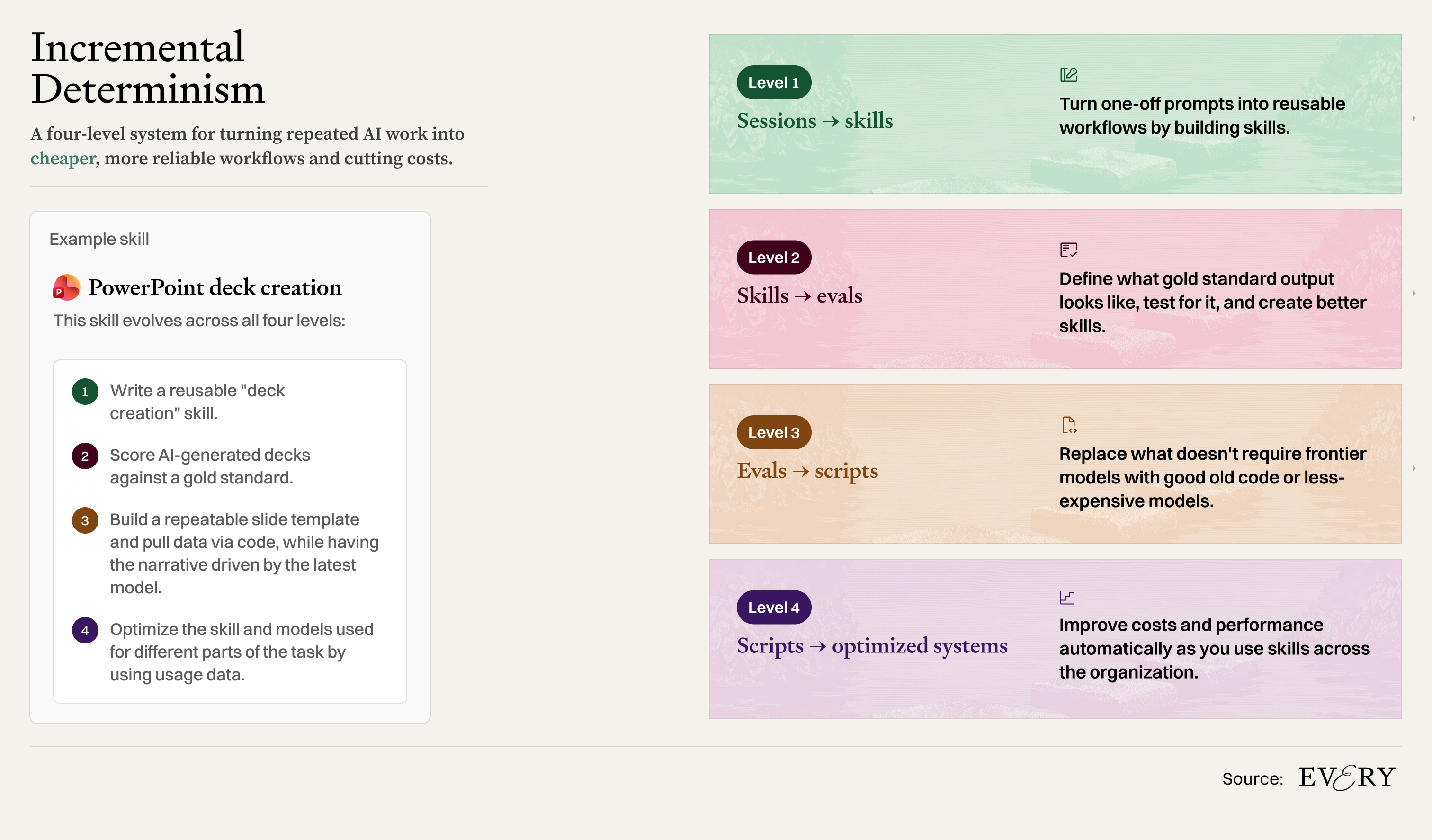



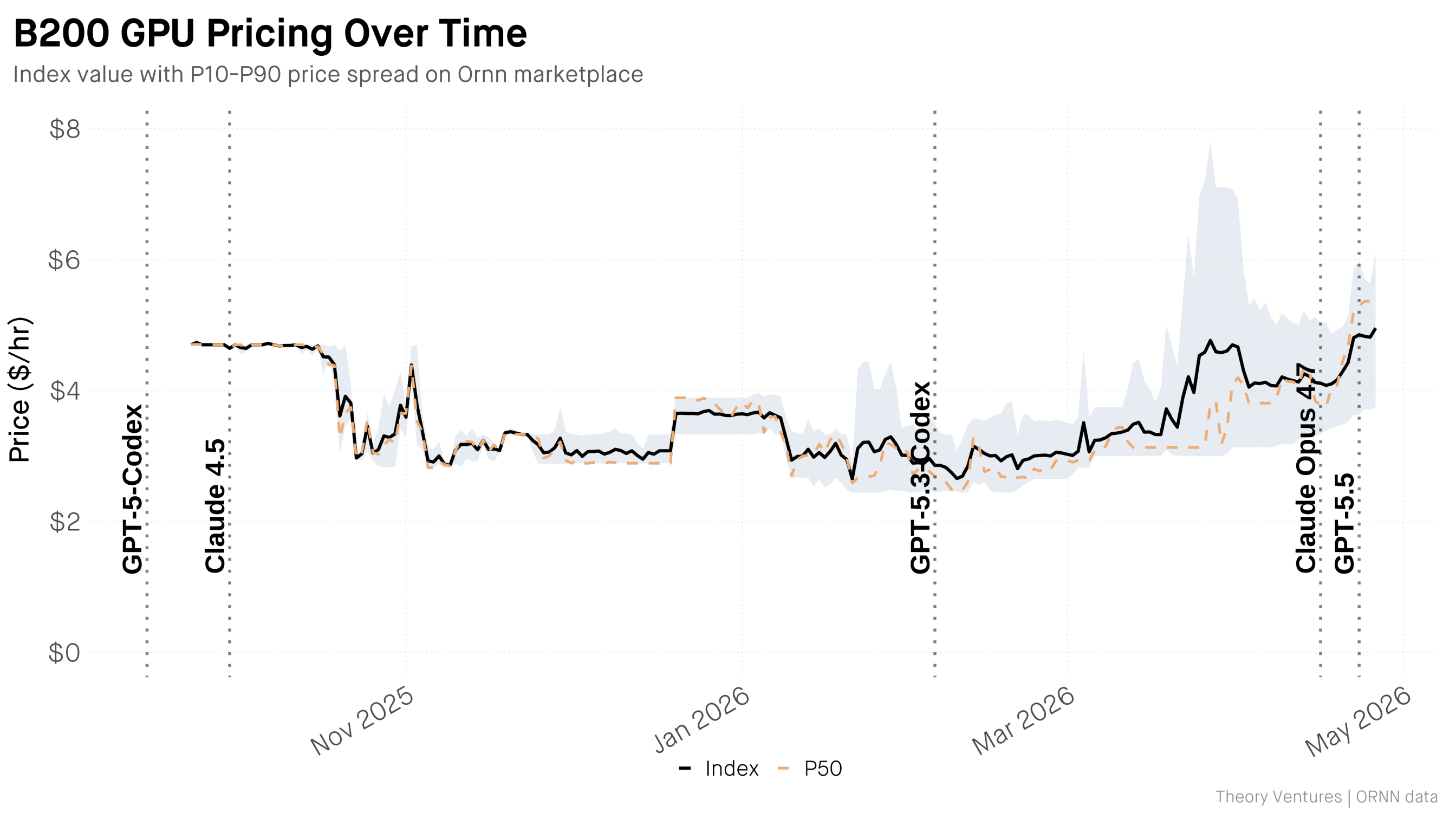



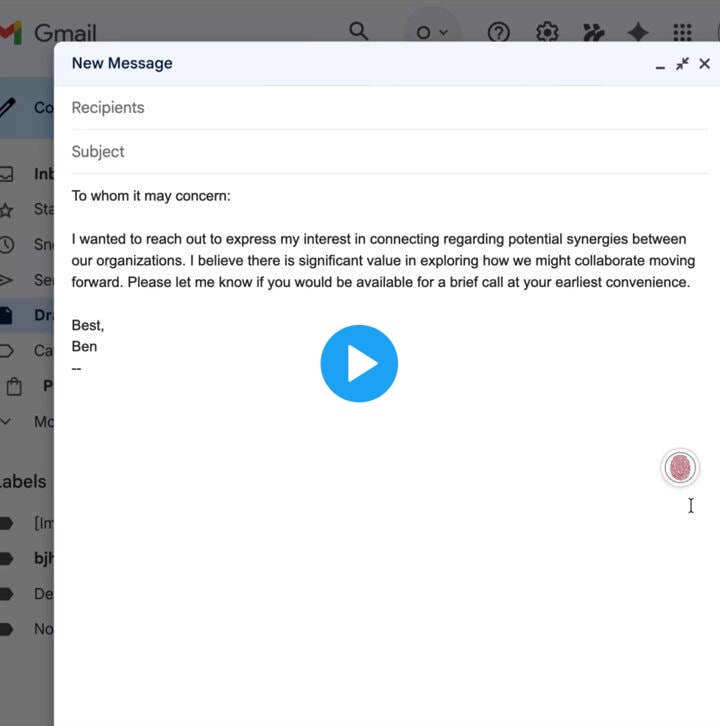
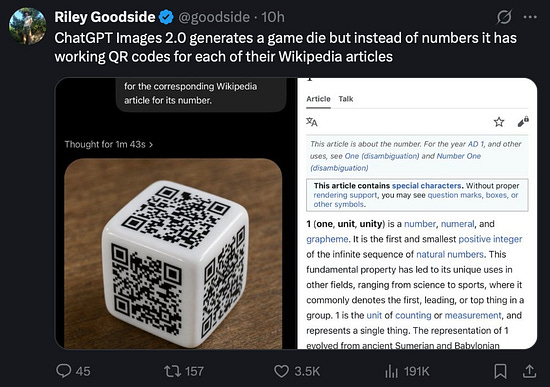 Hewar @hewarsaber
Holy shit, I just switched to the thinking model https://t.co/himClYMaSR
Hewar @hewarsaber
Holy shit, I just switched to the thinking model https://t.co/himClYMaSR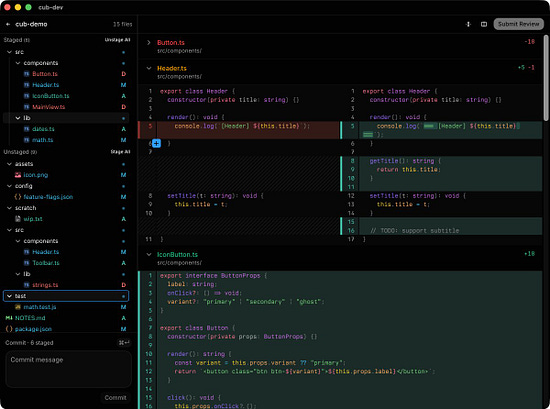 Duncan @ephraimduncan
https://t.co/paAoyBYDB0 is so good, i want to build with it but i don't know what
Duncan @ephraimduncan
https://t.co/paAoyBYDB0 is so good, i want to build with it but i don't know what
.png) Hello, and happy Tuesday! Two months ago, Every’s head of growth
Hello, and happy Tuesday! Two months ago, Every’s head of growth
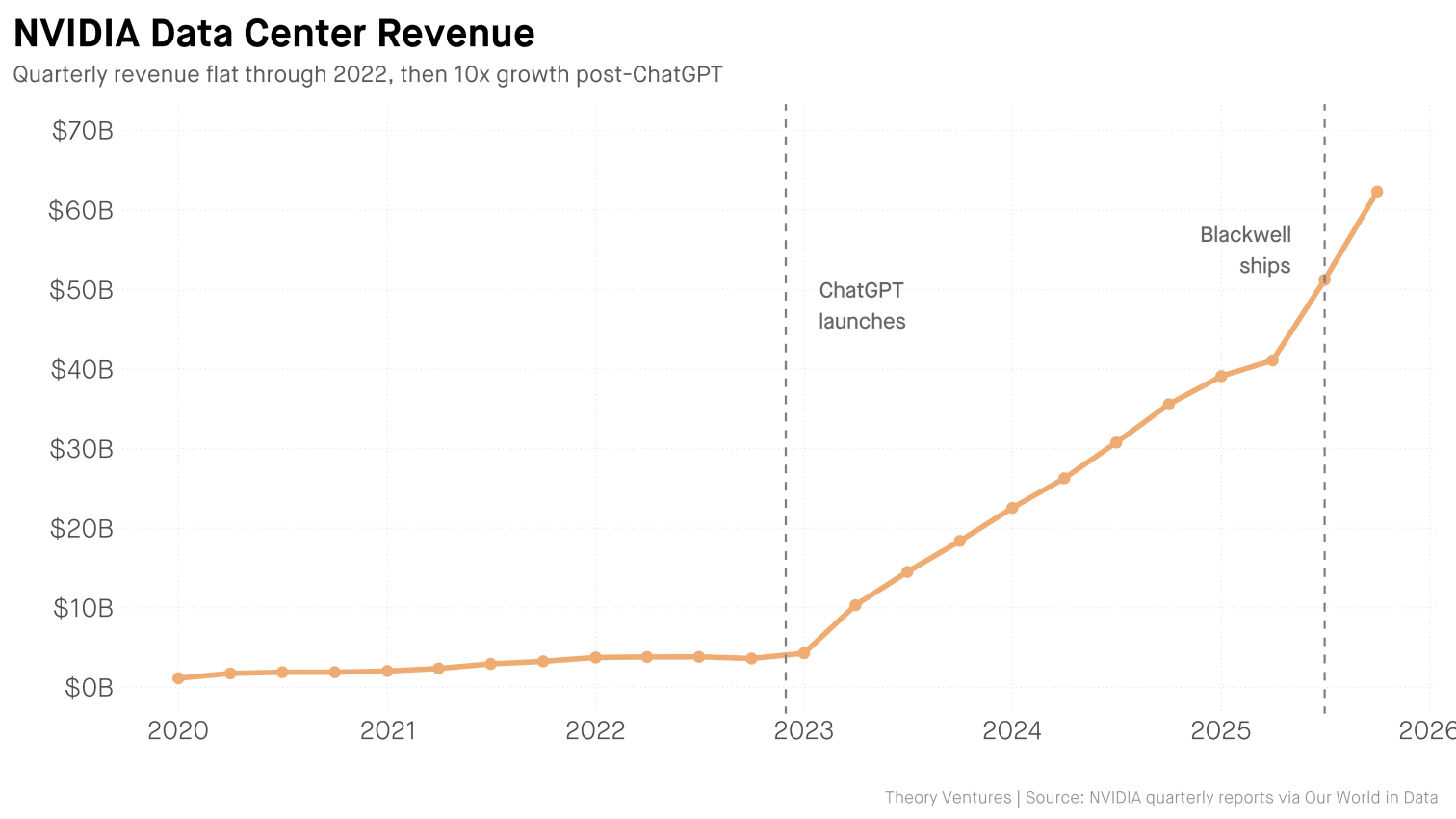
 adam ludwin @adamludwin
https://t.co/imLVKNiwwV started as web hosting for agents Today we’re adding the other half: private storage Just prompt: "save this file to my https://t.co/imLVKNiwwV drive" "after a session, save memory to /context in my drive" "publish the memes folder as a new site"
adam ludwin @adamludwin
https://t.co/imLVKNiwwV started as web hosting for agents Today we’re adding the other half: private storage Just prompt: "save this file to my https://t.co/imLVKNiwwV drive" "after a session, save memory to /context in my drive" "publish the memes folder as a new site"


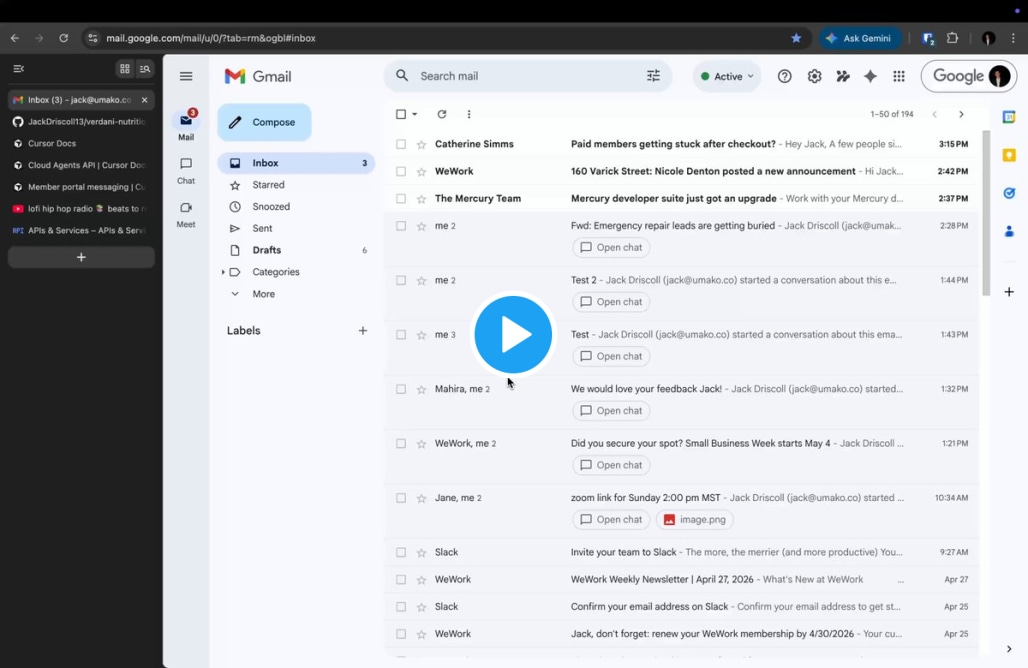 Cursor @cursor_ai
We’re introducing the Cursor SDK so you can build agents with the same runtime, harness, and models that power Cursor. Run agents from CI/CD pipelines, create automations for end-to-end workflows, or embed agents directly inside your products.
Cursor @cursor_ai
We’re introducing the Cursor SDK so you can build agents with the same runtime, harness, and models that power Cursor. Run agents from CI/CD pipelines, create automations for end-to-end workflows, or embed agents directly inside your products. It’s been one week since OpenAI’s last big release,
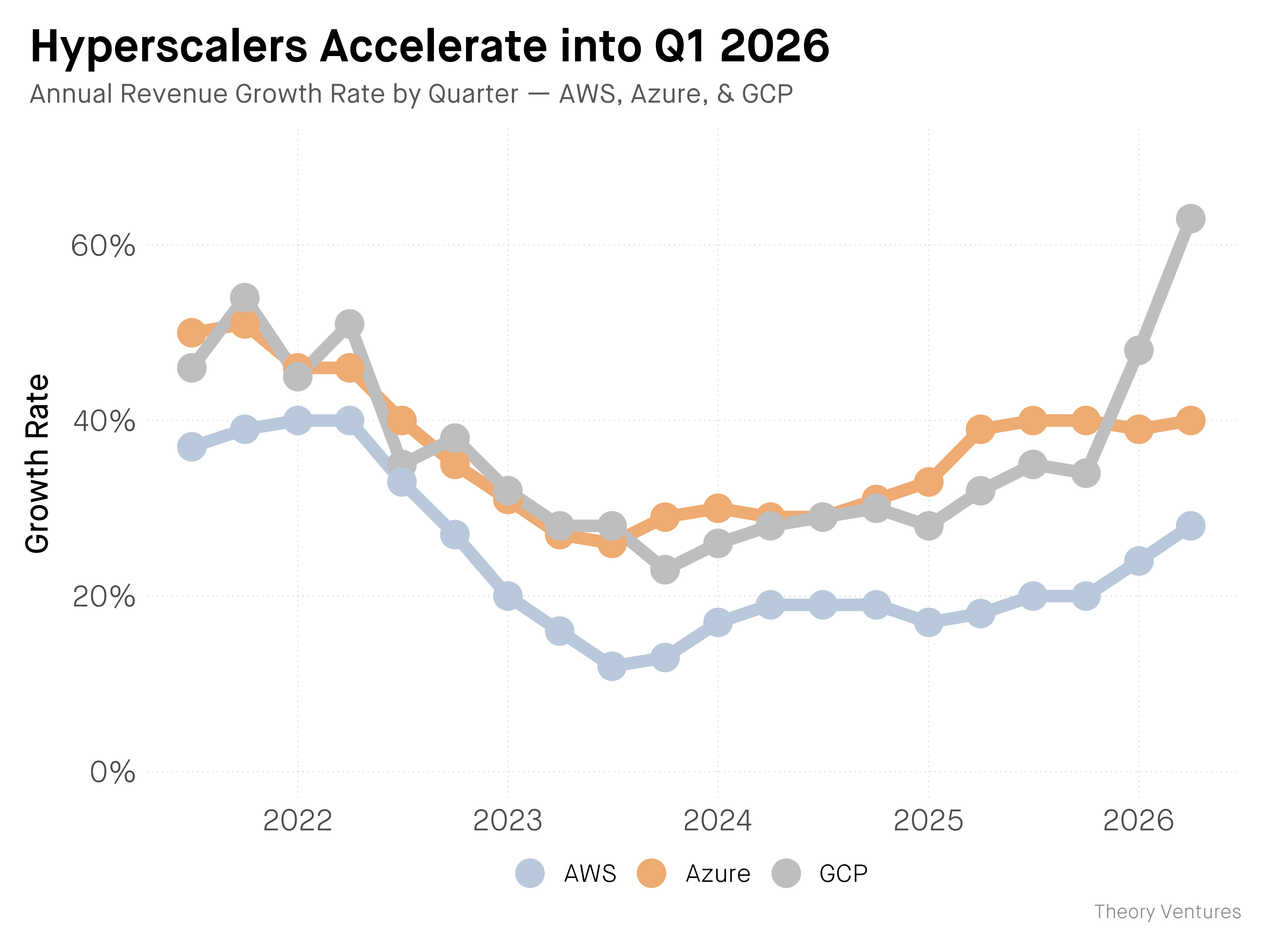 The divergence is striking. AWS & Azure resell compute. Google bundles compute with its own models. Whether that explains the full gap is unclear, but the structural advantage is not : Google owns Gemini & TPUs top to bottom, with no licensing fees to OpenAI or Anthropic. Its growth may be more profitable too. Sundar Pichai gave the clearest explanation on the earnings call :
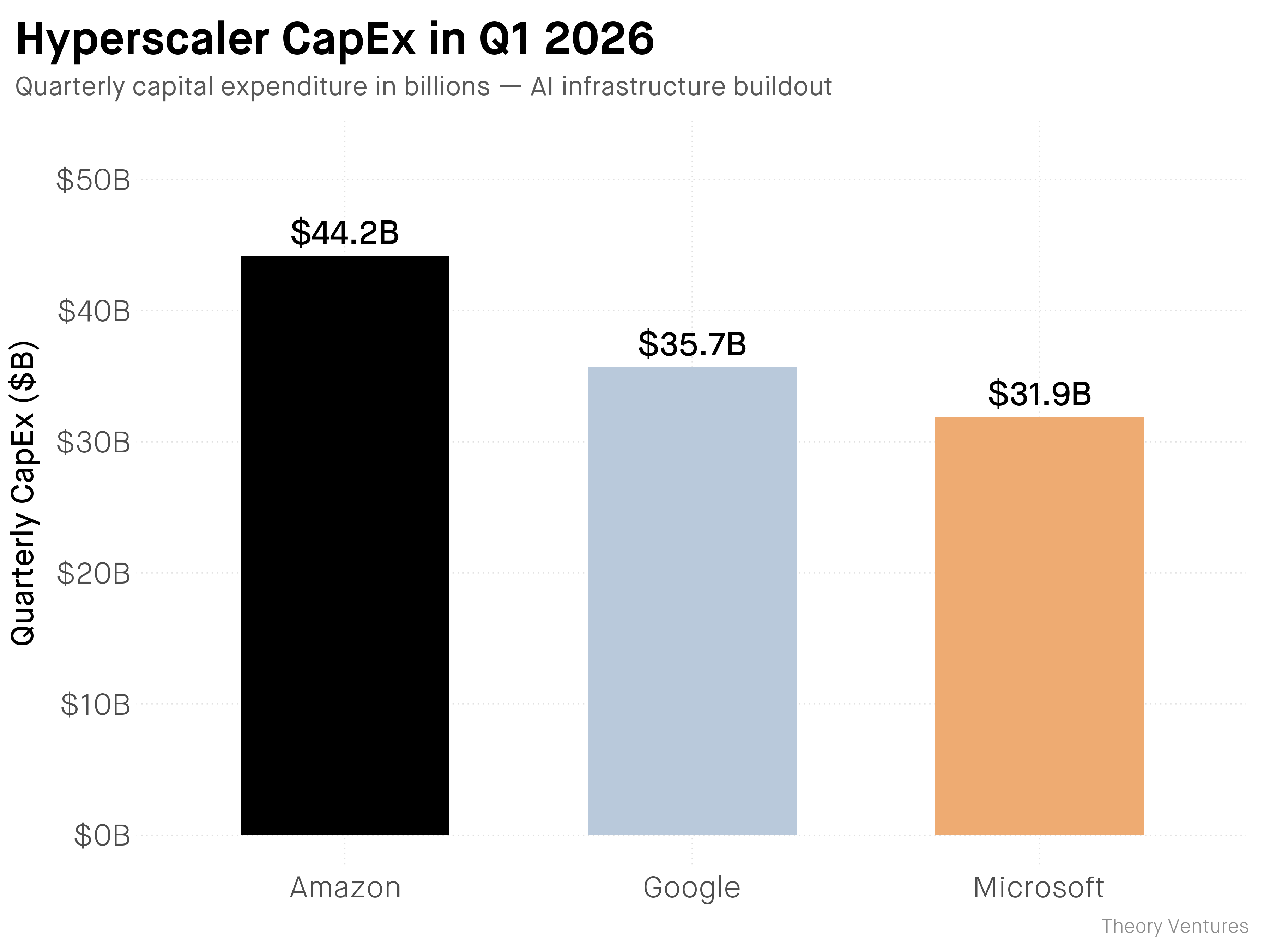 Amazon’s free cash flow collapsed to $1.2 billion as a $59.3 billion year-over-year surge in infrastructure spending consumed nearly all of its $148.5 billion in operating cash flow. Google still generated $64.4 billion in TTM free cash flow. Microsoft produced roughly $15 billion quarterly. How they’re financing the gap is revealing. Alphabet sold a rare 100-year “century bond,” the first by a tech company since Motorola in 1997, as part of a $32 billion debt offering. Amazon raised roughly $54 billion in March. Bank of America forecasts hyperscaler debt issuance will hit $175 billion in 2026, more than six times the $28 billion annual average of the prior five years. Microsoft, by contrast, is funding its buildout from operating cash flow. Google & Amazon are levering up to close a gap. Microsoft is already ahead. But debt isn’t the only way to catch up. Amazon is betting on vertical integration. It landed 2.1 million AI chips over the past twelve months & its chips business has crossed a $20 billion annual revenue run rate, growing triple-digit percentages year-over-year. OpenAI committed to consume approximately 2 gigawatts of Trainium capacity through AWS starting in 2027. Anthropic secured up to 5 gigawatts. But Amazon doesn’t own the model layer. Google does. The hyperscaler that owns the model layer is growing the fastest.

 This piece is an accompaniment to
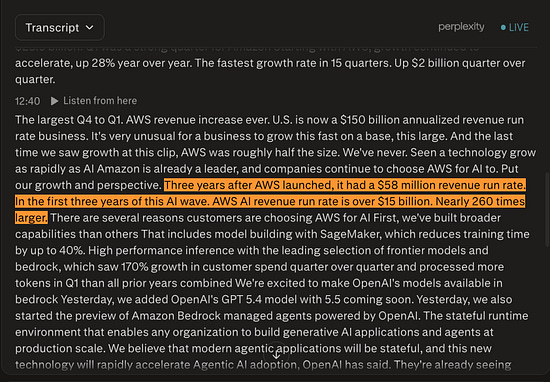
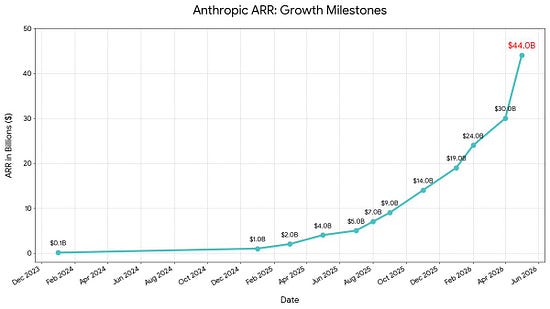
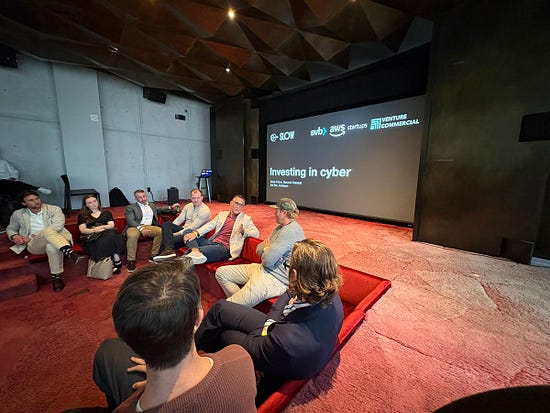
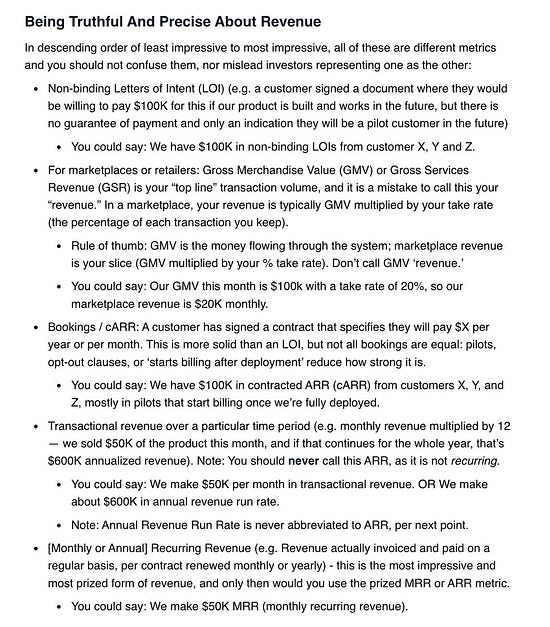
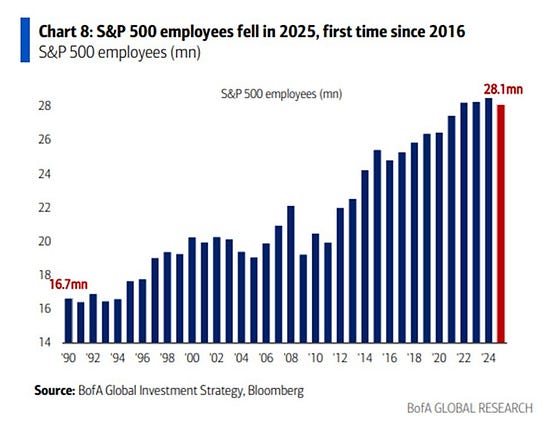
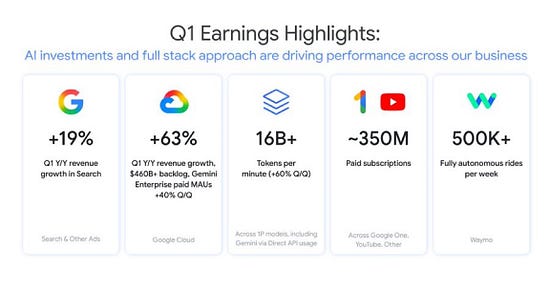

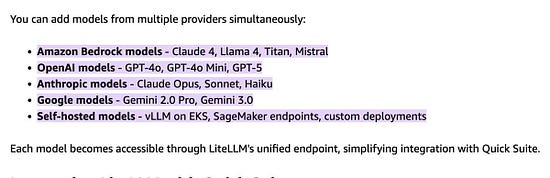 Andy Jassy @ajassy
The Quick desktop app is here, and it’s compelling. Connects to your email, calendar, Slack, local files, and several other apps to flag important communications, retrieve and summarize info, make recommendations, send communications, and create agents that do work you used to
Andy Jassy @ajassy
The Quick desktop app is here, and it’s compelling. Connects to your email, calendar, Slack, local files, and several other apps to flag important communications, retrieve and summarize info, make recommendations, send communications, and create agents that do work you used to
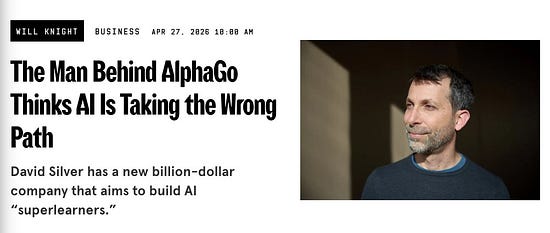


 _Hello, and happy Sunday! ## Knowledge base